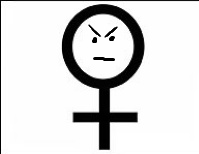
“We need fewer women in politics”

These days, it seems that barely a day goes by without a politician saying something stupid or unpleasant. For example, this week Theresa May has given an interview to the Telegraph where she expresses some frighteningly McCarthayan views regarding Britishness and a veiled threat to those with radical politics.

There is a phenomenon which surrounds an unpleasant statement from a politician who happens to be a woman: some wag will invariably quip “and that’s why we need fewer women in politics”. Something similar happened with Nadine Dorries when she felt it would be appropriate to introduce a bill calling for abstinence education for girls only. The quip has been applied to Margaret Thatcher more times than she had closed mines.

Of course, it is almost always said in jest. The overwhelming majority of those who crack the tired joke do not really believe that half the population have no place whatsoever in politics. So why is this humourless feminazi so annoyed by a little joke?

This humourless feminazi is annoyed by a little joke as it taps so perfectly into a rather well-documented and incredibly irritating effect: attibuting to gender what can easily be attributed to being a dickhead.

Those who repeat the quip will declare that of course they are not sexist, and they genuinely do think that the number of women in politics should be no fewer than those that are already present. They still play directly into the hands of the system, though, and, like it or not, their quip is riddled with residual sexist attitudes and stereotypes.

Put simply, the idiocy and awfulness perpetrated by May, Dorries and Thatcher is almost completely nothing to do with their gender. What little can be attitributed to gender is that women in politics may be more likely to conform with the general consensus (laid down by a group of rich white men) due to stereotype threat. Much scholarly writing has also been dedicated to Margaret Thatcher’s performance of masculinity.

However, using dog-whistle racism to oppress, ruining sex education for a generation of young women, or destroying a country with neoliberal reforms is largely ungendered. Politicians do and say vile things all the time.

Where are the quips that Simon Hughes keeps abstaining from votes because he is a man? Where are the quips that we need fewer men in politics because Eric Pickles is determined to completely annihilate local public services? Why do we need any more men in politics when Andrew Lansley is in the process of cannibalising the NHS?

There are none. And this is because gender is irrelevant to what these politicians are doing. It is only called upon in women in a boring old joke because they are women and they are different and isn’t that funny that they’re doing politics, too?

If course we do not need fewer women in politics.

We need fewer dickheads in politics.

Porn and creativity

I have several reservations about the porn industry. Some of it is political: I would be completely comfortable with the idea of porn were it no so deeply entangled in capitalism and a system of beliefs with some distinctly unpleasant views about gender and sex–even the term “porn industry” shows how commodified sex is in this system. Some of it is personal–if I am watching people fucking, I prefer to be in the same room as them.

My other personal qualm is that much of the porn I have seen tends to be dull. It is a tedious representation of sex. It is repetitive. And it is repetitive.

There seems to be little room for creativity in mainstream porn: it is like summer blockbusters, a presentation of what the executives think their audience want to see. The plots of porn films are as hackneyed as a Michael Bay orgy of explosions; the sex presented within as thoroughly monotonous as yet another superhero origins film. Everything has been done to death. In fact, there is probably a porn film featuring vampires which is called Done To Death.

It surprises me, therefore, when I see deviations, slight glints of creativity in an otherwise lifeless industry.

Porn puns, for example. I appreciate a good pun, and the porn industry seems to be surprisingly good at delivering rather brilliant sex puns based on aspects of popular culture. It is a rather depressing thought that four hundred years ago, this niche was filled by Shakespeare.

Yet pun-based porn titles often make me laugh. Big Trouble In Little Vagina. Sex Trek: The Next Penetration. Shaving Ryan’s Privates  Prude and Pre-juiced. 

I cannot help but laugh. Faint twinkles of imagination; thought went into those titles. It is particularly apparent when compared to other porn versions of real films, such as the obvious Edward Penishands or the horrifyingly stale The Erotic Witch Project. Even The Bare Tits Project would have been a superior title to that banal title.

A similar vein runs through the dim attempts at adding plot to porn. Bored housewives and naughty students still thrive as the storyline holding together a string of spiritlessly rehashed scenes of fucking. It is only rarely that a flicker of something offbeat is seen. What sometimes emerges is surreal and extraordinary.

For example, one film begins with a Russian tank breaking down in front of Sarah Palin’s house. The Russians wish to use Palin’s telephone to call the Kremlin. Fucking ensues.

In another devastatingly bizarre porn introduction, a couple gush over their new lemon tree and its “endless possibilities”, and bemoan the “damn lemon-stealing whores” which appear to be a problem in their neighbourhood. Unbeknownst to them, a lemon whore is stealing their lemons as this conversation is taking place.

A friend of mine once watched a porno which started with a fish falling from the sky and knocking a man out, necessitating his stay in hospital. At one point, she recalls a scene in which an operation was performed, which involved some interpretive ribbon-twirling dance and a tray of eyeballs.

Following all of these quirky introductions, the fucking is as predictable and mechanical as always. Creativity in porn will only go so far. Summer blockbusters always outsell the more interesting films.

I would like the porn industry better were it not so hackneyed. Under capitalism and under society’s current expectations of sex, the best we will get is the odd funny pun, and the occasional peculiar situation. It all leads to the same old contrived fucking.


Nudge: it’s not science, it’s ideology

The latest fad among policy-makers is using “nudges” to gently push people in the right direction. Unsurprisingly, David Cameron is a big fan of this approach, while the Telegraph are preposterously terrified of sinister nannies perpetrating mind control. In a battle between the Telegraph and David Cameron, it is difficult to choose a side. In fact, they are both wrong.

Nudge theory was put forward in the book Nudge: Improving Decisions About Health, Wealth And Happiness in 2009. It is, ostensibly, a book about behaviour change and psychology, and has been heralded as a scientific panacea for developing policy–changing risky behaviour such as smoking and alcohol consumption would lead to fewer deaths, after all.

The book was written by a lawyer and an economist. This is the first alarm bell: neither of these professions are known for their training in human behaviour. To Nudge’s credit, though, at least the authors acknowledge that economic theories have it all wrong about human behaviour: traditional economic models tend to start with the rather flawed assumption that people are completely rational. Nudge instead focuses on the social and environmental context of behaviour and the cognitive shortcuts we use while processing the world around us.

I discussed Nudge’s views on the context of behaviour and how our brains rarely think unless we absolutely have to in more detail in this post on default options, where I opened with the statement that Nudge is the worst book on behaviour change ever written. I stand by this thesis. Here is why.

There are several concepts which are important to nudge theory. The authors propose that decisions take place within a “choice architecture”, that is, the context of the behaviour. They also propose that there are two systems for making decisions: the automatic system and the reflective system. The former is unthinking, unconscious. The latter is rational. There is nothing inherently wrong with these ideas: it is nothing that surprises those in psychology or the field of behaviour change, and it is nothing that has not been extensively researched before. This book, in fact, provides a  overview of these concepts, among others, which influence health behaviour, and synthesises them into a comprehensive theory. It was published several years before Nudge and is not referenced.

In fact, given the depth of understanding of automatic processes, one might suspect that the authors’ research was a quick glance at Wikipedia’s list of cognitive biases.

The framework proposed by the authors to change behaviour is termed “libertarian paternalism”. Both words are enough to set my teeth on edge, and in oxymoronic combination my blood pressure shoots through the roof. In short, libertarian paternalism involves policymakers doing as little as possible–for example, smoking bans are verboten–hoping people will choose to perform the desired behaviour. Policymakers are expected to nudge people in the right direction.

What is a nudge? The authors provide a handy acronym for their proposed methods for changing behaviour. It is rather fudged. Nudges are:

  • iNcentives
  • Understand mappings
  • Defaults
  • Give feedback
  • Expect error
  • Structure complex choices

This translates to various simple, minimal-intervention methods, such as simplifying forms, feedback, providing information in a readable format or modifying default options.

It really is that simple, according to the authors.So simple, that most of the book is dedicated to presenting a series of nudges and things they think could work as a nudge.

To the untrained eye, it appears that Nudge is scientific and evidence-based. There are a lot of references and citations, after all. Surely that must mean it is science?

Not at all. The evidence presented seems cherry-picked. It is likely that this was not undertaken with duplicity, but rather with ignorance. For example, the authors cite a smoking cessation trial in the Philippines which used a method they deemed as nudging. They claimed great success for this intervention–in fact, the trial and analysis were undertaken poorly with a small effect. This happened in a number of places where the authors presented “trial” data; the authors do not seem to understand how best to test that an intervention works.*

In fact, Nudge presents no evidence that nudges would work better than something that was not a nudge. Again, this is likely to be due to the authors’ lack of training in the behavioural sciences. The way to test this would be to conduct a randomised controlled trial. In short, one would randomly allocate a large number of people to be exposed to a nudge, with an equivalent number of people randomly allocated to not receive the nudge. One would then see how many people from each group changed their behaviour. It is quite a simple concept, and seems to have escaped the authors’ knowledge. Instead, they repeatedly trumpet nudges to be effective with no supporting evidence.

Nudge further neglects an important aspect of behaviour change: helping people gain the skills to change their behaviour. It is no good nudging people to buy healthy food by improving labelling if they are not taught how to cook a healthy meal. It is no good providing people with nicotine patches to help them stop smoking if they are not taught how to cope with psychological cravings. Skill-training is important, and there is rather a large evidence base on the importance of training and improving self-regulatory capacity.

There is also a rather large body of evidence to suggest that higher-intensity interventions are much more effective at changing behaviour than those with less contact. So, for example, sitting down with someone and helping them write a plan about how they are going to stop smoking is better than giving them a leaflet and letting them write down how they plan to stop smoking. Nudges are inherently minimal-intervention and thus would be unlikely to be particularly effective.

Useful, perhaps, but not sufficient.

Beyond the distinct lack of evidence to back up the theory, Nudge runs into another enormous problem: even its authors acknowledge that nudges work best for well-educated Western people. This means that in using nudges, whole groups of disadvantaged people miss out on help in changing their behaviour. This seems par for the course with our current government. No wonder David Cameron likes his nudges.

Overall, though, one of the largest problems with Nudge is that after reading the entire bloody book, I was still none the wiser as to what a nudge is. The authors provide numerous examples and a rather fudged acronym, but there is still the sense that a nudge is essentially something that the authors like. As conceptualised, there is no real reason that a smoking ban should not be a nudge–it is, after all, environmental modification to disincentivise smoking. The only reason a smoking ban is not considered a nudge is because the authors say it isn’t.

Despite all of this, and following an evidence inquiry at the House of Lords, an expensive “nudge unit” has been set up and one of Nudge‘s authors called in to advise on policy.

Nudge is not science. Nudge is not a panacea towards behaviour change. It is libertarian, laissez-faire ideology formatted readably.

Nudge is not a road-map. It is a childishly-scrawled drawing of a street scene.
Listening to a conversation on a bus

I eavesdrop. In enclosed public spaces, I listen to microcosms: the funny, the tragic, the absurdly mundane snippets of the life of people I will never know. It is strangely intimate, learning small details of the psyche of strangers.

I rarely let on that I am an unwanted guest in the conversation. Once or twice, perhaps: passing on helpful information–tourists baffled at the intricacies of the Tube; a person puzzling over the year of the Great Fire Of London. They nod and return to their conversation, as though I were never there. It made very little difference, my interjection.

Yesterday, I sat on a bus. Behind me were three girls, no more than sixteen years old.

They were talking about sex, and I listened.

Two were having sex; one was not, and inquisitively probed for information about the act of sex.

It was heartbreaking. All three of these young women viewed sex as something that was done to them by men.

“Did you let him do you up the arse?” the inquisitive girl asked.

“Yeah. I mean, it’s disgusting and it hurts but he likes it,” her friend replied.

It illustrated neatly the horrifying idea that women do not desire, they are just “sexualised”.

It was horrible to hear. I wanted to intervene.

I wanted to tell them that if you are grossed out by something and do not enjoy it, it is perfectly all right to communicate this. I wanted to tell them that an orgasm is more than just a loud porny moan, that it is your whole body tuning in to your cunt. I wanted to tell them that sex is absolutely fucking awesome.

I wondered where they had learned about sex. Nadine Dorries was clearly wrong. Sex education  is still not like a finishing school for how to host a delightful, mutually-satisying orgy, apparently. Had the young women been taught to sayabstain, at best, they would have only delayed having horrible sex for a few years.

I never learned sex was supposed to be fun for me at school. My parents alluded the notion to me, and I stuck my fingers in my ears because it was kind of minging to hear my mum talk about sex when I was eleven. In fact, I learned it from a Judy Blume book.

I wondered if the young women on the bus had ever read Forever. I doubted it.

I considered speaking up. I began to formulate my words. I knew that bellowing “SEX IS NICE AND PLEASURE IS GOOD FOR YOU” was generally considered inappropriate and would have probably failed to change the hearts and minds of the  young women.

I missed my chance.

They girls got off.

They got off the bus. It was apparent from their conversation there was no other form of getting off.

I had failed.

And I write this now: this message will never reach those young women on the bus. I wish I had blurted out to them.

Perhaps the idea would have germinated.

They deserve better than being trapped inside a set of beliefs that denies them pleasure. We all do.

So to the girls on the bus, to all girls on the bus: enjoy sex. It’s fine. It’s fucking lovely.