Today, Kurt Cobain would have been 50. Like many other teenagers, I idolised Kurt Cobain. I was absolutely obsessed with Nirvana. I owned all the albums, I adorned my walls with posters, I downloaded all tracks you couldn’t buy on a CD off of Kazaa. Sadly for me, by the time I got into Nirvana, Kurt Cobain had been dead for at least five years. Kurt’s being dead meant two things. Firstly, to my chagrin, I never got to see Nirvana live, except on a worn-out VHS of Unplugged In New York. And secondly, perhaps the bigger impact, I was never really exposed to a side of Kurt Cobain that I needed to see: his femininity, and his ride-or-die attitude towards women.

When I was a teenager, I was awful. I had well and truly drank the Kool-Aid that femininity was bad and to be cool, you needed to reject that shit. I lived in horrendous ragged jeans, so baggy that if it rained, they’d soak all the way up to the knees, and Converse high-tops that were equally terrible in the rain. I was your stereotypical suburban early noughties grunger kid, my DiscMan screeching Linkin Park or System Of A Down when I wasn’t listening to In Utero for the seventy millionth time, because god forbid I listen to any music recorded by a woman! I bought into internalised misogyny wholesale, hating on other women being “girly”, and embodying that particular flavour of alternative subculture misogynistic pretension.

I spent quite a few years as an awful person, and it took years longer to start undoing the damage.
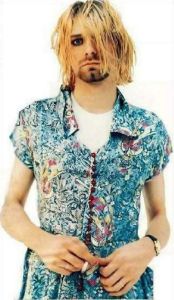
I wonder how differently things would have gone down had I had access the side of Kurt Cobain, my idol, that I only really began to learn about relatively recently. When I was young, I never saw pictures of Kurt embracing femininity, wearing makeup and dresses. The pictures that were available on the posters you bought at Woolies, or the grainy Geocities webring, all showed Kurt in more masculine attire: jeans and unembellished plaid or jumpers. And a lot of the magazine interviews, where Kurt talked about supporting women, articulated sophisticated views on rape culture, played benefits for reproductive rights and unabashedly rode out for women in rock… these interviews were not available to me, the internet not being any good at archiving them back in 2000.
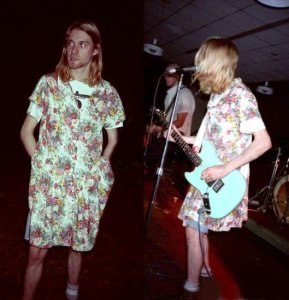
I don’t doubt that the erasure of this aspect of Kurt Cobain’s essence was elided during this period because the gatekeepers were men. It was men who administrated the little websites which featured pictures, men who modded the forums. And it probably made them profoundly uncomfortable that Kurt Cobain was a feminist ally who looked heart-stoppingly beautiful in a dress. So they ignored it and avoided it.
Some of it seeped into my consciousness. I remember once arguing with a friend who didn’t like Nirvana that Kurt Cobain was a good person.
“Why?” asked my friend,
“Errr… he was against rape?” I retorted, which fell rather flat because obviously any decent person was.
I wish I’d had access, then, to what Kurt actually had to say about dealing with rape culture, because it would have helped me no end to have heard these words at the age of 15:
“The problem with groups who deal with rape is that they educate women about how to defend themselves. What really needs to be done is teaching men not to rape. Go to the source and start there.”
I’m not one for handing out cookies, but that’s a pretty important statement, and far more sophisticated than my understanding of the problem (the lyrics to Polly and Rape Me) was at the time.
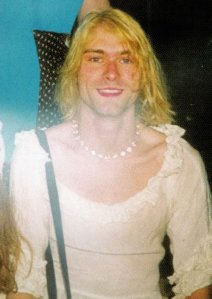
I wonder how much differently things would have gone down if I’d known all about this feminine and pro-woman side to Kurt Cobain at a point in my life when I sorely needed to hear things like that. Would I have embraced–or at least not rejected–femininity that much earlier? Would I have been seduced towards feminism in my teenage years, decided to learn more about it, because my idol was into it? Or would I have simply rejected Nirvana and latched on to a band with worse politics?
I wish I’d had the chance to find out, and that for the years between Kurt’s death and information being more readily available, the feminine side to Kurt Cobain had not been hidden.