Some people are fuckwits. Don’t get over it.

Floundering fuckwit Boris Johnson has, ostensibly, heroically swept in and “banned” adverts from a Christian group advertising some sort of cure for homosexuality (which probably largely consists of praying and repression). Obviously, the ads are completely out of order and silly, and Boris Johnson has probably scored a fair few points in banning them.

More salient, though, is a thoroughly fuckwitted reaction in the Guardian’s Comment Is Free today, in which the commentator concludes that the existence of the homophobic Christian ads is the fault of Stonewall for being a little bit too provocative in their own campaigns.

Yes, really.

Now, apparently, according to professional fuckwit David Shariatmadari, Stonewall’s famous “SOME PEOPLE ARE GAY. GET OVER IT!” campaign is entirely to blame for the Christian campaign (which somewhat plagiarised the wording). David takes umbrage at Stonewall’s campaign, at great, tedious repetitive length. David doesn’t like not understanding who the campaign is aimed at. David doesn’t think there’s a necessity to point out homophobia is uncceptable. David thinks it’s all a bit provocative. David is really, really distressed by the use of an exclamation mark in the slogan.

On the whole, it is a thoroughly stupid article, and none of the points he makes fit together coherently. The nonsense piled upon nonsense leads to this conclusion:

Instead, Core Issues and Anglican Mainstream have won a dollop of free publicity and can portray themselves as victims of persecution and censorship. Gay people have been pointlessly reminded, not that homophobia is unacceptable, but that there exist organised groups that detest them. Defenders of free speech have had their hackles raised and Boris laughs all the way to City Hall.

Stonewall: what were you thinking?

Now, I am not sure whether dear David is straight, gay or queer, and this does make a slight bit of difference to how I would respond. If he is somewhere on the queer spectrum, I think I’d start by shaking him and saying, “Mate. Please stop with the Uncle Tomming.” If he is heterosexual, then he can fuck off out of our struggle, thank you very much, and I shall chase him away with torches, pitchforks and intimidating lesbian paraphernalia.

Whatever his orientation, David speaks from a position of privilege. This is particularly apparent where he acknowledges the existence of homophobia, in particular in schools. He even acknowledges that Stonewall’s GET OVER IT slogan was developed with the help of school-age people, some of whom would have experienced homophobic bullying. Despite this, he still wishes they’d gone with something a bit nicer, a bit fluffier, a bit friendlier.

While the “GET OVER IT” slogan is a mantra for the bullied kids, a phrase to throw back at their bullies, David would prefer they went with something a little more subservient, and rather than standing up to oppression, perhaps they should just be reminded that it’ll all get better in the end.

The GET OVER IT slogan is head and shoulders above the rest of Stonewall’s work of late, which largely consists of being an utter disappointment and using the kind of nicey-nicey-zoo-zoo approach which David Shariatmadari would probably appreciate. Stonewall the charity is a far cry from its namesake, yet despite this their slogan seems to be treated in the same way as some behave in the aftermath of a riot. David’s privilege shows again: he clearly has no idea why any queer person may feel angry or confrontational.

There is the blaming. The denouncement of tactics, and saying they have spoilt their own argument by not kneeling down and kissing their chains.

It is a reluctance to be provocative, and an embracing of conservative values, which has caused the fight for queer liberation to stagnate. We need to be more angry, not less, and we need to call obstructive fuckwits out where we see them.
London, Cairo, Wisconsin: tears in rain

“All those moments will be lost in time, like tears in rain. Time to die.”

A little over a year ago, there was a feeling of momentum within what can loosely be termed as “the protest movement”. It was global, it seemed. The winds were blowing in our favour, and perhaps the underdog would finally have its day.

As we marched through London, we expressed this sentiment with a chant:

London, Cairo, Wisconsin! We will fight them, we will win!

At the time, we looked gladly towards our friends in far-flung countries. We allowed hope to rise in our hearts over the seeming revolution in Egypt, having watched the people struggle to overthrow a tyrannical government and succeed. We felt joy as we watched protesters occupy the Wisconsin State Capitol, thousands of people in a mass mobilisation against right-wing economic policy.

We felt solidarity. If we channelled Cairo and Wisconsin, perhaps we, too, could win.

A year later, how the tides have turned.

Egypt is a military dictatorship, with elections on the way which are unsatisfactory to many. Things are getting worse for many, particularly women who are subjected to “virginity tests”; regressive attitudes towards gender are on the rise. There’s still some fight in the women, thankfully, but these are battles they should no longer need to fight.

Meanwhile, the occupation we so admired in Wisconsin has now become a brand. We do not occupy space, we Occupy™ a tucked-away corner in a tent. As this happens, politicians pass laws signing away protections for vulnerable workers: Wisconsin’s Equal Pay Enforcement Act was quietly repealed with barely a peep.

And what of London? A lot has changed in a year. The summer riots were capitalised upon to expand the state’s ability to use violence. London is being carved up and plunged into an authoritarian nightmare in the name of a sporting event. Not a day goes past without news of another callous act by the government, so many that sometimes they will cover up one callous act with another, slightly lesser callous act.

London, Cairo, Wisconsin… all is lost.

We seem to have reached the Despair Event Horizon, and will continue to fall forever.

If we were a work of fiction, it would be at this point that a ragtag band of misfits would gang together and make a valiant last stand, and, against the odds, succeed. The music would swell, and the credits would roll as we all hugged each other, ecstatic tears streaming down our faces in slow motion.

In the stark reality of things, everything is as likely to end in tears, but probably not the slow-mo huggy kind. If we’re lucky, we’ll just be crying in frustration. We are confronted by the utter futility of our actions, dashing ourselves against the sheer walls of the cruel system. If history remembers us at all, it will be as a mote of dust causing a mildly irritating squeak in an otherwise slick machine.

Last year is currently remembered in a talismanic fashion: all of these magical things happening all over the world, and if only we could regain some of that vigour. The more savoury aspects are performed in a bid to cargo-cult a revolution that will never come. One by one, these little bubbles will burst until it’s all gone.

Despite all this, I have been conditioned by fiction. My heart still holds out hope for that rag tag band of misfits in our glorious final battle. Surely there must be some way to defeat the beast once and for all?

And perhaps there is. What it isn’t is a tired repetition of parts of the near or distant past. It will be something new entirely, this intangible soaring hope.

London, Cairo, Wisconsin. We are all the same.


Abstinence education: better than nothing (with bonus bullshit from the anti-choicers)

Anti-choice news-bender Life News has trumpeted proudly that abstinence education totally works, yo. Using the language of science–and some fancy-looking footnotes (which actually lead to, among other things, a book published by a Mormon abstinence education “research centre”)–Life News claims that abstinence education works.

Well, they’re sort of right. It does work. If taught as an intensive programme compared to reading a few textbooks that are also about abstinence. When tested in a study as full of holes as a colander [not paywalled, and published in a journal I hadn’t heard of].

The participants in the study were ninth-grade pupils in schools in Georgia, a state where abstinence education is already the norm. I’m sure this is a wholly unrelated point, but Georgia also has one of the highest teenage pregnancy rates in the US. Six schools were selected, and parents were asked for consent for their children to participate. Less than 40% of pupils were allowed to participate in the study; among the sample, girls and African Americans were overrepresented demographically. On top of this minor issue is the fact that this means that participants were aware that they were participating in a research study, and had an awareness of whether they were in the intervention or control group. When this happens, results of studies tend to skew somewhat, inflating the positive effect of the intervention.

I am going to give some credit to the authors of the study: they actually made a brave attempt at using a theory to evaluate the intervention: you’d be surprised how many behavioural interventions are atheoretical clusterfucks with a mishmash of things the authors like chucked about willy nilly. Unfortunately, they picked the Theory of Planned Behaviour, which is rather simplistic. And they didn’t even use it that well: they forgot to measure one of the key theoretical constructs (perceived behavioural norms), and threw in a bunch of other measures of things like “hopefulness” which have absolutely nothing to do with the theory.

Perhaps most vitally, though, the authors failed to measure some very important behavioural measures. Sexual behaviour was measured entirely by asking on the questionnaire if participants had “gone all the way” (using those exact words). So there is no way of knowing whether they had been enjoying all of the other rainbow of sexual experience, and whether the participants chose to define what they were doing in such euphemistic terms. Secondly, the authors report that they were not able to measure whether the sex participants were having was safe: this was due to the politics of obtaining participants for the study.

With the measures this royally cocked-up and run in some dodgy circumstances, what can be concluded from the study? Firstly, that there’s a short-term effect of the more intensive abstinence programme, but in the longer-term the effect diminishes. It should be noted that the “long-term” follow-up happened just after the summer holidays, while the “short-term” follow-up happened just before the holidays. So, the effect of a more intensive abstinence programme diminishes in the space of a couple of months. It is worth noting, once again, that this is in comparison to doing nothing different from usual.

With this in mind, it is highly disingenuous–or thoroughly scientifically illiterate–of Life News to dress this study up as evidence that abstinence works. It shows nothing of the kind. It shows that in a study which inherently favours a slightly more intensive approach to teaching abstinence, there’s a slight effect for more intensive teaching of abstince, but that effect fucks off in the space of a summer holiday. And that’s the best they’ve got.

Samantha Brick, attractiveness and missing the point entirely

Some textbook link-baiting trolling has been occurring over at Daily Mail towers these last few days. “Journalist” Samantha Brick has written a piece entitled “THERE ARE DOWNSIDES TO LOOKING THIS PRETTY: WHY WOMEN HATE ME FOR BEING BEAUTIFUL” [clean link]. In it, Brick describes at length how pretty she is, and how nicely the world treats her: she is the very embodiment of Hakim’s thesis that “the world smiles at attractive people, and they smile back“.

But wait! As I am sure the title signified, it is not all farting rainbow kittens when you look like Samantha Brick. See, other women hate her. They see her as a threat, a great big husband-stealing threat. Daily, Samantha Brick receives animosity, and it must all be because she’s pretty.

Well, no, not exactly. Firstly, it’s probable that at least some of the scorn she receives is due to the fact she’s a fucking Daily Mail journalist. While some people are fascist scum who enjoy reading poorly-written tabloids, many are not. Without even seeing a picture of a Mail journalist, I know that I probably hate them just a little bit, as their continued existence in their professional capacity makes the world a significantly worse place.

As for the rest, Brick seems to have missed the point entirely. There are two large problems she outlines, and neither are explored adequately as instead the piece consists of a repetitive litany of “I’m so pretty and they’re all so mean”. The first problem is benevolent sexism, which Brick receives frequently in the form of freebies from men. She is clearly moving in circles wherein benevolent sexism is more widely accepted, and does not see a problem with it. Unfortunately for Brick, it is a massive problem for her, creating a feedback loop where she can only be judged for the fact that she is a good-looking woman.

This problem can easily be solved by Samantha Brick living up to her name and throwing bricks at sexists.

The other problem Brick highlights is hegemonic heterosexuality. In Brick’s world, heterosexual monogamous relationships are the only possible way to be with people. “A catch” in this system becomes a scarce resource: if you’re lucky, you’ll get one partner; if you’re really lucky, they’ll be a good one. This feeds competition and jealousy, when everything could quite nicely be solved by everyone chucking their keys in a bowl and having a nice orgy over a selection of hummus dips.

Brick’s experience further ties in with the class structure we inhabit: she is reasonably well-off, and therefore can afford good clothes, good make-up, good self-presentation. This luxury may not be available to her neighbours. Again, in this kyriarchical minefield, envy rises and animosity is fuelled.

So, ultimately, all of Samantha Brick’s problems would be solved if she grabbed some bricks and effected a revolution.

Of course, this is not the course Brick chose to pursue. Today, another Mail article appeared: “THE I’M SO BEAUTIFUL BACKLASH… THE BILE JUST PROVES I’M RIGHT“. Er, no it doesn’t.

In this piece, Brick reiterates that women are just nasty, jealous bitches (for some reason, the criticism she received from men is ungendered: presumably this conflicts with her thesis that it’s just horrid, horrid women).

Once again, there are a few good points in the article, which Samantha Brick misses entirely. She is right to point out that much of the backlash levelled at her was “well, she’s not really that attractive”, and that is rather nasty. What she ignores, though, is that this is indicative of a system which is radically in need of bashing in with bricks, and that her looks should be completely irrelevant.

Samantha Brick is both a victim and a perpetrator in this system. Assuming what she has written encapsulates her true experience rather than sensationalist Daily Mail drivel, she has stumbled on a whole host of problems for which she chooses to lash out at her peers and shift the blame onto individuals. Yet it is not a problem of personal meanness, or spite. It is a cluster of symptoms of system which needs destroying.

Samantha Brick, live up to your name. Bring bricks. See you on the barricades.

Pro-choicers have more fun: 40 Days For Life counter-demo in Bloomsbury

Last night, I had the pleasure of attending a counter-demo organised by the brilliant Bloomsbury Pro-Choice Alliance. Womb-fanciers 40 Days For Life decided to drag a bishop down to preach outside a (thankfully closed) abortion clinic, and a network of pro-choice people decided they couldn’t let it pass without some noise.

The bishop turned up an hour early, perhaps having heard about the possibility of a counter-demo and wanting to squeeze in some praying for a good peek at the inside of our uteruses before we arrived. Luckily I and many others had been nearby, and we mobilised quickly. In a panic and with no equipment, someone began to sing the first song that came to mind: A Hundred Green Bottles. Once the first eleven or so bottles had fallen of the wall, we’d lost count, and there were finally enough people for some serious chanting.

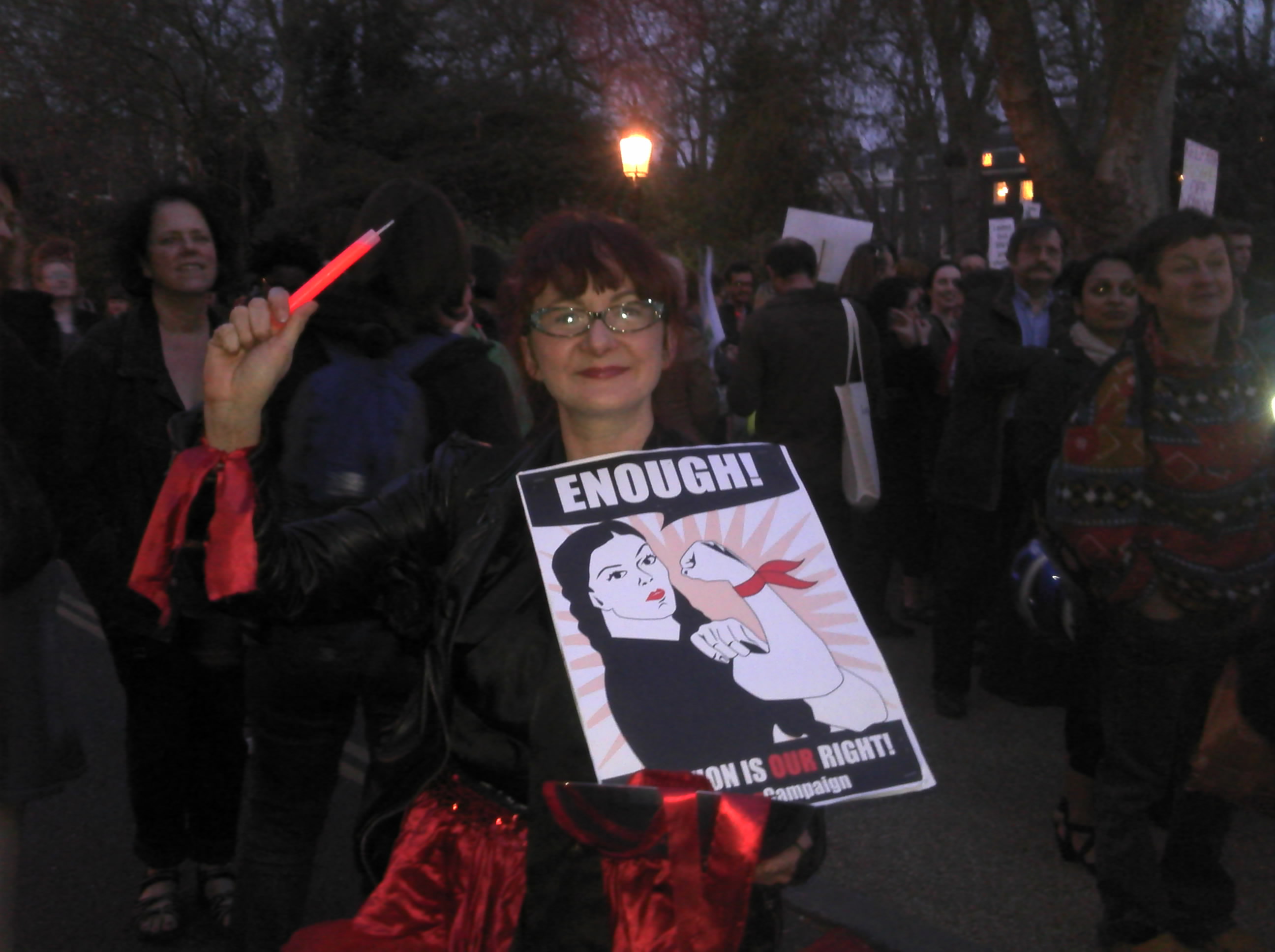
The energy grew and grew. As the original seven o’clock start time approached, more and more arrived. The Red Rag Campaign appeared, clattering away on pots and pans. The SOAS Samba Band, a staple of a good demonstration, provided us with rhythm and the ever-growing crowd began to dance. To loud cheers, hundreds of Critical Mass cyclists rode past, ringing a chorus of bicycle bells. As the night fell, glowsticks were passed around, and we sang and danced until our feet and lungs ached.

It was a party. Sure, there was more placards and banners and chanting, and a heavier-than-necessary police presence, but it was a party nonetheless. The mood was jubilant, celebratory of a person’s right to choose. The atmosphere was irreverent, fun and friendly, never threatening. At times it was easy to forget about the fascists hidden away behind the police lines. We had drowned out their sermon and hidden them from view. Their archaic obsession with our wombs had brought us together, and we were winning.

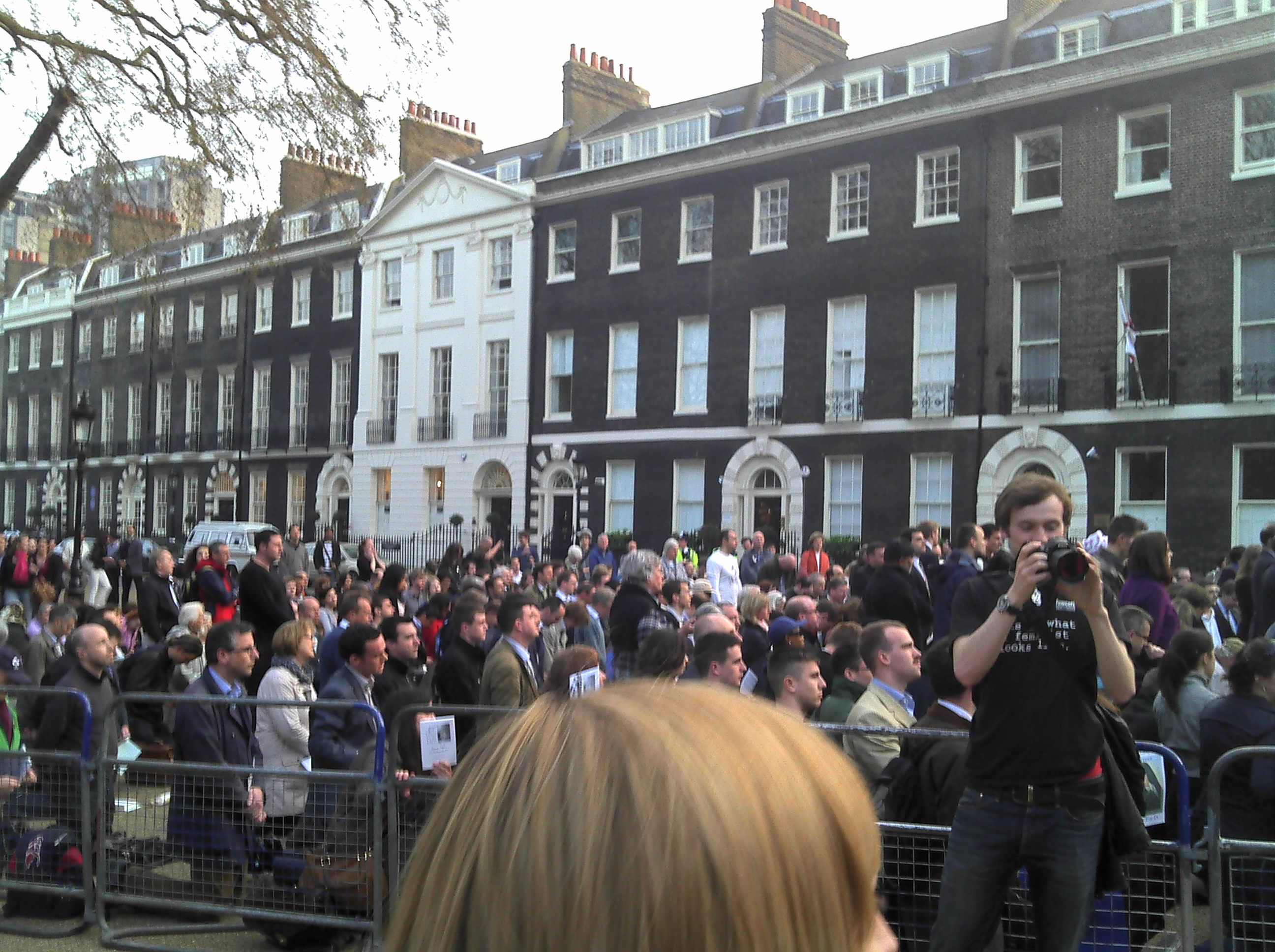
While we danced, 40 Days for Life were doing this.

There is one very notable thing about this image if you enlarge it: I can count only six women among the hundred-or-so anti-choicers.* This is the crux of the anti-choice movement: it is almost invariably men telling women what they can and cannot do with their bodies.

It is crucial that we do not give an inch in protecting the right to choose. The anti-choice movement is gaining traction, putting out lies and propaganda where it can. They are not going to go away, so neither must we. We must call out each lie, each distortion, each veiled threat, resisting every attack. And if resistance means the odd street party now and again, I think I can live with that.

__

*A further point about this photograph: the moustachioed man in the beige jacket behind the photographer is self-professed fascist Geoffrey Godber, which highlights neatly the shared theoretical roots between anti-choice and fascism.

Dickhead round-up

In our semi-regular feature, let’s have a look at what happened next with some of the dickheads with whom regular readers of this blog are familiar.

Unilad: Their site is relaunched, and content is going up. No rape jokes as yet, but some instances of what is approximately the most horribly bad writing imaginable are coming out. Check this out from an “anonymous” contributor (whose username happens to be Lorna. Very anonymous). Is it earnest? Is it satirical? We will never know due to the clusterfuck of sentence structuring.

Dominique Strauss-Kahn: The legal case surrounding his alleged involvement in a prostitution ring continues. Strauss-Kahn’s odious lawyers reckon “He’s being reproached for a kind of crime of lust.” Right. There’s rape culture right there in a nutshell. Crimes of lust. Of course, Strauss-Kahn being so powerful, he’ll likely get off anyway.

Tom Martin: A while back, I blogged about a bloke trying to sue LSE for discrimination and how that was completely silly and he probably lacked the academic smarts to complete his Gender Studies course. He later showed up in the comments, being silly and lacking academic smarts. Martin’s case has now been thrown out of court, with him citing as examples of discrimination the fact that the chairs were a bit hard. He also reckons all women, especially feminists, are whores. This happened last week, and I am still laughing about it.

Religious womb-obsessed fucknuggets: 40 Days For Life, famous for harassing women outside abortion providers, are still there. They are inviting an anti-choice bishop to pray with them this Friday. As the clinic is closed, activists will be holding a counter-demonstration. It’s this Friday in Bedford Square, Bloomsbury at 7pm. If you like uterine privacy, come along.

“Illegal” abortions? Distortions from Dorries, Lansley and the Telegraph

The Telegraph thinks it has a scoop. ONE IN FIVE ABORTION CLINICS BREAK THE LAW, it screams. Womb enthusiast Nadine Dorries and other uterus-fanciers have also jumped on this bandwagon, wheeling out faux-concern with the implicit subtext that maybe we should just shut down everything.

The Telegraph alleges:

The Daily Telegraph understands that more than 250 private and NHS clinics were visited and more than 50 were “not in compliance” with the law or regulations. Doctors were regularly falsifying consent forms and patients were not receiving acceptable levels of advice and counselling in many clinics, the Care Quality Commission (CQC) discovered.

I immediately decided that a better source of information on the matter would be to find the original CQC report, rather than a right-wing newspaper which has been quietly agitating against women’s bodily autonomy for the last few months. I searched and I searched. And it appears that the CQC report does not exist online. All search terms simply led back to a string of Telegraph articles on gender-selective abortions. On the CQC’s own website, precisely one search result for “abortion”, which is a response to the Telegraph articles and a promise to investigate, unhelpfully undated.

With this in mind, it is impossible to tell exactly how the abortion clinics are breaking the law, if the “one in five” statistic is true in the first place.

There are several ways in which the “one in five” statistic could be true. The first is the way the Telegraph spins the story: that 20% of abortion providers are evil baby-killing fraudsters who will stop at nothing to whip a girl-foetus out of an unwilling woman. This scenario seems extremely unlikely.

The second–and more plausible–way in which this can be true is if one worker in each of the “one in five” clinics was breaking some sort of law in some sort of way. The magnitude of the offences is largely unknown due to the fact that we cannot read the report to find out. 

It is impossible to tell exactly who is breaking the law here. The inspections happened at 250 clinics, who may or may not have been a representative sample of abortion providers across the UK. All we are told about the facilities is they were a mix of private and NHS providers: again, we cannot know whether these “illegal” occurrences were more likely to happen under private or public healthcare. Considering that the notably right-wing Telegraph hasn’t bothered making a fuss over “taxpayer’s money” paying for these “illegal” abortions, I’d hazard a guess that the private clinics were the ones with the bigger problems. This is purely, of course, an educated guess in a complete lack of information, given that we cannot read the report to find out. 

The “major” problem which was possibly discovered by the CQC if this report were actually available is “pre-signing” of paperwork. Under UK law, two doctors must sign off on the procedure, and in an unknown number of abortions that were not adequately following procedure, some doctors signed the form without bothering with the consultation. While possibly negligent, this also suggests that perhaps some medical professionals do not believe it is necessary for two doctors to complete the procedure: it may be that this is a redundant safeguard which is rejected by those with more knowledge in the area. Pre-signing, though, is a different kettle of fish entirely to the alleged “falsified consent forms”

Along with the probably-not-entirely-fictitious CQC report, it is interesting to note what the Telegraph has chosen to lump in with its screaming about “illegal” abortions: patients not receiving acceptable levels of counselling. The thing with this is, that this isn’t illegal at all. There is nothing in the 1967 Abortion Act making this compulsory. To imply otherwise is highly disingenuous and clearly misleading.

To summarise, the Telegraph “investigation” and Nadine Dorries’s interpretation thereof is dodgy because:

  • There is a vast difference between “illegal” and “not in compliance with regulations”
  • The report cited is not available to the public to critically appraise
  • We do not know who has been failing to comply with regulations
  • We do not know how exactly they were failing to comply with regulations
  • We do not even know if any of the report cited is true at all
  • Throwing in references to “counselling” is irrelevant to any discussion of abortion providers breaking the law

So what function does all of this distortion serve? Odious twat Andrew Lansley makes it clear, his head sadly still not perched atop a pike:

“I was appalled,” he said. “Because if it happens, it is pretty much people engaging in a culture of both ignoring the law and trying to give themselves the right to say that although Parliament may have said this, we believe in abortion on demand.”

Mr Lansley warned that so-called abortion on demand was not acceptable. “It’s not what Parliament intended and it’s not what the law provides for,” he said. “My job is to enforce the law.”

That’s right. Abortion on demand is apparently not acceptable. We do not live in a free society wherein any person can choose to end a pregnancy. Despite the illusory freedom we have, it has become abundantly clear that there are some elements who wish to control the bodily autonomy of women, and will gladly do this through misleading–or perhaps outright lying. Abortion on demand is nothing more than a loaded term for “choice”.

This story highlights the precariousness of our freedom. The body fascists have opened up new avenues of attack, and we must be ready.

__

Update: It has just come to my attention that there is yet another distortion in the Telegraph piece: although they mention sex-selective abortions, they never state that any instances of this were actually found. Had the report identified this occurring, and given the Telegraph have been banging this drum for months, they would definitely gloat about this. Therefore, the only reason this is mentioned at all is in order to foster this implicit association in readers that sex-selective abortions are commonplace. Which they aren’t at all.

Update 2: @bloggerheads has found the date of the only CQC search result for abortion: 23rd February 2012.

The NHS demo and the failure to report

Yesterday there was a demonstration in Central London against the NHS bill. You may not have heard about this, because the media completely failed to report it.

It started as several hundred people attending a rally outside the Department of Health. Statically they stood there, listening to speeches with an air of Waiting For Something To Happen. The rally had not been well-publicised, but those who attended were the ones who felt like something–anything–had to happen, that we could not let this bill pass without event.

Finally, something did happen. A man cycled into the middle of the road, with a colourful trailer attached to his bicycle. He shouted something into a megaphone. Maybe he called for the demonstrators to join him in the middle of Whitehall, or maybe he said something else. I don’t know. Nonetheless, they joined hands and formed a chain across Whitehall then sat down on the ground. We chanted vigorously against privatisation and of our love for the NHS.

Fittingly, we were sat in the shadow of the Cenotaph. Recall that the NHS was set up following the Second World War: it is itself a war memorial. Unlike the Cenotaph, it serves a function, helping us up when we are harmed, when we are sick, when we are dying. In blocking the road, we had moved from a static commemoration like the Cenotaph, to an active action like the NHS.

At this point, the media was there. I know this because I sat on the ground cross-legged with a news camera pointed up my skirt, painfully aware that in my rush to leave the house that morning I had forgotten to wear knickers. Photographers swarmed and flashbulbs clicked. I’d thought that perhaps this would mean we would get reported.

It started to rain, and the mood changed again. Someone on a megaphone proposed that we pay a visit to Virgin Healthcare, a private company who had been instrumental in drafting the bill with a clear conflict of interest. People sprung up and proceeded to march down the now-empty Whitehall. Suddenly, on the horizon, the powder-blue hats of an advancing TSG line became visible. Adrenaline kicked in, the urge to run at a particular shade of blue following so many bad experiences with that lot of thugs. I ran like crazy. So did many others. Behind us, the line closed in, kettling the rest of the demo. Those at the front waited, unsure of what to do next: to continue or wait for the rest.

It turned out that decision was unnecessary. The kettled crowd–most of them first-time protesters, young and old, all out for the NHS–surged through the line, having successfully broken the kettle. I was pleased; that first broken kettle is one of the most empowering things possible. Down Whitehall they ran, trying to outfox the police.

When the group reached Trafalgar Square, there was some initial confusion. I’d had no idea where we were going, and neither did most others. In the confusion, many milled around in the road or by the square.

It was then that police with machine guns tried to break us up. A red police car drove at the crowd, trying to clear the protesters from the road. A young woman sat down in front of the car, and the officers got out. With their guns. Armed police on the streets of London, all because a woman had sat down and some people were outraged by the corrupt government and businesses who were gutting our welfare state. Protesters scarpered, but did not disperse. Instead they ran down the Strand.

There, more TSG turned up and again tried to kettle. It seemed that nobody knew exactly where Virgin Healthcare was. We found out because the TSG swarmed in front of some gates, effectively shutting it down. Kettle broken, we marched on.

We ran through London, to cheers from the public. Everyone loves the NHS. We chanted, we made noise, we were visible.

I left the demonstration as they turned up Chancery Lane with yet more TSG dogging them. It looked like an unavoidable kettle and the numbers were too small. I understand they got kettled again, threatened with mass arrest and were only allowed to leave following a humiliating data-gathering exercise where they were coerced into giving names and being searched.

The day was pretty eventful, all things considered, and the media were there. So why was it completely unreported?

Several reasons spring to mind. Most cynically, there are a lot of groups with a vested interest in this bill passing without much resistance. It is entirely possible, given the labyrinthine complexity of corporations, that much of the media wins something from the creeping privatisation of the NHS.

This demo also failed to fit with current narratives of dissent. At the moment, everything is all about Occupy: large numbers of people statically camping and waiting for something to happen, asking as nicely as possible. Yesterday was the opposite: yesterday was a small number of people moving and disrupting. We also didn’t break anything. The demo was completely non-violent, and there was no property damage. There was no “MINDLESS THUGS” aspect to hang a story off. It didn’t fit at all with how the stories surrounding protest go.

It is a crying shame that this last stand will go unreported, and I tell this story as I feel it needs to be told. These actions will likely be futile, as there is so much at stake for the state and the corporations. We just refused to go out with a whimper.


Gaslighting, power and differences of opinion

Trigger warning: this post discusses “gaslighting”, a form of emotional abuse

Gaslighting is a form of emotional abuse wherein the perpetrator causes the victim to doubt their perception of reality. It is a powerful tool for tormenting an individual, and may facilitate other abuse by causing even the victim to doubt whether the abuse has occurred. Its name comes from the play and 1944 film Gaslight, wherein the villain disorientates his wife in order to cover his plot. It is a brilliant film, with Ingrid Bergman powerfully portraying a woman who believes herself to be losing her mind as she sees the gaslights in the house dim and reignite and possessions vanishing as her husband convinces her that none of this is happening. I would strongly recommend watching, as it demonstrates the phenomenon so well, that it is little wonder it became its namesake.

After watching Gaslight, a discussion of gaslighting arose, and @a_y_alex posed a rather interesting question which is worth exploring:

Is gaslighting inherent to any difference of opinion within a system of dominance?

Many of us have encountered that frustrating situation wherein we are discussing privilege with a privileged person, and they refuse to believe that such a thing is possible: the pervasive notion that things cannot be anywhere near that bad for the oppressed. They fight their position tooth and nail, that any experience of oppression must be imaginary. Perhaps the derogatory terms will come out. The loony left. The hysterical feminists. The uppity black people. “You’re crazy,” they say, when confronted with a reality which differs from their own.

The effect of this can be quite powerful. When it piles on, it can fundamentally shake up a person’s perception of reality. When this has happened to me, I sometimes find myself seriously wondering if perhaps I have just imagined everything, put greater weight on little things I have experienced, things really aren’t so bad, and somehow twisted something perfectly normal into a victim complex. Having experienced gaslighting before, the effect can be much the same.

What complicates matters, though, is the intention. Gaslighting requires an attempt to cause the victim to doubt reality, by deliberately misleading and misinforming, by tampering with the physical space. In these scenarios, in the disagreements within a system of dominance, this is often not the case. What we get instead is two opposing perceptions of reality: for the less powerful, there is an experience of oppression; for the more powerful, how could such a thing exist when everything is so shiny and fine and the world is good and right? It is not a constructed, malicious attempt to disorientate a person into doubting reality, but rather, a difference of beliefs.

This is not to adopt the fence-sitting liberal position and say that both sides are right and have valid points: indeed, the privileged person is wrong in this instant. They just haven’t noticed because they cannot see the problem. It is something which is inherent to holding these kinds of conversation in an uneven power structure, but it is not gaslighting.

Well, not usually. Once in a while, you will encounter the utterly repulsive specimen who does intentionally, disingenuously mislead, who does attempt to resolve a difference of opinion by making the other person doubt themselves, to discredit and, ultimately, to win. Arguably, the system itself gaslights us: flagrantly denying and misdirecting us, pathologising dissent and painting those who criticise it as somehow mad.

So we often find ourselves in the situation where we feel the doubt, and that our perception of reality and our beliefs are shaken. There are ways of dealing with this. Most importantly, we must remember that we are right, feel stronger in our own beliefs. Upon feeling mislead, we should turn to those who share our critique and remind ourselves of why we are right. We must not be afraid of asking for help, for back up: just as gaslighting alienates and isolates its victims from support, so, too can this form of argument. Together, we can mitigate this impact. Together, we might just finally win.