How To Be A Woman: in which I review a book that I read

I have just read Caitlin Moran’s How To Be A Woman, a semi-autobiographical book which has been hailed as The Next Big Thing in feminism, and has received rave reviews from noted feminists such as Jonathan Ross and Nigella Lawson. On the back, it says that Moran “rewrites The Female Eunuch from a bar stool and demands to know why pants are getting smaller”. Overall, it seems exactly like something an angry feminist such as myself should despise with all of the burning fires of hell.

The short review is that I didn’t hate it. I only hated some of it, actually quite liked some parts, and the rest only left me with a bitter tinge of disappointment.

The writing style veered from engagingly, chattily conversational to annoyingly CAPSLOCKY and RIDDLED! WITH! EXCLAMATION MARKS! It is easy to tear through, in the manner of a sunlounger bonkbusting tome, and I found myself rather liking Moran: she has a good sense of humour and an honesty about her own flaws.

Moran is absolutely spot-on about some issues, and I found myself nodding in agreement in sections on pornography and lapdancing, where Moran argues that while there is nothing inherently wrong with fucking on film or stripping, but it is a problem with the industry. I also very much liked her discussion of what to call one’s cunt (Moran favours “cunt”, but was reticent to teach it to her daughters as it is still a taboo word), and her very frank account of her abortion and her suggestion that this is something we should talk about honestly and openly, and it is all right to feel good about having had an abortion. Moran also puts across good points about society’s expectation about how women should want babies, and this is not right, and not reproducing is perfectly all right, too.

This last good point, though, is sullied by a massive clanger. Talking about childbirth, Moran says:

In short, a dose of pain that intense turns you from a girl into a woman. There are other ways of achieving the same effect–as outlined in Chapter 15 [the chapter on abortion]–but minute for minute, it’s one of the most effective ways of changing your life.

Right there, Moran has declared that use of one’s reproductive organs is the only way to truly become a woman. This line of reasoning is a minefield: it automatically writes off the experiences of infertile cis women, of trans women, of cis women who have been fortunate enough with contraception never to find themselves pregnant. It jars with the rest of the book, the “anything goes” approach, yet it says it there as clear as day. Reproduction is the only path to womanhood. Before that you’re a girl.

When I read that paragraph, I considered rethinking my embargo on burning literature and setting fire to that book there and then. I decided to plough on. Perhaps Moran did not mean what I thought she had meant. Indeed, this is never mentioned again. I still cannot think of another way to interpret that sentence, though.

No other individual part of the book is quite so starkly, shockingly problematic: much of the rest of my issues with it lie in the tone. It smacks of privilege: an amusing point-and-laugh at the working classes here, a throwaway usage of ableist language (“retard”, “thalidomide pasties”) and fat-hating (Moran draws the distinction between “fat” and “human-shaped”) there, and a sort of vaguely patronising view of gay men as nothing more than arbiters of excellent taste in music bars. I prickled in rage each time I saw these.

This privilege also fans out into what is part of the central thesis of the book: that perhaps everything would be improved if we treated humankind as “The Guys” and sexism as “just bad manners”. For a woman in Moran’s position, perhaps this is possible. For many, it is not, and sexism is not dead, and is unlikely to be killed without confronting it head on. I take umbrage to her phrasing viewing everyone as “the Guys”, too, particularly as it jarringly occurs pages after I had been smiling in agreement at Moran’s acknowledgement that men are viewed as “normal” with women as the other. This hypocrisy goes unmentioned, perhaps unnoticed by the author.

The thing is, for much of the book, I was not angry. I was just disappointed. Firstly, Moran seems to have a confused relationship with feminism and feminists. She identifies as such, and, indeed, encourages her readers to identify as feminist as it is not a dirty word. This is laudable. Unfortunately, Moran seems to have a rather dated view of feminist writing, falling back frequently on Germaine Greer as though this is the only feminist she has ever read, and beginning statements with “feminists think”, then falling back on to a straw feminist trope. While Moran wishes fervently for more women to identify as “strident feminists”, the book itself is not particularly stridently feminist.

Most of the issues discussed in the book were very trivial concerns. An inordinate amount of space was dedicated to clothes and shoes and bras and knickers. Rape is given a cursory mention in one sentence somewhere. At no point in the discussion of whether marriage is necessary was it acknowledged that perhaps romantic relationships or traditional monogamous relationships may not be necessary either. The truth is, it all feels a little superficial: talk about handbags is favoured over broader feminist issues. For many women, after all, there are a lot of things more worrying than pubes or ill-fitting knickers.

Take, for example, a point where Moran recounts the story of having met Jordan and being struck by how obsessed Jordan was with selling things and selling herself as a brand. At this juncture, it seems like a fairly obvious place to segue into discussion of the relationship between capitalism and feminism. Instead, Moran just tells the story, then contrasts it with meeting someone whom she considers to be a genuine feminist icon: Lady GaGa.

I sometimes wonder if perhaps Moran knew she could have done this. Much of the book seems to be driving at good points which are never made. Perhaps the editor of the book cut all of the good bits out? Certainly, the editing of the book was poor; I noted numerous typos and the editor was very lenient about allowing all of the CAPITALS and ENHUSIASTIC! PUNCTUATION! to stay in. As I said earlier, I rather like Moran, and I wanted this book to be better than it was.

In the conclusion to the book, though, it becomes abundantly clear that Moran’s feminism–at least, as presented– is shallow, bourgeois feminism, concerned with consumerism: just don’t buy the things you think might be oppressive, is her message. I was thoroughly disappointed by this message. I had hoped for much better, much more. I had hoped for depth.

If this book is our generation’s The Female Eunuch, as it says on the back cover, we are well and truly fucked. The good news, is, I do not think we are. This book is not harmful, it is simply trivial, inconsequential fluff. It is something to read on holiday, and then forget about once the tan has all peeled off. Had the book ended with a list of other (better) feminist books and resources to check out, I would probably see it as a decent, readable, primer to feminism for those who had never thought about the issue before and may be inclined to learn more. It may have also been improved vastly by shaving out the patronising bits and replacing them with something vastly more substantial.

As it stands, though, it is just fluff. This book will not change the world, for better or worse. For that, I am thoroughly disappointed.
Happy birthday, NHS

Without the NHS, I would probably be dead of broken, murderous brain. Today, I wish the NHS a happy 63rd year, and think with pride and gratitude about all of the lives it has saved, all of the people it has mended and all of the highly-trained professionals it has taught to save lives and mend people. It is a beautiful, special thing, the one thing that makes this country great.

To quote Aneurin Bevan, a great person from the days when politicians cared about the people:

The NHS will last as long as there are folk left with the faith left to fight for it.

I think it is apparent that there are. I certainly am.

Our precious NHS is under attack from the Tories. Nye saw this coming over sixty years ago:

That is why no amount of cajolery, and no attempts at ethical or social seduction, can eradicate from my heart a deep burning hatred for the Tory Party that inflicted those bitter experiences on me. So far as I am concerned they are lower than vermin. They condemned millions of first-class people to semi-starvation. Now the Tories are pouring out money in propaganda of all sorts and are hoping by this organised sustained mass suggestion to eradicate from our minds all memory of what we went through. But, I warn you young men and women, do not listen to what they are saying now. Do not listen to the seductions of Lord Woolton. He is a very good salesman. If you are selling shoddy stuff you have to be a good salesman. But I warn you they have not changed, or if they have they are slightly worse than they were.

As a present to the NHS, talk about it to everyone. Express your pride and vow to protect it. It needs our help.


I cannot believe this shit needs to be said

Trigger warning for rape and systemic abuse of a rape survivor

There are, apparently, “major holes” in the credibilty of the woman who alleges she was sexually assaulted by Dominique Strauss-Kahn.  A powerful man, Strauss-Kahn can afford a powerful legal team, and they have been working at full capacity.

The forensic evidence shows sexual contact did occur, so they have attempted a different method of defence: smearing the alleged victim. She is said to have lied on her application for asylum and spoken to an incarcerated drug dealer on the telephone following the alleged attack. While the legal team are deny being behind the rumours that the woman was a prostitute, they are certainly not doing much to stop this being splashed all over the tabloids.

I do not know whether Strauss-Kahn attacked the woman or not (please note: she is a woman, not a “maid”).

What I do know is that undermining the credibility of the witness says nothing about whether Strauss-Kahn attacked her or not.

Her immigration status and her alleged contacts are thoroughly unrelated to what may or may not have happened in that hotel room. Someone whose immigration status is dubious can still be raped. Someone who knows a drug dealer can still be raped.

Yet this is treated as though it is exonerating evidence. It is thoroughly unrelated. Immigration status does not indicate consent. Knowing a person in prison does not indicate consent. This cannot show that the sex was consensual.

I cannot believe anyone needs to say this shit. It should be patently obvious that these two characteristics of the woman are not related to the alleged crime. Yet this sort of thing is used in courtrooms repeatedly: unrelated facts which supposedly prove innocence. A woman’s clothes, her prior sexual behaviour, her job. These things are not consent. They are not relevant.

Another woman has come forward, also accusing Strauss-Kahn of sexual assault. By his defence team’s logic, this means he is guilty as sin. In this case, at least a prior allegation of sexual assault is dimly related to the notion that he may have committed sexual assault. Of course, it is not relevant.

Immigration status and incarcerated friends are thoroughly irrelevant.

Techno and rat cocks and Class As, oh my!

Readers, you have been very good to me these past few months, and I have an end-of-term treat for you.

Let me present to you what is quite possibly the greatest academic paper ever written: Effects on rat sexual behaviour of acute MDMA (ecstasy) alone or in combination with loud music by Cagiano and colleagues. The paper is open-source and I would thoroughly recommend reading it through as it contains some absolutely blindingly brilliant lines. The keywords alone are the stuff of genius: MDMA, Loud music, Sexual behavior, % of ejaculating rats, Copulatory efficiency.

Those who have ever taken MDMA or attempted to fuck someone with a penis who has taken MDMA will be familiar with a problem which can most delicately be described as incredibly willing spirit in combination with incredibly weak flesh. Less delicately, “disappearing cock syndrome”. Cagiano and colleagues politely describe the problem as “impairing human sex drive and behaviour”.

Like good scientists, Cagiano and colleagues acknoweledge that there are a number of confounders to studying the effect of MDMA on vanishing dicks, such as environmental context. For these reasons, the authors decided that the best way to study the effect of MDMA on sexual behaviour would be to introduce the variable of loud music, as MDMA is often consumed in places surrounded by the sort of music that can really only be appreciated with a vast quantity of chemical aid. Therefore, the authors decided it may also be prudent to study the effect of music.

In the study, therefore, some male rats were given varying doses of MDMA, others only a placebo, and some were exposed to music while some where not. The authors are coy about the type of music used: in the introduction, techno music is discussed, while in the method section we are only given information about the sound frequency of the music. Given the frequencies involved, it seems more likely to be techo than dubstep.

The rats were then put in the dark with a “sexually receptive” female rat, and their behaviour was monitored. The authors were fairly thorough about the aspects of sexual behaviour they were observing, including exciting-sounding conscepts such as “mount latency”, “ejaculation latency” and “next intromission in each copulatory series”. Sexual vocalisations were also recorded, including “duration of the 22 kHZ post-ejaculatory vocalisation in each copulatory series”. I can only assume that this means the grunt a male rat makes when he spunks, which is educational.

Until I read this paper, I had never really thought much about what rats do when they fuck. After reading this fairly comprehensive account of various aspects of rat-shagging, I am now, unwillingly, intimately familiar.

The researchers found that MDMA does indeed impair sexual performance in male rats at the higher dose. Surrounded by a lot of statistics, the authors describe how the rats took longer to get going, more of them failed to fuck at all, and they were less likely to ejaculate if they did manage to fuck. Some of this may seem somewhat familiar to anyone who has ever been fucked by a penis-owner on MDMA, or been that penis-owner.

The music had an effect on sexual behaviour among all of the rats: it meant that they ejaculated faster. Fucking to techno music apparently speeds up the time to orgasm. In the rats who had high doses of MDMA, presence of techno music was the only way they could actually manage to come. Without the music, they were highly unlikely to achieve ejaculation. The music also improved how many times the rats were able to fuck, and how frequently they attempted: at the high doses of MDMA, the rats showed higher levels of “copulatory efficiency”.

Again, some of this may sound familiar.

Of course, as a rat study, its results are not necessarily applicable to human experience, and female rat behaviour was not studied at all. It is an amusing study,one which raises a knowing smirk and a giggle. Its major contribution to science is that it provides an empirical account that environmental factors do interact with MDMA and affect what happens, which is quite important.

As with all science, please don’t try this at home, as it is a branch of research in its infancy. Nobody should have to expose themselves to techno until its necessity is proved.

Kallistei: the curse of Eris

Eris, the goddess of discord and strife, was pissed off. The other gods were having a party and nobody had thought to invite her. Perhaps they had snubbed her; she had a habit of ruining parties by disagreeing with everyone and trying to start a fight. Nobody liked to sit next to the goddess of discord when all she did was whisper gossip into their ears. “Hera finds your hunchback repulsive, Hephaestos”; “Demeter thinks you smell a bit fishy, Poseidon”; “You are literally the only Olympian Zeus wouldn’t fuck”.

It pissed Eris off, being left out like that: a perfectly enjoyable night of low-level discord at a wedding, which doubled the fun. She had been planning on seeing just how much she could ruin the happy couple’s union before the marriage were even consumated. If they had only invited her to the party, perhaps she would have played nice and spent just one evening without deciding that the world needed more wars and it was her job to make that happen.

Eris thought hard about how to spoil the party for those bastards who excluded her. Something simple, something divisive, something that would fuck shit up entirely. Turning an apple over in her hands, a plan formed.

Catfight, Eris thought. A catfight so epic it will be remembered for thousands of years to come.

Taking a knife, she carved a message into the apple. One word, a few letters with the potential to bring down cities.

ΚΑΛΛΙΣΤΗΙ.

The wedding feast was in full swing. Gods and heroes danced together, wine flowed. They did not see her there. Eris could have joined the party, but she was pissed off.

Eris lobbed the apple, high into the air. It tumbled, glinting gold. Heads turned skyward.

The apple landed with a bounce between three goddesses. Eris stood back to watch; a smile playing at her lips. They read the message.

Kallistei. For the fairest.

Aphrodite, goddess of love, declared that it must be hers. She was beautiful, she embodied passion and love. Surely it must be hers?

Cow-eyed Hera, the goddess of marriage, claimed the apple for her own. Her own marriage was a shambles: her husband Zeus fucked his way around the pantheon. They had never had the conversation about boundaries and limits. If they had, Zeus would not have heeded it, so Hera responded to his transgressions with vengeful wrath. Her insecurities led her believe that someone must see her as the fairest.

Even smart Athene, clever Athene, goddess of wisdom and warfare, fell prey to the apple’s message. Athene wished fervently that she were the fairest. She declared it hers.

To settle the dispute of who was most beautiful, the goddesses took what they believed to be the only democratic approach: they would ask a man to validate their beauty. They petitioned Zeus, king of the gods with a roving eye for beauty.

He refused. His relationship with his wife was fraught enough. Any answer he gave, he thought, would be wrong.

And so they chose a mortal man, Paris of Troy, who had a decent track record in settling disputes. The three goddesses agreed that he could judge their beauty and tell them, once and for all, who was the fairest, and who owned the apple.

Eris smiled.

Paris chose Aphrodite in the end. She had the power of enchantment and love, and promised Paris the love of the most beautiful mortal woman alive. The other goddesses bickered, knowing Aphrodite had played dirty. They were gratified as a war began. Athene returned to her rightful place, strategising over the Trojan war. Troy fell after a war of ten years.

Eris smiled.

The golden apples of the days of gods with human failings shift forms. They were, after all, only symbols of scarcity.

Yet the curse of Eris remains as potent as ever. Kallistei, emblazoned across this season’s must-have Louboutins. Kallistei, tattooed on the arm of the rock star boyfriend. Kallistei, vajazzled across a bald cunt. Divisive symbols, belonging only to the fairest.

We squabble, we beg men to validate our beauty, and Eris smiles.

Brendan O’Neill is still a weeping syphilitic chode

Brendan O’Neill–last spotted declaring short skirts to be a “definite sexual invitation“–has done it again. This time, O’Neill has decided that the best thing for everyone would be for sexual abuse victims to keep their mouths shut about it.

In a stunningly dismissive opening, O’Neill asks:

If you were sexually abused by a Catholic priest nearly 50 years ago, and that priest was now dying or dead, would it not be wise to keep it to yourself? This awkward question invaded my mind as I watched last week’s BBC1 documentary Abused: Breaking the Silence. It featured mature, respectable and successful men recounting in eye-watering detail what was done to their penises by priests at a Rosminian boarding school in Tanzania in the 1960s. We were meant to be shocked by the alleged foul behaviour. I found myself more shocked by the willingness of these otherwise decorous men to make an emotional spectacle of themselves.

O’Neill, here, states that he is more shocked by men speaking out about abuse than he is by the abuse itself. He is more shocked by men displaying an emotional reaction to trauma than by the trauma itself. Such a reaction is, frankly, terrifying. Where is the empathy? Instead, O’Neill is a little more worried about having to hear about their abuse and the fact that the men involved may have been more than a little bit fucked up about it.

To his credit, O’Neill concedes that it was a terrible thing that the Catholic Church knew about the abuse and did nothing about it. This is secondary, though, to O’Neill’s main point: that this sort of thing shouldn’t be talked about. And that he cannot tell the difference between a decade and a century.

Yet at the same time as we rightly question the morality of a religious institution that seeks to cover up sexual abuse, we are also at liberty to ask about the motivations of those who reveal the details of that sexual abuse almost half a decade after it is said to have occurred. Why now? Why go on BBC1 in 2011 to tell a million viewers about something that was allegedly done to you in 1964 or 1965?

The rest of the article repeatedly rephrases this question, dotted with the declaration that the media has an obsession with people recounting trauma.

I agree with O’Neill that the media does have a ghoulish fascination with horrific tales which it replays in gleeful, pornographic detail. However, O’Neill conflates this with abuse victims speaking out, and presents his argument in the most astoundingly disdainful manner.

The trend for inviting Catholic men in their fifties and sixties to redefine themselves as mental victims of childhood experience is even more pronounced in Ireland and America. In Ireland, the state has explicitly invited its citizens to reimagine themselves as the hapless, unwitting victims of warped Catholic authority.

O’Neill’s contempt for abuse victims speaking out extends to state-led enquiries, and, according to O’Neill, the investigation made people who had experienced something reimagine themselves as abuse victims. Perhaps, before the state investigated abuse, they had thought that being sodomised by someone in authority was a perfectly ordinary part of Mass.

The fact is, if abuse victims are willing to speak out, they have every right to. In the case of the Catholic Church, it is particularly important to hear the voices of the victims: this is an institution which has systematically covered up institutionalised abuse of children–particularly young boys–for decades at the very least. Those who are in a position to do something about this, the bishops, the cardinals, the Pope himself, are thoroughly unwilling to put an end to this. The Vatican has refused to hand over documents regarding abuse to the police. The usual channels are powerless to bring justice for this abuse in the face such a cover up.

So people speak out. And they might do so over the television. It is the only way for their stories to be told, for the small chance that perhaps something may happen to prevent another generation of children suffer as they did. The public become outraged and, perhaps, more mistrustful of priests. With sufficient pressure, perhaps justice can finally be served.

Brendan O’Neill does not care about this. In his devastatingly simplistic analysis, all he wants is for these survivors to shut the fuck up and get off his telly.

This is not what victory looks like

The IMF has appointed its new chief, and she happens to be a woman. This is apparently a victory for feminism, particularly as the former chief was arrested for sexual assault. Having a woman replace an alleged rapist is what passes for victory these days.

This is not a victory for feminism. The “feminist agenda” was never so simple as to just be pushing for putting more women in positions of power. Having more women in power within our current system will not change a thing.

Margaret Thatcher was not a victory for feminism. Giving Nadine Dorries a political platform is not a victory for feminism. Appointing Theresa May as Home Secretary is not a victory for feminism. All of these women are working or worked towards changing nothing, or making life actively worse for women. That they identified as women meant nothing.

The IMF is a corrupt institution, forcing countries to impose budgets which disproportionately negatively impact marginalised groups. For Lagarde’s appointment to be considered a victory for feminism, the IMF would need to change radically, becoming an institution which actively helped build and improve the lives of those who need the most help. This is unlikely to happen.

A victory for feminism is not simply placing a woman into power. Someone of any gender can actively strive to help make life just a bit better for women. Someone of any gender can fight for real equality. That is what a victory for feminism looks like.

An angry childhood

Through my life, I have always been somewhere on the radical left end of the political spectrum, with the exception of a small rebellious phase in my early twenties of being a Liberal Democrat. My parents were broadly left-wing, drifting right with age, following the trajectory of the Labour Party, though I strongly credit them for shaping my opinions and my world view.

One of my earliest memories is a ballet lesson. I was four or five, and anybody worth knowing was utterly furious with Thatcher. I stood in a cold community centre in a purple leotard, awkwardly failing at forming second position in a graceful manner. The activity changed; we were to extend our right arm and right leg into points, and artfully tell off an imaginary naughty dog.

Charmlessly, I assumed the pose. The pointing and stamping reminded me of something that my parents did and I had learned.

‘In my house, we say this’ I declared. I enthusiastically performed the pose. ‘MAGGIE MAGGIE MAGGIE! OUT OUT OUT!’ I chanted. My voice echoed through the hall. No megaphone was required.

I didn’t go back to ballet lessons after that.

I remember, vividly, the day Thatcher finally left. I was allowed to stay up late as a treat.

I didn’t like the new man who took over. He was grey and boring, and I didn’t trust his face. He was just as bad as Maggie, I thought. He hated me as much as Maggie hated me.

I knew Maggie hated me because I had to bring milk money into school, even though I didn’t like milk.

I knew John Major hated me because he didn’t want me to learn at school. I marched with my mum and the NUT for education.

The idea of protests captured my imagination. When we moved house, I played with the estate agent’s SOLD sign, pretending it was a placard. It hardly compared to the real thing, with all the whistles and the shouting, but it was better than nothing.

It was around the age of seven that I undertook my first direct action. The aim of the action is lost to the ages, but the process remains clear as day.

I locked myself in the one bathroom in the house, with a pile of books and some biscuits. With full bladders and an unwillingness to unscrew the hinges from the door of the one bathroom of the house, the demands of my occupation were swiftly met.

I discovered my own power that day, so marvellously effective was my simple act.

The year after that, we got a downstairs toilet and I had to occasionally concede to the whims of others.

I took a break from direct action after that, until I was fourteen and my best friend and I decided to protest against being forced to play football in PE by sitting in the goal. We agitated, and the other chubby, unpopular kids joined our improvised blockade.

Seven was a crucial year for me. As well as developing a taste for direct action, I became an atheist and a pacifist.

The atheism happened as I stopped believing in Santa and the Tooth Fairy. Santa, I realised, had my dad’s handwriting and kept my presents in my parents’ room. The Tooth Fairy had my mum’s handwriting and looked a lot like my mum when she strolled into my room and put 20p under the pillow. That, in conjuction with my mum showing me a jar of my baby teeth, led me to the obvious conclusion that neither of these characters actually existed.

It became immediately clear to me that God, too, must be one of those harmless white lies and fairy tales. At least Santa left presents and ate the mince pie we left for him.

It was my love of Fungus the Bogeyman that led in a roundabout way to becoming vehemently anti-war. One day I spied on the bookshelves a graphic novel by the same author. As a bookish child, I fell upon it hungrily.

To parents, here is a tip: never leave a copy of When The Wind Blows within reach of children. It will permanently fuck them up.

From that day on, I slept under my duvet in a vain attempt to keep the inevitable nuclear fallout away from me. I made sure that the curtains were fully drawn so I would not die a slow radioactive death.

We were moments away from nuclear catastrophe, I believed. Why was nobody doing anything about it?

The answer was, of course, that it was 1993 and the Cold War was over. I did not learn we were no longer under perpetual threat of mutually assured destruction until I was about ten.

I still feel uncomfortable if I sleep in a room where the curtains are open a crack.

These experiences, these little slices of life moulded me. Each time, I drew my own conclusions from what was available. It was a love of learning and synthesis that made me myself. I have, of course, adjusted my belief system with age, but I savour developing my own convictions. It is fluid. It started as far back as I remember.

A Glastonbury tale

I have eaten real food off a plate made of china and drunk tea from a mug. I have scrubbed my fingernails until the point of rawness; all traces of mud are gone. I have washed the faint stink of cowshit from my hair and skin. It is now time to tell a story about something that happened at Glastonbury.

It is not a cool, sexy story. The story I will tell does not involve a cocktail of psychedelic substances, or a celebrity encounter, or a clawing, sweaty, passionate fuck in a hot tent, or seeing the face of Thor appear in the sky to a soundtrack of tribal drums inside a stone circle.

It is not a disgusting story. The story I will tell does not involve a taxonomy of mud types, or running out of bog roll at a crucial moment, or dead Tories in portaloos, or pissing into a paper cup.

Some of those things actually happened.  They are not important stories.

The story I will tell is unglamorous, homely, even mundane. And that’s part of the problem.

On Sunday morning, I attended a debate in the Leftfield tent entitled “Equality and the Cuts”. It opened with the three speakers taking a few minutes to talk about equality issues: Laurie Penny spoke of how the cuts affect women, another of a successful campaign to allow deprived children the same opportunity to attend a nearby school as more privileged children, and the last of how the trade unions are engaging with equality issues.

After ten minutes, equality was never mentioned again, and the whole debate, thanks to questions from the audience, turned into the classic lefty infight: are trade unions A Good Thing?

That was it. Equality was ignored for the rest of the debate.

So much was left unsaid. Only the mere surface on the extent to which the cuts increase inequality was scratched. Women and deprived children had been discussed. What of, for example, people with disabilities who are facing horrendous cuts to a welfare state which helps them live a dignified life, while dribbling cockend Tory backbenchers declare they should work for less than minimum wage?

Why was there no discussion of the inequality and shit that exists in our own back garden, as foul as the squelchy brown lakes surrounding overflowing latrines? Being a woman and an activist is difficult when one’s opinion is not even taken particularly seriously by some male activists. How about the trade unions themselves? How are they looking in terms of equality? The left is still dominated by the voices of the privileged. Will this impede our ability to fight for equality for all? We are all under the umbrella of people fighting the cuts. We need to discuss how we practice equality. What is being done is generally little more than a sticking plaster over a gaping wound.

Some said that there was no need for debate, that everyone agrees that equality is good, the cuts are bad and that the cuts are going to disproportionately affect already disadvantaged groups in society. It is, perhaps, true that everyone inside that tent held that opinion, but this is not the general consensus. How can we work to get the message out and make people care?

We could have discussed whether the government was wilfully targeting the abjected, the deprived, the underprivileged. Do the Tories actually hate poor people, women, disabled people, travellers? Or are they just so fat on champagne and caviar that they have not noticed the lives they are destroying.

These questions buzzed through my head, yet I did not speak. In part, I was tired and inarticulate. In part, I did not want to interrupt the lively debate on trade unions in which everybody else was wholly engaged.

Even in a time slot dedicated for discussion of equality, the topic was the same thing I see so frequently on the left. It was talk of process, it was talk of theory. It was not talk of the actual issue at hand.

Discussion of equality isn’t cool or sexy. It isn’t even particularly interesting. It is, however, vital that we talk about it, as it is an integral part to rebuilding society into something that is, at the very least, more palatable than what we have now.

My Glastonbury tale does not include poo-pirates, spiritual experiences or sex, drugs and rock ‘n’ roll. It is unpretty. But it’s a talk that we need to have.


Avoid condoms. Spunk makes you happy, apparently.

From the magazine that brought you “black women are ugly because they’re fat, stupid and manly” comes a shower of fresh herpetic pus.

The title alone is thoroughly awful: “Attention, Ladies: Semen Is An Antidepressant“. It is steeped in various societal expectations regarding women and sex: women don’t really like semen, and it is up to the men (and male columnist) to persuade them otherwise.

The science is equally shaky; the column itself links three thoroughly unrelated concepts.

It begins with a discussion of the McClintock Effect, the phenomenon where women’s menstural cycles sync when they live or work together, which is apparently due to pheromones (which may not even exist in humans) (and the evidence for the McClintock effect is fairly poor in and of itself) (basically it’s bollocks). According to the article, the phenomenon does not occur in lesbians, and it is posited that the only difference between heterosexual women and lesbians is exposure to semen.

This assertion is complete rubbish for a number of reasons, and I promise I am not oversimplifying the text of the article. It actually says this:

But at the State University of New York, two evolutionary psychologists were puzzled to discover that lesbians show no McClintock effect. Why not? Gordon Gallup and Rebecca Burch realized that the only real difference between lesbians and heterosexual women is that the latter are exposed to semen.

The absence of a scientifically-dubious effect in lesbians is due tolesbians being unexposed to semen. There is no mention of the existence of bisexual/queer women, and absolutely no critical thinking regarding whether there are other lifestyle differences between lesbians and heterosexual women.

Furthermore, they put this ridiculous assertion into the mouths of the cited evolutionary psychologists who published the semen-is-an-antidepressant paper. They wrote nothing of the sort in the original paper (sadly paywalled). Quite what lesbians and their lack of a dubious effect has to do with semen as an antidepressant is unclear, but it speaks volumes about the quality of science reporting in Psychology Today.

I read the whole paper. I had to find it myself, as Psychology Today cited an article in a popular science magazine, outright admitting to churnalism. It is entitled “DOES SEMEN HAVE ANTIDEPRESSANT PROPERTIES?”. Psychology Today summarised it as this:

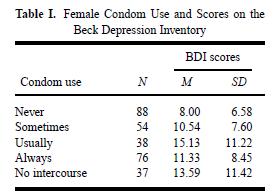
Given vaginal absorptiveness and all the mood-elevating compounds in found in semen, Gallup, Burch, and SUNY colleague Steven Platek wondered if semen exposure might be associated with better mood and less depression. They surveyed 293 college women at SUNY Albany about intercourse with and without condoms, and then gave the women the Beck Depression Inventory, a standard test of mood. Compared with women who “always” or “usually” used condoms, those who “never” did, whose vaginas were exposed to semen, showed significantly better mood–fewer depressive symptoms, and less bouts of depression. In addition, compared to women who had no intercourse at all, the semen-exposed women showed more elevated mood and less depression.

Meanwhile, risky sex is usually associated with negative self-esteem and depressed mood. Among college women, risky sex includes intercourse without condoms, so we would expect sex sans condoms to be associated with more depressive symptoms, and more serious depression including suicide attempts. However, in the Gallup-Burch-Platek study, among women who “always” or “usually” used condoms, about 20 percent reported suicidal thoughts, but among those who used condoms only “sometimes,” the figure was much lower, 7 percent, and among women who “never” used condoms, only 5 percent reported suicidal thoughts. (This study controlled for relationship duration, amount of sex, use of the Pill, and days since last sexual encounter.) So it appears quite possible that the antidepressants in semen might have a real mood-elevating effect.

The first paragraph is largely correct: 293 women were surveyed, using the Beck Depression Inventory (BDI), which is a self-report questionnaire designed for screening for depression. The BDI is limited in its utility as it is a self-report measure, and it also contains a mixture of physical and emotional symptoms.In samples of college students, the BDI may not necessarily measure depression, but rather, general psychopathology, meaning that in this study, the authors may not have been measuring depression, and therefore it is not possible to conclude that semen has antidepressant qualities as depression has not been measured.

The second paragraph is rather misleading. The authors did not control for any of the variables that the article said it controlled for. The results section of the original paper is what can only be described as a clusterfuck of various correlations, none of which actually include controlling for anything. The women differed on many of the variables, for example, on frequency of intercourse (the women who never used condoms had the most sex). This was not statistically controlled for: everything was simply chucked into the same regression model. The model was not significant and explained a trivial amount of the variance in depressive symptoms. Although the coefficient for condom use was statistically significant, the coefficient itself was small, and likely trivial.

Important variables were also not measured: for example, the authors failed to measure the quality of the relationships the women were having, something which may be highly relevant to their mood.Furthermore, the authors had adequate data to identify a “dose-response” relationship–in keeping with their hypothesis that semen is an antidepressant, there should be a relationship where women who were had greater exposure to semen reported lower depressive symptoms and vice versa. This could easily be analysed from data, combining condom use frequency and frequency of intercourse. It is not. I wonder if they ran the analysis and nothing emerged?

The authors also fail to comment on a very noticeable pattern in their results:

The women who reported always using condoms had markedly lower BDI scores than those who used condoms “usually”. This pattern was also present in the data regarding suicide attempts. It runs counter to the authors’ hypothesis: the women who always used condoms, by the authors’ use of condom use as a proxy for exposure to semen, were less depressed than those who would sometimes be exposed to semen.

The suicide attempts data is bafflingly high. 29% of the women in the “usually” use condoms group had reported previous suicide attempts.  The population average is about a tenth of this. It is probably that the data were gathered poorly. Given all of the other effect sizes, it is highly unlikely that exposure to semen is related in any way to a ridiculously high rate of suicide attempts.

On the whole, then, the study is shaky at best, though the phrase I would use would be “HOW THE FUCK DOES SHIT LIKE THIS MANAGE TO GET ITSELF PUBLISHED?” followed by throwing my (as yet entirely unpublished) PhD at a wall.

The Psychology Today article then flies off on another tangent, discussing human concealed ovulation, a topic of obsession for evolutionary psychologists. According to speculation, semen can force ovulation in a woman. It is such unsupported bollocks that to destroy this would be like punching a kitten in the face.

The Psychology Today article ends on an important caveat:

Now, I’m not advocating that reproductive-age people shun condoms to elevate women’s mood at the risk of unplanned pregnancy. But this effect might come in handy for women over age 50, who are experiencing menopausal blues.

There are so many things wrong with this paragraph that it is hard to know where to begin. It is commendable that the columnist thinks that unprotected fucking is not the way to cure depression. He is, however, completely oblivious to the fact that the risks of unprotected fucking go far beyond “unplanned pregnancy”. If he is, as I suspect, an evolutionary psychologist, it is understandable why he thinks that: the evolutionary psychologists tend to construct sex as something for nothing more than reproduction. He is also utterly wrong about how this effect may be useful for menopausal women. Even if we pretend that the semen-antidepressant study was done really well, the findings still only apply to young women.

In sum, then, spunk will not cheer you up or stop you killing yourself. Don’t avoid condoms unless it is safe for you to do so. The science is thoroughly awful.

If sex cheers you up, have sex, with the level of protection of your choosing. It is unlikely that it will be a magic panacea, but a good fucking is tremendous fun.

__

Big thanks to Tom, Alice and Fabi in the PhD room for reading through this drivel with me and having brilliant scientific brains