ACAB, AJAB, &c., &c.

From last night, two horrible stories about the police, reflecting how all cops are bastards. The first involves a peaceful university occupation. Students occupied Senate House in solidarity with staff. The students were violently evicted by police–including the TSG–within a few hours. Several were arrested, and some were assaulted by police. The second story took place that same night in Soho, where the police charged in and arrested sex workers, using the excuse that the women were “handling stolen goods”.

In both of these instances, people have been harmed by police, and it looks like the filth had a busy night being utter bastards. So surely the media have been busy with their unbiased reporting?

Er, obviously not. We live in a country where journalism mostly consists of regurgitating press releases. This is fairly evident in the Evening Standard’s reporting of the Soho raids, especially when it is compared to what sex workers are saying happened on social media. Unfortunately, there doesn’t even seem to be a will to listen to what sex workers say: observe the feeble excuses coming from journalists in this thread on being called out for not bothering to cover the story.

Meanwhile, the Guardian is reporting on the Senate House eviction, and has even posted a video of some of the police violence. The video clearly shows a police officer punching a protester, so it is somewhat perplexing that the Guardian has seen fit to put scare quotes around the word “punch” in the headline.

We’ve seen it throughout Leveson, and I don’t doubt we’ll see this again and again. The media is firmly in the pockets of the police. Rather than a free press, what we have is an extension of the police press office. This grip is maintained partially through a mutually beneficial arrangement, but further because these days, journalists don’t seem interested in doing research, in listening and stepping outside of their media clique and actually criticising the establishment that serves them.

The police perpetrate violence, and the media gladly covers for them. Remember this.

Your periodic reminder that the system still fails rape survivors

Content note: this post discusses rape and rape apologism

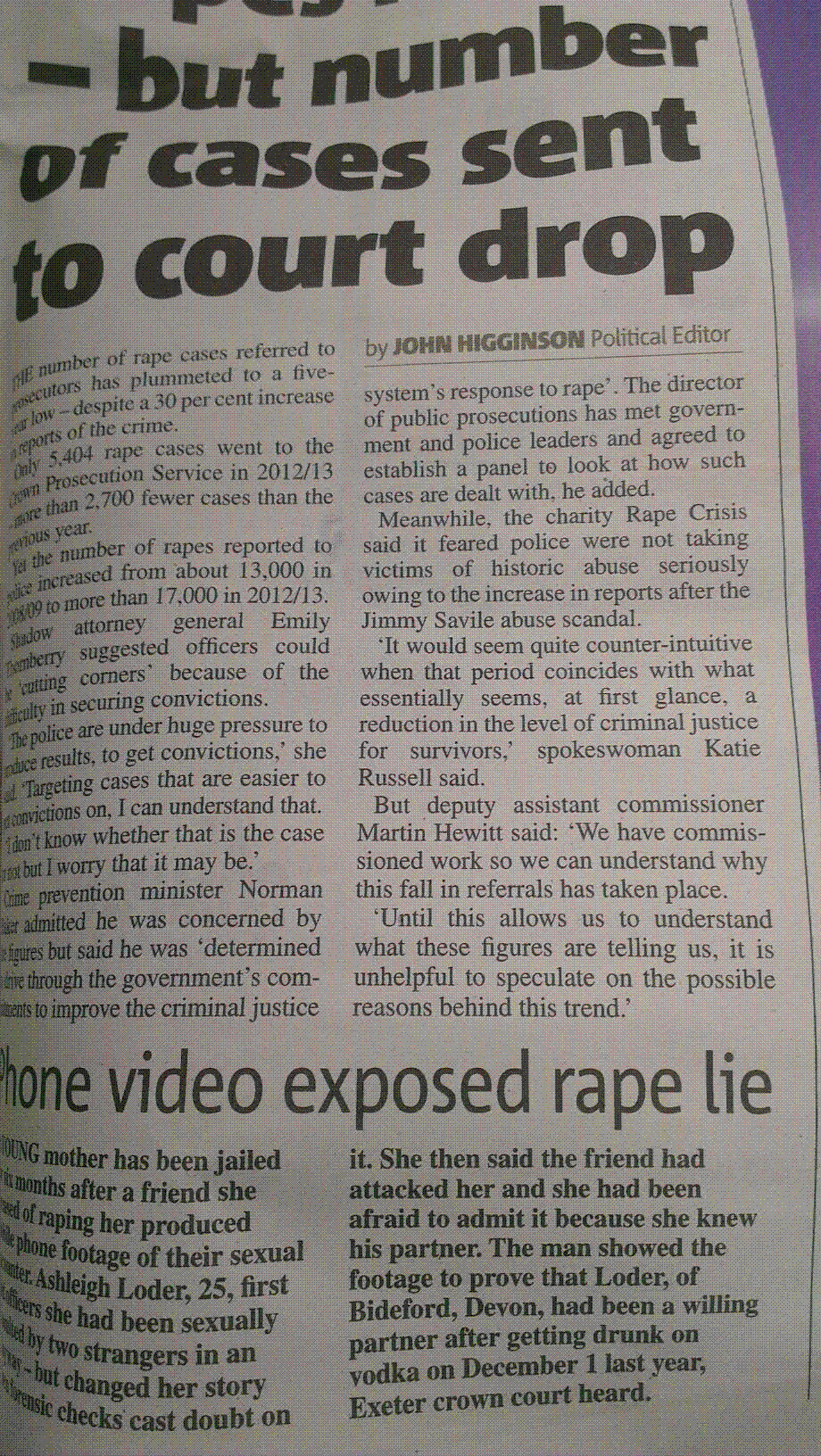
The latest figures suggest that the police are getting increasingly bad at referring rape cases to the CPS, despite the fact reporting is on the rise. This must be absolutely devastating for the survivors who chose to report, finding this route to justice the best.

For me, the official route has never been particularly appealing. I’ve written before about why I feel that way. I feel for those who felt that reporting and the court system was what they wanted; they have been failed so much. Why have the police suddenly decided that so much isn’t worth prosecuting, after gaining the trust of more and more survivors?

The answer is, of course, rape culture. It’s worth noting that this is alive and roaring from the establishment in this situation. Take a look at these two juxtaposed headlines:

BXp41R0IMAA9AS3

This was likely accidental, inasmuch as these things are accidental. Certainly, I don’t think anyone set out this page thinking “I want to associate rape reporting with lies”. It’s just that these associations exist in our minds, because we were all born and raised in a rape culture.

And very few of us see that everything we thought to be true about rape is wrong. So we end up here.

Their intent is not magical, and I do not trust the police, the media, the justice system to deal with rape adequately. They have too much power and too little understanding. Remember just how much they fail us.

How V53 might not be a liar (but is still a racist and a murderer)

No doubt some of you have been following the Mark Duggan inquest today. The officer who shot Duggan, V53, gave some rather baffling evidence. He swears blind that he saw a gun in Duggan’s hand, to the point that he could describe it, and yet the alleged gun which he saw in so much detail was also shrouded in a sock and somehow managed to teleport quite far away. Supernatural explanations notwithstanding, it looks rather a lot like our porcine witness is telling fibs. This seems like a particularly logical conclusion on a day where it has emerged that–shock horror!–cops are fucking liars.

Even assuming that it is impossible for guns to apparate by magic out of a sock and over a fence some distance away, however, it is possible that V53’s evidence is entirely honest. There is a psychological effect known as “weapon bias” which makes people see guns where there are none. Simply the effect of seeing a black face can make research participants imagine that they have seen a gun, especially when they are tasked with making a split-second decision. Interestingly, this effect seems to happen even when the participants are black. It is theorised that the underlying cause for this is racial stereotypes, which is exacerbated by making snap decisions.

Ultimately, then, it is entirely possible that V53 was telling the truth when he saw that magical gun. That doesn’t make him any less of a racist or a murderer, simply that the fact he is a racist has warped his memory. Likewise, it doesn’t make him any less culpable for the killing.

The knowledge that a bias exists which makes imaginary weapons appear in black hands means that we ought to treat such police claims with utmost scepticism, and question the notion that it is ever necessary to arm those who will make snap decisions based on racism with the capacity to end lives.

The police and instrumentalising survivors

Content note: this post discusses rape 

On Saturday night I sat shivering outside a police station with a bag of cereal bars and a friendly smile, waiting for comrades to be released from police custody following their mass arrest for Standing While Antifascist. Police came and went from the station, and eventually a car rocked up full of plainclothes cops, one of whom I’m pretty sure I recognised from actions and so forth; a meat-headed hegemonically masculine fucker.

Unsurprisingly, comrades were vocally critical of the police, particularly as it was a day where more than 280 people had been arrested for Standing While Antifascist. The police were asked what good they thought they possibly served in their role of police officers.

And they went on the defensive with a tired old line I’ve heard a thousand times before. “Tell that to the rape victims [sic],” they said. “Tell them we’re not doing any good.”

I’m not sure why it hit me so hard this time, but I kind of shut down. Full anxiety, unable to form words bollocks. Basically, I knew I would either cry or hit one of those jowly-faced pricks, and neither option was particularly appealing as showing weakness in front of pigs is almost as bad as assaulting one directly outside a cop shop. And so my brain decided to temporarily BSoD.

And now I’m left thinking of what I should have said, what I would have said had I been able to.

I’m thinking of how perhaps I could have said that as a survivor myself I never wanted to go fucking near the police because who on earth would? I would not want their sausage fingers probing my recently-violated flesh, hands more suited to violence than to aid. I wouldn’t trust the sensitivity of that porcine pair in any of it.

I’m thinking of how perhaps I could have pointed out the numerous fuck-ups that the police as an institution have made. Losing evidence, dropping cases on purely arbitrary criteria, all adding to unnecessary additional trauma. I could have mentioned how their Sapphire unit seems to be under a near-perpetual state of reshuffle as yet another survivor is let down. I could have mentioned how they continue to pump out propaganda placing blame on the survivor rather than the perpetrator. I could have mentioned how when police officers rape, it is often treated as an internal matter, only misconduct, much like fudging some paperwork (although, often their fudged paperwork happens to help perpetrators). I could have mentioned how they deceive women into sex to collect information on them. I could have mentioned how all of these failings put together paint a picture that suggests they cannot possibly be so awful by accident. I could have asked them whether they think their all-round hideousness contributes to the fact that the vast majority of rapes go unreported.

I’m thinking of how perhaps I could have asked why they had decided to point at an area where they are mostly contributing to a culture of violence by their inaction, rather than their usual method of actively perpetrating violence; in particular on a night where they were holding hundreds of non-consenting people merely because they had Stood While Antifascist.

I’m thinking of how perhaps I could have said that it is utterly disgusting that they use rape survivors as human shields against criticism. We are people, not an abstract concept which helps the filth sleep at night, that allows them to pretend to themselves that they are somehow doing good. We are not a trump card to be played, nor are we a distraction from the utterly unjustifiable. It is vile to instrumentalise human beings, yet this is what the bastards do time and time again. And it is horrible to see this line trotted out, confirming suspicions that this is all the police think of survivors. A problem to be solved so they have a success story so they can deflect attention away from their own thoroughly inexcusable violences.

I said none of this, because I was scared and anxious and angry and upset through their behaviour. I said none of this because as a woman and a survivor, the presence of gigantic meaty men who position themselves as gatekeepers for justice makes me feel fundamentally unsafe. I said none of this because I do not think it would have swayed them at all: they are incapable of reason, and it was not worth my while.

Fellow feminists and survivors, never forget that the police are not our friends.

Cordial reminder: the state is not our friend

Content note: this post discusses rape and victim blaming

Look, I respect your decision to call the cops if you’re feeling threatened–it’s not a choice I’d ever make, but do what works for you. Let’s never take things further than that, though. Let us not continue to step in and ask the state to do shit for us, like porn filtering and new laws and the like. Let us remember that they are definitely not our friends.

Let’s have a look at two stories that have been in the news today. First, we have the sad tale of a woman who reported her rape to the police, was referred to the specialist unit and they ignored her. The rapist was her husband. He went on to murder their two children. The police resisted an investigation into how this could have possibly been allowed to happen. Eventually, a disciplinary happened, and the officer in charge of this… didn’t lose his job, and just got a little slap on the wrist.

Then there’s this story. A thirteen year old girl was abused by a man who owned videos depicting child abuse. The judge allowed him to walk free because the survivor was “predatory” and was “egging him on”.

Ask yourselves. How can you ever trust an institution whose arms have such a pisspoor understanding of how rape and abuse work? You might think they have the potential for change, but these things keep happening again and again. The state is a particular manifestation of patriarchy. The state is not our friend, and it never will be. It is always against us.

My feminism will stand against the state, because it has to.

Signal boosts: Racial profiling and racist raids–don’t look away

The Home Office Twitter account has been gloating of late, after having rounded up a lot of “immigration offenders”, who it looks increasingly likely were racially profiled. The raids have, unsurprisingly, not been received well in local areas. This is in conjunction with the Home Office’s other immigration project, where it looks like they believed they were blowing a dogwhistle, but actually ended up reaching for a bassoon and playing a jaunty, racist melody.

The raids are nothing new. I urge you all to read and share this story from SandiaElectrica from three years ago, where the same causes for concern have been happening. It happened to her family again, only a few days ago.

This is Britain now, and it is a Britain which many white people will remain unaware of. A Britain steeped in racism, a fascist Britain where state bullies harass and intimidate people of colour, dragging them away to rot in detention centres if they are considered “illegal”. No human being is illegal, and yet the state considers some people’s mere existence to be illegal, and so do the dribbling racists who hang off their every word. They claim their concerns about immigration do not make them racist, except they are completely and utterly wrong. The state has played off of their racism, and amplified it and tickled them with glee.

We mustn’t look away from these horrors that are happening, feeling that it is a hopeless battle we are fighting. Instead, we must address what is happening head-on. First of all, if we see these raids and stops in progress, it is important that people know their rights. As this article points out, immigration officers actually have fairly little power and have basically been pushing it and abusing it. While it’s worth reading the whole thing, here are some important things you can do if you witness or are victim of any of these spot checks:

Do not change the speed of your walking or suddenly change direction. Maintain a steady pace. Do not hang back from the barriers. Do not behave confrontationally or aggressively. Enter into the conversation willingly, and then state that you are aware of your rights and can walk away unless the officer can give a reason for having reasonable suspicion of your status.

Use your phone to film the entire encounter. Any officer who speaks to you must identify themselves verbally and by producing a warrant card. They must explain their reason for questioning you.

At this point ask them what gave them reasonable suspicion to have stopped you. They must tell you that you are not obliged to answer any questions. They must tell you that you are not under arrest and are free to leave at any time. If they fail to do any of these things, tell them.

Make sure you clearly record the identification number of the officer. Sometimes this will be covered up or not present – it’s a common tactic. Insist on knowing the number before you cooperate with the officer. If at any point you decide to leave they cannot pursue you unless they have sufficient basis to arrest you under paragraphs 17(1) & 16(2) of Schedule 2 or of the Immigration Act 1971, or if you satisfy section 28A of the Act.

If you are not being questioned – and if you are white and middle class that is very likely – you can still help. You can record everything. You can inform people of their rights when they are stopped by officers. You can take people’s contact details if they are stopped. If there is a case against them, a failure of protocol by the officer will be relevant. You can get a useful fact-sheet of your rights for printing out and handing to people here.

Tell your story. Bear witness, and tell other people’s stories, while maintaining their privacy by not giving out any of their details. Amplify and signal boost the stories of others who have suffered through this. Join a local anti-fascist group and discuss coordinating responses–maybe you might like to follow the example of Southall Black Sisters, or maybe distribute information?.

We need to create an environment where it is impossible for people to look away from what is happening, the repeated harassments and attacks on people for the colour of their skin. This needs to be absolutely fucking everywhere, these stories, this information for how to cope. We need to challenge the state repeatedly, every day, through any action we see fit to take.

If you have your own story, please leave it here, and I will signal boost it. It is so important that people hear about what is going on beneath their radars. I firmly believe that most people are decent, and that most will be horrified when they realise what is happening. Of course, there’s the dribbling racists, but they were beyond help in the first place.

Don’t look away from what is happening in Britain. It is silence that allows abuse to thrive.

Projects people are working on:
Anti-raids network Providing information and support for victims of raids.

Listen to our story A theatre project, telling the stories of asylum seekers

Stories:
Pensive Observer talks about UKBA racism
Yasin Bangee on fears about coming to London

Response to Home Office consultation on stop and search

The Home Office is running a consultation on stop and search powers. You can get involved by filling in the online form here. Yes, I am inciting you to engage with the government. I participated. I didn’t even swear. Here’s my responses.

Q1. 

To what extent do you agree or disagree that the use of police powers of stop and search is effective in preventing and detecting crime and anti-social behaviour?

Strongly disagree

Recent data show that stop and search has a 9% arrest rate, which suggests that the overwhelming majority of stop and searches have no ability whatsoever to detect crime and anti-social behaviour. Furthermore, as I understand it, stop and search powers were granted to stop crime rather than anti-social behaviour so I fail to understand why you have included it in this question.

Q2. 

What are, in your view, the types of crime and anti-social behaviour that can be tackled effectively through the application of stop and search powers? Please give reasons.

This provocative tactic does nothing to alleviate problems caused by social conditions which are often constructed by the privileged as “crime and antisocial behaviour”. In fact, it may exacerbate these conditions.

Q3.
To what extent do you agree that the arrest rate following stop and search events is a useful measure of the power’s effectiveness? (please select one)

Neither agree nor disagree.

It is abundantly clear this question was included to merely attempt to smooth over the fact that stop and searches very seldom result in an arrest, a major indicator of their ineffectiveness. However, it is also true that there are less tangible consequences of stop and search, which also point to how utterly damaging this tactic is: for example, many people who participated in the riots considered police stop and search to be a provocation and incitement, and how many people, particularly people of colour, who view stop and search powers to be abused to harass and intimidate them.

Q4. 

In your view, what other things, beyond the number of resulting arrests, should be considered when assessing how effective the powers of stop and search are? Please give reasons.

The impact on communities of stop and search should be considered, in particular racial harassment perpetrated by a predominantly white and institutionally racist police force.

(re: section 1 and section 23) Q5.
To what extent do you agree or disagree that the ‘with reasonable grounds’ stop and search powers, described in the paragraphs above, are used by police in a way which effectively balances public protection with individual freedoms? (please select one) 

Strongly disagree

“Reasonable grounds” needs to be clearly-defined, as at present it appears to be merely applied to groups of people who are already on the receiving end of harassment by police. It ought to be specified. As it is currently defined, it is left up to the judgment of the institutionally racist police force.

(re section 60) Q6. 

To what extent do you agree or disagree that the ‘without reasonable grounds’ stop and search powers described in the paragraphs above are used by police in a way which effectively balances public protection with individual freedoms? (please select one)

Once again, this “reasonable grounds” must be specified. Furthermore, it is concerning how frequently section 60s are imposed in situations wherein people are dissenting against the state, giving the appearance that they are merely used to quash criticism.

Q7. 

To what extent do you agree that it is right that the police are under a national requirement to record the information set out above in respect of each stop and search? (please select one)

Strongly agree

If anything, the police must be required to go further in setting out their reasons for conducting the stop and search, going into detail as to why they chose to target that specific individual. It ought to be a time-consuming process in order to discourage police from abusing their power.

It is also important that the confidentiality of people who are stop and searched is maintained, and therefore it is important that police conducting stop and searches are honest that people are not required to give names or identifying details. At present, they often lie about this, which can be seen as a method of surveillance.

Q8. 

In your view, should government require police forces to record stop and search events in a certain way (for example, using particular technology) or are individual forces better placed to make this decision? Please give reasons.

As described above, police should be required to give exhaustive reasoning every time they are tempted to conduct a stop and search to discourage abuse of power. Use of technology would be unwelcome, however, as this would further contribute to the view that they are using stop and search as an elaborate data-gathering exercise.

Q9. 

To what extent do you agree or disagree with the following statement: “I am confident that the police use stop and search powers fairly to prevent and detect crime and anti-social behaviour?” (please select one)

Strongly disagree

Given the discrepancy of how many people of colour are searched compared to how many white people are searched, it would appear that stop and search powers are racially-motivated. Furthermore, section 60 powers appear to be used largely to harass dissenters rather than prevent crime. They appear to be provocative rather than preventive.

Q10. 

What would give you greater confidence in the police’s use of stop and search powers? Please give reasons.

If they stopped using them, as apparently they cannot be trusted with this power.

Q11. 

To what extent do you agree or disagree that the current requirement to explain the reasons for the stop and search make the use of the power more fair and transparent? (please select one)

Strongly disagree

As operationalised, police fail to give adequate explanation and also fail to inform citizens of their rights in the face of these searches. Many citizens emerge from stop and searches none the wiser as to why they were targeted and with the strong suspicion they were chosen because the police had taken against them.

Q12. 

Before today, had you heard of the police.uk website? (please select one)

No.

Q13. 

To what extent do you agree or disagree that police.uk should contain information on stop and search in your local area? (please select one)

Strongly agree

The site should contain data on how many people were stop and searched, and how many of these stop and searches resulted in a complete lack of finding anything, so that citizens have better information to make up their own minds about how ineffective at its stated purpose stop and search power is. Broken down at a local level, citizens may also be able to see trends in why searches are conducted in their area and who is targeted and draw conclusions about any possible racial bias.

Q14.
To what extent do you agree or disagree that local communities should have direct involvement in deciding how the police use their stop and search powers? (please select one)

Neither agree nor disagree

It is an unfortunate fact of life that those who are more likely to participate in such civic processes are also those who are least affected by police violence. I agree that those who are most likely to find themselves victims of the police should have a greater say, but in practice, it is likely that it will merely be white middle-class people making these decisions with no knowledge of the realities of how the police behave towards people who are not like them.

Q15. 

In your view, how might local communities be directly involved in decisions concerning the use of stop and search powers? Please give reasons.

In general, the police must be held to account better. It can take decades for accountability to happen through the IPCC: the process is repeatedly stalled and shrouded in secrecy. This must change in order to give communities the ability to get better involved in decisionmaking.

Q16. 

Are there are any other views or comments that you would like to add in relation to stop and search powers that were not covered by the other questions in this consultation?

Ask yourselves: why do so many people think that all coppers are bastards?

All undercover cops are a special kind of bastard

All over the news today is the revelation that undercover police were instructed to infiltrate and smear the family and supporters of murder victim Stephen Lawrence in order to discredit them. It seems the porcine party had a precarious problem: everyone had noticed they were massive fucking racists for completely failing to investigate a racially-motivated murder. Rather than deal with the increasing mound of excreta accumulating in their lair, they felt it might be somewhat easier to try to ruin the lives of a grieving family in the hope that they’d shut up, or the public would stop listening to them.

Of course, this putrid plan failed to work out as well as the cops would have liked, but thanks to all sorts of other dicking around and failing to do anything, it still took the best part of two decades to achieve anything resembling justice (and even that was inadequate). This heel-dragging is par for the course, an attempt to make people forget just how awful they are.

Undercover policing in a particularly vicious and especially bastardly category of policing. While most policing relies on the use of physical force–or threats of physical force–to coerce, undercover policing is a more insidious beast, an emotional violation. The undercover cop slips in, distorting reality around himself, fucking shit up from the inside and selling the secrets of those whose trust he stole.*

It is not just grieving families these bastards decide to worm into. It is absolutely anyone who stands against the social order the state would prefer to silence. Eight activist women from various projects are currently taking legal action against the police as undercover police slipped in and insinuated their way into a position of trust by engaging in romantic relationships with them. They were tricked into sex, into pregnancy by liars who were tasked with gaining information on them and their friends.

All of this was found out after it had happened, after it had been happening for years. Who knows how many other women were abused in this fashion? Who knows how many other groups of people who made the terrible error of dissenting the status quo have been infiltrated in such a fashion?

And the effect of knowing all this has an impact, and it is one which I don’t doubt that the police had hoped for. Sometimes it makes us paranoid. Sometimes there’s a little shadow of concern, it becomes a little harder to trust our comrades, just in case they, too, are police spies. It can make activist circles exclusionary and cliquey, because of rightful safety concerns. Undercover policing is a violation which ripples throughout a community.

Make no mistake. This has not stopped, and it will not stop in the near future. If you listen closely, you can hear the echoes from the future of all of this happening again and again. We don’t hear about it very often, because they hide it well. It’s rare the covers get blown. We must just be vigilant, and not let the bastards keep getting away with it. Let the face of every undercover cop discovered be distributed far and wide so they cannot abuse again. Support campaigns like that for women victims of undercover police.  Be critical of the police as an institution, and the role that they serve; not just undercover, but in all they do. And never, never let them get away with it.

__

*Using he/him pronouns here because in all the cases that came to light, those were the pronouns used. Also, the pigs still have a massive gender problem because they’re an oppressive institution.

G4S running rape support. Fuck that shit.

Content note: This post discusses rape and the aftermath

I have written before about why I never reported my rape to the police, and reams about the trail of disgusting fuck-ups the police have displayed in handling of rape. I know that many feel the same way, unable to trust this violent, patriarchal institution to help healing and justice. Yet some do, or at least see going to the police is the best option available. And for some, the police really are helpful. For the rest of us, we look at the police and plot revolution, plot for a day when they are the best option for none as we deal with the entrenched societal problem with rape and let go of models of retributive justice, doing away with this coercive arm of the state.

Getting rid of the police and their role in dealing with the aftermath of rape requires a revolution. It doesn’t require what the state are doing: outsourcing rape support services to G4S. It is reported in the Birmingham Mail that the private security company will be managing sexual assault referral centres in Walsall and Birmingham, where their staff will be present in the centres doing medical assessments and providing advice. The regurgitated press release informs us that survivors will not even have to speak to the police first. Under privatisation, this coded little phrase usually means “because the police will send them there anyway”.

In the context of the state’s continued programme of cutting literally everything that makes life a little more tolerable, they are presenting us with a choice: get nothing for rape support, or have G4S. In a conversation on Twitter last night, I idly wondered which was worse, my own personal thoughts drifting towards it being G4S. A reply from @gherkinette helped put my finger on a lot of the problem: “allowing people to trust you and then fucking up is in my experience worse than no help at all. Others may disagree.”

Once, I told a friend I trusted about the awful things that had happened to me in greater detail than I have ever told anyone else. I was rewarded with a complete lack of sensitivity and unhelpfulness, a nagging sense of not being believed. I am no longer friends with that person, and it was not at all conducive to my own healing process, throwing me into a deep depression and rendering it nearly impossible for me to talk about any of this stuff with reference to my own personal experience. I sometimes beat myself up for putting my trust in that person, even though on a level I know that the fault was theirs and not mine.

So I can only imagine how fucking awful it must be for a survivor to make the decision to report, and be lumbered with G4S and their enormous scope for fucking up enormously. As a private company, they are far less accountable for errors than the police–who have proved, time and time again to avoid accountability at all costs. What we know of G4S is that it was they who were responsible for a cock-up of such magnitude that the Army had to be called in. That they are famous for running prisons and detention centres for immigrants, hardly a sector known for its sensitivity. That they undertake similar work in Israel and Palestine. And now, that the responsibility for sensitively helping survivors of sexual violence is being placed in their incapable hands, all for the sake of a political agenda.

They have ruined many lives already, and the doors have been thrown open for them to ruin more lives in new, different ways.

It is a repugnant state of affairs that this task is being entrusted to G4S. We need that revolution more than ever.

Why did they try to lock us out of the Alfie Meadows trial?

Yesterday, I trudged to Woolwich Crown Court, in deepest darkest Plumstead, at stupid o’clock in the morning. It was for an important enough reason: it was the beginning of the third trial for Alfie Meadows and Zac King, two young people arrested for their participation in the 2010 student protests on a charge which was simply stuck there for the police to cover for the fact that they very nearly killed Alfie with their aggressive tactics. I was there to show support as were many others.

There was a small demonstration outside the gates of a complex which housed to the right the court, and to the left Belmarsh Prison, connected to the court by an underground tunnel in a clear illustration of the purpose of the buildings. We turned to enter the court to sit in the public gallery: as members of the public, this is something that we are allowed to do in an open court. The way was blocked by police. They told us we couldn’t pass: not even the families of Alfie and Zac.

It was still early, so we concerned members of the public went for breakfast. During this time, after some cajoling and an attempt to lock the doors of the court, the families and the defendants were finally allowed into court for their own fucking trial. When we returned, the doors were locked.

Woolwich Crown Court is a public building. It’s not the sort of building one would ever choose to go to, just an ugly functional factory for churning out a certain definition of justice. It is a public building, which members of the public can access: maybe they’re lawyers, maybe they’re on trial, maybe they’re witnesses or jurors or work in the canteen. Or maybe they’re journalists, there to report on the trial. Or maybe they’re just there to support someone in court. Literally everyone was locked out of the front of Woolwich Crown Court yesterday morning, because the court security did not want to allow access to those who had come to support Alfie and Zac.

None of the security seemed to understand quite why they couldn’t let us in, just that it was forbidden by the court manager. Direct attempts at communicating with this court manager resulted in a ringing telephone with no answer; apparently he just didn’t want to hear it. Trapped outside were friends of Alfie and Zac, supporters and a journalist. We were hardly a terrifying baying mob ready to make the storming of the Bastille look like a picnic; there were seven of us huddled like penguins. Eventually, a security guard informed us that six seats had been allocated in the public gallery (which held twelve 18*) for supporters. That meant two of us could go in. It was an easy decision to make, and those closest to Alfie went inside, promising to let us know of any developments. Soon after, the arbitrary proof that the journalist was, indeed, a journalist, was received by the court, and she, too, was allowed in, leaving four of us.

We spent our time shivering and pointing people who wanted to access the court to the door that security would allow them to pass through, since security weren’t exactly making their reasons for locking an entire public court to the public particularly clear. At one point, some police smugly asked us if we were cold. It made me glow briefly with irritation, at least.

It was freezing, and we came to realise that there was no way that we would be allowed to sit in the public gallery of an open trial, and after an hour in what had turned into hail, we decided it was time to head back and warm up. “State-1, us-nil,” I was muttering, just as we got a text from someone inside, who had left the courtroom to text us and tell us the judge had said that the public gallery should be open to the public. I heard later that he had been rather surprised to learn that the doors to a busy public building had been locked to bar our access.

As we walked back past the security a hundred metres from the court the guard asked “Are you protesters?” We didn’t even dignify that with an answer–we patently weren’t protesting anything apart from grumbling about how cold our hands were. Annoyed, and feeling as though he had to do something, the guard continued. “Is the lady of the group taking pictures?” he asked. It was a very silly question. I had my phone in my hand, and I was clearly typing on it. It was pointed at my feet; or, if it were the front camera, would be poised to be taking the least flattering selfie imaginable. He gave me an impotent lecture about how I was not allowed to take pictures. I decided not to tell him off for referring to me as “the lady of the group” as I had more important things to do.

When we returned to the court, the doors were still locked, and the same security guard still wouldn’t let us in despite our assertions that the judge had said so. He hadn’t heard anything about that, he said, and refused to check the information he could have easily accessed. It was only when a second security guard came down and let us in that he conceded. The second guard, apparently forewarned by the man in the hut, once again informed me I wasn’t allowed to take pictures. He delivered this in a wearied tone, unable to even pretend he thought that was the case.

Finally, after the first security guard had nicked my perfume out of my bag (presumably in case I scented the court), we were in and able to watch the–by my reckoning–half hour of court proceedings that happened in between all the hanging around that is commonplace in court.

I’ve supported people in court before and it was always farcical, but this was by far the most absurd of my experiences. Never before have I known of the doors to a public building to be locked like that, and based entirely on the say-so of security going against the judge’s wishes. From the looks of it, they were taking their lead from the police. And why?

Your guess is as good as mine, but it seems to me that this was the state once again exerting its power in any way it could. This has marked the entirety of the Alfie Meadows case: him and Zac are currently on their third trial, as the fact the police nearly killed Alfie kind of looks bad for them. They wanted to hide the level of support–from Alfie, and, perhaps, from the jury. They didn’t want witnesses to the injustice of the whole humourless farce of a trial.

If you’re outraged by this, remember that this is only the tip of the iceberg. Feel that outrage, and understand that things like this happen all the time. Talk about your outrage, the state of the justice system. Familiarise yourself with Alfie’s story, and others that are similar. Know that the state does not act fairly or justly, and share these tales because it’s absurd and it’s repulsive.

And remember that that’s just how power works.

__

Corrected the number of seats in the public gallery, thanks to Nina pointing it out below. Should also mention that when we got in there, there were plenty of empty seats as the court officials had done such a fine job of getting rid of supporters.