In which I am visible and bi

Today is Bi Visibility Day. It is a necessary day, not because bisexual people tend to be completely transparent, but because there is still a lack of acceptance for bisexual folk.

I suppose, technically, I am bisexual, although I hate that word as it reinforces binary notions of gender. Instead, I tend to use the vaguer term “queer”, or simply “hi. I fancy you.” I’m roughly a 3 on the Kinsey Scale. I like cock. I like cunt. I like boobs and bums and beards and I don’t really mind if all of those things occur on the same person.

A lot of the time, I do not really feel the need to be visible. Most of my friends and lovers also happen fall somewhere in the great territory between heterosexual and homosexual. Those who are not are usually unfazed by my sexual orientation; it doesn’t bother them in the slightest.

And yet, from personal experience, there are some times that I see just why we need a day for bisexuality to be celebrated. There are some times that I see just why we need a day for bisexuality to be visible.

It’s those times exclusively gay women will believe me to just be experimenting, and therefore will reject any opportunity for us to experiment with each other to see if they are sexually compatible. There are still some people that hold the belief that it is not possible for me to be genuinely attracted to both women and men (and, of course, those in between). Luckily, they are few and far between, but when that happens it’s like a slap in the face for how far we need to go.

It’s those times when heterosexual men will believe that I am attracted to women purely for their gratification and wonder if maybe, just maybe, I might snog their girlfriend so they can get their cheapies.

It’s those times when I hear that godawful Katy Perry song that reinforces this awful stereotype that bi women do not really exist, because it’s a pop song about precisely that. It’s those times when I see that very same godawful stereotype rehashed in a popular women’s magazine as a way to turn on “your man”, and nothing else.

It’s all those times I turn on my TV and characters will be either straight or gay. They might “turn gay” or “turn straight”. The notion that they are bisexual is never even entertained. When a show which had previously good bi credentials seems to forget its roots, it makes me cry a little inside (and blog, angrily).

I exist. I do not need the media and other people telling me I do not. I exist, and I am furious that we are still in a position where we need a day to point out that I exist and that millions of others like me also exist.

We have work to do. Heaps and heaps of work to do. To start with, let us make sure we are visible every single day; challenging our general invisibility with in-your-face visibility; challenging prejudice with love.

I exist, and I want everyone to know this.

Lies in the Daily Mail to suit a crooked agenda

Yesterday, my friend Ellen was at Dale Farm. Throughout the day, I got texts from her, texts denoting worry, fear and most of all a fundamental sadness and anger at the injustice of the eviction. “I don’t feel like I’m doing enough to help them,” she kept saying. Later in the day, the news broke that the eviction would be put off till Friday at the very earliest, and she phoned me. She told me there was a sense of relief in the air, and she seemed much happier. She told me that her visit to the site had been a profound experience, but she still didn’t feel like she’d done enough to help all of the people. She cares deeply. She is planning on going back when she can.

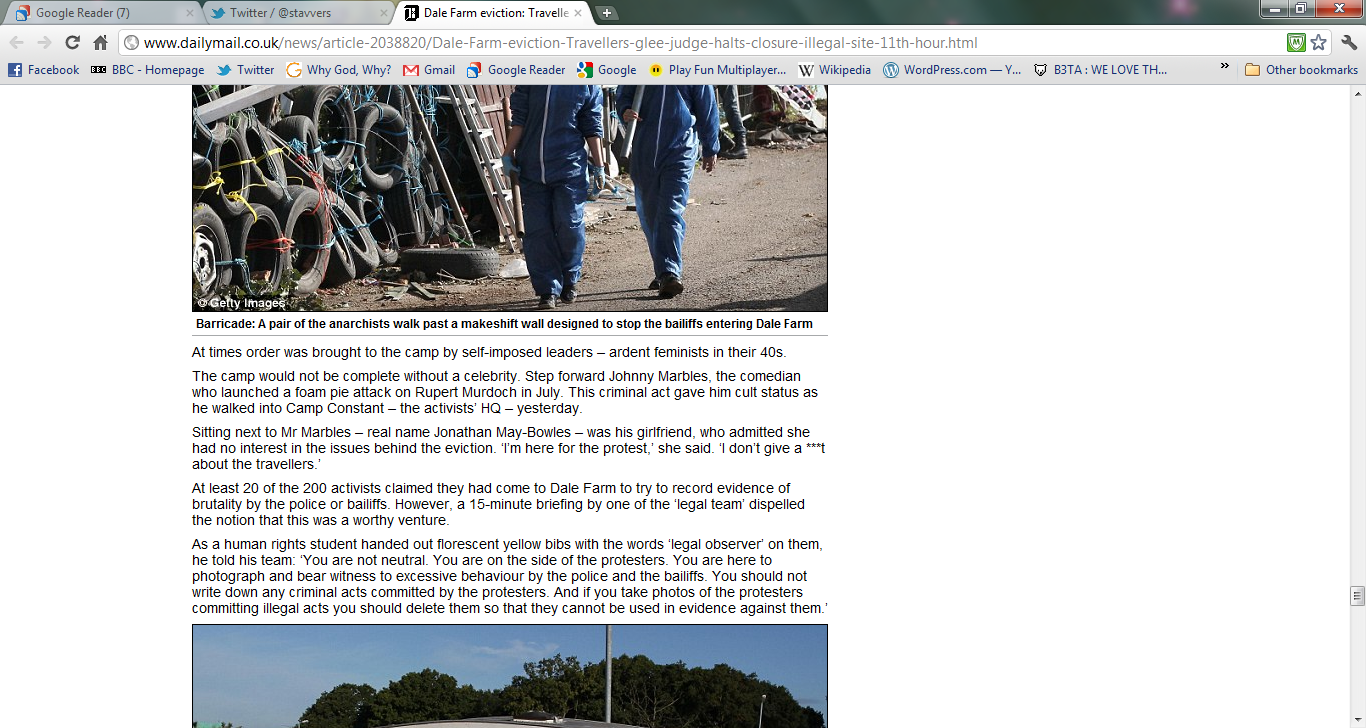
It is curious, then, that this porky pie appeared in the Daily Mail today. In a quote attributed to Ellen, she allegedly said “I’m here for the protest, I don’t give a shit about the travellers”. Here is a screencap of the offending quote; I will not link to the Mail.

Click for full size

Ellen doesn’t remember talking to a journalist and certainly didn’t–and wouldn’t–say anything of the sort. The quote appears to have been conjured entirely from the imagination of the journalist, Arthur Martin, whose journalistic oeuvre seems to be writing misleading articles about anarchists and travellers. It is hardly surprising that he fabricated a quote, then. The Mail seem to keep him on the books as the one who defames marginalised people and those with political opinions that differ from their own.

Martin made up the quote to suit the Mail’s agenda. It hardly needs saying that the Mail has a history of racism that skims the line just below overt. It suits the Mail to paint travellers as people who are not actually supported by anyone, their only friends being people who fancy a bit of a fight with the bailiffs. The quote Arthur Martin made up smacks of the prejudice that swirls within his own head, that prejudice that makes the Mail salivate for more articles.

It is also telling that he only named Ellen in relation to her boyfriend. The Mail aren’t exactly keen on her boyfriend, either, and relish at the opportunity to defame by proxy. Perhaps the quote was not attributed to Jonnie himself as due to his profile, they would be smacked down far more quickly? It may be an attempt to cover their arses when Ellen complains. Or, perhaps, it speaks volumes on how the Mail view women: girlfriends, without their own merits.

They sell Ellen short, they really do. Ellen is one of the smartest people I know. She has recently completed a Masters degree in Genocide Studies, and was very concerned that the Dale Farm eviction looked a lot like ethnic cleansing. She has talked a lot about this; perhaps the Mail didn’t fancy quoting something she actually said because it clashed so hard with their own agenda?

The Daily Mail is a vile rag full of vile lies. It is dangerous. For every lie they print we must kick up a stink. They cannot get away with this.

Other coverage of the story from Minority Thought and Nothing Special


Torchwood and queer stuff: the problem of immortality-AIDS

Spoiler warning: This post contains massive spoilers for the finale of the most recent season of Torchwood. It’s not really worth watching as it’s utter bollocks, but if you are planning on doing so and are spoiler averse, look away now. Also, be careful with clicking links. Some are TV Tropes links. 

Yesterday, I got round to watching the season finale of Torchwood. And I was absolutely flabbergasted by the unfortunate implications.

In a remarkably convoluted bid to fix the world, what needed to happen was for the blood of a mortal to hit the magical plot device on both ends of the earth at exactly the same time. For those in China, this was dead easy, as Captain Jack had veins swimming with the stuff. For those on the other side of the world, it was equally easy as due to some kind of improbably contrived bollocks, Rex had filled himself up with Captain Jack’s blood. Hooray! World saved! Everyone is mortal except Captain Jack. But wait–there’s still seven minutes left of the episode!

And in those seven minutes, Rex, who had been previously mortal, is shown to have become immortal, like Captain Jack. Now, aside from the fact that Rex is one of the most egregious Scrappies that has shat all over my screen in a long time, and I’m a little annoyed that he won’t be killed off any time soon, there is a problem with this plotline.

Rex “caught” immortality off of a blood transfusion. Immortality has always been seen in-show as something of a curse, something unpleasant, something that causes an undue amount of angst and is generally a blessing of suck. When The Doctor found out about Captain Jack’s immortality, he was disgusted by it and wanted nothing more to do with him. Even The Doctor is a little bit grossed out by immortality! Rex himself is absolutely furious about the development–he doesn’t want to be like Captain Jack. Oh, and did I mention that Captain Jack is a bisexual man?

Catching something shown to be terrible off of a blood transfusion from a bisexual man kind of smacks a lot of the AIDS scare in the eighties. At least Rex caught what Chris Morris delightfully calls “the good AIDS“. At least he didn’t catch immortality from bumming. Which, actually, raises an interesting point, and I hope Captain Jack is very safe during sex. Otherwise, who knows how many immortals there are wandering around?

Perhaps I am reading too much into this, as I have been reading rather a lot recently about the “gay plague” propaganda which was used to drive homophobia. The thing is, the latest series of Torchwood has already abundantly demonstrated that it is not the queer-friendly show it once was. I would not be surprised at all if they picked up this unfortunate implication and ran with it; Rex has already shown himself to be homophobic and highly hostile to Jack.

I miss proper Torchwood. I really do. It used to be my weekly fix of queer fun. Now it is homophobia, couched in plausible deniability.

While a chode syphilitically weeps

Brendan O’Neill is a weeping syphilitic chode, and it’s getting to the point where I wonder if he was invented specifically to piss me off.

This time, O’Neill has decided that Topman should be selling misogynistic T-shirts, and that feminists have no sense of humour. To answer the second charge first, here is a joke:

What’s the difference between Brendan O’Neill and a weeping syphilitic chode?

Nothing.

It might need some work, but it’s a damn sight funnier than the T-shirts in question, and that’s already one joke more than O’Neill’s opinion piece had.

Of the Topman T-shirts in question, one uses dehumanising language, and the other refers to male-on-female intimate partner violence. O’Neill doesn’t even bother talking about the dehumanising T-shirt, despite the fact that use of dehumanising language is pretty fucking dangerous, with real-world implications, and is literally just hate speech. To defend the other T-shirt, O’Neill attempts to wiggle about with semantics:

A young man could just as easily say the words “I’m sorry but I was drunk” to another young man, after an argument or a fight or something.

That could happen. But the whole “joke” of the T-shirt is that it refers to beating women. Without the stereotype it primes, it is no longer a controversial joke, and it simply becomes a checklist. Which is a fairly pointless T-shirt, all things considered. Consider, for example, a T-shirt that is laid out similarly that says “I hate you because… [] You run fast [] You eat a lot of fried chicken [] You always die first in movies”. Would this T-shirt be considered racist? I’d say so, but according to Brendan O’Neill, that T-shirt is fine and dandy.

O’Neill’s article also demonstrates that while a weeping syphilitic chode can write–presumably, with infected pus dripping from chancre to keyboard–a weeping syphilitic chode cannot read. O’Neill denies that there can possibly be any cultural explanation for violence. Now, while the extent to which the media influences violence is equivocal, what is clear is that there is some link. Discussion should focus on what action is acceptable to take, rather than whether the link exists at all. That’s where O’Neill really falls flat. He is so interested in flatly denying any link  he does not discuss this at all. And it’s an issue that warrants discussion–should Topman have pulled those T-shirts?

There are a number of issues which could have been discussed were O’Neill up for talking about Topman T-shirts, rather than working out his issues with feminists in a public domain (in general, he’s not keen on feminists, because they think he’s a prick). O’Neill touches on class, completely wrongly:

That’s because they are driven by the elitist belief that there are some people out there (whisper it: working-class lads) who cannot distinguish right from wrong and therefore must have their eyes and ears protected from poisonous words.

Now, here, O’Neill is wrong on several counts–and he can’t help it, seeing as he is a penis that is wider than it is long, infected with The Great Pox to the extent that he oozes unpleasant fluids. Topman is not a shop for working class people: its goods are far too expensive for that. Furthermore, those T-shirts are indicative of hipster irony, a subculture which once again is not associated with working class people. This analysis is completely off.

Capitalism could legitimately be brought into this discussion: ultimately, these T-shirts were pulled not because of feminist censorship, but because of good old-fashioned brand damage. Topman didn’t want to lose customers, so they decided to pull the T-shirts, as they realised the products were somewhat controversial in the sort of way that could lose them a lot of money. Essentially, it was not the feminists who censored free speech. It was Topman making a decision in their corporate interests.

For what it’s worth, I want people to be free to wear this sort of T-shirt. It is a nice little at-a-glance indicator that the person wearing the T-shirt is an interminable cuntspanner. I would like them to do, as O’Neill suggests, a “blokestrut” wearing such T-shirts. One thing I would change? The name.

I think a “chodeweep” is much more fitting.


Suing LSE for discrimination against men is silly and wrong

I am sure many of you will have seen the press about a man suing LSE as he believes their Masters course in Gender Studies discriminates against men because the taught materials do not focus enough on men’s issues. Unsurprisingly, I think this case is completely silly.

There are a number of issues that make this case thoroughly ridiculous. The notion that a man is complaining about a woman-heavy focus in a gender studies course has been covered well elsewhere, and I do not have much to add to this issue. Another very noteworthy point is that it is hard to see how this is actually “discrimination”. LSE point out that as men and women had equal access to both the course and the key readings, no direct gender discrimination took place. This point is expanded here.

Many have already covered the important points, so I would like to add something from my own perspective. Basically, I wonder, what the fuck did Tom Martin expect from a Masters degree? From everything he has said on the matter, it would appear that what he wants is for a course to spoon-feed him information, for every lecture and seminar to provide a constant drip of knowledge with absolutely no independent study. The source of his complaint appears to be that the reading list did not consist of articles and theory that he wanted to read.

Well, Tom Martin, here’s some big news: that’s not how Masters degrees work. They’re hard work, because you’re supposed to read around the issues. The taught components of Masters degrees–lectures, seminars, reading lists–are a suggestion: a possible starting point. Everything else is entirely up to the student. In my Masters, I ended up conducting my research project and dissertation on a topic we had not been taught at all, nor had it been in any of the reading lists. But am I suing UCL for discrimination against the Implicit Association Test? Of course not. That would just be silly.

A solution to Martin’s problem is simple, and what is generally expected of a Master’s question. If Martin believes that there is some sort of systemic bias against men, or that the gender studies literature is lacking in its discussion of men’s issues, he should write his dissertation about it. Essentially, that’s what academia is all about: one reads, one identifies gaps in the literature, one researches, one plugs the gap. The dissertation Martin didn’t write could have been really interesting. It could have been worthwhile. It could have been brilliant.

Having checked out Tom Martin’s Twitter feed, @sexismbusters, an interesting picture emerges. Martin does not seem to be engaging in debate: rather, if someone tweets at him with a point with which he disagrees, he will generally respond with the cerebral argument of “if you hate equality, go to Yemen”, or requests to donate to his legal fund. There is no actual discussion of points–valid points, which should be addressed. Likewise, Martin wrote an article in the Guardian’s CIF, which he claims to show that there is systemic male bias, particularly in LSE’s Gender Studies course.

Unfortunately, the piece has all the intellectual rigor of a toasted tea cake. Martin falls prey to accidentally turning his whole argument fallacious by declaring texts “never” discuss misandry–which can be neatly popped by just one academic article about misandry (of which, of course, there are loads). Martin also makes repeated unreferenced assertions about things “the research” allegedly shows. When a reference finally appears, it is to a video on Youtube uploaded by a user called TheHappyMisogynist. The video appears to be based on a single academic paper, which Martin himself was clearly unable to critically appraise: he claims the paper shows that women are more likely to be violent against men in an intimate partner situation. What is actually shows is that this is the case in a certain type of violence among a certain population group, assessed by self report, is more commonly initiated by women.

With an ability to construct an argument like that, Martin probably should be suing LSE. Their teaching of academic skills appears to be deeply flawed if a few “if you like it so much, why don’t you go and live there” tweets and a very shonky, short article are all one of their former students is capable of doing.

It is hardly surprising, then, that rather than take the intellectual route and write a simply blinding, groundbreaking dissertation on gender dynamics in gender studies courses, Tom Martin has decided to hide behind the skirts of litigation. I don’t think there’s much else he can do.

Polyamory: the solution to literally everything!

Warning: This post will contain spoilers for True Blood up to the end of season 4, the most recent episode of Doctor Who, Battlestar Galactica and Caprica.  The spoilers do not pertain to anything crucial to the content of the shows, but some people are incredibly spoiler-averse. Also, most of the links in this piece will lead to TV Tropes, so here’s a courtesy warning that if you click any links, you might lose an afternoon.

Sometimes, I shout at the TV. Scratch that. When I am watching TV, I am usually shouting at it at some point. Often it’s at characters waving around an idiot ball or a plot hole I could drive a bus through (and I’m terrible at driving) or a particularly egregious lack of research which leads to ridiculously bad made up science and nothing making a tiny ounce of goddamn sense.

I do not suffer fools gladly. Despite this, a lot of my shouting tends to be loudly offering solutions to a problem.

This week, I watched two TV shows which made me think. The first was Doctor Who, which featured two copies of Amy, one who, due to some magic timey-wimey that I tend to forgive Doctor Who for, happened to be forty years older. At one point, it looked like older Amy would be travelling with our regular characters, and Amy’s husband Rory was struggling to come to terms with having two wives. The choice was rendered moot by said timey-wimey magic. The second was the season 4 finale of True Blood, which saw the love triangle between Sookie, Eric and Bill come to a head. Throughout the season, there had been an exploration of the idea that Sookie was in love with both Eric and Bill, and both Eric and Bill were in love with Sookie. There was even a dream sequence in which the three worked out ways to make this relationship work. Unfortunately, this plot was not resolved in this way. Instead, Sookie decided, rather boringly, to choose neither of the buff, hunky vampires.

Both of these plotlines had something in common: polyamory was explored as a genuine solution to the issues at hand. In Doctor Who, Rory took the idea that he would have two copies of the same wife in his stride, and seemed fairly comfortable with the situation. It was only temporal paradoxes that forced him to make the choice. In True Blood, Sookie’s dream sequence displayed how happy she would be with the idea, and in a later scene in the finale, both Eric and Bill seemed fairly comfortable with feeding from Sookie at the same time.

Of course, mainstream TV is never going to actually propose that polyamory can be a good solution for these plotlines, despite the fact that it is. Being poly is, sadly, still a marginalised way of being, so it is still largely invisible in the mass media.

I can think of one TV programme I have watched in which poly characters are represented. In Caprica, Sister Clarice lives in a group marriage with several husbands and wives, in a house full of children from various combinations of the family. She sleeps in a large bed with some of her spouses. It seems idyllic, until it turns out they’re all crazy religious terrorists.

What we have is TV representing largely heteronormative relationships, and almost exclusively monogamous relationships. Tropes abound from this: characters having to “choose” which potential suitor they want, characters breaking up and making up to allow various permutations of the cast to hook up, cheating lover drama, and the nightmarish love triangle scenario. Drama springs from allowing shows to remain monotonously uniform in their portrayal of the default option of monogamy.

And here’s the thing: I’d rather do without all that drama. I do without that drama in my day to day life, and frankly, I’m sick of seeing all this “you must choose between him or me” bollocks on TV, when it’s perfectly easily resolved by applying poly principles and working out some easy way for everyone to be happy and loved up. I don’t want to see Buffy moping over whether she should choose the sensible, good bloke or the rakish bad boy. I want to see her killing monsters. I don’t want to see some sort of horrible quadrangle sexual musical chairs eclipsing all the cool blowing up robots in space.

For an example of how much better things would be if polyamory was actually visible on TV, I will rewrite part of the third season of Battlestar Galactica, in which two married couples, Lee and Dee, and Starbuck and Sam spent much of the season taking up vital screen time with their affairs.

SCENE: Officer’s quarters

LEE: Dee, I love you very much, but right now I am suffering from some serious unresolved sexual tension with Starbuck. You know that we’ve sort of been flirting for a while, but we never got down to it because she was engaged to my dead brother.

DEE: I feel a little bit upset by this, because I love you very much.

LEE: And I love you very much, Dee. Love doesn’t divide, it multiplies.

STARBUCK: Damn right. I’m madly in love with my husband Sam, but I am also subject to this attraction with Lee. I think I’ve noticed Sam checking you out, Dee, because you’re very beautiful. By the way, even though I’m passionate about Lee, I have to say it’s nice how happy he is with you.

DEE: Thank you. Sam, is this true?

SAM: Yes. I am dull and uncharismatic, but I am also hot. I think your attraction to me is probably physical.

STARBUCK: I love you, honey.

SAM: Blah blah meh, I am so dull and uncharismatic, but I love you.

LEE: Let’s not forget that I’m a really annoying character.

DEE: Oh no! DRADIS says we have incoming Cylon raiders in half an hour!

STARBUCK: Are you psychically connected to DRADIS or something?

DEE: Yes. That doesn’t matter. In about half an hour, we’re going to have a huge epic space-battle.

LEE & STARBUCK: AWESOME!

SAM: Half an hour, you say? Time for a quick orgy!

END SCENE, CHARACTERS NAKED AND RUTTING

And that would have completely improved season three if all of the characters had just been honest rather than having an interminable few months of whinging about their marriages.

Of course, I do not expect to see any positive portrayals of poly relationships on my television in the near future. Consider how long it took for anything close to positive portrayals of queer people and relationships to appear: this 50-minute video showcases just some of the homophobic jokes that popped up in Friends over its run. For the time being, any poly relationship is doomed to fail: the mainstream media lags behind society, and society is only just beginning to learn of the possibility of loving and fucking more than one person.

For now, we’re stuck with monogamous TV, and all the rubbish tropes it brings with it.
A lack of oppression is not what caused the riots

A lot of the discourse surrounding the recent riots has focused on a very individualist perspective: bad people, wrong people, criminals. This analysis is at the expense of examining systemic problems–the role of poverty and deprivation, provocative policing, rampant consumerism.

Then there is this article: “How our race taboo makes us colour blind to the truth” [clean link; this does not deserve clicks]. Here, the author examines systemic causes and concludes that what we need is more racism and more patriarchy. The whole thing is enough to leave one shaking with rage. It is a torrent of hate, a portrait of pure prejudice. It’s also completely wrong. The author appears to exist on a completely different plane of existence to reality.

Perhaps the most astounding element in the television coverage of the riots over much of England has been the steadfast refusal to mention the race of most of the rioters.

Except everywhere. The television and the news reports perpetually make reference to race, both in dog-whistle terms and overtly, gratuitiously mentioning “a mixed-race girl”, “a black boy”.

They are clearly, and overwhelmingly, Afro-Caribbean, the descendants of immigrants, though such has been the utter British failure to integrate so much of the immigrant population that many have retained something of a Caribbean accent. Admittedly, not all of the rioters are ‘black’: clearly, some white youths have joined in.

According to the writer, young white people are being lead astray by the bad immigrants with their strange way of speaking. The casting of white people as passive rather than active agents is clearly deliberate: the writer is so hell-bent on pushing the race angle that he needs to handwave away the existence and participation of white people in the riot.

After this, there is a brief anti-feminist, sexist interlude:

An astonishing number of young males in London are the sons of single mothers. They have been raised without the presence of a male authority figure to impose familial order and, furthermore, and most vitally, to promote the patriarchy.

Contrary to what the feminist mantra of recent decades has proposed, the patriarchy was not invented to oppress woman, but devised by Abraham to control men.

Let us ignore the batshit notion that rioting is caused by Not Enough Patriarchy for a minute. What I suspect the author is driving at here is the notion of children obeying their fathers, which is what is proposed in the Bible. This is, strangely for the Bible, actually not gendered. Patriarchy was devised to control. Not to control men, but to control everyone. And it does. 

The riots, though, I do not think can be blamed on the patriarchy–presence or absence thereof. Gender and gendered oppression does not seem to play as much of a role as poverty here.

Adolescent males, without an imposed order, are as feral as chimpanzees. This is why all societies have adopted rigorous means of imposing authority on teenage boys.

Recall that merely a few paragraphs ago, the author was blaming the rioting on race: now he is comparing rioters to chimpanzees. The use of this word, again, is likely deliberate: a piece of dehumanising language typically applied to people of colour. The second sentence is thoroughly unreferenced, and I doubt that the author is an expert in comparative anthropology. Certainly, this effect is not considered a cultural universal.

Using logical leaps, the author then continues his tirade against single mothers, declaring them to be “incentivised” by benefits and asserting that it is wrong that women can bear children without being married. It is a hate-filled assertion, thoroughly steeped in patriarchy; consciously so. The author believes patriarchy to be the thing that was missing in the world.

Following this, the author bends reality to suggest that the immigrants coming over here and taking our jobs is another problem which caused not just rioting but also the financial crisis. Once again, this seems to be all a thin veneer over personal hatred: it is not backed up by evidence, simply by assertions.

In short, what happened here is an attempt at a systemic explanation of what happened this week which bends everything towards hate. In the author’s world, black people are feral, and the Polish are somehow to blame. In the author’s world, feminism has won and broken everything. It is nothing but bigotry, this article: these claims carefully flutter on the covert side of prejudice, yet are riddled with it.

It must be hard, being the person who wrote this article, with such hatred for all but white men.

Data confidentiality: do not fill in the Guardian riot survey.

Following yesterday’s riots in Tottenham, the Guardian has launched a survey to seek further information about what happened. It is spun as an attempt to understand why the riots took place following in a rich academic tradition of post-riot interviewing.

If you were in Tottenham, do not fill in the survey. 

Here’s the thing: with academic research, there are certain rules surrounding how survey information is used. Before one does a survey, one has to apply for ethical permission and fulfil criteria to make sure that the data stay confidential, with those who provided it remaining completely confidential. This means that research surrounding sensitive issues such as illegal activity can be gathered without putting the participant at risk. On the flip side, it means more honest responses which will help researchers gain a better understanding of the issue. What is collected in academic surveys is completely unidentifiable. It’s research ethics.

The Guardian survey does not do this. 

There is no guarantee of confidentiality to be seen. Information which could possibly lead to the arrest of the survey participant or acquaintances with no guarantee of any safeguards. Given that political policing and political sentencing are so prevalent these days, it is not safe to fill in this survey. Given that the phone-hacking scandal has exposed that it is almost commonplace for information to exchange hands between journalists and police, it is not safe to fill in this survey. You may land yourself in trouble. You may land your friends in trouble.

Show solidarity. Stay safe. Do not fill in the survey.

Unseen sexism and journalistic misinterpretation of a research study

I seem to have reached the point where people send me things that will piss me off enough to blog about. Today, Nat sent me this: “Feminism’s misdirected targets”, a Guardian article

The article reports a research study called “Seeing The Unseen“, which is about attention paid to everyday sexism. The paper aimed to investigate whether people who were more likely to endorse benevolent sexist or modern sexist beliefs did so because they were unaware of sexist behaviour around them. The paper is open-source and, in a pleasant subversion of expectations, is actually linked in the Guardian article. At face value, it would almost appear as though the journalist had read the research paper, which is as much to be expected given that it is a freely-accessible paper.

However, I don’t think Jennifer Abel did read the whole paper. Abel gleefully takes apart a measure used in the study:

But the study didn’t ask women to seek sexism in discussions about women’s proper roles in marriage, combat or any other positions. Instead, it asked women to note:

“[If they] observed a man helping a woman with a task because he assumed that, as a woman, she should not have to grapple with it (eg, long drive, selection of a new laptop, carrying shopping bags).”

This is not true. It says, as clear as day in Table 1 of the article, what was measured. Among these things are hearing traditional stereotypes about women, heard traditional beliefs about relationships, heard paternalistic stereotypes about women, and witnessing traditional or paternalistic treatment of women. How this does not translate as seeking sexism in discussions about women’s proper roles in marriage, combat or and other positions, I do not know. Perhaps Abel didn’t look at the table. It is also worth noting that many of these observations are lifted directly from the gold-standard measure of benevolent sexism.

The measure Abel does report is not perfect, and I do wish the authors of the research paper had provided more context as to why these incidents were selected. It is a worthy critique based upon what is otherwise a fundamental misunderstanding of the research.

For the rest of the article, Abel builds to the thesis that feminism is targeting the wrong kind of sexism, and we should focus our energies on more hostile forms of sexism. This is erroneous on two fronts. Philosophically, it buys into the myth that one should only focus on one fight at a time rather than using all tools in the box. Scientifically, it is also wrong: benevolent sexism has real-world implications for women. Fighting benevolent sexism is therefore not a “misdirected target”. It is a valid target, a source of oppression. To say that it is misdirected is plain wrong.

Furthermore, there is some confusion in the article about Abel’s beliefs. Towards the beginning, she (incorrectly) outlines the journal in which the journal appears*:

in the current issue of Psychology of Women Quarterly. (Speaking of sexist beliefs, there is the idea that any questions about my psyche can be answered “Because hers is a woman‘s mind.”)

Yet later in the article, Abel says:

Even if humanity builds the feminist utopia of my dreams, there will still be certain traits more common in one sex than the other. I suspect, for example, people who choose careers working with young children will always skew overwhelmingly towards females.

Which one is it? Is it that men and women are fundamentally different in their minds, or is that untrue? The answer to that question is that it is untrue, which Abel touched upon at the beginning of the article and then changed her mind. Apparently she did not read Delusions of Gender.

Abel ends by saying that feminism has been hijacked by fundamentalists, feminists who believe benevolent sexism to be a major problem. It is a major problem. The evidence behind it suggests it to be a major problem. Abel clearly did not read this evidence.

One can hardly blame her; Abel is, after all, a journalist without scientific training, and a lot of the literature is paywalled. This is a shortcoming of science: how can journalists be expected to report adequately on an area of research if they cannot access some of the pertinent research? Furthermore, how can the piece be expected to accurately report when the piece was written by someone unfamiliar with reading research papers, then edited by someone unfamiliar with reading research papers, then published by someone unfamiliar with reading research papers?

It is a shame that even decent, doing-it-largely-right science reporting is still so poor. Every time it is in the media, misconceptions about benevolent sexism crop up, with the “but it’s not a valid target” being the most frequent response.

Science-types are traditionally quite rubbish at engaging with the media, and media-types are traditionally quite rubbish at engaging with science. I wish that more were involved in both. Perhaps, then, we would see accurately-reported research.

__

*In fact, Psychology of Women Quarterly makes no claims to cover the psychology of all women, any more than the discipline of women’s studies claims to understand every single woman ever.

The socialist feminist dystopia, and why I’d like to live there

According to some, we ought to lay down our tools. The fight for social justice has been won, and the world is now ruled by feminists and socialists according to politically correct principles. It says so in a book:

‘Buchanan’s Dictionary of Quotations for Right-minded People’ has been edited by a writer in the USFR, the Union of Socialist Feminist Republics (1997), formerly the United Kingdom. The book is for people who are tired of living in a country run in accordance with socialist, feminist, and politically correct principles.

Don’t just take the word of a (possibly vanity-published) book. Richard Littlejohn also thinks so, as does pretty much every other right-wing columnist. Even the Norwegian murderer seems to believe that social justice is on top.

I am entirely unsure as to why this rag-tag band seem to think that this could possibly be a bad thing. Imagine a world in which there was gender equality. Imagine a world where there was racial equality. Imagine a world where every single person had the same opportunities in life. In this world, the word “equality” would be unnecessary, as individual differences would be meaningless and irrelevant. In this world, any person who got sick, or was born with special needs would have the same access to the same care and nobody would begrudge this. Every person would be seen as a person. There would be no genocide as there would be no hate. There would be no class war, as class would be a historical curiosity. There would be no rape, no sexual coercion, as all would understand principles of respect and consent.

Demonstrably, we do not live in this world, and that’s a real bummer as it would be absolutely fucking brilliant. It would be about as dystopian as being trapped in a room made out of chocolate and having to eat your way out, being greeted on the other side by a fluffy pile of hypoallergenic kittens that shat rainbows.

There are two questions here, then, and the answers to both are related. Why do some believe we live in a world run by feminists and socialists? And why do they think it is a bad thing?

The answer, I think, is because these people construct life as a zero-sum game. These people believe that they were born special and that nobody can take that away from them. To point out that they are wealthy and powerful by an accident of birth rather than anything else is inherently threatening to them. They look down on others–people born the wrong gender or race or sexual orientation, and are frightened that they are only a few genes away from oppression.

Equality is scary, and any moves to equality are terrifying to those who believe in the socialist-feminist dystopia as that would take away their special status, stripping them of the wealth and privilege that allow them to look down on their fellow human beings in disgust.

Letting go of the hate and fear, embracing a world where they were just like everyone else would be beneficial to them. Equality benefits all–that is why it is called equality. 

We are nowhere near that point. And I am trapped with the curious feeling that it might be quite nice to live in Richard Littlejohn’s brain.