How To Be A Woman: in which I review a book that I read

I have just read Caitlin Moran’s How To Be A Woman, a semi-autobiographical book which has been hailed as The Next Big Thing in feminism, and has received rave reviews from noted feminists such as Jonathan Ross and Nigella Lawson. On the back, it says that Moran “rewrites The Female Eunuch from a bar stool and demands to know why pants are getting smaller”. Overall, it seems exactly like something an angry feminist such as myself should despise with all of the burning fires of hell.

The short review is that I didn’t hate it. I only hated some of it, actually quite liked some parts, and the rest only left me with a bitter tinge of disappointment.

The writing style veered from engagingly, chattily conversational to annoyingly CAPSLOCKY and RIDDLED! WITH! EXCLAMATION MARKS! It is easy to tear through, in the manner of a sunlounger bonkbusting tome, and I found myself rather liking Moran: she has a good sense of humour and an honesty about her own flaws.

Moran is absolutely spot-on about some issues, and I found myself nodding in agreement in sections on pornography and lapdancing, where Moran argues that while there is nothing inherently wrong with fucking on film or stripping, but it is a problem with the industry. I also very much liked her discussion of what to call one’s cunt (Moran favours “cunt”, but was reticent to teach it to her daughters as it is still a taboo word), and her very frank account of her abortion and her suggestion that this is something we should talk about honestly and openly, and it is all right to feel good about having had an abortion. Moran also puts across good points about society’s expectation about how women should want babies, and this is not right, and not reproducing is perfectly all right, too.

This last good point, though, is sullied by a massive clanger. Talking about childbirth, Moran says:

In short, a dose of pain that intense turns you from a girl into a woman. There are other ways of achieving the same effect–as outlined in Chapter 15 [the chapter on abortion]–but minute for minute, it’s one of the most effective ways of changing your life.

Right there, Moran has declared that use of one’s reproductive organs is the only way to truly become a woman. This line of reasoning is a minefield: it automatically writes off the experiences of infertile cis women, of trans women, of cis women who have been fortunate enough with contraception never to find themselves pregnant. It jars with the rest of the book, the “anything goes” approach, yet it says it there as clear as day. Reproduction is the only path to womanhood. Before that you’re a girl.

When I read that paragraph, I considered rethinking my embargo on burning literature and setting fire to that book there and then. I decided to plough on. Perhaps Moran did not mean what I thought she had meant. Indeed, this is never mentioned again. I still cannot think of another way to interpret that sentence, though.

No other individual part of the book is quite so starkly, shockingly problematic: much of the rest of my issues with it lie in the tone. It smacks of privilege: an amusing point-and-laugh at the working classes here, a throwaway usage of ableist language (“retard”, “thalidomide pasties”) and fat-hating (Moran draws the distinction between “fat” and “human-shaped”) there, and a sort of vaguely patronising view of gay men as nothing more than arbiters of excellent taste in music bars. I prickled in rage each time I saw these.

This privilege also fans out into what is part of the central thesis of the book: that perhaps everything would be improved if we treated humankind as “The Guys” and sexism as “just bad manners”. For a woman in Moran’s position, perhaps this is possible. For many, it is not, and sexism is not dead, and is unlikely to be killed without confronting it head on. I take umbrage to her phrasing viewing everyone as “the Guys”, too, particularly as it jarringly occurs pages after I had been smiling in agreement at Moran’s acknowledgement that men are viewed as “normal” with women as the other. This hypocrisy goes unmentioned, perhaps unnoticed by the author.

The thing is, for much of the book, I was not angry. I was just disappointed. Firstly, Moran seems to have a confused relationship with feminism and feminists. She identifies as such, and, indeed, encourages her readers to identify as feminist as it is not a dirty word. This is laudable. Unfortunately, Moran seems to have a rather dated view of feminist writing, falling back frequently on Germaine Greer as though this is the only feminist she has ever read, and beginning statements with “feminists think”, then falling back on to a straw feminist trope. While Moran wishes fervently for more women to identify as “strident feminists”, the book itself is not particularly stridently feminist.

Most of the issues discussed in the book were very trivial concerns. An inordinate amount of space was dedicated to clothes and shoes and bras and knickers. Rape is given a cursory mention in one sentence somewhere. At no point in the discussion of whether marriage is necessary was it acknowledged that perhaps romantic relationships or traditional monogamous relationships may not be necessary either. The truth is, it all feels a little superficial: talk about handbags is favoured over broader feminist issues. For many women, after all, there are a lot of things more worrying than pubes or ill-fitting knickers.

Take, for example, a point where Moran recounts the story of having met Jordan and being struck by how obsessed Jordan was with selling things and selling herself as a brand. At this juncture, it seems like a fairly obvious place to segue into discussion of the relationship between capitalism and feminism. Instead, Moran just tells the story, then contrasts it with meeting someone whom she considers to be a genuine feminist icon: Lady GaGa.

I sometimes wonder if perhaps Moran knew she could have done this. Much of the book seems to be driving at good points which are never made. Perhaps the editor of the book cut all of the good bits out? Certainly, the editing of the book was poor; I noted numerous typos and the editor was very lenient about allowing all of the CAPITALS and ENHUSIASTIC! PUNCTUATION! to stay in. As I said earlier, I rather like Moran, and I wanted this book to be better than it was.

In the conclusion to the book, though, it becomes abundantly clear that Moran’s feminism–at least, as presented– is shallow, bourgeois feminism, concerned with consumerism: just don’t buy the things you think might be oppressive, is her message. I was thoroughly disappointed by this message. I had hoped for much better, much more. I had hoped for depth.

If this book is our generation’s The Female Eunuch, as it says on the back cover, we are well and truly fucked. The good news, is, I do not think we are. This book is not harmful, it is simply trivial, inconsequential fluff. It is something to read on holiday, and then forget about once the tan has all peeled off. Had the book ended with a list of other (better) feminist books and resources to check out, I would probably see it as a decent, readable, primer to feminism for those who had never thought about the issue before and may be inclined to learn more. It may have also been improved vastly by shaving out the patronising bits and replacing them with something vastly more substantial.

As it stands, though, it is just fluff. This book will not change the world, for better or worse. For that, I am thoroughly disappointed.
I cannot believe this shit needs to be said

Trigger warning for rape and systemic abuse of a rape survivor

There are, apparently, “major holes” in the credibilty of the woman who alleges she was sexually assaulted by Dominique Strauss-Kahn.  A powerful man, Strauss-Kahn can afford a powerful legal team, and they have been working at full capacity.

The forensic evidence shows sexual contact did occur, so they have attempted a different method of defence: smearing the alleged victim. She is said to have lied on her application for asylum and spoken to an incarcerated drug dealer on the telephone following the alleged attack. While the legal team are deny being behind the rumours that the woman was a prostitute, they are certainly not doing much to stop this being splashed all over the tabloids.

I do not know whether Strauss-Kahn attacked the woman or not (please note: she is a woman, not a “maid”).

What I do know is that undermining the credibility of the witness says nothing about whether Strauss-Kahn attacked her or not.

Her immigration status and her alleged contacts are thoroughly unrelated to what may or may not have happened in that hotel room. Someone whose immigration status is dubious can still be raped. Someone who knows a drug dealer can still be raped.

Yet this is treated as though it is exonerating evidence. It is thoroughly unrelated. Immigration status does not indicate consent. Knowing a person in prison does not indicate consent. This cannot show that the sex was consensual.

I cannot believe anyone needs to say this shit. It should be patently obvious that these two characteristics of the woman are not related to the alleged crime. Yet this sort of thing is used in courtrooms repeatedly: unrelated facts which supposedly prove innocence. A woman’s clothes, her prior sexual behaviour, her job. These things are not consent. They are not relevant.

Another woman has come forward, also accusing Strauss-Kahn of sexual assault. By his defence team’s logic, this means he is guilty as sin. In this case, at least a prior allegation of sexual assault is dimly related to the notion that he may have committed sexual assault. Of course, it is not relevant.

Immigration status and incarcerated friends are thoroughly irrelevant.

Brendan O’Neill is still a weeping syphilitic chode

Brendan O’Neill–last spotted declaring short skirts to be a “definite sexual invitation“–has done it again. This time, O’Neill has decided that the best thing for everyone would be for sexual abuse victims to keep their mouths shut about it.

In a stunningly dismissive opening, O’Neill asks:

If you were sexually abused by a Catholic priest nearly 50 years ago, and that priest was now dying or dead, would it not be wise to keep it to yourself? This awkward question invaded my mind as I watched last week’s BBC1 documentary Abused: Breaking the Silence. It featured mature, respectable and successful men recounting in eye-watering detail what was done to their penises by priests at a Rosminian boarding school in Tanzania in the 1960s. We were meant to be shocked by the alleged foul behaviour. I found myself more shocked by the willingness of these otherwise decorous men to make an emotional spectacle of themselves.

O’Neill, here, states that he is more shocked by men speaking out about abuse than he is by the abuse itself. He is more shocked by men displaying an emotional reaction to trauma than by the trauma itself. Such a reaction is, frankly, terrifying. Where is the empathy? Instead, O’Neill is a little more worried about having to hear about their abuse and the fact that the men involved may have been more than a little bit fucked up about it.

To his credit, O’Neill concedes that it was a terrible thing that the Catholic Church knew about the abuse and did nothing about it. This is secondary, though, to O’Neill’s main point: that this sort of thing shouldn’t be talked about. And that he cannot tell the difference between a decade and a century.

Yet at the same time as we rightly question the morality of a religious institution that seeks to cover up sexual abuse, we are also at liberty to ask about the motivations of those who reveal the details of that sexual abuse almost half a decade after it is said to have occurred. Why now? Why go on BBC1 in 2011 to tell a million viewers about something that was allegedly done to you in 1964 or 1965?

The rest of the article repeatedly rephrases this question, dotted with the declaration that the media has an obsession with people recounting trauma.

I agree with O’Neill that the media does have a ghoulish fascination with horrific tales which it replays in gleeful, pornographic detail. However, O’Neill conflates this with abuse victims speaking out, and presents his argument in the most astoundingly disdainful manner.

The trend for inviting Catholic men in their fifties and sixties to redefine themselves as mental victims of childhood experience is even more pronounced in Ireland and America. In Ireland, the state has explicitly invited its citizens to reimagine themselves as the hapless, unwitting victims of warped Catholic authority.

O’Neill’s contempt for abuse victims speaking out extends to state-led enquiries, and, according to O’Neill, the investigation made people who had experienced something reimagine themselves as abuse victims. Perhaps, before the state investigated abuse, they had thought that being sodomised by someone in authority was a perfectly ordinary part of Mass.

The fact is, if abuse victims are willing to speak out, they have every right to. In the case of the Catholic Church, it is particularly important to hear the voices of the victims: this is an institution which has systematically covered up institutionalised abuse of children–particularly young boys–for decades at the very least. Those who are in a position to do something about this, the bishops, the cardinals, the Pope himself, are thoroughly unwilling to put an end to this. The Vatican has refused to hand over documents regarding abuse to the police. The usual channels are powerless to bring justice for this abuse in the face such a cover up.

So people speak out. And they might do so over the television. It is the only way for their stories to be told, for the small chance that perhaps something may happen to prevent another generation of children suffer as they did. The public become outraged and, perhaps, more mistrustful of priests. With sufficient pressure, perhaps justice can finally be served.

Brendan O’Neill does not care about this. In his devastatingly simplistic analysis, all he wants is for these survivors to shut the fuck up and get off his telly.

Avoid condoms. Spunk makes you happy, apparently.

From the magazine that brought you “black women are ugly because they’re fat, stupid and manly” comes a shower of fresh herpetic pus.

The title alone is thoroughly awful: “Attention, Ladies: Semen Is An Antidepressant“. It is steeped in various societal expectations regarding women and sex: women don’t really like semen, and it is up to the men (and male columnist) to persuade them otherwise.

The science is equally shaky; the column itself links three thoroughly unrelated concepts.

It begins with a discussion of the McClintock Effect, the phenomenon where women’s menstural cycles sync when they live or work together, which is apparently due to pheromones (which may not even exist in humans) (and the evidence for the McClintock effect is fairly poor in and of itself) (basically it’s bollocks). According to the article, the phenomenon does not occur in lesbians, and it is posited that the only difference between heterosexual women and lesbians is exposure to semen.

This assertion is complete rubbish for a number of reasons, and I promise I am not oversimplifying the text of the article. It actually says this:

But at the State University of New York, two evolutionary psychologists were puzzled to discover that lesbians show no McClintock effect. Why not? Gordon Gallup and Rebecca Burch realized that the only real difference between lesbians and heterosexual women is that the latter are exposed to semen.

The absence of a scientifically-dubious effect in lesbians is due tolesbians being unexposed to semen. There is no mention of the existence of bisexual/queer women, and absolutely no critical thinking regarding whether there are other lifestyle differences between lesbians and heterosexual women.

Furthermore, they put this ridiculous assertion into the mouths of the cited evolutionary psychologists who published the semen-is-an-antidepressant paper. They wrote nothing of the sort in the original paper (sadly paywalled). Quite what lesbians and their lack of a dubious effect has to do with semen as an antidepressant is unclear, but it speaks volumes about the quality of science reporting in Psychology Today.

I read the whole paper. I had to find it myself, as Psychology Today cited an article in a popular science magazine, outright admitting to churnalism. It is entitled “DOES SEMEN HAVE ANTIDEPRESSANT PROPERTIES?”. Psychology Today summarised it as this:

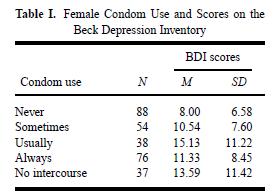
Given vaginal absorptiveness and all the mood-elevating compounds in found in semen, Gallup, Burch, and SUNY colleague Steven Platek wondered if semen exposure might be associated with better mood and less depression. They surveyed 293 college women at SUNY Albany about intercourse with and without condoms, and then gave the women the Beck Depression Inventory, a standard test of mood. Compared with women who “always” or “usually” used condoms, those who “never” did, whose vaginas were exposed to semen, showed significantly better mood–fewer depressive symptoms, and less bouts of depression. In addition, compared to women who had no intercourse at all, the semen-exposed women showed more elevated mood and less depression.

Meanwhile, risky sex is usually associated with negative self-esteem and depressed mood. Among college women, risky sex includes intercourse without condoms, so we would expect sex sans condoms to be associated with more depressive symptoms, and more serious depression including suicide attempts. However, in the Gallup-Burch-Platek study, among women who “always” or “usually” used condoms, about 20 percent reported suicidal thoughts, but among those who used condoms only “sometimes,” the figure was much lower, 7 percent, and among women who “never” used condoms, only 5 percent reported suicidal thoughts. (This study controlled for relationship duration, amount of sex, use of the Pill, and days since last sexual encounter.) So it appears quite possible that the antidepressants in semen might have a real mood-elevating effect.

The first paragraph is largely correct: 293 women were surveyed, using the Beck Depression Inventory (BDI), which is a self-report questionnaire designed for screening for depression. The BDI is limited in its utility as it is a self-report measure, and it also contains a mixture of physical and emotional symptoms.In samples of college students, the BDI may not necessarily measure depression, but rather, general psychopathology, meaning that in this study, the authors may not have been measuring depression, and therefore it is not possible to conclude that semen has antidepressant qualities as depression has not been measured.

The second paragraph is rather misleading. The authors did not control for any of the variables that the article said it controlled for. The results section of the original paper is what can only be described as a clusterfuck of various correlations, none of which actually include controlling for anything. The women differed on many of the variables, for example, on frequency of intercourse (the women who never used condoms had the most sex). This was not statistically controlled for: everything was simply chucked into the same regression model. The model was not significant and explained a trivial amount of the variance in depressive symptoms. Although the coefficient for condom use was statistically significant, the coefficient itself was small, and likely trivial.

Important variables were also not measured: for example, the authors failed to measure the quality of the relationships the women were having, something which may be highly relevant to their mood.Furthermore, the authors had adequate data to identify a “dose-response” relationship–in keeping with their hypothesis that semen is an antidepressant, there should be a relationship where women who were had greater exposure to semen reported lower depressive symptoms and vice versa. This could easily be analysed from data, combining condom use frequency and frequency of intercourse. It is not. I wonder if they ran the analysis and nothing emerged?

The authors also fail to comment on a very noticeable pattern in their results:

The women who reported always using condoms had markedly lower BDI scores than those who used condoms “usually”. This pattern was also present in the data regarding suicide attempts. It runs counter to the authors’ hypothesis: the women who always used condoms, by the authors’ use of condom use as a proxy for exposure to semen, were less depressed than those who would sometimes be exposed to semen.

The suicide attempts data is bafflingly high. 29% of the women in the “usually” use condoms group had reported previous suicide attempts.  The population average is about a tenth of this. It is probably that the data were gathered poorly. Given all of the other effect sizes, it is highly unlikely that exposure to semen is related in any way to a ridiculously high rate of suicide attempts.

On the whole, then, the study is shaky at best, though the phrase I would use would be “HOW THE FUCK DOES SHIT LIKE THIS MANAGE TO GET ITSELF PUBLISHED?” followed by throwing my (as yet entirely unpublished) PhD at a wall.

The Psychology Today article then flies off on another tangent, discussing human concealed ovulation, a topic of obsession for evolutionary psychologists. According to speculation, semen can force ovulation in a woman. It is such unsupported bollocks that to destroy this would be like punching a kitten in the face.

The Psychology Today article ends on an important caveat:

Now, I’m not advocating that reproductive-age people shun condoms to elevate women’s mood at the risk of unplanned pregnancy. But this effect might come in handy for women over age 50, who are experiencing menopausal blues.

There are so many things wrong with this paragraph that it is hard to know where to begin. It is commendable that the columnist thinks that unprotected fucking is not the way to cure depression. He is, however, completely oblivious to the fact that the risks of unprotected fucking go far beyond “unplanned pregnancy”. If he is, as I suspect, an evolutionary psychologist, it is understandable why he thinks that: the evolutionary psychologists tend to construct sex as something for nothing more than reproduction. He is also utterly wrong about how this effect may be useful for menopausal women. Even if we pretend that the semen-antidepressant study was done really well, the findings still only apply to young women.

In sum, then, spunk will not cheer you up or stop you killing yourself. Don’t avoid condoms unless it is safe for you to do so. The science is thoroughly awful.

If sex cheers you up, have sex, with the level of protection of your choosing. It is unlikely that it will be a magic panacea, but a good fucking is tremendous fun.

__

Big thanks to Tom, Alice and Fabi in the PhD room for reading through this drivel with me and having brilliant scientific brains

Anti-social sluts

This may be one of the worst things you will ever read: “These are the most anti-social sluts on earth“. It is hosted by the source of 40% of evil in the world, the Torygraph, and written by a man called Brendan O’Neill, who, judging by the article, is a weeping syphilitic chode.

The article is ostensibly a critique of SlutWalks, wherein women and allies march against the notion that a person is in any way responsible for their own rape. O’Neill”s article is, in fact, nothing more than a seething pile of misogyny and rape apologism. O’Neill’s main thesis is that women who wear a short skirt and don’t immediately fuck a man are anti-social. Really.

The high-minded feminists who make up SlutWalk’s supporters and cheerleaders seem to want to opt out of this everyday social interaction, to dress as sluttishly as they like while also being surrounded by some magic forcefield, legally enforced perhaps, which protects them from any unwanted male gaze or whistle. They are prudes disguised as sluts, self-styled victims pretending to be vixens, astonishingly anti-social creatures who imagine it is possible to parade through society dressed outrageously without any member of that society ever making a comment about or to them. This is the highly individuated politics of fear – fear of men, fear of unplanned-for banter, fear of sexual licence – dressed up as radical feminism. But to update an old saying: no slut is an island.

He actually said that. He actually said that.

There is much to unpack in that short segment–the conclusion of the article–alone. First of all is the argument that women are “asking for it” if dressed in a certain way. Secondly, that O’Neill clearly has no idea what radical feminism is. Thirdly, that O’Neill also cannot comprehend why a woman would possibly be afraid of strange men harassing them (this is, apparently, nothing more than “unplanned-for banter”).

Most of all, that women who wish to live a life free from harassment are somehow anti-social. They are the “mean bitches“, one of the roles for women who refuse to inhabit rape culture and do not follow the rules.

Not only does O’Neill believe women are asking for it, he also believes that harassment is absolutely fine and dandy as long as you don’t stick your dick in the woman.

Yet that is what some SlutWalkers seem to be demanding: effectively the right to dress provocatively without ever being looked at, commented on, whistled at or spoken to by a member of the opposite sex. Unless such interaction is clearly solicited, of course.

O’Neill’s attitude towards women is rampantly obnoxious and hideous. It is hard to believe, from his writing, that when he refers to “cocky, swaggering men”, he is not casting himself in this role. He smirks smugly at the top of the page; his face says “come on, love, it’s just a bit of light-hearted banter”.

O’Neill wishes for a world in which a woman’s mode of attire is the same as a baboon’s swollen arse: an invitation to leer, to grab, to blow beery breath down the back of her neck and vomit in her tits. He is angry that such a world does not exist, and that some women believe that such contact should only be available with explicit, enthusiastic consent.

O’Neill does not stop for one moment to wonder why this is considered unacceptable by some. Instead, he frames women who want sexual contact with consent to be anti-social. This is a strangely socialist perspective for a Torygraph article. O’Neill believes cunt to be a commodity which should be distributed fairly, and that obnoxious oglers deserve a share. From each, according to her sluttiness. To each, according to his desires.

As more women realise that street harassment is wrong and become empowered to enthusiastically consent to sex and sexual contact, men who do not respect boundaries and rape apologists become more reviled. No wonder O’Neill is frightened. He and his leery ilk are becoming less and less able to express their entitlement over women, and so write angry Torygraph articles or post misogynistic comments beneath them.

They cannot blame themselves. They lack the self awareness to blame themselves. And so they hit out at the mean bitches.

Rape apologism and this sense of entitlement require challenging.

O’Neill’s article neatly demonstrates why a SlutWalk is so necessary and timely.

Porn and creativity

I have several reservations about the porn industry. Some of it is political: I would be completely comfortable with the idea of porn were it no so deeply entangled in capitalism and a system of beliefs with some distinctly unpleasant views about gender and sex–even the term “porn industry” shows how commodified sex is in this system. Some of it is personal–if I am watching people fucking, I prefer to be in the same room as them.

My other personal qualm is that much of the porn I have seen tends to be dull. It is a tedious representation of sex. It is repetitive. And it is repetitive.

There seems to be little room for creativity in mainstream porn: it is like summer blockbusters, a presentation of what the executives think their audience want to see. The plots of porn films are as hackneyed as a Michael Bay orgy of explosions; the sex presented within as thoroughly monotonous as yet another superhero origins film. Everything has been done to death. In fact, there is probably a porn film featuring vampires which is called Done To Death.

It surprises me, therefore, when I see deviations, slight glints of creativity in an otherwise lifeless industry.

Porn puns, for example. I appreciate a good pun, and the porn industry seems to be surprisingly good at delivering rather brilliant sex puns based on aspects of popular culture. It is a rather depressing thought that four hundred years ago, this niche was filled by Shakespeare.

Yet pun-based porn titles often make me laugh. Big Trouble In Little Vagina. Sex Trek: The Next Penetration. Shaving Ryan’s Privates  Prude and Pre-juiced. 

I cannot help but laugh. Faint twinkles of imagination; thought went into those titles. It is particularly apparent when compared to other porn versions of real films, such as the obvious Edward Penishands or the horrifyingly stale The Erotic Witch Project. Even The Bare Tits Project would have been a superior title to that banal title.

A similar vein runs through the dim attempts at adding plot to porn. Bored housewives and naughty students still thrive as the storyline holding together a string of spiritlessly rehashed scenes of fucking. It is only rarely that a flicker of something offbeat is seen. What sometimes emerges is surreal and extraordinary.

For example, one film begins with a Russian tank breaking down in front of Sarah Palin’s house. The Russians wish to use Palin’s telephone to call the Kremlin. Fucking ensues.

In another devastatingly bizarre porn introduction, a couple gush over their new lemon tree and its “endless possibilities”, and bemoan the “damn lemon-stealing whores” which appear to be a problem in their neighbourhood. Unbeknownst to them, a lemon whore is stealing their lemons as this conversation is taking place.

A friend of mine once watched a porno which started with a fish falling from the sky and knocking a man out, necessitating his stay in hospital. At one point, she recalls a scene in which an operation was performed, which involved some interpretive ribbon-twirling dance and a tray of eyeballs.

Following all of these quirky introductions, the fucking is as predictable and mechanical as always. Creativity in porn will only go so far. Summer blockbusters always outsell the more interesting films.

I would like the porn industry better were it not so hackneyed. Under capitalism and under society’s current expectations of sex, the best we will get is the odd funny pun, and the occasional peculiar situation. It all leads to the same old contrived fucking.


It speaks!: on being a woman and an activist

I protest quite a bit. Sometimes I march. Sometimes I charge around with a megaphone. Sometimes I commit acts of aggravated sitting or aggravated banner waving or other aggravated perfectly legal activities. Sometimes I might get a little stubborn about melted cheese on my food and throw a bit of a strop.

I protest quite a bit.

I also happen to be a woman. A cis, somewhat femme woman.

In a perfectly gender-neutral, equal society in which women are viewed as people rather than objects, these two facts should be entirely unrelated. This is the world I am fighting to build. It is not a world we inhabit.

The media tend to view women who protest as something of an anomaly: a fascinating creature to be documented and photographed meticulously. A particularly striking example of this is this Daily Mail article [clean link; they will not be getting the clicks they crave] which mixes images of “riot porn” with young women, breathlessly commenting on how exciting and new it is that girls are worrying their pretty little heads with politics. The images are strikingly similar to the annual newspaper feeding frenzy of printing pictures of girls celebrating their A Level results, which tend to imply that the route to four As at A Level is to appear female and jump a lot. Many of the photo collections of actions feature a young woman holding a placard or shouting as their front page, reducing the message of the protest down to”you’re cute when you’re angry”. These photographs are invariable captioned “a female protester joins in”.

From personal experience, this is because photographers tend to gravitate towards the women, buzzing like wasps at a jam sandwich. I recall one instance in which a photographer lay down on the floor in front of me, attempting an upskirt shot. A comrade of mine once attracted the attention of a particular photographer, who spent the entire action taking close up pictures of her face and breasts. Another comrade is prominently featured in the photosets of every action she has ever attended.

These women are intelligent, articulate, opinionated and angry, and yet their participation is reduced to little more than a bit of cheap eye candy.

Then there are the trolls: an example of this is the overt misogyny in criticism of articles written by journalist Laurie Penny, who happens to be a young woman. These criticisms are rarely related to the content of her writing, or even to her politics, but, rather a stinking mire of hatred, much of it focused on her gender, including calls for her to be raped and an obsessive deconstruction of her looks.

I have experienced this to a much, much smaller extent on Twitter. Members of the EDL have a fondness for talking about my breasts rather than responding to the fact that I called them a bunch of fucking fascists.

The objectification of women is not merely external, though. Some of it comes from our own back garden.

I have expressed my frustration before that the dominant voices in consensus meetings tend to be male. This can sometimes trickle down into actions.

On more than one occasion, I have heard a frantic whisper ripple through the group:

“Can we have a woman talk on the megaphone?”

On more than one occasion, I have heard this succeeded by:

“We don’t want it looking like it’s all blokes. It doesn’t matter what you say. We just need a woman to speak.”

Before I stopped worrying and learned to love the megaphone, a part of me believed that perhaps this should be the extent of my participation in a protest planned by someone else. These days, I have no such qualms, and that megaphone will be pried from my cold, dead hand.

At the back of my mind, though, I still fear that my words are less important than my gender to the media and some of my comrades.

In the comments to my post on decision making among activists, it was noted that male privilege can sometimes be left unchecked. I have some comrades who identify as feminists, but their behaviour is far from it. They are not misogynistic, rather, they display benevolent sexism.

When I speak with them, I see a look cross their faces of bewilderment mixed with paternalistic delight.

It speaks, they seem to silently say. Isn’t that sweet?

I believe this to be the crux of all of these experiences: the photogenicity of woman activists, the resorts to misogyny rather than political debate, the manarchists finding opinions coming from a woman more adorable than valid.

It speaks. 

We are still lumbered with the belief that women should be seen but not heard, that we are objects rather than people. Our opinions, therefore, are less worthy. Even among those leading the charge for social change, there is unchecked privilege, which, in the unlikely event of a revolution, would mean building a world in which a woman’s opinion is still novel and surprising.

These attitudes need to be destroyed. Benevolent sexism is as dangerous as hostile sexism.

An angry woman is not cute. An angry woman is a person. It speaks. Why should this be exceptional?

Wisdom teeth: Evolutionary psychology and gender

Recently, I have been thinking a lot about evolutionary psychology. Evolutionary psychology is an area of psychology which views many psychological traits as evolutionary adaptations; for example, having a good memory is an adaptation, and organisms which do, tend to survive better.

I have no quibble with this general thesis; I do not subscribe to the tabula rasa view, and I am sure, despite what Steven Pinker believes, that very few do.

There are, however, some examples of very shaky science in evolutionary psychology, particularly in regards to controversial work surrounding gender and gender roles. I myself am particularly interested in what the discipline says about gender, having studied it previously and being a massive raving feminazi.

Evolutionary psychology considers traditional gender roles, i.e. the dominant, aggressive man and the submissive, nurturing woman, to be adaptations. Much of this essentially comes down to sex and childcare: women need to be gentle and empathic to raise children, while it is necessary for men to be agressive and strong to protect their offspring.  In and of itself, this is vastly contestable: using a comparative approach, as is often used in evolutionary psychology, it is evident that there is a plethora of childrearing strategies in the animal kingdom.

Evolutionary psychology has been used to explain a variety of gender differences and gendered behaviours. For example, this article entitled “Ten Politically Incorrect Truths About Human Nature” outlines a few: beauty standards are hardwired, men are not naturally inclined to monogamy and will cheat, male sexual harassment of women is perfectly natural, and, my personal favourite, Muslims become suicide bombers because polygynous culture means that they cannot get laid. Really.

These claims have a vague intuitive appeal, and yet, for the most part, they are largely built on hypothesising about how such behaviours can be hardwired, with very little empirical investigation as to how this can be the case. Often these claims come from popular science books which theorise, such as Pinker’s Blank Slate. This “storytelling” that behaviours are adaptations is particularly noticeable in theories such as the suicide bombers idea: polygyny is not particularly common in Islam, and therefore it cannot possibly explain the prevalence of Muslim suicide bombers. Another example of this is the infamous evolutionary psychology paper which claimed that girls’ preference for pink was an adaptation, while cheerily ignoring the idea that a hundred years ago, pink was the colour for boys while blue was the colour for girls.

Such data-free just-so stories are worryingly popular in the media: google “girls prefer pink evolution”, and there are many gushing newspaper articles reporting uncritically the girls’ preference for pink myth.

Not all evolutionary psychology is quite so evidence-free. Sometimes hypotheses are tested, although often with small sample sizes, or findings which go against the general big-strong-dominant-man-is-sexy dogma. In the media, though, empirical studies are treated with the same weight as hypothesising: both are seen to be painting the status quo with science.

With the ease with which one can hypothesise an evolutionary basis for a trait, it is no surprise that so many become armchair evolutionary psychologists, theorising after having once read Blank Slate. For example, this rather silly blog seems to suggest that there is an adaptive, innate reason that little girls want to be princesses when they grow up. In the comments, the blogger rather unparsimoniously tries to defend this view by suggesting that advertisers capitalise upon girls’ innate lust for princess-based paraphernalia. Such lay theorising and justification of behaviour is common: the man who cheats  may say “it’s in my genes”; the woman pregnant by another man may say “his sperm looked stronger”, the plastic surgeon will declare there’s a valid evolutionary reason that you should have a nose job, or you’ll never find a mate. Evolutionary psychology has even been used to justify the existence of rape, adding a pseudoscientific sheen to the myths that men can’t help themselves and women should stop wearing short skirts.

The science behind evolutionary psychology is not as strong as many appear to think, and it is an area to which many professed-sceptics show a distinct lack of critical thinking. I advise caution in interpreting evolutionary studies: many are not actually studies, but stories. The remainder are often poorly-conducted, as it is very hard to empirically test evolution without a fossil record of thoughts.

Suppose, though, that all or some of the claims made by evolutionary psychology are true: perhaps, that men are indeed, genetically, big hairy dominant hunters, while women are nice pink mummies, and these roles are hardwired as adaptations to the environment in which humans evolved.

The human body is rather imperfectly designed. We have a lot of various things that we don’t really need, for example, the appendix. Once, we needed our appendix to digest grass. These days, it sits there, until suddenly it might fancy getting blocked and exploding everywhere. Or, more often, it’ll just sit there, doing nothing at all. The appendix, though, was never really used by humans. It is just a vestige.

Wisdom teeth, though, were highly useful to humans when we first evolved. Humans were still a long way off inventing dental hygiene, and, so, tended to die once all of their teeth had rotted away and they could no longer eat. Wisdom teeth, emerging in the mid-twenties, gave an extra few years of life: four more teeth meant more time being able to eat. With the advent of dental hygiene, we no longer lose all of our teeth to decay, and wisdom teeth have become an annoyance. When a wisdom tooth grows into a mouth full of healthy teeth, there is often not enough room, and the new tooth impacts. I had a wisdom tooth that solved the lack-of-space problem by growing horizonally. Each time I bit down, it would take a chunk out of the inside of my cheek. I had it removed.

Wisdom teeth, then, are a solution to a problem that no longer exists, and when the tooth becomes a problem we have it yanked out.

If one were to assume that claims regarding gender made by evolutionary psychology were true, these gender roles are as irrelevant to modern life as wisdom teeth. They are a solution to a problem that no longer exists: we shop in supermarkets now; we have modern health care; our children are sent off to school; we have DNA testing for identification of fathers; we can have sex for pleasure with a very low risk of reproduction. The adaptations we developed to childrearing and mating problems no longer exist.

Why, then, would we cling on to the notion that it’s perfectly natural to rape, to cheat, to subscribe to the idea that male and female minds are inherently different, and so such things are inevitable?

We can overcome wisdom teeth, and, if any of the shaky claims of evolutionary psychology regarding gender turn out to be true, we can yank that out of our society, too.

The contents of a uterus are in the public interest

I spied the front page of the Metro today, that free rag that appears to be spontaneously generated from bus seats.

The news–front page news, the most important of all of the news that is happening in the world–was that famous woman had a miscarriage. It featured a picture of the woman and her boyfriend leaving the doctor’s office, grim-faced and grief-stricken with the gleefully-captalised caption “HEARTACHE”. The text featured two quotes from “sources”, both saying that the people wished to have their privacy respected.

The hypocrisy was stark. Quotes of a plea for privacy juxtaposed with an invasion of privacy.

Front page news? Why are the contents of a famous uterus so important that they are front page news?

It is hardly surprising. The media is obsessed with pregnancy. Famous women are monitored from the second they announce that their uterus is occupied. Breathy features praise these women for maintaining a rake-thin figure with a bump in the middle, like a sated anaconda with a “healthy glow”. Some women are criticised for the fact that pregnancy takes a strain on their body, causing weight gain and fatigue and bad skin. Body language experts are called in, invited to guess the sex of the foetus from the position of the woman’s stomach. The woman’s diet is recounted in great detail. Speculation about how the foetus will emerge is rife: is the famous woman “too posh to push”? Will her cunt ever be the same after a small person has crawled out of it?

Even when a famous woman is not pregnant, the media cannot help themselves but gossip. She has a new boyfriend, and she is wearing a loose top. She must be pregnant. Her stomach bulges slightly. This is unnatural; she must be pregnant. She hasn’t been out and about for a while. She must be pregnant.

For those women unlucky enough to experience a miscarriage, this news is brazenly splashed across the media. It is in the public interest. We must be updated on every second of a woman’s pregnancy, at the expense of her personal privacy.

Her uterus is public property.

Is it really so surprising that the contents of a woman’s uterus are considered so fascinating?

After all, since the dawn of civilisation, women have tried to abort pregnancies, and the patriarchy has tried to stop them. Throughout the ages, society has tried to control the contents of a woman’s uterus. Forced pregnancies and forced abortions are written into our culture.

To many, the contents of a woman’s uterus are her own business; she may do with them what she wishes. We are pro-choice because we do not believe we have the right to make that choice for another person.

To others, though, the contents of a woman’s uterus are their business. They try to exert control through the law, through religion, through hijacking sex education and through harassment. They have jammed our culture; our media is riddled with detailed accounts of pregnancy, infertility and miscarriage.

They have made the contents of a uterus public interest.

In a bow to this, I shall declare the contents of my uterus: tumbleweeds, cobwebs, and the skeletons of old lovers who went too far.

You need to know this.  The contents of a uterus are important to you.

Default options

Despite being the worst book about behaviour change ever written, Nudge has a point: people tend to pick the default option. If the default option is a plain digestive and you have to work a little harder to get a chocolate digestive, chances are, you’ll stick with the plain digestive. It’s still a digestive, after all. By manipulating the default option, one can manipulate behaviour. If one wanted to stop people eating biscuits at all, the default option would be a dry hunk of Ryvita, with hoop-jumping required for digestives, plain or chocolate. Fewer people would eat biscuits.

We are bombarded with default options. Everywhere we look, we do things without thinking.

Businesses know this, and have been capitalising on this tendency of ours. Open up a phone book. Count the number of companies with names such as “A1 Cabs, ABC Cabs, Aardvark Cabs”; the ones that you will call before you ever bother reading down. Consider how shelves are stacked, with the cheap goods at the bottom so the eye is drawn to the identical, yet dearer, products placed at eye level. Think about the last time you went to a supermarket? Did you buy the special offer chocolate near the till, just because it was there?

Not everything comes so naturally and so easily. Sometimes it needs some marketing to point out a problem people never knew existed in order to sell products: many beauty products are targeting ugliness that did not exist before an advertising executive had a smart idea. Removing most body hair has now become default and automatic for women. Make-up is sold as something which does not look like one is wearing any make-up at all. It is, after all, normal and natural for women to wear make-up, so they should paint their faces to make it appear as though they are wearing none at all.

Most of us swallow this without ever really thinking about it.

We then convince ourselves that we made the right choice, and that we consciously chose the product we did.

What it is, is control. We will unthinkingly purchase products not because they are better, but because they’re there and everyone else is doing it. There is not a readily visible alternative, and our big brains are used to taking shortcuts to get things done.

A lot of what we do is based on this. Take monogamy.

There is absolutely no good reason for monogamous relationships to be the only way to have a romantic relationship or to raise a family. None whatsoever.

Yet monogamy is the default. It is taken as a given that relationships should and must contain two people: no more, no less. It is visible in formal forms: always “partner”, never “partner (s)”. It is visible in invitations: “bring a plus one”. It is visible on Valentine’s Day: a restaurant with orderly tables for two set out.

Unthinkingly, we accept monogomy to be normal and natural. Everyone else is doing it. To reinforce this supposedly natural default, a little intervention is undertaken: the institution of marriage. Here, the state validates what it perceives as appropriate ways to love. In the UK, marriage is only available to a couple consisting of a man and a woman. It is not even open to monogamous same-sex couples, who receive a similar but different state-sanctioned seal of approval on their relationship.

Many people claim to have consciously chosen monogamy. When it is presented as the norm, as the default option, how is that a choice at all?

It is a conscious choice in the same way that the slightly pricier, equally inferior noodles you chose to buy was a conscious choice. Everyone else does it, it’s right there, it is sanctioned by external forces who do not present alternative options.

The default is as normal and natural as any other choice. Think. Beware the nudges.