Avoid condoms. Spunk makes you happy, apparently.

From the magazine that brought you “black women are ugly because they’re fat, stupid and manly” comes a shower of fresh herpetic pus.

The title alone is thoroughly awful: “Attention, Ladies: Semen Is An Antidepressant“. It is steeped in various societal expectations regarding women and sex: women don’t really like semen, and it is up to the men (and male columnist) to persuade them otherwise.

The science is equally shaky; the column itself links three thoroughly unrelated concepts.

It begins with a discussion of the McClintock Effect, the phenomenon where women’s menstural cycles sync when they live or work together, which is apparently due to pheromones (which may not even exist in humans) (and the evidence for the McClintock effect is fairly poor in and of itself) (basically it’s bollocks). According to the article, the phenomenon does not occur in lesbians, and it is posited that the only difference between heterosexual women and lesbians is exposure to semen.

This assertion is complete rubbish for a number of reasons, and I promise I am not oversimplifying the text of the article. It actually says this:

But at the State University of New York, two evolutionary psychologists were puzzled to discover that lesbians show no McClintock effect. Why not? Gordon Gallup and Rebecca Burch realized that the only real difference between lesbians and heterosexual women is that the latter are exposed to semen.

The absence of a scientifically-dubious effect in lesbians is due tolesbians being unexposed to semen. There is no mention of the existence of bisexual/queer women, and absolutely no critical thinking regarding whether there are other lifestyle differences between lesbians and heterosexual women.

Furthermore, they put this ridiculous assertion into the mouths of the cited evolutionary psychologists who published the semen-is-an-antidepressant paper. They wrote nothing of the sort in the original paper (sadly paywalled). Quite what lesbians and their lack of a dubious effect has to do with semen as an antidepressant is unclear, but it speaks volumes about the quality of science reporting in Psychology Today.

I read the whole paper. I had to find it myself, as Psychology Today cited an article in a popular science magazine, outright admitting to churnalism. It is entitled “DOES SEMEN HAVE ANTIDEPRESSANT PROPERTIES?”. Psychology Today summarised it as this:

Given vaginal absorptiveness and all the mood-elevating compounds in found in semen, Gallup, Burch, and SUNY colleague Steven Platek wondered if semen exposure might be associated with better mood and less depression. They surveyed 293 college women at SUNY Albany about intercourse with and without condoms, and then gave the women the Beck Depression Inventory, a standard test of mood. Compared with women who “always” or “usually” used condoms, those who “never” did, whose vaginas were exposed to semen, showed significantly better mood–fewer depressive symptoms, and less bouts of depression. In addition, compared to women who had no intercourse at all, the semen-exposed women showed more elevated mood and less depression.

Meanwhile, risky sex is usually associated with negative self-esteem and depressed mood. Among college women, risky sex includes intercourse without condoms, so we would expect sex sans condoms to be associated with more depressive symptoms, and more serious depression including suicide attempts. However, in the Gallup-Burch-Platek study, among women who “always” or “usually” used condoms, about 20 percent reported suicidal thoughts, but among those who used condoms only “sometimes,” the figure was much lower, 7 percent, and among women who “never” used condoms, only 5 percent reported suicidal thoughts. (This study controlled for relationship duration, amount of sex, use of the Pill, and days since last sexual encounter.) So it appears quite possible that the antidepressants in semen might have a real mood-elevating effect.

The first paragraph is largely correct: 293 women were surveyed, using the Beck Depression Inventory (BDI), which is a self-report questionnaire designed for screening for depression. The BDI is limited in its utility as it is a self-report measure, and it also contains a mixture of physical and emotional symptoms.In samples of college students, the BDI may not necessarily measure depression, but rather, general psychopathology, meaning that in this study, the authors may not have been measuring depression, and therefore it is not possible to conclude that semen has antidepressant qualities as depression has not been measured.

The second paragraph is rather misleading. The authors did not control for any of the variables that the article said it controlled for. The results section of the original paper is what can only be described as a clusterfuck of various correlations, none of which actually include controlling for anything. The women differed on many of the variables, for example, on frequency of intercourse (the women who never used condoms had the most sex). This was not statistically controlled for: everything was simply chucked into the same regression model. The model was not significant and explained a trivial amount of the variance in depressive symptoms. Although the coefficient for condom use was statistically significant, the coefficient itself was small, and likely trivial.

Important variables were also not measured: for example, the authors failed to measure the quality of the relationships the women were having, something which may be highly relevant to their mood.Furthermore, the authors had adequate data to identify a “dose-response” relationship–in keeping with their hypothesis that semen is an antidepressant, there should be a relationship where women who were had greater exposure to semen reported lower depressive symptoms and vice versa. This could easily be analysed from data, combining condom use frequency and frequency of intercourse. It is not. I wonder if they ran the analysis and nothing emerged?

The authors also fail to comment on a very noticeable pattern in their results:
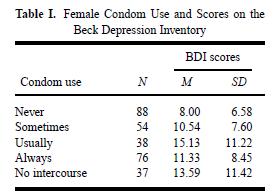
The women who reported always using condoms had markedly lower BDI scores than those who used condoms “usually”. This pattern was also present in the data regarding suicide attempts. It runs counter to the authors’ hypothesis: the women who always used condoms, by the authors’ use of condom use as a proxy for exposure to semen, were less depressed than those who would sometimes be exposed to semen.

The suicide attempts data is bafflingly high. 29% of the women in the “usually” use condoms group had reported previous suicide attempts.  The population average is about a tenth of this. It is probably that the data were gathered poorly. Given all of the other effect sizes, it is highly unlikely that exposure to semen is related in any way to a ridiculously high rate of suicide attempts.

On the whole, then, the study is shaky at best, though the phrase I would use would be “HOW THE FUCK DOES SHIT LIKE THIS MANAGE TO GET ITSELF PUBLISHED?” followed by throwing my (as yet entirely unpublished) PhD at a wall.

The Psychology Today article then flies off on another tangent, discussing human concealed ovulation, a topic of obsession for evolutionary psychologists. According to speculation, semen can force ovulation in a woman. It is such unsupported bollocks that to destroy this would be like punching a kitten in the face.

The Psychology Today article ends on an important caveat:

Now, I’m not advocating that reproductive-age people shun condoms to elevate women’s mood at the risk of unplanned pregnancy. But this effect might come in handy for women over age 50, who are experiencing menopausal blues.

There are so many things wrong with this paragraph that it is hard to know where to begin. It is commendable that the columnist thinks that unprotected fucking is not the way to cure depression. He is, however, completely oblivious to the fact that the risks of unprotected fucking go far beyond “unplanned pregnancy”. If he is, as I suspect, an evolutionary psychologist, it is understandable why he thinks that: the evolutionary psychologists tend to construct sex as something for nothing more than reproduction. He is also utterly wrong about how this effect may be useful for menopausal women. Even if we pretend that the semen-antidepressant study was done really well, the findings still only apply to young women.

In sum, then, spunk will not cheer you up or stop you killing yourself. Don’t avoid condoms unless it is safe for you to do so. The science is thoroughly awful.

If sex cheers you up, have sex, with the level of protection of your choosing. It is unlikely that it will be a magic panacea, but a good fucking is tremendous fun.

__

Big thanks to Tom, Alice and Fabi in the PhD room for reading through this drivel with me and having brilliant scientific brains

Understanding men who rape and why they rape

Studying who rapes and why is a difficult task: it is far more than a simple matter of strolling up to your local neighbourhood rapist and saying “Oi, you, why did you do it?”

The first issue is that most rapists do not get caught. The majority of rapes are not reported, and of those that are, the conviction rape is very low.  Because of this, it is difficult to identify rapists to understand who rapes.

Two recent studies have addressed the question of identifying “undetected rapists”: the first, McWhorter and colleagues, used a sample of young men enlisting in the navy, while the second, Lisak & Miller, sampled college students.

In the McWhorter sample, approximately 13% of the sample had perpetrated attempted or completed rape, while approximately 6% of the Lisak & Miller sample had done so. In both samples, the reperpetration rate was high: in the McWhorter sample, 71% of the men had repeatedly attempted to or successfully raped a woman. Lisak & Miller found an average of 5.8 rapes among the repeat rapists in their samples. These findings are startling: in both samples, the rapes had never been reported to the authorities by the victim, yet these rapists had perpetrated multiple rapes. In the McWhorter study, it was found that the majority of victims were acquaintances of the rapists.

These findings are in keeping with those regarding rapists who are caught: that they frequently reoffend, and the victim often knows the rapist. The evidence is not in favour of the classic rape myths that rapists are a stranger in a balaclava leaping out of a bush. It also fails to support the folk notion that rape is something that happens just once when a man gets a little bit hot and bothered by a woman all dressed up sexy near him.

It is frightening to note the sheer quantity of undetected rapists. The McWhorter sample is unrepresentative of the general population, being young men enlisting for the military: 91% were single, and they had a lower level of education than the US average. Likewise, the Lisak & Miller sample were drawn from a particular college. However, these figures are informative about certain population groups, and it would merit further investigation into other groups using similar methodology to identify the true prevalence of undetected rapists.

To identify undetected rapists, both studies used the Sexual Experiences Survey (SES), a 13-item self-report questionnaire. This measure never mentions the word “rape”, instead asking questions such as “Have you ever had a woman misinterpret the level of sexual intimacy you desired?”, “Have you ever obtained sexual intercourse by saying things you didn’t really mean?” and “Have you ever Had sexual intercourse with a woman when she didn’t want to because you used some degree of physical force (twisting your her arm, holding her down, etc.)?” Crucially, questions in the SES do not mention the word “rape” at any point. Statistical tests have found it to be a reliable and valid measure, i.e. it measures what it is attempting to measure, and all of the items in it are distinct.

There are two major criticisms of the SES. First, it is a self-report measure, which are prone to people answering the questions in a socially desirable manner. This is the best one can hope for in this type of research: it is not possible to follow people around, videotaping their every sexual encounter to check for signs of coercion. Second, the SES is entirely focused on men’s sexual violence against women. To address this issue would improve the quality of research into rapists and why they rape greatly: sexual violence is not exclusively men against women, after all.

A further question to be addressed is why do rapists rape? One study has attempted to address this question. The researchers administered a battery of tests to men who were in prison for a range of offences, using a modified version of the SES. Although the majority of participants were imprisoned for non-sexual offences, 51% had engaged in verbally coercive sexual behaviours, and approximately 20% in sexually aggressive behaviours. There was some evidence that the self-reported measure was underestimating the number of men who raped: 85% of those who denied using sexually aggressive tactics on the questionnaire were classified as sexually aggressive due to previous criminal history. This corroborates the problem outlined earlier with using questionnaire measures.

Some characteristics were common to both coercers and aggressors. Both groups had a history of sexual promiscuity, aggressive tendencies and were poor at empathising. Furthermore, both groups were more likely to subscribe to rape myths. Belief in rape myths was measured using a questionnaire called the RAPE scale. The RAPE scale was developed from clinical work with sex offenders and validated on a sample of incarcerated rapists, therefore representing beliefs which many rapists hold. It consists of 36 items which read like a rape culture checklist, such as:

  • “Before the police investigate a woman’s claim of rape, it is a good idea to find out what she was wearing, if she had been drinking, and what kind of a person she is.”
  • “A lot of women claim they were raped just because they want attention.”
  • “Often a woman reports rape long after the fact because she gets mad at the man she had sex with and is just trying to get back at him.”
  • “I believe that if a woman lets a man kiss her and touch her sexually, she should be willing to go all the way.”
  • “Most of the men who rape have stronger sexual urges than other men.”
  • “If a woman gets drunk at a party, it is really her own fault if someone takes advantage of her sexually.”
  • “I believe that any woman can prevent herself from being raped if she really wants to.”

Belief in such myths was found to differentiate between men who were sexually coercive or aggressive, and those who were not. This study therefore provides some evidence that these rape culture myths facilitate rape, and provides an important reason to attack such beliefs wherever they are seen.

Differences in coercers and aggressors were also found: coercers were less able to imagine others’ reactions, while aggressors showed higher levels of hostility towards women, higher impulsivity and reported higher levels of emotional abuse in childhood.

As with the other studies, this sample was not particularly representative of the general population. Men in prison are different to men who are not in prison.

In general, it is difficult to study rapists, and the existing tools we have need work. Due to our current measures, it is not possible to investigate men who rape men, or women who rape, and we must rely on self-reported measures on which it is possible to lie.

What evidence is there suggests that, thankfully, not all men are rapists, and that rape culture is very dangerous indeed. With further research and a constant attack on the flawed belief system which allows rape to happen, we can fight rape.

Nudge: it’s not science, it’s ideology

The latest fad among policy-makers is using “nudges” to gently push people in the right direction. Unsurprisingly, David Cameron is a big fan of this approach, while the Telegraph are preposterously terrified of sinister nannies perpetrating mind control. In a battle between the Telegraph and David Cameron, it is difficult to choose a side. In fact, they are both wrong.

Nudge theory was put forward in the book Nudge: Improving Decisions About Health, Wealth And Happiness in 2009. It is, ostensibly, a book about behaviour change and psychology, and has been heralded as a scientific panacea for developing policy–changing risky behaviour such as smoking and alcohol consumption would lead to fewer deaths, after all.

The book was written by a lawyer and an economist. This is the first alarm bell: neither of these professions are known for their training in human behaviour. To Nudge’s credit, though, at least the authors acknowledge that economic theories have it all wrong about human behaviour: traditional economic models tend to start with the rather flawed assumption that people are completely rational. Nudge instead focuses on the social and environmental context of behaviour and the cognitive shortcuts we use while processing the world around us.

I discussed Nudge’s views on the context of behaviour and how our brains rarely think unless we absolutely have to in more detail in this post on default options, where I opened with the statement that Nudge is the worst book on behaviour change ever written. I stand by this thesis. Here is why.

There are several concepts which are important to nudge theory. The authors propose that decisions take place within a “choice architecture”, that is, the context of the behaviour. They also propose that there are two systems for making decisions: the automatic system and the reflective system. The former is unthinking, unconscious. The latter is rational. There is nothing inherently wrong with these ideas: it is nothing that surprises those in psychology or the field of behaviour change, and it is nothing that has not been extensively researched before. This book, in fact, provides a  overview of these concepts, among others, which influence health behaviour, and synthesises them into a comprehensive theory. It was published several years before Nudge and is not referenced.

In fact, given the depth of understanding of automatic processes, one might suspect that the authors’ research was a quick glance at Wikipedia’s list of cognitive biases.

The framework proposed by the authors to change behaviour is termed “libertarian paternalism”. Both words are enough to set my teeth on edge, and in oxymoronic combination my blood pressure shoots through the roof. In short, libertarian paternalism involves policymakers doing as little as possible–for example, smoking bans are verboten–hoping people will choose to perform the desired behaviour. Policymakers are expected to nudge people in the right direction.

What is a nudge? The authors provide a handy acronym for their proposed methods for changing behaviour. It is rather fudged. Nudges are:

  • iNcentives
  • Understand mappings
  • Defaults
  • Give feedback
  • Expect error
  • Structure complex choices

This translates to various simple, minimal-intervention methods, such as simplifying forms, feedback, providing information in a readable format or modifying default options.

It really is that simple, according to the authors.So simple, that most of the book is dedicated to presenting a series of nudges and things they think could work as a nudge.

To the untrained eye, it appears that Nudge is scientific and evidence-based. There are a lot of references and citations, after all. Surely that must mean it is science?

Not at all. The evidence presented seems cherry-picked. It is likely that this was not undertaken with duplicity, but rather with ignorance. For example, the authors cite a smoking cessation trial in the Philippines which used a method they deemed as nudging. They claimed great success for this intervention–in fact, the trial and analysis were undertaken poorly with a small effect. This happened in a number of places where the authors presented “trial” data; the authors do not seem to understand how best to test that an intervention works.*

In fact, Nudge presents no evidence that nudges would work better than something that was not a nudge. Again, this is likely to be due to the authors’ lack of training in the behavioural sciences. The way to test this would be to conduct a randomised controlled trial. In short, one would randomly allocate a large number of people to be exposed to a nudge, with an equivalent number of people randomly allocated to not receive the nudge. One would then see how many people from each group changed their behaviour. It is quite a simple concept, and seems to have escaped the authors’ knowledge. Instead, they repeatedly trumpet nudges to be effective with no supporting evidence.

Nudge further neglects an important aspect of behaviour change: helping people gain the skills to change their behaviour. It is no good nudging people to buy healthy food by improving labelling if they are not taught how to cook a healthy meal. It is no good providing people with nicotine patches to help them stop smoking if they are not taught how to cope with psychological cravings. Skill-training is important, and there is rather a large evidence base on the importance of training and improving self-regulatory capacity.

There is also a rather large body of evidence to suggest that higher-intensity interventions are much more effective at changing behaviour than those with less contact. So, for example, sitting down with someone and helping them write a plan about how they are going to stop smoking is better than giving them a leaflet and letting them write down how they plan to stop smoking. Nudges are inherently minimal-intervention and thus would be unlikely to be particularly effective.

Useful, perhaps, but not sufficient.

Beyond the distinct lack of evidence to back up the theory, Nudge runs into another enormous problem: even its authors acknowledge that nudges work best for well-educated Western people. This means that in using nudges, whole groups of disadvantaged people miss out on help in changing their behaviour. This seems par for the course with our current government. No wonder David Cameron likes his nudges.

Overall, though, one of the largest problems with Nudge is that after reading the entire bloody book, I was still none the wiser as to what a nudge is. The authors provide numerous examples and a rather fudged acronym, but there is still the sense that a nudge is essentially something that the authors like. As conceptualised, there is no real reason that a smoking ban should not be a nudge–it is, after all, environmental modification to disincentivise smoking. The only reason a smoking ban is not considered a nudge is because the authors say it isn’t.

Despite all of this, and following an evidence inquiry at the House of Lords, an expensive “nudge unit” has been set up and one of Nudge‘s authors called in to advise on policy.

Nudge is not science. Nudge is not a panacea towards behaviour change. It is libertarian, laissez-faire ideology formatted readably.

Nudge is not a road-map. It is a childishly-scrawled drawing of a street scene.

Justifying the system: why do disadvantaged people believe the game isn’t rigged?

Why do some people continue to believe that the system is fair, that this is a meritocracy, that they can win? Why do they fail to see the system as I do?

Intuitively, one would believe that those for whom the system doesn’t work–those in marginalised groups–would be those who express the most rage at the system. In fact, the converse is true: for example, people from economically deprived groups often believe capitalism to be fair and good, rejecting socialism. There is also a strong bias towards believing that profitable companies are more ethical than non-profitable companies, despite the opposite being true. Stereotypes flourish: black people are lazy and that is why they can’t get jobs; Polish people work insane hours and that is how they are stealing all our jobs. People will vote for political parties that do not represent them: for example, many economically deprived people vote for parties that endorse neoliberal ideologies, destroying services they access in favour of the pursuit of profit.

This seeming anomaly is explained by a psychological theory: System Justification Theory.

System Justification Theory posits that people are motivated to perceive the world around them as fair, that even though they themselves may be receiving the thin end of the wedge, the system is inherently just. This happens because people want to believe that the world is predictable, giving a sense of certainty and stability. Due to this motivation, people fall over themselves to justify the system.

It is comforting to believe that everything makes sense, and that the world isn’t all fucked up and crooked. It is more comforting to believe that people are poor because they don’t work hard enough, and they’re happier poor, anyway. It is more comforting to believe that women who are raped had probably done something wrong or deserved it–rather that than believe it could happen to anyone. It is easy to believe that immigrants are to blame for unemployment than it is to believe a corrupt capitalist system is streamlining the number of jobs to maximise profits.

System justification increases when people are thinking about their own mortality, or when they believe the world is not a safe place. Threats of terrorism and crime increase people’s belief in system-justifying ideologies.

I, of course, get frustrated when I see other people justifying a system which I believe to be unjust (though that may be because people who do not endorse system-justifying ideologies display higher levels of anger and frustration). However, there are consequences to system justification beyond me being a bit angry.

Psychologically, people who endorse system-justifying ideologies are happier and more satisfied with life, and less angry and frustrated, across the board. For advantaged people, additional benefits emerge: those who endorse system-justifying ideologies have higher levels of self-esteem and feel a greater sense of solidarity with people from similar social groups. For disadvantaged groups, the opposite is true: self-esteem is lower, and there is less solidarity with similar individuals.

Increased system justification also leads to increased perceptions of legitimacy of governments and institutions, and decreased support for social change: in other words, system justification may help maintain a fundamentally unjust and broken system.

Put together, it is unsurprising that very few class revolutions or civil rights movements are successful with the strong psychological barriers in the way.

Real-world implications of system justification have been measured with regards to beliefs about climate change and behaviours to protect the environment. In this study (unfortunately, paywalled), it was found that system justification led to climate change denial and a reduction in environmentally protective behaviours such as recycling.

The authors of the study then attempted to work with system-justifying beliefs to attempt to encourage environmentally protective behaviours, by informing participants that such behaviours were vital for protecting their way of life, and it was therefore patriotic. This had the desired effect: people changed their behaviour.

Such “system-sanctioned change” may represent a way of counteracting some of the negative effects of justifying the system, but it is difficult to see how it can have an effect on stereotyping and prejudice and building an altogether fairer society.

It is frustrating and anger-inducing to be unable to justify the system. I have enough rage, though, that I wish to see an end to hierarchical power structures. It keeps me fighting.

A big wet guff from evolutionary psychology

I don’t really have much to say about this.

The evolutionary psychologist who believes incredibly daft things like Muslims become suicide bombers because they can’t get laid because of polygyny has absolutely excelled himself.

He has written an article for Psychology Today–which has since been pulled–which suggests that black women are ugly because they are manly, even when controlling for the fact that they are ugly and stupid.

At no point does the author address any of the following issues:

1. That black women are rated as less attractive by a completely subjective measure, of which we have absolutely no information about the raters. In fact, the author gushingly declares this method of rating as objective. Yes. Apparently Hot or Not is now a scientifically-valid instrument.

2. The relationship between race and intelligence is utter cock.

3. BMI is an equally poor measure, with limited utility even in epidemiological studies. It is not even a particularly good marker of “fatness”.

4. He throws around phrases like “mutation loading” willy-nilly. I do not think it means what he thinks it means.

Instead, he chooses to interpret dodgy data with a dollop of racism, concluding that evolutionary psychologists’ favourite hormone must be at play: testosterone.

Evolutionary psychology has a peculiar obsession with testosterone, and it is trotted out to explain everything from aggression  to bad relationships with your mum. Perhaps testosterone does explain these things.

Here, though, the explanation requires no hard-to-measure hormones at all: it’s bad data interpreted by a racist.

Edit: This fantastic post at Racialicious gives a more thorough account of how to debunk this bollocks with 100% less swearing.

Wisdom teeth: Evolutionary psychology and gender

Recently, I have been thinking a lot about evolutionary psychology. Evolutionary psychology is an area of psychology which views many psychological traits as evolutionary adaptations; for example, having a good memory is an adaptation, and organisms which do, tend to survive better.

I have no quibble with this general thesis; I do not subscribe to the tabula rasa view, and I am sure, despite what Steven Pinker believes, that very few do.

There are, however, some examples of very shaky science in evolutionary psychology, particularly in regards to controversial work surrounding gender and gender roles. I myself am particularly interested in what the discipline says about gender, having studied it previously and being a massive raving feminazi.

Evolutionary psychology considers traditional gender roles, i.e. the dominant, aggressive man and the submissive, nurturing woman, to be adaptations. Much of this essentially comes down to sex and childcare: women need to be gentle and empathic to raise children, while it is necessary for men to be agressive and strong to protect their offspring.  In and of itself, this is vastly contestable: using a comparative approach, as is often used in evolutionary psychology, it is evident that there is a plethora of childrearing strategies in the animal kingdom.

Evolutionary psychology has been used to explain a variety of gender differences and gendered behaviours. For example, this article entitled “Ten Politically Incorrect Truths About Human Nature” outlines a few: beauty standards are hardwired, men are not naturally inclined to monogamy and will cheat, male sexual harassment of women is perfectly natural, and, my personal favourite, Muslims become suicide bombers because polygynous culture means that they cannot get laid. Really.

These claims have a vague intuitive appeal, and yet, for the most part, they are largely built on hypothesising about how such behaviours can be hardwired, with very little empirical investigation as to how this can be the case. Often these claims come from popular science books which theorise, such as Pinker’s Blank Slate. This “storytelling” that behaviours are adaptations is particularly noticeable in theories such as the suicide bombers idea: polygyny is not particularly common in Islam, and therefore it cannot possibly explain the prevalence of Muslim suicide bombers. Another example of this is the infamous evolutionary psychology paper which claimed that girls’ preference for pink was an adaptation, while cheerily ignoring the idea that a hundred years ago, pink was the colour for boys while blue was the colour for girls.

Such data-free just-so stories are worryingly popular in the media: google “girls prefer pink evolution”, and there are many gushing newspaper articles reporting uncritically the girls’ preference for pink myth.

Not all evolutionary psychology is quite so evidence-free. Sometimes hypotheses are tested, although often with small sample sizes, or findings which go against the general big-strong-dominant-man-is-sexy dogma. In the media, though, empirical studies are treated with the same weight as hypothesising: both are seen to be painting the status quo with science.

With the ease with which one can hypothesise an evolutionary basis for a trait, it is no surprise that so many become armchair evolutionary psychologists, theorising after having once read Blank Slate. For example, this rather silly blog seems to suggest that there is an adaptive, innate reason that little girls want to be princesses when they grow up. In the comments, the blogger rather unparsimoniously tries to defend this view by suggesting that advertisers capitalise upon girls’ innate lust for princess-based paraphernalia. Such lay theorising and justification of behaviour is common: the man who cheats  may say “it’s in my genes”; the woman pregnant by another man may say “his sperm looked stronger”, the plastic surgeon will declare there’s a valid evolutionary reason that you should have a nose job, or you’ll never find a mate. Evolutionary psychology has even been used to justify the existence of rape, adding a pseudoscientific sheen to the myths that men can’t help themselves and women should stop wearing short skirts.

The science behind evolutionary psychology is not as strong as many appear to think, and it is an area to which many professed-sceptics show a distinct lack of critical thinking. I advise caution in interpreting evolutionary studies: many are not actually studies, but stories. The remainder are often poorly-conducted, as it is very hard to empirically test evolution without a fossil record of thoughts.

Suppose, though, that all or some of the claims made by evolutionary psychology are true: perhaps, that men are indeed, genetically, big hairy dominant hunters, while women are nice pink mummies, and these roles are hardwired as adaptations to the environment in which humans evolved.

The human body is rather imperfectly designed. We have a lot of various things that we don’t really need, for example, the appendix. Once, we needed our appendix to digest grass. These days, it sits there, until suddenly it might fancy getting blocked and exploding everywhere. Or, more often, it’ll just sit there, doing nothing at all. The appendix, though, was never really used by humans. It is just a vestige.

Wisdom teeth, though, were highly useful to humans when we first evolved. Humans were still a long way off inventing dental hygiene, and, so, tended to die once all of their teeth had rotted away and they could no longer eat. Wisdom teeth, emerging in the mid-twenties, gave an extra few years of life: four more teeth meant more time being able to eat. With the advent of dental hygiene, we no longer lose all of our teeth to decay, and wisdom teeth have become an annoyance. When a wisdom tooth grows into a mouth full of healthy teeth, there is often not enough room, and the new tooth impacts. I had a wisdom tooth that solved the lack-of-space problem by growing horizonally. Each time I bit down, it would take a chunk out of the inside of my cheek. I had it removed.

Wisdom teeth, then, are a solution to a problem that no longer exists, and when the tooth becomes a problem we have it yanked out.

If one were to assume that claims regarding gender made by evolutionary psychology were true, these gender roles are as irrelevant to modern life as wisdom teeth. They are a solution to a problem that no longer exists: we shop in supermarkets now; we have modern health care; our children are sent off to school; we have DNA testing for identification of fathers; we can have sex for pleasure with a very low risk of reproduction. The adaptations we developed to childrearing and mating problems no longer exist.

Why, then, would we cling on to the notion that it’s perfectly natural to rape, to cheat, to subscribe to the idea that male and female minds are inherently different, and so such things are inevitable?

We can overcome wisdom teeth, and, if any of the shaky claims of evolutionary psychology regarding gender turn out to be true, we can yank that out of our society, too.

Feminism, feminist identity and man-hating: a research study

I briefly touched upon a fantastic piece of research into the myth of the man-hating feminism in the post about ambivalent sexism. It was quite an interesting paper which warrants further discussion. In order for this post to make sense, it is probably best to read the ambivalent sexism one first.

The paper is entitled: “ARE FEMINISTS MAN HATERS? FEMINISTS’ AND NON-FEMINISTS’ ATTITUDES TOWARD MEN“, by Anderson, Kanner and Elsayegh (2009). The title is the holy grail of psychology paper titles–it grabs attention and it manages to neatly summarise the research conducted.

In short, the authors administered a questionnaire to feminists and non-feminists. This questionnaire measured benevolent and hostile attitudes towards men. The group of feminists had a lower level of hostility towards men.

The questionnaire was constructed very similarly to the Ambivalent Sexism Inventory: “hostile” items included “When men act to ‘help’ women, they are often trying to prove they are better than women”, while the “benevolent” items included “Women are incomplete without men”, and “Even if both members of a couple work, the woman ought to be more attentive to taking care of her man at home”. It was hypothesised that were feminists man-haters, they would be more inclined to agree with the hostile statements than non-feminists.

Of course, the authors also needed to measure “feminism”, or at least separate the feminists from the non-feminists along a meaningful dimension. Many of us are familiar with the statement, “I’m not a feminist, but…” proceeded by reeling off a list of feminist statements, so the task of identifying feminists is somewhat difficult. The authors used a rather elegant solution to this problem: participants were asked to write a definition of feminism, then asked whether they identified as a feminist.

Participants who were unable to define feminism were excluded. A worryingly large proportion of participants failed this criterion: from the original sample of 488 participants, only 296 were able to adequately define what feminism was. This shows an area where work is still required: many people do not know what feminism is, and therefore lack the knowledge to accept or reject its ideas.

In the sample of people who were able to define feminism, around 14% identified as feminist, with 58% identifying as non-feminist and the remainder unsure. There were gender and ethnic differences in identifying as feminist; 17% of women participants identifying as feminist, compared to just over 7% of men. White people were most likely to identify as feminist, with African Americans least likely–less than 5% of African American participants said that they were feminists. It is unsurprising that people from minority ethnic groups were less likely to identify as feminist–feminism is often seen as reflecting the concerns of and solutions for of middle class white women.

With feminism measured and large differences in ethnicity and gender found, analyses were conducted based on these differences. On the whole, it was found that feminists displayed lower levels of benevolence and hostility towards men, that is, feminists were less likely to report “hatred” towards men, but also less likely to report the infantilising, protective, hegemonically hetrosexual attitudes towards men.

Gender differences were visible: on the whole, women reported higher levels of hostility towards men, while men reported higher levels of benevolence towards men–this effect is also visible when assessing attitudes towards women, where it is reversed.

The paper was less than perfect, relying on self-report measures, and it is possible that feminists were filling in the questionnaire with a social desirability bias: feminist participants may still “hate” men and agree with sentiments such as “men believe they are better than women”, but they know that it is wrong to report this in a questionnaire. If this is the case, it’s still a start, that a chunk of the population believe these attitudes to be undesirable.

This research shows some directions for the feminist fight. Firstly, we need to raise awareness of what feminism is: an approach to fighting for gender equality. Additionally, the hostile and benevolent attitudes towards men were not zero in the sample of feminists–this suggests we need to work towards eradicating seeing a group through the lens of the “other”. This goes for all such attitudes, this is our goal: ambivalent sexism must disappear.

Ambivalent sexism: research into attitudes towards women

Many of us are familiar with the concept of misogyny: hatred of women. Sexism has another face, though: the belief that women are wonderful and must be protected from the big, bad world.

These two sides to sexism were given a name in a paper by Glick and Fiske (1996): ambivalent sexism. Ambivalent sexism consists of two types of attitude towards women: hostile sexism, and benevolent sexism. Hostile sexism is classic prejudice; benevolent sexism is the view that women are lovely, fluffy nurturing caregivers (or, as the paper puts it, intimacy-seeking and prosocial). Within these categories are three “sources” of ambivalent sexism, each with its corresponding hostile and benevolent face.

First, paternalism. Paternalism is theorised to come in two forms. Dominant paternalism is the idea that men should control women, while protective paternalism is the notion that men should protect women.

Second, gender differentiation. Competitive gender differentiation is a set of beliefs that bolster the idea that men are the better sex, while complementary gender differentiation, its benevolent counterpart, focuses on the “equal but different” myth, wherein women have their own, special roles in the kitchen.

Finally, heterosexuality. The theory of ambivalent sexism acknowledges that a major source of sexism is the hegemonic heterosexual ideal. Heterosexual hostility is the viewing of women as sex objects and fear of female sexual power, while intimate heterosexuality romaticises this objectification and sees men as incomplete without a woman.

The theory therefore provides a fairly comprehensive account of sexism. It does not just stop at theorising.

Measurement of ambivalent sexism

Ambivalent sexism is measured by a questionnaire called the Ambivalent Sexism Inventory (ASI). This measure was subjected to the rigorous development and validation standards typically used in questionnaire development (for those interested in methodology, it is described fully in the Glick and Fiske paper, which is available in full without paywall).

The ASI consists of 22 items; 11 in each category. Examples of questions which tap hostile sexism are “Once a man commits, she puts him on a tight leash” or a reverse-scored item “Feminists are not seeking more power than men“. Reverse scoring allows researchers to check if participants are just selecting the same response for every item on a questionnaire, and also help to test the reliability of the measure.

Examples of questions which tap into benevolent sexism include “A good woman should be set on a pedestal“, “Women have a quality of purity few men possess“, and “Men are complete without women“. Spot the reverse-scored item.

The Glick and Fiske study found that benevolent and hostile sexism were distinct, but they were also correlated with one another, suggesting that people who hold hostile sexist attitudes also hold benevolent sexist attitudes.

A problem with the ASI, though, is that it is dependent on self-reporting. Even in an anonymous questionnaire, research participants may give responses that make them seem socially desirable (i.e. less of a sexist knobend). Furthermore, a questionnaire may influence their behaviour or responses to other questions if the participant guesses that the study is about sexism. For that reason, some researchers prefer to modify the ASI to present scenarios or observe behaviour.

Effects of ambivalent sexism

Much of the ambivalent sexism research has focused on workplace sexism. Hostile sexism has been linked to negative evaluations of women candidates for a managerial job and higher recommendations for a male candidate for the same role. It has also been linked to greater tolerance of sexist events after hearing a sexist joke, which suggests that sexist humour does have real-world implications, for hostile sexist people, at least.

Benevolent sexism has many real-world implications. It, too, has been linked to low evaluations of women in the workplace, as women are seen to be neglecting their traditional roles as caregivers and homemakers. As well as this systemic negative effect on women, the impact of benevolent sexism extend to psychological effects. When experiencing benevolent sexism, women perform worse at various cognitive tasks, which suggests that the benevolent sexist attitude further reinforces a vicious circle which allows women to do worse.

What about teh menz?

A similar scale has been created for measuring attitudes towards men: the Ambivalence Towards Men Inventory, a 20-item questionnaire which also differentiates between hostile and benevolent attitudes. This measure has generated much less research than the ASI, with fewer real-world implications. However, using the measure, it has been found that feminists are not man-haters: in fact, women who identify as feminist score significantly lower on hostility towards men.

Conclusions

While the problems of hostile sexism are well-known, and generally viewed as less acceptable in our society, “benevolent” sexism, too, has huge implications for equality for women. Benevolent sexism still allows women to be viewed as objects, and unworthy of equal employment, yet it is thoroughly acceptable to express opinions that women are cute little walking wombs. This needs to change.

Black bloc: a psychological perspective

A l0t has been said about the actions of people adopting black bloc tactics at the March 26th demonstration. An epic lefty clusterfuck ensued, with passionate defences and condemnations flying through the press, blogosphere and twitter.

As the dust settled, more nuanced discussion began, calling for critical thinking and discussion about strategy and tactics:

What Black Bloc has done is highlight a grey area in our thinking about protest, property and violence. We need to think deeply and critically about that, not just thoughtlessly denounce or defend.

I wholeheartedly concur with this sentiment, and would like to add my own concerns about Black Bloc tactics to the debate. My collection of psychology degrees and obsession with good decision making feature heavily in this analysis, and I express these views to add to the debate.

Black bloc involves anonymising all members of the group by wearing similar, all-black clothing, and, crucially, covering the face. There are several reasons for this:

Anarchists using the black bloc tactic wear masks for many reasons. The main one is the fact that the police videotape activists for their “Red” files. The police do this surveillance and information-gathering to frighten moderate activists from participation in protests and social struggle. The police do this even when there are laws against it (see red squads). Masks promote anonymity and egalitarianism. Instead of a “leader” yelling instructions to a protest group via a megaphone, those in the bloc make decisions among themselves. They also protect the identities of those who want to engage in illegal acts and escape to fight another day.

The identical clothing and masking of the face are therefore important tactics for creating anonymity, which, from a security perspective, is essential. From a psychological perspective, though, it is problematic.

Anonymity has some rather unfortunate side effects, most notably, the phenomenon of deindividuation. Deindividuation is the phenomenon which causes people on the internet to behave like dickheads. Deindividuation the phenomenon which facilitates massacres and police violence–after all, riot police cover their faces and become a swarming mass of identically-clad perpetrators of aggression. Deindividuation can lead to making strategically flawed decisions.

Three effects are thought to emerge from deindividuation:

  1. Weakening people against performing harmful or socially disapproved actions
  2. Heightening responsiveness to positive or negative cues
  3. Increasing adherence to group norms

Much has been made of the first point: whether the Black Bloc performed harmful actions. As RozK puts it:

If you have a loose structure and perform slightly random acts, you may end up going further than is compatible with the general will you are trying to embody. You are not going to persuade people of the justice of attacking the Ritz if you also attack a Pret. You are not going to keep the sympathy of people who might like you to target banks if you also go after the Boris bikes.

I can see the case against Pret and Boris bikes – but am not especially convinced, let alone convinced they would be any sort of priority.

I would regard these as concerns, not criticisms.

This theme has emerged frequently in discussion surrounding Black Bloc actions at the demonstration, and it would seem that many are uncomfortable with the selection of some of the targets. Some actions have certainly perceived to be harmful and undesirable from those who broadly support the nebulous aims of the Black Bloc.

It is entirely possible that some of the targets which were less-well selected were down to cue-responsivity: the lure of the Boris Bike was too great and subsumed the thought which generally tends to go into target selection.

It is therefore not a stretch to imagine that deindividuation may have contributed somewhat to Black Bloc actions. Importantly, though, deindividuation and its cousin, dehumanisation run the other way: a classic example of this is the Stanford Prison Study, in which ordinary people were made to act like prison guards and prisoners. A key effect was that the “guards” stopped seeing the “prisoners” as individual people.

Within the press, Black Bloc people have been seen as “thugs” and “hooligans”. Even on the left, this language has been used to describe Black Bloc. Furthermore, to police eyes, the Black Bloc cease to be human, thus providing impetus for indiscriminate brutality.

Because of these factors, I think that serious thought needs to be given to addressing this psychological effect. While many on the left hurriedly denounce Black Bloc, we in the anti-cuts movement are all together, and while showing solidarity, we need to rethink, regroup and focus on strategy.

Enthusiastic consensus

This post is a follow-up from yesterday’s discussion about consensus decision making, groupthink and inclusion. It might not make sense on its own.

In the comments, it transpired that good facilitation can go a long way towards addressing some of the concerns I have with consensus meetings, and so it may well be that what I talk about here is also “good practice” which I have not witnessed.

A tiny fraction of a thoroughly brilliant comment from .j inspired a conversation with some friends yesterday. .j said:

Of the problems you list, I suspect that the illusion of unanimity is the most pervasive and hardest to combat. Encouraging portions of a meeting to brainstorm on devil’s advocate positions can help allow some unspoken reservations to emerge, but it’s certainly not a perfect method.

The illusion of unanimity certainly is a problem, and one which is exacerbated by people feeling unable to express opinions. Silence is generally taken for agreement.

A parallel can be drawn here, and that parallel is with sexual consent.

Sexual consent is traditionally constructed as “no means no”, that is, it is a person’s responsibility to say “no” to unwanted contact. Under this model of consent, silence can be viewed as an implicit nod. Silence, however, does not mean “yes”. One particularly horrifying example of this is a rape case involving a celebrity where the woman said:

The young woman did not push Tweed off or tell him to stop because she was “frozen with fear”, the court heard.

“I wasn’t able to physically move or say anything, or even function about what was going on,” she said.

The rapist was acquitted, because the woman never said “no”.

In many cases, silence is not a “yes”. Silence may be an expression of fear, of powerlessness, of being unsure, of years of socialisation that means not blindly submitting will make you a frigid bitch or a mean bitch or a crazy bitch.

There is an alternative: enthusiastic consent. Enthusiastic consent means that “yes means yes”. Enthusiastic consent means that an enthusiastic “fuck yeah!” is what passes for consent, not an absence of a “no”. Enthusiastic consent means that if enthusiasm is not shown, it is best to check whether the other person is comfortable and consenting.

Thinking back to consensus decision making, many marginalised people do not feel empowered or comfortable in speaking up. I have seen decisions made where many people do not show their jazz hands of agreement, yet a decision is still taken to be “the mood of the room”.

What if we reverse this? What if we take silence as not assent, but dissent? What if, in the face of silence, we checked for enthusiastic consensus rather than implicit agreement?

Consensus meetings would take longer, that’s for sure, but how can that be a bad thing if we are ensuring that all present are comfortable with the decisions being made?

Could enthusiastic consensus help empower marginalised groups to participate in group decision making? On its own, of course not. But, as with enthusiastic consent’s role in building a world without rape, it is a tool that we should, and must, use to bring ourselves baby steps closer to optimising our decision-making.