Over the last few days, I have found myself experiencing a shuddering anxiety which had been at bay for years. I’ve been made to feel ashamed for my queer, poly sexuality. I have been made to feel like maybe I should just shut the hell up and stop being so open about this part of my identity, because it’s bad and wrong and whatever the hell else. I know, in my head, that this is just how heterosexist patriarchy wants me to feel so I will stay in my allocated place. That doesn’t stop it getting to me.
It all started with a complicated situation wherein a feminist blogger started attacking a feminist woman of colour, seemingly inexplicably. The aggressor then wrote a blog to defend her stance, in which she decided to air her grievances with a number of other women. It has been critiqued here, by Sam Ambreen. In it was the following line, which rang a few alarm bells for dogwhistle biphobia:
I will not go along with the lie that any white, cis, middle-class blogger who announces she is [made-up word] sexual is therefore just as oppressed as those she claims to represent.
When challenged, it became all the more obvious what she was driving at. I should note from later tweets, one of the people she means here is me:
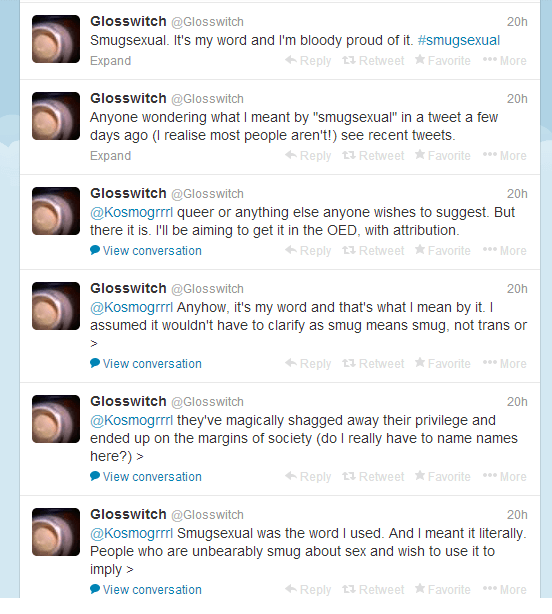
All together, this “smugsexuals” rant displays a number of tropes which occupy the intersections of biphobia and misogyny, and I’m not even going to go into how blatantly little she doesn’t understand how intersectionality and privilege work, as this is fairly self-evident. First is the assertion that queer sexualities are “made up”, that any language we use to describe our experiences is somehow not real. I’d have thought we’d moved to a position where we could at least acknowledge that some people don’t fall neatly into little filing drawers marked “gay” or “straight”, but between this and the nonsense surrounding Tom Daley’s coming out, it is abundantly clear that we still haven’t even gained this little bit of ground.
Second is the implication that queer folk are attention-seeking, embodied in this mention of smugness. This notion of “attention-seeking” is levelled at bi and queer women far too much, and it’s tangled in all sorts of hideous assumptions about queer sex and what a woman should do. Heterosexist patriarchy wants us to be quiet, keep our pretty little heads down and if we stray outside the norms we must be doing it for the attention of men.
I am open about my identity because it’s a part of me that I spent a long time coming to terms with. And I also talk about it a lot because I know that when I was coming to terms with it, seeing people being out and unabashed really helped me understand, and gave me the courage and strength to be out myself.
My friend Charlie wrote this beautiful and heartfelt post a while back about how straight people often ask why her sexuality is so important to her. There is such an assumption amongst straight people that we’re just going on about it and obsessing over one aspect of ourselves, while nobody ever pays any attention to straight people talking about marriage and dating and so forth. It’s the same thing, our lives are just… well… queerer. Our love is important to us. This is a given.
Ultimately, it doesn’t really matter what Glosswitch intended when she developed this brand new slur to smack down queer women with. What she has said takes place against the backdrop of policing of women’s sexuality, of a societal disgust levelled at queer people. This “smugsexual” slur is just a shorter word for what is usually yelled at us.
And it’s facing this, and seeing it go relatively unchallenged, hits me. It took me a long time to overcome all the horrible stuff I had internalised, and having it repeated and spat back into my face really fucking hurts. It’s enough to make me want to go back into the closet.
…except, according to the other face of biphobia considered acceptable in feminism, I’m already there.
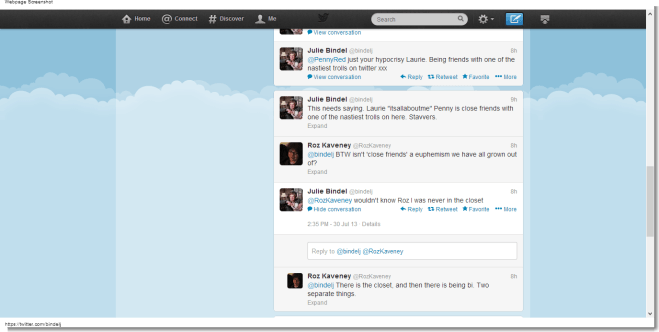
This position is rooted in a feminism which likes to police women’s behaviour and coerce them into lesbianism, and it’s not like Julie Bindel doesn’t have a track record with this. It was because of the dominance of this feminism–in conjunction with general societal monosexual supremacy–that I still sometimes find myself saying I am a lesbian rather than being truthful about who and how I love. The expectation of this kind of feminism is that we should pack away a part of ourselves, stick it into a locked box and bury it under six feet of concrete, rather than living and loving to the fullest extent possible.
This kind of rigid feminism is, thankfully, in decline, and I expect to see less of this kind of rhetoric in the future. What we’ll see more of, though, is this new biphobia. As @nanayasleeps puts it, we’ve gone from “the love that dare not speak its name” to “the love that will not shut up”. Where once we were silent and we hid in the shadows of the closet, we are now too loud, too unreasonable, asking for too much and waving our sexuality in the face of others.
Bisexual people are more likely to suffer from mental health problems than lesbian, gay or straight people, and it’s unlikely that our sexual orientation is a product of our madness. Rather, it is because we end up facing an ugly pincer manoeuvre of prejudice, from all corners. We are told we do not exist, and when we point out that we do, we are told to fuck off because we’re being smug about it. It is a grinding daily stressor, with little support offered to us, as most deny that biphobia even exists.
There is nothing more scary to heterosexist patriarchy than a queer woman who is not afraid to speak out, who cuts through the silence like a hot knife through butter.
I love people of all genders. I am satisfied with my sex life. I am at peace with the fact that I am not like the others. I am secure in the knowledge that I know who I am, and I kind of like it. If that makes me smug, so be it. I wish nothing but smugness on the rest of my queer sisters.
Edit 10/12/13: For the record, Glosswitch replied. Here are her tweets: 1 2 3 4. Here is how I responded: 1 2 3 4 5 6 7.


 Another angry woman