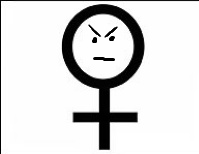
Some people are fuckwits. Don’t get over it.

Floundering fuckwit Boris Johnson has, ostensibly, heroically swept in and “banned” adverts from a Christian group advertising some sort of cure for homosexuality (which probably largely consists of praying and repression). Obviously, the ads are completely out of order and silly, and Boris Johnson has probably scored a fair few points in banning them.

More salient, though, is a thoroughly fuckwitted reaction in the Guardian’s Comment Is Free today, in which the commentator concludes that the existence of the homophobic Christian ads is the fault of Stonewall for being a little bit too provocative in their own campaigns.

Yes, really.

Now, apparently, according to professional fuckwit David Shariatmadari, Stonewall’s famous “SOME PEOPLE ARE GAY. GET OVER IT!” campaign is entirely to blame for the Christian campaign (which somewhat plagiarised the wording). David takes umbrage at Stonewall’s campaign, at great, tedious repetitive length. David doesn’t like not understanding who the campaign is aimed at. David doesn’t think there’s a necessity to point out homophobia is uncceptable. David thinks it’s all a bit provocative. David is really, really distressed by the use of an exclamation mark in the slogan.

On the whole, it is a thoroughly stupid article, and none of the points he makes fit together coherently. The nonsense piled upon nonsense leads to this conclusion:

Instead, Core Issues and Anglican Mainstream have won a dollop of free publicity and can portray themselves as victims of persecution and censorship. Gay people have been pointlessly reminded, not that homophobia is unacceptable, but that there exist organised groups that detest them. Defenders of free speech have had their hackles raised and Boris laughs all the way to City Hall.

Stonewall: what were you thinking?

Now, I am not sure whether dear David is straight, gay or queer, and this does make a slight bit of difference to how I would respond. If he is somewhere on the queer spectrum, I think I’d start by shaking him and saying, “Mate. Please stop with the Uncle Tomming.” If he is heterosexual, then he can fuck off out of our struggle, thank you very much, and I shall chase him away with torches, pitchforks and intimidating lesbian paraphernalia.

Whatever his orientation, David speaks from a position of privilege. This is particularly apparent where he acknowledges the existence of homophobia, in particular in schools. He even acknowledges that Stonewall’s GET OVER IT slogan was developed with the help of school-age people, some of whom would have experienced homophobic bullying. Despite this, he still wishes they’d gone with something a bit nicer, a bit fluffier, a bit friendlier.

While the “GET OVER IT” slogan is a mantra for the bullied kids, a phrase to throw back at their bullies, David would prefer they went with something a little more subservient, and rather than standing up to oppression, perhaps they should just be reminded that it’ll all get better in the end.

The GET OVER IT slogan is head and shoulders above the rest of Stonewall’s work of late, which largely consists of being an utter disappointment and using the kind of nicey-nicey-zoo-zoo approach which David Shariatmadari would probably appreciate. Stonewall the charity is a far cry from its namesake, yet despite this their slogan seems to be treated in the same way as some behave in the aftermath of a riot. David’s privilege shows again: he clearly has no idea why any queer person may feel angry or confrontational.

There is the blaming. The denouncement of tactics, and saying they have spoilt their own argument by not kneeling down and kissing their chains.

It is a reluctance to be provocative, and an embracing of conservative values, which has caused the fight for queer liberation to stagnate. We need to be more angry, not less, and we need to call obstructive fuckwits out where we see them.

Ad campaigns that need to die: transphobia edition

Advertising, as I have noted before, loves nothing more than to try to grab our attention by playing loudly and proudly to societal prejudices. It is hardly surprising, then, that transphobia features so prominently. Two campaigns have come to my attention in the last few days.

The first campaign provoked controversy when it first aired, and rightly so. In a short thirty-second advert for betting on a horse race, viewers are presented with images of women, some of whom are trans, and are invited to guess whether they are “stallions or mares”. A voice-over cheerily narrates “that one’s a man” “ooh, that’s a woman”, finally concluding with “dog… er, I mean man”, adding a charming little soupçon of misogyny to the mix. Every second of the advert seethes with transphobia, bristling with the form of everyday oppression faced by the very people who are the butt of this supposed joke. As one commentator puts it:

The problem with “spot the trans lady” though is that, for one person in the game, it’s really not that fun. Ask any trans woman. Most of us, at some stage, have faced the humiliation of strangers playing it on us, (I use “on” as it’s something that’s done to you, not with you, and rarely with permission). You know it’s coming, as you walk down the street, like any other member of the public, on your way to buy milk. You see the curious look in a stranger’s eye, the excitement as they wonder if it could truly be – if they could really have found someone as laughable and as exotic as you. You note their lack of subtlety as they nudge the person next to them. They walk by. Seconds pass. And, no matter how you try to prepare for the certainty of what comes next, the phrase “Is that a tranny?” stabs like a dagger every time.

I find it staggering that this advert is recent; it stings of something from a hackneyed seventies sitcom, tedious trope upon tedious trope. It is so overtly hateful, that it provoked a number of complaints. The people behind the ad responded with a fairly typical lack of grace.

“I’m really surprised that it has had some negative responses but overall it has had a mixed reaction. It won’t be pulled because we then run the risk of taking ourselves too seriously or pandering to political correctness.

To them, it is all a big joke. The issues mean nothing to the pack of cis men who make up the company’s executive board and marketing department, and anyone who kicks up a fuss must be some sort of hummus-munching killjoy, yet to blithely pursue such salient oppression in the name of a cheap laugh at a group of people who live under the threat of violence is sickening. Continuation of applied pressure in the form of complaints and boycotts may force a better apology, but if not, I’d give good odds for a well-deserved brick flying through their window.

The second ad campaign I spotted presents a less-immediately noticeable form of discrimination. It follows the latest fad for interactive billboards, using face recognition technology to identify the gender of the viewer, and only those it deems to be women get to see the ad. The stated aim of the campaign is to teach women about their sisters in developing countries and the oppression they face, while teaching men that gender discrimination exists by not letting them see the ad.

There are so many things wrong with this campaign that it is hard to know where to begin. First of all is the horrifying implications of the technology, allowing an era of ever-more-specific targeted advertising to take hold: think Google Ads with all of its data collection, but in the meatspace. Secondly, it seems misguided to believe that men do not know gender discrimination exists without letting them feel a little kick of oppression by denying them access to an advertisement. Likewise, women are unlikely to be the only ones who care about the plight of girls in poorer countries.

Perhaps most importantly, what of all the people who will be mis-gendered by this ad campaign? The publicity materials admit to a “90% success rate” in identifying the gender of the target, though it is unclear as to how this was piloted–on whom did they test the technology. I can see numerous instances wherein it would be difficult to determine someone’s gender based on facial features such as bone structure and jaw shape. Trans people are likely to be smacked with an ad targeted at their birth gender. Cis people who do not conform to the ideal standards of masculinity or femininity in the genes they are given are also likely to be mis-gendered, as will children: face shape changes during puberty.

New avenues for bullying and discrimination open up when in the middle of a public street, a billboard decides to label you. It seems as though this issue has not been given much thought.

One can argue that this campaign is for “a good cause” which will do good, and therefore should not be criticised too heavily.  This logic is faulty: any good it can do is at the expense of others, and transphobia has no place in feminism. The number of people helped by a billboard advertising a charity is likely to be smaller than those harmed by the existence of the billboard. We must be critical of this campaign in order to help effect change.

Ultimately, these ads buy into the myth of acceptable targets. Whether by malicious bullying or unthinking ignorance, advertising still buys into the myth that it’s all right to dehumanise trans people. It is an unflattering reflection of societal attitudes on the whole, and these attitudes must change. Taking out these adverts is a good place to start.

On the obscenity of everyday life

Today in the UK, a person stands trial for distributing allegedly “obscene” DVDs. These DVDs contain scenes of fisting, watersports and some fairly hardcore BDSM activities, which are considered to be “obscene”. Now, these activities are perfectly legal to watch if you happen to be in the same room as the participants with their consent, but it is, for some strange reason, possibly illegal under British law to represent them on film. The outcome of the trial will therefore be very interesting–if the DVDs are deemed “not obscene”, this opens up an avenue for porn to contain such activities.

What is deemed “obscene” and “not obscene” is a thorny issue, and appears to be defined arbitrarily. In the current obscenity trial, one of the contentious issues is that the “four finger” rule was violated–usually, porn sticks to insertion of only four fingers to avoid the legal trouble full fisting entails. Likewise, the British Board of Film Classification has deemed films depicting female ejaculation to be problematic, ludicrously believing that squirting is the same as urine and is therefore subject to the same censorship as watersports.

It is curious to note that what is considered to be prosecutable under the Obscene Publications Act appears to be entirely content of a sexual nature. ObscenityLawyer lists the following:

·“sadomasochistic material which goes beyond trifling and transient infliction of injury”
 ·“torture with instruments”
 ·“bondage (especially where gags are used with no apparent means of withdrawing consent)”
 ·“activities involving perversion or degradation (such as drinking urine, urination[…] on to the body…)”
·“fisting”

This demonstrates our peculiar hang-up about sex. If one literally interprets the word “obscene“, it can be taken to mean “repulsive by reason of crass disregard of moral and ethical principles” or “disgusting to the senses”.

Here, I can count dozens of instances of things which I perceive to be obscene: indeed, half of day-to-day life appears obscene. There is the egregious the egregious, such as newspapers running a vast colour photograph of Gaddafi’s bloody corpse on their front page or triggering videos advising women not to get into an unbooked minicab or they will be raped horribly. Then there’s the low-level, less visible stuff which is dictionary-definition obscene nonetheless: consider that we have a government whose goal appears to be to tear the welfare state to pieces and redistribute the shreds to their rich mates. Consider rape culture, street harassment, the trivialising of violence against women. All crassly disregard moral and ethical principles, and all are utterly repugnant.

Yet none of this considered obscene, at least not by law. The law–and I again thank ObscenityLawyer’s brilliant post on the issue for this–states that the material must be likely to “deprave or corrupt”. This ambiguous definition is steeped in society’s aversion to sex but not violence. Therefore, a picture of a murdered man may be run on the front page of a newspaper where a big dripping cunt may not. Therefore, Michael Gove may cheerfully quietly privatise state education  and the papers will report it as though he is doing good humanitarian work, while had he had a fist up his bottom most people would cry obscenity.

Yet the low-level stuff, the morally and ethical disregard can and does deprave and corrupt. It seeps into our vocabulary: suddenly “choice” becomes anything but, and basic right for every person to live in dignity becomes seen as a dirty word. It cannot be prosecuted because the legal system is a part of the same obscenity: for example, is it not obscene that it took 18 years to convict two (of more murderers) for a racially-motivated crime, while children participating in poverty riots were convicted in days?

The system looks at obscenity in porn through the lens of the acts itself, but here is nothing inherently obscene about consenting adults fucking on film, no matter what kinds of sex to which they are consenting. Yet we may critique things which are obscene–is there coercion and a lack of consent in some porn? Does some porn convey misogynistic attitudes? These instances are real obscenities.

So much of society is riddled with genuinely repugnant content, everywhere we look. And it’s far worse than a bit of fisting.

Irene Adler: how to butcher a brilliant woman character

SPOILER WARNING: This post discusses the plot of Sherlock: A Scandal in Belgravia and the original source material, Arthur Conan Doyle’s A Scandal in Bohemia.

It’s pretty ghastly when a story written over 120 years ago has better gender politics than its modern reimagining. With BBC’s Sherlock, this is exactly what happened. The most recent episode, A Scandal in Belgravia puts a modern spin on the Holmes story A Scandal in Bohemia, and manages to engage in a horrifying mess of feminism-fail by the end.

The feminism-fail is hardly surprising when the series is written by Stephen Moffat, whose previous works include heteronormative, binary-obsessed Coupling and episodes of Doctor Who which include womb-magic resurrecting the dead and saving some trees among other horrors. For much of Sherlock, I was actually pretty impressed with Moff. Maybe, just maybe, he had finally managed to write a female character who was awesome.

And this is the thing. For at least 80 minutes, the character Irene Adler was really awesome. Irene Adler was updated from a controversial opera singer who had affairs with the nobility to a dominatrix to the rich and famous. As with the original, Adler was portrayed as incredibly smart–an intellectual match for Holmes himself.

In the original story, Adler is clever enough to fool Holmes himself and escape, not allowing a scandalous photograph of a Bohemian royal to fall into Holmes’s hands and sneaking herself out of the country. All in all, she is fierce, resourceful and clever. Holmes himself is impressed and learns that women can be clever. Given the story was written rather some time ago, this is progressive in a way which seems thoroughly sexist these days.

In Sherlock, for the first 80 minutes, the character of Adler is much the same. She is an intellectual foil to Sherlock, anticipating his every move in order to stop him getting hold of an iPhone containing scandalous photographs of what we can only assume is Kate Middleton in a ball gag.  In the first scene in which she and Sherlock meet, Adler is completely naked. I read this scene as Adler being intelligent enough to know that Holmes has a nasty habit of reading all sorts of details about a person’s life from their clothes, and therefore gave him little to go on, although given the sexism towards the end, I may be optimistic in this assessment.

Everything goes horribly wrong at the end. Out of nowhere, Adler reveals that much of her security arrangements and her outfoxing of Holmes is down to advice received from Moriarty. That’s right. Irene Adler goes from being the fierce, resourceful, clever woman to being somebody who had to ask a man for help in order to succeed. She is not allowed to be brilliant in her own right, only through the advice from a dude who has some tension with the main dude in the show. In the space of a few lines, Adler is reduced from an active force to a passive pawn in Moriarty and Holmes’s ongoing cock-duelling.

It gets worse. We are shown what had appeared to be moments of affection between her and Holmes that we had been shown previously in the episode, and Holmes informs us that he was actually checking her pulse and pupil dilation, and he has concluded that she loves him. This is in spite of the fact that Adler has previously pointed out to Watson that she is gay. Holmes being Holmes, he is right. Holmes is such an uber-dude that a lesbian has fallen in love with him and thoroughly fucked up all of her security arrangements by the password to the only thing keeping her safe being an allusion to her crush.

Adler is left friendless due to her fluttery lady-emotions being her downfall, and we are solemnly informed that she has been beheaded by terrorists. Fortunately for Adler, in the last few moments of the show we are informed what actually happened: she was rescued from certain by Holmes. In the course of the episode, Adler goes from being a genuinely awesome female character to a damsel in distress who is propped up entirely by men.

While the original story was written over a century ago, none of this bullshit happened. Adler is consistently portrayed as strong and bright. Yes, she does what she does so she can get married, but here’s the crucial point: she does it all herself. 

Not so for the recent adaptation. In this, we are shown that as women, we’re always going to need a man to rescue us. We just can’t do it on our own: were we to try, we’d end up losing vital documents and on the headless end of a jihadi-beheading. Once again, Moff has managed to put women in the place he want them.

I would gladly keep the sparkling, sexy, sharp Irene Adler of most of the episode, and cut off the end entirely. And if the BBC need to fill up the full 90 minutes, why not extend the scene where she is beating Sherlock Holmes with a cane? And perhaps, let’s see him beg for mercy. Twice.

When is an attack not an attack?

Today, I found myself in a position I hadn’t been in since early 2010: I agreed with Nick Clegg. On the proposed tax breaks for married couples, Clegg said the following:

“We can all agree that strong relationships between parents are important, but not agree that the state should use the tax system to encourage a particular family form.”

I don’t take this to mean that Clegg has suddenly started talking sense. He has just spotted an open goal and managed to kick the ball in vaguely the right direction in a desperate bid to resuscitate his dead party, the political equivalent of slapping a corpse and screaming “PLEASE DON’T DIE ON ME, I LOVE YOU”.

He does have a very good point, though. The state should have no role in meddling with how a family should look. This suggestion has naturally pissed off some of the usual suspects like Cristina Odone and the bafflingly-still-alive Norman Tebbit. As always, when a socially progressive attitude towards families is expressed, they fall back on the favourite language: the language of being under attack.

It happens all the time. The notion of the family being somehow attacked crops up frequently in discussion of marriage equality, the rhetoric surrounding single-parent families, and more broadly in terms of socially progressive legislation. Put simply, they cry out THOSE SCARY HUMMUS-MUNCHERS ARE COMING FOR OUR CHILDREN. In fact, it is nothing of the kind.

The language of the attack on the family implicitly applies the capitalist narrative of scarcity to families. As with money, their line of reasoning goes, there is a finite amount of love in the world, and we’d better not let those scrounging single mothers or gays have any of it, lest there’s none left for anyone else. By their very existence, non-conventional families threaten the social order by apparently hogging some love which could better go to a family with a mummy, a daddy and 2.4 kiddiwinks.

Of course, this line of reasoning is patent gibberish. Love is infinite, and money is a fiction so the narratives fail to hold up in any way imaginable. I pity those who believe that a family with one parent, or four parents or two parents who happen to be of the same sex are in any way a threat to their wellbeing. They are hiding from an imaginary foe, terrified that the rug will come out from under them when that rug is perfectly secure.

Perhaps the fear is where all of this ends, yet I suspect that using the language of an external threat or attack serves a deeper, murkier function. When one is attacked, one has two options: to fight, or to surrender. While an unprovoked attack is generally frowned upon, few except the most peaceful of pacifists will have an issue with self-defence. Pretending that families are under attack therefore legitimises the genuinely coercive tactics that the state is using to regulate family structure. It stops being outright aggression and starts to look like reasonable defence against the phalanx of queers and single mums who are bogarting all the nice things.

There is no attack on the traditional family. If anything, it is quite the other way round: we are being gradually coerced into living in the way that suits the state. It’s so clear, even a Lib Dem can spot it.

Transphobia has no place in feminism

TRIGGER WARNING for transphobia

I write this as a cis woman. If I’ve fucked up anywhere due to cis privilege, please, please CALL ME ON IT. 

Hundreds of women have been killed violently. Many more live in fear of violence, sexual assaults and are at a greater risk of suicide. It’s a fucking travesty.

Yet there are some feminists who don’t really give a shit about this particular group. There are some feminists who actively partake in systemic oppression of others. There are some who call themselves feminists yet express hate-filled transphobia which, on closer inspection, is thoroughly indistinguishable from that coming from outside our supposedly safe space.

The vast majority of feminists are perfectly accepting of trans people. As far as I can discern, the transphobia comes from a small, though noisy minority. Unfortunately, this minority seems to be influential, and still get the platform to speak: I write this post after seeing that people are still paying attention to Julie Bindel, who spouted transphobic thought in an Oxford student newspaper today.

Bindel argues that trans people reinforce ideas of gender essentialism: that by getting surgery, or by living as a women when born a man one somehow metaphorically scabs as they “fly in the face of the feminist notion that feminized behaviour or masculinized behaviour is a social contract”. The logic here is flabbergasting. Apparently gender is a social construct, but it cannot be changed. So much for malleability. In arguing that people must stick with their biologically-assigned gender, Bindel herself is the gender essentialist.

Likewise, transphobic feminist Sheila Jeffreys labels reassignment surgery as “self-mutilation” and suggests that transmen are just lesbians trying to be more manly. It’s nothing more than a nasty hateful diatribe, and by arguing this line, it removes bodily autonomy from people. Bodily autonomy is apparently a privilege that only applies to some in Jeffreys’s book.

The “theory” underlying feminist transphobia is as flimsy as an Argos flat-pack, which suggests to me that it is not theoretically-driven at all, but rather a manifestation of a lack of understanding of intersectionality, combined with a hearty dollop of spite and prejudice. Twitterer @scattermoon recently found herself responding to Julie Bindel’s tweets about Channel 4 show My Transsexual Summer, pointing out that many trans people agreed that the editing of the show presented gender essentialism. This was retweeted by Bindel, yet hours later, Bindel bemoaned the fact that there was little to no condemnation of essentialism in the show from the trans community. Either Bindel has a goldfish memory, or, more likely, she is disingenuously pushing an agenda which is harmful to trans people.

Beyond hate speech dressed up as theorising lies another worrying fashion among some feminists. A few months ago, pseudo-feminist Caitlin Moran casually used the phrase “pre-op tranny”. This is hardly the first time Moran has used oppressive language; she has a history of throwing around words like “retard” to get a cheap giggle. When called out on her use of a word which is used as a weapon, Moran decided to block her critics, so desperate was she to hold on to such a vile word.

The shit from these influential transphobic feminists rolls downhill. The thorny issue of inviting trans women into women-only spaces periodically rears its ugly head, when the patently obvious answer to this debate is “of course. It’s a women-only space. We should allow women into the women only space.” Sometimes this manifests as dangerous, aggressive bullying, such as a feminist blog outing trans women. Given the very real threats many trans people face, I cannot believe that some feminists would gladly expose fellow people to such risk.

Transphobia has no place in feminism. None whatsoever. You can dress it up in as much theory as you want, you can stick your hands over your ears and deny you’ve done anything wrong, you can wilfully twist the truth into lies, but if you’re transphobic, you have no place in feminism.

For too long, we have been giving platform to those who actively harm members of an oppressed group, people on the same team as us. Enough is enough. We don’t need our Bindels or our Morans; they are not part of the struggle, they are manifestations of the problem we are tackling.

We do not have to listen to them. We must not.

In which I am visible and bi

Today is Bi Visibility Day. It is a necessary day, not because bisexual people tend to be completely transparent, but because there is still a lack of acceptance for bisexual folk.

I suppose, technically, I am bisexual, although I hate that word as it reinforces binary notions of gender. Instead, I tend to use the vaguer term “queer”, or simply “hi. I fancy you.” I’m roughly a 3 on the Kinsey Scale. I like cock. I like cunt. I like boobs and bums and beards and I don’t really mind if all of those things occur on the same person.

A lot of the time, I do not really feel the need to be visible. Most of my friends and lovers also happen fall somewhere in the great territory between heterosexual and homosexual. Those who are not are usually unfazed by my sexual orientation; it doesn’t bother them in the slightest.

And yet, from personal experience, there are some times that I see just why we need a day for bisexuality to be celebrated. There are some times that I see just why we need a day for bisexuality to be visible.

It’s those times exclusively gay women will believe me to just be experimenting, and therefore will reject any opportunity for us to experiment with each other to see if they are sexually compatible. There are still some people that hold the belief that it is not possible for me to be genuinely attracted to both women and men (and, of course, those in between). Luckily, they are few and far between, but when that happens it’s like a slap in the face for how far we need to go.

It’s those times when heterosexual men will believe that I am attracted to women purely for their gratification and wonder if maybe, just maybe, I might snog their girlfriend so they can get their cheapies.

It’s those times when I hear that godawful Katy Perry song that reinforces this awful stereotype that bi women do not really exist, because it’s a pop song about precisely that. It’s those times when I see that very same godawful stereotype rehashed in a popular women’s magazine as a way to turn on “your man”, and nothing else.

It’s all those times I turn on my TV and characters will be either straight or gay. They might “turn gay” or “turn straight”. The notion that they are bisexual is never even entertained. When a show which had previously good bi credentials seems to forget its roots, it makes me cry a little inside (and blog, angrily).

I exist. I do not need the media and other people telling me I do not. I exist, and I am furious that we are still in a position where we need a day to point out that I exist and that millions of others like me also exist.

We have work to do. Heaps and heaps of work to do. To start with, let us make sure we are visible every single day; challenging our general invisibility with in-your-face visibility; challenging prejudice with love.

I exist, and I want everyone to know this.

Torchwood and queer stuff: the problem of immortality-AIDS

Spoiler warning: This post contains massive spoilers for the finale of the most recent season of Torchwood. It’s not really worth watching as it’s utter bollocks, but if you are planning on doing so and are spoiler averse, look away now. Also, be careful with clicking links. Some are TV Tropes links. 

Yesterday, I got round to watching the season finale of Torchwood. And I was absolutely flabbergasted by the unfortunate implications.

In a remarkably convoluted bid to fix the world, what needed to happen was for the blood of a mortal to hit the magical plot device on both ends of the earth at exactly the same time. For those in China, this was dead easy, as Captain Jack had veins swimming with the stuff. For those on the other side of the world, it was equally easy as due to some kind of improbably contrived bollocks, Rex had filled himself up with Captain Jack’s blood. Hooray! World saved! Everyone is mortal except Captain Jack. But wait–there’s still seven minutes left of the episode!

And in those seven minutes, Rex, who had been previously mortal, is shown to have become immortal, like Captain Jack. Now, aside from the fact that Rex is one of the most egregious Scrappies that has shat all over my screen in a long time, and I’m a little annoyed that he won’t be killed off any time soon, there is a problem with this plotline.

Rex “caught” immortality off of a blood transfusion. Immortality has always been seen in-show as something of a curse, something unpleasant, something that causes an undue amount of angst and is generally a blessing of suck. When The Doctor found out about Captain Jack’s immortality, he was disgusted by it and wanted nothing more to do with him. Even The Doctor is a little bit grossed out by immortality! Rex himself is absolutely furious about the development–he doesn’t want to be like Captain Jack. Oh, and did I mention that Captain Jack is a bisexual man?

Catching something shown to be terrible off of a blood transfusion from a bisexual man kind of smacks a lot of the AIDS scare in the eighties. At least Rex caught what Chris Morris delightfully calls “the good AIDS“. At least he didn’t catch immortality from bumming. Which, actually, raises an interesting point, and I hope Captain Jack is very safe during sex. Otherwise, who knows how many immortals there are wandering around?

Perhaps I am reading too much into this, as I have been reading rather a lot recently about the “gay plague” propaganda which was used to drive homophobia. The thing is, the latest series of Torchwood has already abundantly demonstrated that it is not the queer-friendly show it once was. I would not be surprised at all if they picked up this unfortunate implication and ran with it; Rex has already shown himself to be homophobic and highly hostile to Jack.

I miss proper Torchwood. I really do. It used to be my weekly fix of queer fun. Now it is homophobia, couched in plausible deniability.

Silliness about gay marriage


Roger Helmer, the Tory MEP who previously suggested that all men are rapists in a messy attempt at rape apologism is at it again. This time he’s feeling all cross about the government vowing to bring in gay marriage. I mean, I’m less than happy about this blatant attempt at distraction that isn’t sexual liberation at all, but Roger Helmer MEP is cross for thoroughly different, thoroughly unpleasant reasons.

The whole piece is worth a read as it’s lulz-tastic, and one can easily play a drinking game while reading along with the following rules:

  1. Every time Roger Helmer MEP bemoans political correctness–ONE FINGER
  2. Every time Roger Helmer MEP talks about how gross gay people are, couching it in “but of course I don’t think that”–ONE FINGER
  3. Every time Roger Helmer MEP makes a really confusing analogy–ONE FINGER
  4. Every time Roger Helmer MEP makes a veiled reference to the gay agenda–ONE FINGER
  5. Every time Roger Helmer MEP says he is not talking about morals while moralising–ONE FINGER
  6. Every time Roger Helmer MEP bemoans the coalition for not being right wing enough–TWO FINGERS
  7. While reading the entire piece–WATERFALL

There are some particularly egregious parts of the article that warrant further inspection. First, this:

I don’t approach this as a question of morality.  Indeed I take a broadly libertarian approach.

Now, keep this bit in mind as we get to his conclusions. SPOILER WARNING: He doesn’t take a broadly libertarian approach.

Of course I know that some people find the idea of homosexual behaviour repugnant.  Maybe some homosexuals find the idea of heterosexual behaviour repugnant.  And as a libertarian, I support the right of people to hold those opinions, just as I support the right of individuals to behave as they choose — though it seems that in these politically-correct times, it is no longer acceptable to voice such views.  It is worth adding that these opinions may be intrinsic, and not a matter of choice.  I did not (for example) choose to like ice-cream and to dislike foie gras.  It’s just the way I feel.

I hope you downed your finger for Roger pretending that he isn’t disgusted by gays, here, and another finger for a tortured analogy. Now you’re good and tipsy, have a burble of shocked laughter at Roger seriously trying explain his prejudice with “I was born this way”. He actually does this, and tries to distract us by talking about tasty, tasty foie gras immediately afterwards. What is particularly interesting here is that it is unclear as to whether he is talking about general homosexual behaviour, including going to the shops, eating sandwiches and getting married, or simply limiting it to his disgust about gay sex. If it’s the former, I think that Roger Helmer MEP is a revolting, bigoted dingleberry. If it is the latter, I think that Roger Helmer MEP is a revolting, bigoted dingleberry. I can’t help it. I was born that way.

And also, he’s behaved like a revolting, bigoted dingleberry.

While legislators may occasionally need to define some technical term in the context of a piece of legislation, it is not the business of government to legislate to change the meaning of a common and well-established word, and least of all a word that describes such a key institution in society.  The government doesn’t own the English language: the people do.

Second, yes, marriage is a right, but marriage is a relationship between a man and a woman.

Here, Roger is trying to suggest that in the English language, marriage can only pertain to a solemnised relationship between a man and a woman, which is patently bollocks. How often is the word “marriage” also used to describe the coming together of two ingredients–for example, one could easily describe the music of Gogol Bordello as a marriage of gypsy folk and punk music. Does this mean the two musical styles are now legally married in a way two men or two women cannot be? If that’s true, what are Gogol Bordello doing to ensure full marriage equality?

Everyone should have the right to procreate, but that doesn’t mean that a man can or should get pregnant.  There are certain things that people can and cannot do because of their gender.  It’s a limit placed on us by nature and biology, not by law.

Actually, it’s not.

The next bit gets really silly, so I hope you’re all good and drunk by now. It’s the only way one can read this drivel without throwing things.

Thirdly (and it cannot be stressed too often) marriage is a relationship between three parties: a woman, a man and society.  Society down the ages has recognised marriage, and offered married couples recognition, respect and often financial benefits in terms of taxation and inheritance, because society recognises the importance of the institution.  The expectation is that marriage will generally lead to procreation and children, and that the resultant nuclear family will promote stability in society, replenish the population, and provide the ideal circumstances in which children can be raised and socialised.

A same-sex partnership is a relationship between two parties, not three, and there is no reason why society should treat it in the same way as marriage, because it does not offer the same broad benefits to society as a whole.

Excuse me. I just threw all of my belongings in the direction of the East Midlands. Strangely enough, Roger Helmer MEP has articulated many of the reasons why I am opposed to marriage in general: essentially, that it is a tool for social order and enforcing the “nuclear family”. And apparently those gays are just free-riders because they don’t crap out lots of babies to keep the population going.

To Roger Helmer MEP, marriage is all about popping out kids. He is far from alone in using this ridiculous notion to oppose same sex marriage: a lot of the bigots do. Not one of them has yet been able to offer a satisfactory, consistent explanation as to why, by this line of thinking, marriage should not be denied to an elderly heterosexual couple or an infertile heterosexual couple.

Roger ends his piece with a plaintive whinge that Those Pesky Gays are trying to undermine the meaning of marriage, and that society will automatically descend into anarchy. I wish I shared the opinion in the last clause. I’d be happier about the news myself.

Roger Helmer MEP has once again displayed himself to be a steaming twat, with an inability to form a coherent argument. I find him thoroughly repulsive.


How to distract an angry population: WEDDINGS!

So, it finally happened. The government have announced that gay marriage–forget your silly civil partnerships, we’re talking full marriage marriage!–will soon be written into UK law. It’s a victory for gay rights, there’s no doubt about that, and one that I wasn’t expecting in the foreseeable future. So why does this victory feel so hollow to me?

First is the obvious: I’d like to see marriage abolished entirely and for people to love freely, away from church and state meddling. To me, this victory means that one more group of people are subjected to an oppressive seal of approval on their relationships–I explain these thoughts more fully here.

The part of this that leaves the truly bitter taste in my mouth, though, is that it is clearly nothing more than a political manoeuvre. The timing of it couldn’t be more obvious: it is the day of the opening of the Lib Dem party conference. What we see here is the senior coalition partners finally throwing their underlings a bone, something that makes them feel like they’re doing good. A little sweetener for their cooperation in their incremental dismantling of the welfare state. It’s a mutually beneficial arrangement; the Lib Dems stop feeling so much like sellouts, the Tories move away from their image as the party which introduced Section 28.

It is a shiny distractor for everyone else, too. While we are all busy celebrating the victory for gay rights, and praising our government for finally doing The Right Thing on something, what will be happening? It is the time of year that the redundancies for public sector workers will start to kick in. It is the time when the students return to university, furious and ripe for radicalisation. It is the time of year that with a focus of concerted effort, there might a long shot to save the NHS. And instead, the government are hoping we’ll be cooing over gay marriage and flapping with so much gratitude that we shall not shout. Given the time the consultation is taking place, I wonder what they’re planning in March?

This is not the first time we have been distracted by a big shiny wedding. Back in April, in the midst of all of the Royal Wedding drama, the news slipped out, unnoticed, that the NHS was being cut much more than we thought. Squats were raided, people removed from their homes. People were arrested for crimes they had not committed, on the charge that at some point in the next few days, they might commit a crime. Much of it was lost in the noise, as everyone was too busy gawping at a bride, a groom and a bridesmaid’s bottom. Even those who were less than happy about paying for some aristocrats to throw a party join in with the mass distraction. We dignified it by talking about it. Our voices, when talking about the bigger issues, were drowned out.

The introduction of gay marriage is more important than a pair of toffs getting hitched. It is something big, and it is beautiful. There is now no longer a linguistic difference between a state-approved same-sex relationship and a state-approved heterosexual relationship. In a world where homophobia is still rife, though, and queer folk live at risk from violence, have we really won equality? We have made a baby step in the right direction. But it is being granted equality, rather than liberation. And fuck it, I want liberation. I want to be free from oppression and persecution, free to fuck who ever I like, set up home with whoever I like, without having to ask nicely for the approval from some rich bastards in Westminster in the hope they might grant me it when it suits them.

Of course, providing something that looks like equality is rather savvy for this government. They are courting the “pink pound“, using the provision of an illusion of equality to court voters and donors, and to further feed the wedding-industrial complex. I am not fooled by this. I hope many other people are equally sceptical, and that we do not simply lay down arms in the fight for queer liberation. We’re not liberated here. We’re just consumers, we’re just pawns.

We must not get distracted by this small victory. We must celebrate it by working harder. We must work for true sexual liberation, we must work for true social liberation, and we must liberate ourselves from a government who believe we are stupid.

Update: @helen_bop raises a very good point about the changes to legislation: as there will be no changes to the Gender Recognition Act. In an existing couple one or both partners are trans, they would still have to divorce and remarry; nothing will change for trans people. This is another case wherein the T in LGBT is being woefully ignored. We deserve better than these miserable scraps.