Avoid condoms. Spunk makes you happy, apparently.

From the magazine that brought you “black women are ugly because they’re fat, stupid and manly” comes a shower of fresh herpetic pus.

The title alone is thoroughly awful: “Attention, Ladies: Semen Is An Antidepressant“. It is steeped in various societal expectations regarding women and sex: women don’t really like semen, and it is up to the men (and male columnist) to persuade them otherwise.

The science is equally shaky; the column itself links three thoroughly unrelated concepts.

It begins with a discussion of the McClintock Effect, the phenomenon where women’s menstural cycles sync when they live or work together, which is apparently due to pheromones (which may not even exist in humans) (and the evidence for the McClintock effect is fairly poor in and of itself) (basically it’s bollocks). According to the article, the phenomenon does not occur in lesbians, and it is posited that the only difference between heterosexual women and lesbians is exposure to semen.

This assertion is complete rubbish for a number of reasons, and I promise I am not oversimplifying the text of the article. It actually says this:

But at the State University of New York, two evolutionary psychologists were puzzled to discover that lesbians show no McClintock effect. Why not? Gordon Gallup and Rebecca Burch realized that the only real difference between lesbians and heterosexual women is that the latter are exposed to semen.

The absence of a scientifically-dubious effect in lesbians is due tolesbians being unexposed to semen. There is no mention of the existence of bisexual/queer women, and absolutely no critical thinking regarding whether there are other lifestyle differences between lesbians and heterosexual women.

Furthermore, they put this ridiculous assertion into the mouths of the cited evolutionary psychologists who published the semen-is-an-antidepressant paper. They wrote nothing of the sort in the original paper (sadly paywalled). Quite what lesbians and their lack of a dubious effect has to do with semen as an antidepressant is unclear, but it speaks volumes about the quality of science reporting in Psychology Today.

I read the whole paper. I had to find it myself, as Psychology Today cited an article in a popular science magazine, outright admitting to churnalism. It is entitled “DOES SEMEN HAVE ANTIDEPRESSANT PROPERTIES?”. Psychology Today summarised it as this:

Given vaginal absorptiveness and all the mood-elevating compounds in found in semen, Gallup, Burch, and SUNY colleague Steven Platek wondered if semen exposure might be associated with better mood and less depression. They surveyed 293 college women at SUNY Albany about intercourse with and without condoms, and then gave the women the Beck Depression Inventory, a standard test of mood. Compared with women who “always” or “usually” used condoms, those who “never” did, whose vaginas were exposed to semen, showed significantly better mood–fewer depressive symptoms, and less bouts of depression. In addition, compared to women who had no intercourse at all, the semen-exposed women showed more elevated mood and less depression.

Meanwhile, risky sex is usually associated with negative self-esteem and depressed mood. Among college women, risky sex includes intercourse without condoms, so we would expect sex sans condoms to be associated with more depressive symptoms, and more serious depression including suicide attempts. However, in the Gallup-Burch-Platek study, among women who “always” or “usually” used condoms, about 20 percent reported suicidal thoughts, but among those who used condoms only “sometimes,” the figure was much lower, 7 percent, and among women who “never” used condoms, only 5 percent reported suicidal thoughts. (This study controlled for relationship duration, amount of sex, use of the Pill, and days since last sexual encounter.) So it appears quite possible that the antidepressants in semen might have a real mood-elevating effect.

The first paragraph is largely correct: 293 women were surveyed, using the Beck Depression Inventory (BDI), which is a self-report questionnaire designed for screening for depression. The BDI is limited in its utility as it is a self-report measure, and it also contains a mixture of physical and emotional symptoms.In samples of college students, the BDI may not necessarily measure depression, but rather, general psychopathology, meaning that in this study, the authors may not have been measuring depression, and therefore it is not possible to conclude that semen has antidepressant qualities as depression has not been measured.

The second paragraph is rather misleading. The authors did not control for any of the variables that the article said it controlled for. The results section of the original paper is what can only be described as a clusterfuck of various correlations, none of which actually include controlling for anything. The women differed on many of the variables, for example, on frequency of intercourse (the women who never used condoms had the most sex). This was not statistically controlled for: everything was simply chucked into the same regression model. The model was not significant and explained a trivial amount of the variance in depressive symptoms. Although the coefficient for condom use was statistically significant, the coefficient itself was small, and likely trivial.

Important variables were also not measured: for example, the authors failed to measure the quality of the relationships the women were having, something which may be highly relevant to their mood.Furthermore, the authors had adequate data to identify a “dose-response” relationship–in keeping with their hypothesis that semen is an antidepressant, there should be a relationship where women who were had greater exposure to semen reported lower depressive symptoms and vice versa. This could easily be analysed from data, combining condom use frequency and frequency of intercourse. It is not. I wonder if they ran the analysis and nothing emerged?

The authors also fail to comment on a very noticeable pattern in their results:
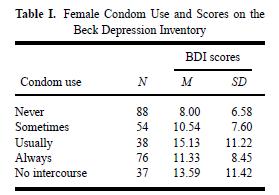
The women who reported always using condoms had markedly lower BDI scores than those who used condoms “usually”. This pattern was also present in the data regarding suicide attempts. It runs counter to the authors’ hypothesis: the women who always used condoms, by the authors’ use of condom use as a proxy for exposure to semen, were less depressed than those who would sometimes be exposed to semen.

The suicide attempts data is bafflingly high. 29% of the women in the “usually” use condoms group had reported previous suicide attempts.  The population average is about a tenth of this. It is probably that the data were gathered poorly. Given all of the other effect sizes, it is highly unlikely that exposure to semen is related in any way to a ridiculously high rate of suicide attempts.

On the whole, then, the study is shaky at best, though the phrase I would use would be “HOW THE FUCK DOES SHIT LIKE THIS MANAGE TO GET ITSELF PUBLISHED?” followed by throwing my (as yet entirely unpublished) PhD at a wall.

The Psychology Today article then flies off on another tangent, discussing human concealed ovulation, a topic of obsession for evolutionary psychologists. According to speculation, semen can force ovulation in a woman. It is such unsupported bollocks that to destroy this would be like punching a kitten in the face.

The Psychology Today article ends on an important caveat:

Now, I’m not advocating that reproductive-age people shun condoms to elevate women’s mood at the risk of unplanned pregnancy. But this effect might come in handy for women over age 50, who are experiencing menopausal blues.

There are so many things wrong with this paragraph that it is hard to know where to begin. It is commendable that the columnist thinks that unprotected fucking is not the way to cure depression. He is, however, completely oblivious to the fact that the risks of unprotected fucking go far beyond “unplanned pregnancy”. If he is, as I suspect, an evolutionary psychologist, it is understandable why he thinks that: the evolutionary psychologists tend to construct sex as something for nothing more than reproduction. He is also utterly wrong about how this effect may be useful for menopausal women. Even if we pretend that the semen-antidepressant study was done really well, the findings still only apply to young women.

In sum, then, spunk will not cheer you up or stop you killing yourself. Don’t avoid condoms unless it is safe for you to do so. The science is thoroughly awful.

If sex cheers you up, have sex, with the level of protection of your choosing. It is unlikely that it will be a magic panacea, but a good fucking is tremendous fun.

__

Big thanks to Tom, Alice and Fabi in the PhD room for reading through this drivel with me and having brilliant scientific brains

Revolutionary envy

As I write this, Athens is aflame with metaphorical revolutionary spirit, and literal fire from firebombs and the revolutionary tendency to burn stuff.

They call themselves the Αγανακτισμένων, the indignant. In parallel, the Spanish have the Indignados.

Greece and Spain are doing fairly well in terms of revolution. Srtiking images of crowds of people sick of the parasitic system they inhabit flood the news. Their efforts may prove futile in the future, but they are not without soul. It is a beautiful sight: a roiling mass of faces screaming against their masters. They have, for now at least, had enough.

Contrast with the British anti-cuts movement.

We are not indignant. We are a little bit pissed off.

There are those of us who care, of course there are. We are the ones who expressed disappointment at the failure of the March 26th marches. Some of us tried to occupy Trafalgar Square, imitating the Egyptian example. It seems to be working well in Greece and Spain, the occupation of public squares.

Our revolution is currently confined to interminable consensus meetings leading to small direct actions leading to arrests. We do not have the tipping point, where seemingly most of the population of a city runs riot through clouds of tear gas and smoke. We sit and listen to the same male voices drone about minor theoretical points.

Our “anti-cuts movement” lacks rage, lacks anger. Perhaps it is a by-product of British culture. Perhaps it is because the majority of British people see no reason to be furious.

We are not the indignant. We are the dry, the boring, the floundering; against something, but unemotional.

Is it time to become the Absolutely Fucking Livids?

Understanding men who rape and why they rape

Studying who rapes and why is a difficult task: it is far more than a simple matter of strolling up to your local neighbourhood rapist and saying “Oi, you, why did you do it?”

The first issue is that most rapists do not get caught. The majority of rapes are not reported, and of those that are, the conviction rape is very low.  Because of this, it is difficult to identify rapists to understand who rapes.

Two recent studies have addressed the question of identifying “undetected rapists”: the first, McWhorter and colleagues, used a sample of young men enlisting in the navy, while the second, Lisak & Miller, sampled college students.

In the McWhorter sample, approximately 13% of the sample had perpetrated attempted or completed rape, while approximately 6% of the Lisak & Miller sample had done so. In both samples, the reperpetration rate was high: in the McWhorter sample, 71% of the men had repeatedly attempted to or successfully raped a woman. Lisak & Miller found an average of 5.8 rapes among the repeat rapists in their samples. These findings are startling: in both samples, the rapes had never been reported to the authorities by the victim, yet these rapists had perpetrated multiple rapes. In the McWhorter study, it was found that the majority of victims were acquaintances of the rapists.

These findings are in keeping with those regarding rapists who are caught: that they frequently reoffend, and the victim often knows the rapist. The evidence is not in favour of the classic rape myths that rapists are a stranger in a balaclava leaping out of a bush. It also fails to support the folk notion that rape is something that happens just once when a man gets a little bit hot and bothered by a woman all dressed up sexy near him.

It is frightening to note the sheer quantity of undetected rapists. The McWhorter sample is unrepresentative of the general population, being young men enlisting for the military: 91% were single, and they had a lower level of education than the US average. Likewise, the Lisak & Miller sample were drawn from a particular college. However, these figures are informative about certain population groups, and it would merit further investigation into other groups using similar methodology to identify the true prevalence of undetected rapists.

To identify undetected rapists, both studies used the Sexual Experiences Survey (SES), a 13-item self-report questionnaire. This measure never mentions the word “rape”, instead asking questions such as “Have you ever had a woman misinterpret the level of sexual intimacy you desired?”, “Have you ever obtained sexual intercourse by saying things you didn’t really mean?” and “Have you ever Had sexual intercourse with a woman when she didn’t want to because you used some degree of physical force (twisting your her arm, holding her down, etc.)?” Crucially, questions in the SES do not mention the word “rape” at any point. Statistical tests have found it to be a reliable and valid measure, i.e. it measures what it is attempting to measure, and all of the items in it are distinct.

There are two major criticisms of the SES. First, it is a self-report measure, which are prone to people answering the questions in a socially desirable manner. This is the best one can hope for in this type of research: it is not possible to follow people around, videotaping their every sexual encounter to check for signs of coercion. Second, the SES is entirely focused on men’s sexual violence against women. To address this issue would improve the quality of research into rapists and why they rape greatly: sexual violence is not exclusively men against women, after all.

A further question to be addressed is why do rapists rape? One study has attempted to address this question. The researchers administered a battery of tests to men who were in prison for a range of offences, using a modified version of the SES. Although the majority of participants were imprisoned for non-sexual offences, 51% had engaged in verbally coercive sexual behaviours, and approximately 20% in sexually aggressive behaviours. There was some evidence that the self-reported measure was underestimating the number of men who raped: 85% of those who denied using sexually aggressive tactics on the questionnaire were classified as sexually aggressive due to previous criminal history. This corroborates the problem outlined earlier with using questionnaire measures.

Some characteristics were common to both coercers and aggressors. Both groups had a history of sexual promiscuity, aggressive tendencies and were poor at empathising. Furthermore, both groups were more likely to subscribe to rape myths. Belief in rape myths was measured using a questionnaire called the RAPE scale. The RAPE scale was developed from clinical work with sex offenders and validated on a sample of incarcerated rapists, therefore representing beliefs which many rapists hold. It consists of 36 items which read like a rape culture checklist, such as:

  • “Before the police investigate a woman’s claim of rape, it is a good idea to find out what she was wearing, if she had been drinking, and what kind of a person she is.”
  • “A lot of women claim they were raped just because they want attention.”
  • “Often a woman reports rape long after the fact because she gets mad at the man she had sex with and is just trying to get back at him.”
  • “I believe that if a woman lets a man kiss her and touch her sexually, she should be willing to go all the way.”
  • “Most of the men who rape have stronger sexual urges than other men.”
  • “If a woman gets drunk at a party, it is really her own fault if someone takes advantage of her sexually.”
  • “I believe that any woman can prevent herself from being raped if she really wants to.”

Belief in such myths was found to differentiate between men who were sexually coercive or aggressive, and those who were not. This study therefore provides some evidence that these rape culture myths facilitate rape, and provides an important reason to attack such beliefs wherever they are seen.

Differences in coercers and aggressors were also found: coercers were less able to imagine others’ reactions, while aggressors showed higher levels of hostility towards women, higher impulsivity and reported higher levels of emotional abuse in childhood.

As with the other studies, this sample was not particularly representative of the general population. Men in prison are different to men who are not in prison.

In general, it is difficult to study rapists, and the existing tools we have need work. Due to our current measures, it is not possible to investigate men who rape men, or women who rape, and we must rely on self-reported measures on which it is possible to lie.

What evidence is there suggests that, thankfully, not all men are rapists, and that rape culture is very dangerous indeed. With further research and a constant attack on the flawed belief system which allows rape to happen, we can fight rape.

Cunts, bitches and weeping syphilitic chodes

In a recent post, I called Brendan O’Neill a weeping syphilitic chode, and I was deluged by complaints that I had used a gendered insult. Hypocrite!  Twitter harrumphed. Look at the big mean feminist saying nasty things about men! 

I received more complaints from that one remark than I have ever received for using the word “cunt”, which, Cursebird tells me, has been 640 times on Twitter alone. A more detailed breakdown of my swearing was unavailable, but I imagine a large proportion of that was during episodes of Question Time, where I tend to tweet prolifically about how the entire panel is comprised of terrible cunts.

In fact, had I called O’Neill a weeping syphilitic cunt, I doubt much would have come of it.

I swear a lot, then. I will gleefully throw around cock, cunt, bellend, twat and ballbag with impunity. To me, anatomical terms are, as Forty Shades Of Grey puts it, just words. 

I use other body parts as insults too: arsehole, and its derivatives, for example. “You big shitting arsehole”; “you sphincter”, “you ringpiece”, e.g. I heard a fantastic anecdote which culminated in a thoroughly odious person being put down with being called a “little finger”.

I am not convinced that using a body part as an insult can be gendered. Gender is, after all, nothing to do with what is hanging between one’s legs. Men can have cunts; women, cocks; and moving beyond traditional binary notions of gender, anything goes. Anyone can have a weeping syphilitic chode.

To me, there are some slurs that do have gendered connotations. They are not disembodied parts of the anatomy. They are the words used to regulate behaviour of those who do not conform to their prescribed gender roles. Take, for example, “bitch”, which, with a variety of different uses tells women how to behave. Don’t set boundaries, or you’re a mean bitch. Don’t show more than the “correct” amount of emotion, or you’re a crazy bitch.

Some of these words are not even rude, but used to tick off women for behaving in a certain way: prima donnas, divas and drama queens. These are women who draw too much attention to themselves rather than sit meekly in the shadows.

Although I walked in the SlutWalk and self-identify as an ethical slut, I have misgivings about the word. We are in the process of reclaiming the word; it is still thrown as a weapon to attack women who fail to conform to society’s sexual expectations. I believe this word to be salvageable–a person who enjoys consensual sex–but we have far to go before the word becomes neutral.

These words are all thrown at men, too, once again to enforce gender-appropriate behaviour: if a man is a drama queen, a bitch, a diva, he is like a woman, which is supposed to serve as doubly insulting. Some feminising words are developed entirely to be hurled at men, like “sissy“. I am unfamiliar with any words which are used to enforce behaviour for men which do not feminise. If there are any, I would like to know.

It is the weapons to force me to behave in a manner which is acceptable to society that I truly find offensive. A floating anatomical part cannot hurt me. Behavioural enforcement can.

Walking like a slut

Yesterday I participated in the London SlutWalk. To concisely summarise my experience of the day, it was fucking awesome.

I arrived at the assembly point at the top of Piccadilly in a foul mood, having been rained on and repeatedly betrayed by London Transport. As soon as I found the SlutWalkers, with hundreds of heart-shaped red balloons, my mood lifted and, in solipsistic pathetic fallacy, the sun emerged.

The turnout was large. The Torygraph estimated ‘hundreds’, the organisers 5000, and the Socialist Worker will likely declare a hundred thousand glorious comrades. I was right at the back, and would easily agree with the organisers that a reasonable number of thousands of people turned up.

It was a ragtag bunch. Old and young, people of all genders and races. We were all there for the same reason: we rejected the notion that a person is in any way to blame for their rape.

As we marched down Piccadilly, heartland of the capitalist plutocracy which feeds patriarchy and commodification of sex, we shouted a chant which summarised the purpose of the day:

‘Wherever we go, however we dress, no means no and yes means yes’.

It really is that simple to me. It really was that simple to my fellow SlutWalkers.

The mood was bright, jubilant, fun; positive and accepting. Here was a band of folk who did not judge and saw no reason to be afraid of their own clothes and sexual behaviour. Every banner reinforced the message: ‘RAPISTS! STOP RAPING!’; ‘A DRESS IS NOT CONSENT’; my personal favourite, the Flight Of The Conchords-inspired ‘A KISS IS NOT A CONTRACT’. This was not a day for reclaiming the word ‘slut’. Even the mainstream media seemed to get the message. We were marching against rape. We were marching against victim-blaming.

My mother called me today to express how proud she was of all of us.

Later, as we headed to the pub, feet sore from high heels, I was reminded of why we needed to have such a march. Being in the company of thousands who agreed that clothes were not an invitation, I had temporarily forgotten that the world was not yet on our side.

A leery, beery man took my friend’s SlutWalk outfit as an invitation to harass.

I shouted at him, loudly, copiously, swearily.

I sometimes wonder if all street harassment should be greeted with an angry assertion that this is not acceptable.

In all, though, it was a wonderful day, and clearly still needed. We must remain visible and vocal. We are chipping away at rape culture. Sluts and allies are everywhere, and we will be unstoppable.

Search terms.


I occupy my days working on a PhD which includes a hefty chunk of taxonomy development. This blog is half procrastination and half catharsis from said day job. Unfortunately, sometimes they meld together. While looking through the search terms which lead to this blog, I happened upon something worrying: I was mentally taxonomising search terms.

I hereby present a taxonomy of search terms used to find this blog. They are all real search terms.

I. The relevant (these are, unfortunately, slightly boring)

1. Feminism

A. “Straw feminist” statements: “all men are rapists”, “feminists hate men”.

B. General searches for information about feminism: “what is misogyny?” “how many people identify as feminists?” “feminists and equal pay”

2. Psychology concepts

A. Relating to ambivalent sexism: “reverse scored items in the ASI”, “how to measure misogyny”, etc.

B. Relating to evolutionary psychology: “evolutionary psychology”, “evolutionary psychology critique”

C. Relating to Nudge: Only one of these so far, but it made me the happiest woman in the world: “nudge- worst book of the year”. Yes. Yes it was.

3. Names of people mentioned in this blog: Dorries and Roger Helmer MEP. I am glad.

4. This blog– searches for “Another Angry Woman” or “stavvers”. Meta.

II. The irrelevant (In which I extend an apology to all those who found this blog looking for porn, and instead ended up with feminism)

1. Searches for porn 

A. Knicker-based porn: “british woman flashes knickers”, “world’s sexiest woman giving you a glimpse of their knickers”, “upskirt orgasme [sic]”

B. Porn involving belly buttons: “fucking beautiful navels”, “sex with navel”.

C. Porn involving hairy women: “hairy woman in the world naked pic”, “big cock fuk hairy cunt [sic]”

D. The quest for fanny: the top referrer in search terms to this blog is “female fannies”. More so than searching my name.

2. Sex advice for fanciers of angry women

Invariably pertains to sex with angry women, for example, “how to make an angry woman calm by fucking”, “learn how to fuck angry woman”. For the former, I would say that fucking isn’t always the best approach to making an angry woman calm.

3. The downright bizarre

Some absolute blinders here:

“islamic view of wisdom teeth”

“drawing or picture of an angry woman with a tray full of fruits”

“black bloc badminton” I do hope this tactic is adopted at future demos. I am not sure the police would know how to react if a black bloc showed up and started enthusiastically volleying a shuttlecock.

The vast majority of searches were of the not-relevant variety, which leads me to ponder a new tagline for the blog:

“Another Angry Woman: Sorry. You probably weren’t asking for it.”

Accompanied, of course, with a drawing or picture of an angry woman with a tray full of fruits.


Anti-social sluts

This may be one of the worst things you will ever read: “These are the most anti-social sluts on earth“. It is hosted by the source of 40% of evil in the world, the Torygraph, and written by a man called Brendan O’Neill, who, judging by the article, is a weeping syphilitic chode.

The article is ostensibly a critique of SlutWalks, wherein women and allies march against the notion that a person is in any way responsible for their own rape. O’Neill”s article is, in fact, nothing more than a seething pile of misogyny and rape apologism. O’Neill’s main thesis is that women who wear a short skirt and don’t immediately fuck a man are anti-social. Really.

The high-minded feminists who make up SlutWalk’s supporters and cheerleaders seem to want to opt out of this everyday social interaction, to dress as sluttishly as they like while also being surrounded by some magic forcefield, legally enforced perhaps, which protects them from any unwanted male gaze or whistle. They are prudes disguised as sluts, self-styled victims pretending to be vixens, astonishingly anti-social creatures who imagine it is possible to parade through society dressed outrageously without any member of that society ever making a comment about or to them. This is the highly individuated politics of fear – fear of men, fear of unplanned-for banter, fear of sexual licence – dressed up as radical feminism. But to update an old saying: no slut is an island.

He actually said that. He actually said that.

There is much to unpack in that short segment–the conclusion of the article–alone. First of all is the argument that women are “asking for it” if dressed in a certain way. Secondly, that O’Neill clearly has no idea what radical feminism is. Thirdly, that O’Neill also cannot comprehend why a woman would possibly be afraid of strange men harassing them (this is, apparently, nothing more than “unplanned-for banter”).

Most of all, that women who wish to live a life free from harassment are somehow anti-social. They are the “mean bitches“, one of the roles for women who refuse to inhabit rape culture and do not follow the rules.

Not only does O’Neill believe women are asking for it, he also believes that harassment is absolutely fine and dandy as long as you don’t stick your dick in the woman.

Yet that is what some SlutWalkers seem to be demanding: effectively the right to dress provocatively without ever being looked at, commented on, whistled at or spoken to by a member of the opposite sex. Unless such interaction is clearly solicited, of course.

O’Neill’s attitude towards women is rampantly obnoxious and hideous. It is hard to believe, from his writing, that when he refers to “cocky, swaggering men”, he is not casting himself in this role. He smirks smugly at the top of the page; his face says “come on, love, it’s just a bit of light-hearted banter”.

O’Neill wishes for a world in which a woman’s mode of attire is the same as a baboon’s swollen arse: an invitation to leer, to grab, to blow beery breath down the back of her neck and vomit in her tits. He is angry that such a world does not exist, and that some women believe that such contact should only be available with explicit, enthusiastic consent.

O’Neill does not stop for one moment to wonder why this is considered unacceptable by some. Instead, he frames women who want sexual contact with consent to be anti-social. This is a strangely socialist perspective for a Torygraph article. O’Neill believes cunt to be a commodity which should be distributed fairly, and that obnoxious oglers deserve a share. From each, according to her sluttiness. To each, according to his desires.

As more women realise that street harassment is wrong and become empowered to enthusiastically consent to sex and sexual contact, men who do not respect boundaries and rape apologists become more reviled. No wonder O’Neill is frightened. He and his leery ilk are becoming less and less able to express their entitlement over women, and so write angry Torygraph articles or post misogynistic comments beneath them.

They cannot blame themselves. They lack the self awareness to blame themselves. And so they hit out at the mean bitches.

Rape apologism and this sense of entitlement require challenging.

O’Neill’s article neatly demonstrates why a SlutWalk is so necessary and timely.

“We need fewer women in politics”

These days, it seems that barely a day goes by without a politician saying something stupid or unpleasant. For example, this week Theresa May has given an interview to the Telegraph where she expresses some frighteningly McCarthayan views regarding Britishness and a veiled threat to those with radical politics.

There is a phenomenon which surrounds an unpleasant statement from a politician who happens to be a woman: some wag will invariably quip “and that’s why we need fewer women in politics”. Something similar happened with Nadine Dorries when she felt it would be appropriate to introduce a bill calling for abstinence education for girls only. The quip has been applied to Margaret Thatcher more times than she had closed mines.

Of course, it is almost always said in jest. The overwhelming majority of those who crack the tired joke do not really believe that half the population have no place whatsoever in politics. So why is this humourless feminazi so annoyed by a little joke?

This humourless feminazi is annoyed by a little joke as it taps so perfectly into a rather well-documented and incredibly irritating effect: attibuting to gender what can easily be attributed to being a dickhead.

Those who repeat the quip will declare that of course they are not sexist, and they genuinely do think that the number of women in politics should be no fewer than those that are already present. They still play directly into the hands of the system, though, and, like it or not, their quip is riddled with residual sexist attitudes and stereotypes.

Put simply, the idiocy and awfulness perpetrated by May, Dorries and Thatcher is almost completely nothing to do with their gender. What little can be attitributed to gender is that women in politics may be more likely to conform with the general consensus (laid down by a group of rich white men) due to stereotype threat. Much scholarly writing has also been dedicated to Margaret Thatcher’s performance of masculinity.

However, using dog-whistle racism to oppress, ruining sex education for a generation of young women, or destroying a country with neoliberal reforms is largely ungendered. Politicians do and say vile things all the time.

Where are the quips that Simon Hughes keeps abstaining from votes because he is a man? Where are the quips that we need fewer men in politics because Eric Pickles is determined to completely annihilate local public services? Why do we need any more men in politics when Andrew Lansley is in the process of cannibalising the NHS?

There are none. And this is because gender is irrelevant to what these politicians are doing. It is only called upon in women in a boring old joke because they are women and they are different and isn’t that funny that they’re doing politics, too?

If course we do not need fewer women in politics.

We need fewer dickheads in politics.

Porn and creativity

I have several reservations about the porn industry. Some of it is political: I would be completely comfortable with the idea of porn were it no so deeply entangled in capitalism and a system of beliefs with some distinctly unpleasant views about gender and sex–even the term “porn industry” shows how commodified sex is in this system. Some of it is personal–if I am watching people fucking, I prefer to be in the same room as them.

My other personal qualm is that much of the porn I have seen tends to be dull. It is a tedious representation of sex. It is repetitive. And it is repetitive.

There seems to be little room for creativity in mainstream porn: it is like summer blockbusters, a presentation of what the executives think their audience want to see. The plots of porn films are as hackneyed as a Michael Bay orgy of explosions; the sex presented within as thoroughly monotonous as yet another superhero origins film. Everything has been done to death. In fact, there is probably a porn film featuring vampires which is called Done To Death.

It surprises me, therefore, when I see deviations, slight glints of creativity in an otherwise lifeless industry.

Porn puns, for example. I appreciate a good pun, and the porn industry seems to be surprisingly good at delivering rather brilliant sex puns based on aspects of popular culture. It is a rather depressing thought that four hundred years ago, this niche was filled by Shakespeare.

Yet pun-based porn titles often make me laugh. Big Trouble In Little Vagina. Sex Trek: The Next Penetration. Shaving Ryan’s Privates.   Prude and Pre-juiced. 

I cannot help but laugh. Faint twinkles of imagination; thought went into those titles. It is particularly apparent when compared to other porn versions of real films, such as the obvious Edward Penishands or the horrifyingly stale The Erotic Witch Project. Even The Bare Tits Project would have been a superior title to that banal title.

A similar vein runs through the dim attempts at adding plot to porn. Bored housewives and naughty students still thrive as the storyline holding together a string of spiritlessly rehashed scenes of fucking. It is only rarely that a flicker of something offbeat is seen. What sometimes emerges is surreal and extraordinary.

For example, one film begins with a Russian tank breaking down in front of Sarah Palin’s house. The Russians wish to use Palin’s telephone to call the Kremlin. Fucking ensues.

In another devastatingly bizarre porn introduction, a couple gush over their new lemon tree and its “endless possibilities”, and bemoan the “damn lemon-stealing whores” which appear to be a problem in their neighbourhood. Unbeknownst to them, a lemon whore is stealing their lemons as this conversation is taking place.

A friend of mine once watched a porno which started with a fish falling from the sky and knocking a man out, necessitating his stay in hospital. At one point, she recalls a scene in which an operation was performed, which involved some interpretive ribbon-twirling dance and a tray of eyeballs.

Following all of these quirky introductions, the fucking is as predictable and mechanical as always. Creativity in porn will only go so far. Summer blockbusters always outsell the more interesting films.

I would like the porn industry better were it not so hackneyed. Under capitalism and under society’s current expectations of sex, the best we will get is the odd funny pun, and the occasional peculiar situation. It all leads to the same old contrived fucking.


Nudge: it’s not science, it’s ideology

The latest fad among policy-makers is using “nudges” to gently push people in the right direction. Unsurprisingly, David Cameron is a big fan of this approach, while the Telegraph are preposterously terrified of sinister nannies perpetrating mind control. In a battle between the Telegraph and David Cameron, it is difficult to choose a side. In fact, they are both wrong.

Nudge theory was put forward in the book Nudge: Improving Decisions About Health, Wealth And Happiness in 2009. It is, ostensibly, a book about behaviour change and psychology, and has been heralded as a scientific panacea for developing policy–changing risky behaviour such as smoking and alcohol consumption would lead to fewer deaths, after all.

The book was written by a lawyer and an economist. This is the first alarm bell: neither of these professions are known for their training in human behaviour. To Nudge’s credit, though, at least the authors acknowledge that economic theories have it all wrong about human behaviour: traditional economic models tend to start with the rather flawed assumption that people are completely rational. Nudge instead focuses on the social and environmental context of behaviour and the cognitive shortcuts we use while processing the world around us.

I discussed Nudge’s views on the context of behaviour and how our brains rarely think unless we absolutely have to in more detail in this post on default options, where I opened with the statement that Nudge is the worst book on behaviour change ever written. I stand by this thesis. Here is why.

There are several concepts which are important to nudge theory. The authors propose that decisions take place within a “choice architecture”, that is, the context of the behaviour. They also propose that there are two systems for making decisions: the automatic system and the reflective system. The former is unthinking, unconscious. The latter is rational. There is nothing inherently wrong with these ideas: it is nothing that surprises those in psychology or the field of behaviour change, and it is nothing that has not been extensively researched before. This book, in fact, provides a  overview of these concepts, among others, which influence health behaviour, and synthesises them into a comprehensive theory. It was published several years before Nudge and is not referenced.

In fact, given the depth of understanding of automatic processes, one might suspect that the authors’ research was a quick glance at Wikipedia’s list of cognitive biases.

The framework proposed by the authors to change behaviour is termed “libertarian paternalism”. Both words are enough to set my teeth on edge, and in oxymoronic combination my blood pressure shoots through the roof. In short, libertarian paternalism involves policymakers doing as little as possible–for example, smoking bans are verboten–hoping people will choose to perform the desired behaviour. Policymakers are expected to nudge people in the right direction.

What is a nudge? The authors provide a handy acronym for their proposed methods for changing behaviour. It is rather fudged. Nudges are:

  • iNcentives
  • Understand mappings
  • Defaults
  • Give feedback
  • Expect error
  • Structure complex choices

This translates to various simple, minimal-intervention methods, such as simplifying forms, feedback, providing information in a readable format or modifying default options.

It really is that simple, according to the authors.So simple, that most of the book is dedicated to presenting a series of nudges and things they think could work as a nudge.

To the untrained eye, it appears that Nudge is scientific and evidence-based. There are a lot of references and citations, after all. Surely that must mean it is science?

Not at all. The evidence presented seems cherry-picked. It is likely that this was not undertaken with duplicity, but rather with ignorance. For example, the authors cite a smoking cessation trial in the Philippines which used a method they deemed as nudging. They claimed great success for this intervention–in fact, the trial and analysis were undertaken poorly with a small effect. This happened in a number of places where the authors presented “trial” data; the authors do not seem to understand how best to test that an intervention works.*

In fact, Nudge presents no evidence that nudges would work better than something that was not a nudge. Again, this is likely to be due to the authors’ lack of training in the behavioural sciences. The way to test this would be to conduct a randomised controlled trial. In short, one would randomly allocate a large number of people to be exposed to a nudge, with an equivalent number of people randomly allocated to not receive the nudge. One would then see how many people from each group changed their behaviour. It is quite a simple concept, and seems to have escaped the authors’ knowledge. Instead, they repeatedly trumpet nudges to be effective with no supporting evidence.

Nudge further neglects an important aspect of behaviour change: helping people gain the skills to change their behaviour. It is no good nudging people to buy healthy food by improving labelling if they are not taught how to cook a healthy meal. It is no good providing people with nicotine patches to help them stop smoking if they are not taught how to cope with psychological cravings. Skill-training is important, and there is rather a large evidence base on the importance of training and improving self-regulatory capacity.

There is also a rather large body of evidence to suggest that higher-intensity interventions are much more effective at changing behaviour than those with less contact. So, for example, sitting down with someone and helping them write a plan about how they are going to stop smoking is better than giving them a leaflet and letting them write down how they plan to stop smoking. Nudges are inherently minimal-intervention and thus would be unlikely to be particularly effective.

Useful, perhaps, but not sufficient.

Beyond the distinct lack of evidence to back up the theory, Nudge runs into another enormous problem: even its authors acknowledge that nudges work best for well-educated Western people. This means that in using nudges, whole groups of disadvantaged people miss out on help in changing their behaviour. This seems par for the course with our current government. No wonder David Cameron likes his nudges.

Overall, though, one of the largest problems with Nudge is that after reading the entire bloody book, I was still none the wiser as to what a nudge is. The authors provide numerous examples and a rather fudged acronym, but there is still the sense that a nudge is essentially something that the authors like. As conceptualised, there is no real reason that a smoking ban should not be a nudge–it is, after all, environmental modification to disincentivise smoking. The only reason a smoking ban is not considered a nudge is because the authors say it isn’t.

Despite all of this, and following an evidence inquiry at the House of Lords, an expensive “nudge unit” has been set up and one of Nudge‘s authors called in to advise on policy.

Nudge is not science. Nudge is not a panacea towards behaviour change. It is libertarian, laissez-faire ideology formatted readably.

Nudge is not a road-map. It is a childishly-scrawled drawing of a street scene.