An anticipatory obituary for the SWP

The SWP have appeared dead in the water for months, since the revelations of sexual violence and attempts at cover-up like an inept, less popular and worse-dressed Catholic Church. And yet, like cockroaches, they have survived.

The latest horror to come to light is a phrase uttered to applause at their conference:

We aren’t rape apologists unless we believe that women always tell the truth – and guess what, some women and children lie

At best, this statement can be interpreted as unabashed, unapologetic rape apologism. At worst, one wonders why they’re laying the groundwork for smearing children who have survived sexual violence as liars, and what else may emerge.

Following this statement, the SWP has once again haemorrhaged members, and some are once again celebrating the death of the party. I hope this is true, but sadly I suspect that we’ll be seeing this gang of misogynists shambling on, long outstaying their welcome. After all, they’ve survived this long.

Part of the problem is the SWP are everywhere. As well as their folding tables and newspaper salesmen, and the chap who shows up with a legion of placards screaming the SWP branding, you’ll find them in other places. They get themselves elected into positions on trade unions. They have a number of front organisations, including Unite Against Fascism, Unite The Resistance and Right To Work.

There’s a lot we can do to hasten the demise of the SWP. First and foremost, we absolutely must not organise with these fuckers. We must not organise with the SWP itself, and we must not organise with the front groups. This is harder than it sounds, given they have attempted to monopolise resistance, but it’s absolutely crucial if we are to take a stand against sexual violence.

We must make sure that they are completely and utterly unwelcome in our spaces. Wherever there is a SWPper, have the words “misogynist” and “rape apologist” ringing in their ears, as anyone with principles left long ago. Vote them from elected positions, and scream at them in the streets. If they do not leave, direct action may be necessary. Be critical not just of the SWP, but those who try to defend them, like the AWL did.

This is not a ban. It is simply standing up.

And finally, we need to create a climate wherein misogyny and rape apologism are thoroughly unwelcome in all of our organising spaces. It’s not enough to challenge it when it comes from the SWP–after all, everyone hates them. We need to put the necessity of safer spaces front and centre in all that we do.

I look forward to the demise of the SWP. I look forward to the demise of misogyny in my organising spaces even more.

Further reading:

I heard you have an SWP problem (thenameoflove)

Kill the SWP inside your head (me)

Things I read this week that I found interesting

Greetings everybody. Have you been listening to the new Beyonce album? Isn’t it amazing? Anyway, in between that and all the drama of this week, I managed to read some things and find them interesting. Here they are.

As a black feminist, I see how the wider movement fails women like my mother (Lola Okolosie)- Amazing piece celebrating the largely invisible achievements of black feminism.

Does talking about race fuel racism (End Racism)- A must-watch video conversation.

A Storify about consent within feminism and who it applies to (Flavia Dzodan)- Important points about where feminist rhetoric is failing. Very much worth reading.

Soho police raids show why sex workers live in fear of being ‘rescued’ (Molly Smith)- The impact of anti sex work laws has horrific consequences for workers. Read all about them.

fair (Taking Steps)- Heartbreaking post on growing up trans under patriarchy.

5 Reasons I’m Here for Beyonce’, the Feminist (crunkfeministcollective)- Short and sweet explanation of why Beyonce is amazing.

Why White Feminists Are Mad At Beyonce (Julia Sonenshein)- An overview of white feminism versus Beyonce.

Beyonce’s new album should silence her feminist critics (Mikki Kendall)- Truth.

The everyday microaggressions I experience as a black woman in Berlin (Bim Adewunmi)- Bim gives some examples of everyday racism.

21 Racial Microaggressions You Hear On A Daily Basis (buzzfeed)- The issue of microaggressions is visible this week, which is vital for this to change.

Can a feminist wear high heels? Is the Pope a Catholic? (The Life and Times of Jude)- Jude drops some truth bombs that shouldn’t need dropping.

Myths About Gender Confirmation Surgery (Brynn Tannehill)- Busting myths about GCS.

And finally, the best feminist music videos of 2013. Sadly, published before Beyonce dropped her new album, so missing 17 of them, but there’s still some amazing stuff in here.


Lucifer, literally. Or, yes, I am jealous. Yes, I do want to drag you down.

Content note: this post discusses rape, transphobia, disablism, racism and abuse. 

There are a lot of women who I can say make me feel jealous. And there are a lot of women who I would like to drag down to my level of misery.

I envy the women who think a few tweets with four-letter words in them telling them they’re wrong is abuse. I know abuse, both online and offline. Online, even the death and rape threats, the sustained harassment and the attempted doxxings fade into insignificance next to what has happened to me in the meatspace. There’s only one thing that happened to me that I “count” as rape, because it was violent and it involved the word “no” being ignored a lot, but I wonder if internalised rape culture myths have left me discounting other very coercive sexual experiences. There was the emotionally abusive relationship wherein my head was being so fucked with I couldn’t even consent. There were the attempts to somehow correct me. I’ve been manipulated into sex I didn’t necessarily want more times than I can count.

And beyond the physical stuff, there’s all the verbal assaults, the slutbitchdyke stuff which is supposed to keep me in my place, and keep me down. I am simultaneously frigid and fucking too much. These slurs based on my sexuality and on my femininity serve to support and enable the sexual violence.

So yes. I’m deeply jealous of anyone who thinks that a couple of rude words on the internet are in any way comparable with all of this.

I envy the women who believe certain oppressions cannot possibly exist. The ones who believe biphobia isn’t real, so can’t possibly hurt. The ones who believe that I cannot possibly have a disability because I have a job and am capable of articulating my opinions, blissfully ignorant of the fact that if I didn’t have the former I’d starve and die, and if I didn’t do the latter the silence would gnaw away at my soul, and that I’d rather be able to focus on taking care of myself than grind away to survive and defend myself.

I envy those who think transphobia isn’t a real thing, or those who think it’s just a little intellectual squabble, a petty parlour game. I have held someone I love in my arms more times than I care to count, comforting against the vicious assaults. I have dried tears of people I care about as their very existence is questioned, and spent long hours reiterating that mere existence does not make one scum, or a rapist.

I find myself in similar situations with my sisters of colour, talking through racism that has been too often denied, providing support where I can, because there’s a lot of lucky women out there who believe that the only manifestation of white supremacy is a KKK hood or an EDL flag.

I find myself wishing I could be like those other women, the ones who don’t have to see this, the ones who can sit comfortably and believe that nothing is wrong. It must be so nice, having so little to worry about. It must be lovely, not having to check oneself at all, with no knowledge of one’s own complicity in this oppressive power structure. It must be absolutely fucking brilliant, being able to feel like they can actually do things and achieve things because the magnitude of the problem is largely invisible.

And it makes me angry, and it makes me want for them to see what I see. It makes me want to prop open their eyes with matchsticks and scream “LOOK AT IT. FUCKING LOOK AT ALL OF THIS.” It is a miserable thing, seeing all of this, and I want them to be down on my level of misery so we can actually begin to maybe solve these problems.

I am Lucifer, literally. The light bearer, illuminating the injustices that they do not see. And it’s not just me, it is all of us who see it, all of us who have had enough and want to point it out. We shine a light in the direction of just how deep the rot goes, and just how much of a battle we have left to fight.

And of course, this is not a popular position. Nobody wants to see it. I sure as shit wish I couldn’t, but because I do, the only option left open to me is to oppose it, fight it, hope that perhaps one day it will shift and do all that I can to help this on my way.

I want you to see what I see. I know it will hurt. But you need to see it to destroy it.

__

Thank you,  @veidtlemania, for calling me Lucifer. ❤

“I see it too”

Content note: this post discusses gaslighting, a form of emotional abuse

One of the films I find myself revisiting from time to time is Gaslight. It tells the story of a young woman–played by Ingrid Bergman–who marries a villainous man who is out to steal some jewels left in her family home. His search is noticeable, so he tries to convince the woman that she is mad so she will not notice. His evil plan almost succeeds, except it doesn’t, which is why I love this film rather than it being a horrible, miserable experience to watch.

Towards the climax, someone else sees the gaslight dim. Bergman’s acting in this scene is beautiful, going from certainty of her own madness to relief–and almost joy–at reality finally breaking through. From this point on, she is empowered to take down her villainous husband. And, my god, she does it gloriously.

The moment where someone says “I see it too” is often all too precious. I’ve written before about how differences of opinion under an unequal power structure often result in gaslighting, but the problem often goes beyond this. Microaggressions so often mean that someone’s very experience is completely trivialised if they dare draw attention to what is happening. It’s all too easy to be made to feel as though you’re imagining something when all around you people are refusing to acknowledge it.

Yesterday, I blogged about a level of biphobia which is considered acceptable in feminism. I was anxious about posting it, imagining a pile-on of people saying that it was all in my head, that there was nothing wrong with the comments made about me, that biphobia isn’t real anyway. It felt so good to hear that other people saw it too. Indeed, with the exception of literally one comment saying “I’m bisexual and this isn’t my reading”, what happened was overwhelmingly supportive. Other women like me had been feeling this too. Other women like me had been feeling this too, and thought it was only them.

Likewise, sometimes someone will put into words a problem I have experienced that I felt like I was alone in feeling. Another person saying “Yes, I see this. No, it’s not OK. No, you’re not imagining it” always fills me with a rush of relief. It gives me the strength to keep on fighting, knowing I’m not fighting something completely imaginary.

Pointing out that the gas has dimmed is a small act, but one which is deeply meaningful. We spend too much time being told that the truths we perceive are not there, and this is a profoundly draining experience. We are made to feel as though we have lost touch, when in fact it’s not us at all. It shouldn’t be a radical act, saying “I see it too”, but it is, because in doing this we are jamming the system and forming rich bonds of solidarity and sisterhood.

I pay it forward, because I have no way to pay back the gift that others have given me. I make sure I tell women that I see what they’re seeing, and I think it’s awful. I know just how precious it can be, and I want you all to know just how much I need to hear those words occasionally.

Smugsexual and the closet: two faces of feminist biphobia

Over the last few days, I have found myself experiencing a shuddering anxiety which had been at bay for years. I’ve been made to feel ashamed for my queer, poly sexuality. I have been made to feel like maybe I should just shut the hell up and stop being so open about this part of my identity, because it’s bad and wrong and whatever the hell else. I know, in my head, that this is just how heterosexist patriarchy wants me to feel so I will stay in my allocated place. That doesn’t stop it getting to me.

It all started with a complicated situation wherein a feminist blogger started attacking a feminist woman of colour, seemingly inexplicably. The aggressor then wrote a blog to defend her stance, in which she decided to air her grievances with a number of other women. It has been critiqued here, by Sam Ambreen. In it was the following line, which rang a few alarm bells for dogwhistle biphobia:

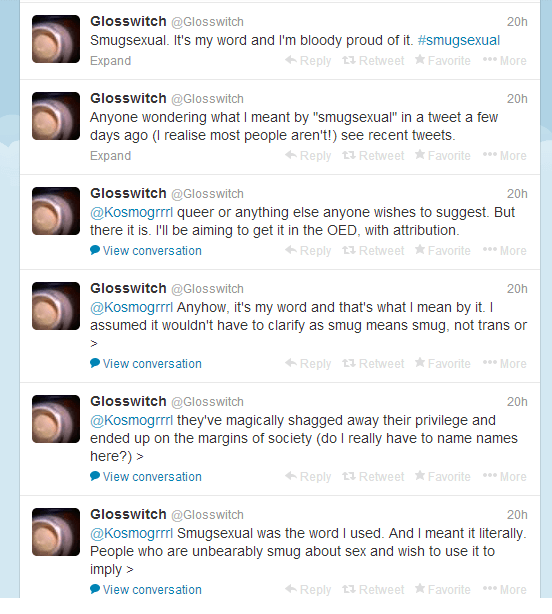
I will not go along with the lie that any white, cis, middle-class blogger who announces she is [made-up word] sexual is therefore just as oppressed as those she claims to represent.

When challenged, it became all the more obvious what she was driving at. I should note from later tweets, one of the people she means here is me:
Glosswitch  Glosswitch  on Twitter

All together, this “smugsexuals” rant displays a number of tropes which occupy the intersections of biphobia and misogyny, and I’m not even going to go into how blatantly little she doesn’t understand how intersectionality and privilege work, as this is fairly self-evident. First is the assertion that queer sexualities are “made up”, that any language we use to describe our experiences is somehow not real. I’d have thought we’d moved to a position where we could at least acknowledge that some people don’t fall neatly into little filing drawers marked “gay” or “straight”, but between this and the nonsense surrounding Tom Daley’s coming out, it is abundantly clear that we still haven’t even gained this little bit of ground.

Second is the implication that queer folk are attention-seeking, embodied in this mention of smugness. This notion of “attention-seeking” is levelled at bi and queer women far too much, and it’s tangled in all sorts of hideous assumptions about queer sex and what a woman should do. Heterosexist patriarchy wants us to be quiet, keep our pretty little heads down and if we stray outside the norms we must be doing it for the attention of men.

I am open about my identity because it’s a part of me that I spent a long time coming to terms with. And I also talk about it a lot because I know that when I was coming to terms with it, seeing people being out and unabashed really helped me understand, and gave me the courage and strength to be out myself.

My friend Charlie wrote this beautiful and heartfelt post a while back about how straight people often ask why her sexuality is so important to her. There is such an assumption amongst straight people that we’re just going on about it and obsessing over one aspect of ourselves, while nobody ever pays any attention to straight people talking about marriage and dating and so forth. It’s the same thing, our lives are just… well… queerer. Our love is important to us. This is a given.

Ultimately, it doesn’t really matter what Glosswitch intended when she developed this brand new slur to smack down queer women with. What she has said takes place against the backdrop of policing of women’s sexuality, of a societal disgust levelled at queer people. This “smugsexual” slur is just a shorter word for what is usually yelled at us.

And it’s facing this, and seeing it go relatively unchallenged, hits me. It took me a long time to overcome all the horrible stuff I had internalised, and having it repeated and spat back into my face really fucking hurts. It’s enough to make me want to go back into the closet.

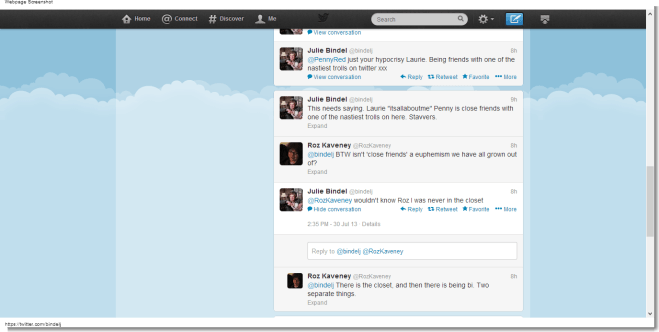
…except, according to the other face of biphobia considered acceptable in feminism, I’m already there.
Julie Bindel  bindelj  on Twitter (1)

This position is rooted in a feminism which likes to police women’s behaviour and coerce them into lesbianism, and it’s not like Julie Bindel doesn’t have a track record with this. It was because of the dominance of this feminism–in conjunction with general societal monosexual supremacy–that I still sometimes find myself saying I am a lesbian rather than being truthful about who and how I love. The expectation of this kind of feminism is that we should pack away a part of ourselves, stick it into a locked box and bury it under six feet of concrete, rather than living and loving to the fullest extent possible.

This kind of rigid feminism is, thankfully, in decline, and I expect to see less of this kind of rhetoric in the future. What we’ll see more of, though, is this new biphobia. As @nanayasleeps puts it, we’ve gone from “the love that dare not speak its name” to “the love that will not shut up”. Where once we were silent and we hid in the shadows of the closet, we are now too loud, too unreasonable, asking for too much and waving our sexuality in the face of others.

Bisexual people are more likely to suffer from mental health problems than lesbian, gay or straight people, and it’s unlikely that our sexual orientation is a product of our madness. Rather, it is because we end up facing an ugly pincer manoeuvre of prejudice, from all corners. We are told we do not exist, and when we point out that we do, we are told to fuck off because we’re being smug about it. It is a grinding daily stressor, with little support offered to us, as most deny that biphobia even exists.

There is nothing more scary to heterosexist patriarchy than a queer woman who is not afraid to speak out, who cuts through the silence like a hot knife through butter.

I love people of all genders. I am satisfied with my sex life. I am at peace with the fact that I am not like the others. I am secure in the knowledge that I know who I am, and I kind of like it. If that makes me smug, so be it. I wish nothing but smugness on the rest of my queer sisters.

Edit 10/12/13: For the record, Glosswitch replied. Here are her tweets: 1 2 3 4. Here is how I responded: 1 2 3 4 5 6 7.
Things I read this week that I found interesting

Good afternoon, darlings. I read some things this week. Would you like to see them? As always, please do drop things in the comments which might interest me.

New insights into gendered brain wiring, or a perfect case study in neurosexism? (Cordelia Fine)- Cordelia Fine smacks down the latest “male and female brains are different” nonsense, and it’s magnificent.

Mandela will never, ever be your minstrel. (Musa Okwonga)- Bloody hell, just read this.

Three Myths about Mandela Worth Busting (Tony Karon)- …and this.

My Mandela Tweets (BlackAmazon)- …and also this.

cis women are cisgender even if gender essences aren’t real (radtransfem)- A really good conversation starter.

A few words on privilege… (Paul Bernal)- A rich white cis guy writes about privilege, and says something that isn’t awful. Really.

The Discomfort Zone (Tressie McMillan Cottom)- An excellent takedown of the “white people learning about structural racism is as bad as racism itself” narratives, framed around a recent US case.

When is it appropriate to gender things? (Milena Popova)- A PSA about gendering objects.

[untitled] (How are you I’m fine thanks)- Heartfelt cartoon about body image.

Student protests are changing tack – and facing heavy police repression (Aaron Bastani)- Aaron describes the current state of the student movement and the frightening state of policing.

The University is dead… and cop free zones! (copsoffcampus)- The case for making university campuses police-free areas.

‘Dear Vice-Chancellor’ – a porter’s resignation letter (libcom)- A porter at Sussex Uni resigns over outsourcing, with the most glorious resignation letter.

And finally, want to know how to be a feminist? These stock pictures should help.

Ira must stay.

Irina Putilova is a Russian LGBTQ activist. She fled the country and sought asylum here in the UK because the persecution of queer people and activists in Russia put her in danger.

Unfortunately, UKBA do not want Ira to be safe from imprisonment, from raids and state harassment, from attacks. Yesterday, she was taken to Yarl’s Wood–the detention centre which deported a witness to institutional sexual abuse. She risks deportation within days, and it is very likely that she will be imprisoned indefinitely if she is sent back to Russia.

Ira’s case is complex, and it is thoroughly inappropriate to fast-track sending her back into danger, even by the standard of the skewed and violent rules created by abusive xenophobes.

There are some things you can do which could help Ira and persuade the government not to send a queer person into a situation which could endanger her life. Please share her story, and make sure it is visible. Ask journalists to cover what is happening. You can also write to your MP asking them to make a statement in support of Ira–there’s a model letter here, and you can get your MP’s contact details here. Tomorrow–the 8th–there will be a solidarity demo at 6pm outside the UKBA offices at London Bridge, which you might like to attend.

And finally, remember that what is happening to Ira is sadly far from unusual. The immigration system is racist, and exploits intersecting oppressions. You might like to become active in “No Borders” work to try to end this system once and for all.

No person is illegal. Ira must stay.

Edit 9/12/13: Ira has been released! This is brilliant news, and shows how much showing support for asylum seekers can achieve.

ACAB, AJAB, &c., &c.

From last night, two horrible stories about the police, reflecting how all cops are bastards. The first involves a peaceful university occupation. Students occupied Senate House in solidarity with staff. The students were violently evicted by police–including the TSG–within a few hours. Several were arrested, and some were assaulted by police. The second story took place that same night in Soho, where the police charged in and arrested sex workers, using the excuse that the women were “handling stolen goods”.

In both of these instances, people have been harmed by police, and it looks like the filth had a busy night being utter bastards. So surely the media have been busy with their unbiased reporting?

Er, obviously not. We live in a country where journalism mostly consists of regurgitating press releases. This is fairly evident in the Evening Standard’s reporting of the Soho raids, especially when it is compared to what sex workers are saying happened on social media. Unfortunately, there doesn’t even seem to be a will to listen to what sex workers say: observe the feeble excuses coming from journalists in this thread on being called out for not bothering to cover the story.

Meanwhile, the Guardian is reporting on the Senate House eviction, and has even posted a video of some of the police violence. The video clearly shows a police officer punching a protester, so it is somewhat perplexing that the Guardian has seen fit to put scare quotes around the word “punch” in the headline.

We’ve seen it throughout Leveson, and I don’t doubt we’ll see this again and again. The media is firmly in the pockets of the police. Rather than a free press, what we have is an extension of the police press office. This grip is maintained partially through a mutually beneficial arrangement, but further because these days, journalists don’t seem interested in doing research, in listening and stepping outside of their media clique and actually criticising the establishment that serves them.

The police perpetrate violence, and the media gladly covers for them. Remember this.

Things I read this week that I found interesting

This week, a lot of the stuff I read was about the Vampire Castle. In the interest of sour-faced identitarian piety and following my priest’s desire to excommunicate and condemn, I put all that in another post. Meanwhile, here’s some other stuff.

Dumbing down feminism for the working class is tedious and offensive (Dawn Foster)- Dawn knocks it out of the park here, and says some very important things.

Monosexism: Battling the Biases of Biphobia (Erin Tatum)- A really good primer.

Intersectionality for 7 year olds (Disabled Feminism)- A really sweet story about how a woman explained intersectional feminism to her seven year old.

Your Ability to Can Even: A Defense of Internet Linguistics (Tia Baheri)- Cool piece about how we talk on the internet and I rlly enjoyed it so

Being transgender and transitioning doesn’t make me brave or courageous (Entirely Amelia)- Important piece on courage narratives.

Maybe it’s more important than you think (fearlessknits)- A personal post about the importance of queer sexuality.

Public bodies (sometimes it’s just a cigar)- An examination of how women are still seen as property.

And finally, have some ridiculous street posters.

Bored now: Communiques from the Vampire Castle

I don’t doubt that many of you who follow “left” politics will have come across Mark Fisher’s essay “Exiting the Vampire Castle“. I would like to say how grateful I am to Fisher for writing it. His analysis is so far off the mark throughout that it manages to lay bare major problems which plague our organising, and  has empowered those whose analysis serves to justify these problems to make themselves known. It shows us a movement which is desperate for leaders, any leaders, who must be above criticism. It shows us a movement where any woman who asks to be treated as a human must be bourgeois, even as a millionaire white man somehow qualifies as authentically working class. It shows us a movement which uses pseudotheory to validate threatened entitlement and maintain a status quo. I could at this point compare this shambling, dated mess intent on cannibalising class solidarity to the point it only extends to white men to a zombie; I shan’t because this debate is already saturated with mythical beasts.

At any rate, some good writing highlighting the myriad problems has emerged. I have little to add to this discourse, so will link to the critiques. I will add more as I find them. All of these are worth reading, as this analysis is so poor that there are many facets to critique.

B-grade politics and reaction (Angela Mitropoulos)

K-Punk and the Vampire’s Castle (Not Just The Minutiae)

Brocialism (Recording Surface)

All hail the vampire-archy: what Mark Fisher gets wrong in ‘Exiting the vampire castle’ (Ray Filar)

Vampires aren’t actually real, though. Class is: a reply to Mark Fisher’s castle of bollocks (Cautiously Pessmistic)

Damn these vampires (synthetic_zero)

A neo-anarchist vampire bites back: Mark Fisher and neoconservative leftism (Automatic Writing)

Gothic Politics: A Reply to Mark Fisher (Matthijs Krul)