I’m in the Occupied Times writing on media feminists and intersectionality.
Author: stavvers
Sexism from “the left”: why it has to stop
A spectre is haunting the left. The spectre of feminism.
I expect nobody is as annoyed by that opening line as me, but it got stuck in my head and I had to write it down somewhere, and here’s as good a place as any. I’m sorry.
I’m writing this in a fit of fury at the latest manifestation of left sexism, having spent two days in an argument with a left-wing man and a lot of his left-wing mostly male followers where they have been absolutely refusing to see the point I’ve been trying to make. Of course, this isn’t the first time something like this has happened, and it certainly won’t be the last unless something absolutely spectacular gives right at this moment. As I can’t hear the sweet sound of kyriarchy falling over and smashing into dust, I can only assume that all of this is going to happen again in due course.
Sexism on the left comes in forms as diverse as the beliefs of those who are lumped under the umbrella term of “the left”. The most overt form, perhaps, is outright sexist language (bitch, etc), and rape apologism (e.g. George Galloway, the SWP), but that’s the tip of a very sexist iceberg. Among the liberals, it often comes as a backlash against calling out sexism and pleas for unity. For some, sexism is a problem to be solved later, and we should, at present, fight the perceived “real enemy”. Then there’s the manarchists, swinging their dicks as they ignore their female comrades. There’s also those who can say all of the right words, and then their behaviour doesn’t match up at all, and they will defend their behaviour using theory that they learned and are apparently incapable of applying to themselves. Others still think that they’re doing more than enough already to combat sexism. Then there’s the ones who insist that intersectionality is somehow equivalent to identity politics, proving that they are ignorant about what at least one of these things is. This is hardly an exhaustive list. Left sexism manifests in so many ways.
It all has one thing in common: that self-assurance that they are completely right which comes with male privilege.
The impact of sexism from those who are ostensibly on my side is different to that which comes from those who are unequivocally not on my side. While I’ve written about my “oderint dum metuant, fuckers” mentality when it comes to dealing with abuse, it’s much harder when it’s the insidious sexism of the left. It’s more wearing by far, as these are men who genuinely believe they don’t hate women so definitely aren’t sexist, who think they’re doing their bit to fight sexism. So they react defensively when it is called out, and are backed up by other men, who I can only assume are terrified of the creeping feminist threat coming to get them too. It doesn’t help that society–and indeed, the way we organise–immediately constructs “saying something sexist” as “being a bad person who needs to be purged”. This means it’s very difficult to call out dodgy behaviour without it turning into a massive attempt at denial to avoid being lumbered with the identity of “sexist pigdog”.
Let it be known, male comrades, that I’ll probably only think you’re a sexist pigdog if you react badly once the problem’s been called to your attention. Privilege blinds the privileged to its presence, and ignorance is forgivable. Once the curtain has been opened and you have an opportunity to reflect upon your own unexamined privilege, it’s your responsibility to do this.
I tend to be politer when I encounter left sexism than usual, and this is largely because I often have to organise with at least some of these people (although I refuse to organise with some of the worst). It turns out that when I’m polite, it has an incredibly devastating effect on my emotional wellbeing. As you may have noticed, I shout and swear. It’s kind of cathartic for me, rudeness. When I bottle it up, the anger turns inward, leaving me anxious and close to tears with frustration. I dwell, and it’s fucking horrible for me. I’m not quite silenced, but restrained, and it eats away at me.
And often, because of this, I don’t bother challenging it at all, because I know exactly how awful it would be for me. There, I am effectively silenced.
This is exacerbated, at least in part, by a prevalent belief that everything is a matter for debate. This debate ought to be held cordially and civilly, ending with either agreement, or at least by politely agreeing to disagree. For the privileged, it is perfectly easy to view oppressions as a sort of intellectual game and little more than a topic to agree to disagree on. For those who experience these oppressions, it’s not that simple and it’s not a fucking game. And so we’re branded as over-emotional about things which we don’t have the luxury of turning off our emotions on. It’s a thing we face every day, and its very existence is being denied and defended by those who claim to be on our side.
I feel like I’ve written my fingers to the bone on how we really need to get all of the shit out of our back garden before we can get things done, and I can’t believe I’m having to do it again and again. All of this oppression is connected, and all of it needs to be challenged. This time I’m aiming this same argument I’ve put forward a dozen times before at the men on the left who exhibit sexism.
If you want unity on the left, then listen to those you’re (probably inadvertently) shitting all over. Listen up and be an ally. It makes me sad when I feel a bounce of pathetic gratitude when I talk to men who Get It and behave as good allies. That should be the norm, not the exception. That it isn’t is alienating for many, and nothing ruptures a movement more than (probably inadvertently) pissing off more than half of the population.
Men on the left, try to be better. Feminist struggle is not an add-on to class struggle, and sexism is not a small problem, because all of this is intimately connected. If your revolution is one-dimensional, I want no part in it. Be open to being wrong, and be open to being corrected. It will strengthen us, not weaken us. Be reflective and thoughtful, acknowledge and abolish your own blind spots.
I want men on my side who I am proud to call my comrades, and there are far too few of these. I want to see better, and I want you to be better. We have a world to win, and I’d like to be comfortable organising with you. I’m one of those who feels able to say this, yet there are many who cannot, silenced against sexisms on all sides.
In truth, there’s no such thing as doing enough to work against sexism. It’s a vast, structural issue, and, as such, requires vast efforts to bring this system down. I’m not doing enough myself. No matter what anyone is doing, as an individual, it isn’t enough. If you’re a male ally, accept that you won’t be getting pats on the head for your good work, and if you’re doing any of this to get a pat on the head in the first place, fuck right off.
We really, really can win these interconnected battles, though, if only we recognise the connected nature and start to challenge our own privileges and prejudices in the most important place: within ourselves.
__
Note on terminology: I have come to despise the term “the left”, signifying a diverse range of beliefs and ideologies which share almost nothing but a few common enemies. Often, it feels like I’m not on the same side at all as a lot of those who profess to share enemies with me, since I disagree with many about issues such as tactics, the role of the state and intersectionality. While I don’t feel that “the left” is a particularly meaningful category, I use it here as shorthand for that umbrella term of those opposed to those who definitely aren’t on my side, who are themselves classed as “the right”.
Also, obviously I’m oversimplifying when I say “men” and “women”. These problems also manifest in the form of cissexism and bad assumptions about gender, something which I, as the most cis woman on the planet, am occasionally guilty and am receptive to being called out on. “Men” can be read as “cis men”, and “women” to be “those who they oppress, who are often, due to statistics, cis women, but also covers trans people, intersex folks, genderqueer and non-binary identified”. Come to think of it, women is a terrible term, but I’m leaving the cis privilege I exhibited when writing this intact as I’m crap at rephrasing things effectively. Help appeciated in the comments 🙂
PE lessons
Things I read this week that I found interesting
Yes, it’s that time of the week again. Here’s some things I read this week that I found interesting, and you might find them interesting too. Also, please share more things that may interest me in the comments.
Reeva Steenkamp (Guardian)- you’ve read a lot about Oscar Pistorius. Read about the life of the woman he killed. It sounds like she was an amazing human being.
White Feminists (TM)- Page Three (Funny Grrrl)- a discussion of class and race issues in the No More Page Three campaign. In short, race very absent, and the campaign is really quite classist.
Exposing the sexism on the pages (Squeamish Bikini)- interesting points about how objectification doesn’t have to involve nudity.
Why No More Page Three is a bad idea in almost every way (Hunter not the hunted)- An very thorough analysis of the flaws of the No More Page Three campaign, picking up some stuff I missed.
Men, we need to engage with women (A dragon’s best friend)- A quick call for men to get better, with a few interesting thoughts on political institutions and squeamishness about bodies.
Django deconstructed: returning Tarantino’s “gift” (Justin Struggles)- Justin analysis Django Unchained, and is fairly unhappy with how the film handled race.
Beyond Silk Roads– Analysis of homosexuality in China and Japan, right up until the beginning of the 20th century.
And finally. As you might be able to tell, I’m furious at Murdoch this week. Here’s a video from back in 2011 of me and some mates torching the last issue of News of the World in a mock funeral. I hope we are doing this for the Sun before long. And then the Mail. All the while muttering “you’re next”. Yes, the bearded man is Mediocre Dave, before you ask.
Fuck the Sun.
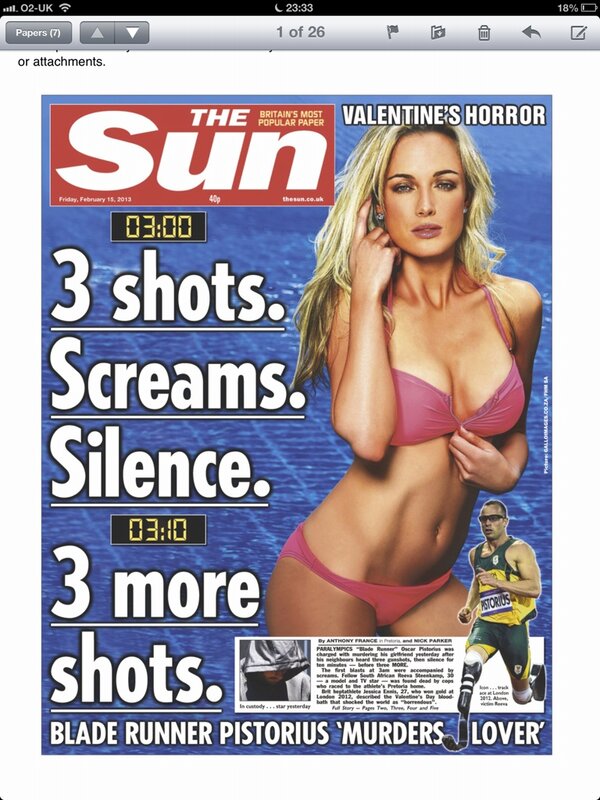
The woman, pictured in a bikini, positioned carefully by the editors to invite leering. She was killed. The headline, sensationalistic and lurid. The scare quotes, trivialising violence.
Her name was Reeva Steenkamp, not that you’d know from the reportage. It’s irrelevant to them.
This is hardly the first time I’ve been appalled by the lows to which this vile rag can sink. I am shocked and sickened, but not surprised. This is par for the course for The Sun. This is not new, merely different.
I have spent the last few days arguing with defenders of the No More Page 3 campaign, and when I see this I wonder how anyone can continue to argue that the page beneath this is the problem.
It’s how these bastards operate. I don’t doubt that this will sell well, and our disgust will be dismissed. It happens every single fucking time they do this.
Come and perv on the dead woman. Stay for the sensationalism and trivialisation. It’s just another method of exploitation that can be marketed, and our society is fucked enough to buy.
Why I never signed the No More Page 3 petition
The other day, while I was busy being snowed on outside a courthouse that had been locked to keep people like me out, there was apparently a development in the ongoing No More Page Three campaign. It had sort of passed me by, I’ll admit; the only news that day that came to my attention was the papal resignation (it’s alarmingly disconcerting to emerge from the toilet to discover the pope’s resigned. Makes one wonder just how unholy one’s urine is).
It seems, though, that Rupert Murdoch has alluded to modifying Page 3 to make it all fashionable or something, and possibly taking the boobs off the dedicated boob-page. This has breathed new life into the No More Page Three campaign, and it’s been everywhere once again.
I’ve tried to bite my lip on the No More Page Three campaign, being painfully aware of my burgeoning reputation as that feminist who spends too much time shouting at other feminists, and thinking it ultimately rather harmless and easy to ignore. The thing is–to use a figure of speech befitting the theme–the No More Page Three campaign has been getting right on my tits. At best, it won’t get much done, and at worse, its supporters will think this lack of things getting done is some sort of a victory.
Let’s start with a tweet from an online repository of jokes, many of which are sexist, ableist, racist, cissexist, heterosexist and any other form of oppression you can name (and probably some that don’t even have names):
So, Rupert Murdoch is considering axing Page 3 of The Sun. He should axe pages 1-2 and 4-76 while he’s at it.
— sickipediabot (@sickipediabot) February 11, 2013
Strangely, this tweet actually manages to Get It far more than vast swathes of the No More Page Three supporters. The Sun is a buzzing wasp nest of misogyny: itsjustahobby documented just a day’s worth of sexism in the top stories of their website alone. I find Page 3, with its large picture of boobs taken with the woman’s consent, actually somewhat better than all of the other pages of longlensings and body-shaming and gleeful rubbing over celebrities and their mental health, and so forth. That’s not even including the frequent bouts of overt racism, homophobia, transphobia and ableism that pepper its foul pages. The whole publication is absolutely fucking vile, and participates actively daily in outright harassment of women who have the misfortune of being famous, or poor, or brown, or whatever other excuse they can conjure to invade their privacy and pretend this is somehow in the public interest. Whether words or images, all of this is irrevocably harmful to both the individuals “exposed” by this pathetic excuse for journalism, and to society for thinking believing the propaganda in the Sun is anything other than hideous.
And when you think about it that way, you realise that the whole of the media is rotten all the way down: all of the tabloids stoop to the same low tricks as The Sun, and everyone else is complicit. They all revealed their true colours as they closed ranks against the findings of the Leveson Report. Combatting a single page of a single newspaper doesn’t even leave a dent in this apparatus. It feels almost like going after this one page legitimises the rest of the sorry mess by its omission to even address this.
Now, one could say this campaign is a transitional demand in ending the objectification of women. However, that’s ignoring the fact that objectification is itself a symptom; the problem of objectification did not magically spring from nowhere: it is a product of capitalist patriarchy. Sex sells. And to end that, one sort of has to absolutely rip this shit out at the roots and enact a global revolution, which is a bit of a big ask for liberal feminists. Even on its own terms, getting rid of that single page in a single newspaper won’t exactly do much for ending the objectification of women, because this shit is absolutely everywhere.
However, that’s assuming that No More Page Three is actually about objectification, which many of its supporters argue it is. I’ve read the text of the No More Page Three petition. I read it before deciding–with all of these criticisms already in mind–not to sign it. And it is just about boobs. It’s literally just about the presence of boobs and how they’re not on This Morning and other such stuff. I couldn’t agree with the fact that boobs shouldn’t be in a “family newspaper”, which is all that the text of the petition said, so I didn’t sign it.
And actually, if anything, we need more boobs everywhere. Diverse boobs. Parents breastfeeding openly, pictures of all colours and shapes of boob captioned “look, boobs, aren’t they pretty?” and boobs depicted like they ain’t no thing, because a lot of people have boobs. And not just boobs: cunts and cocks and bums and naked bodies in all their glory. Willingly shown. The human body is kept a mystery, and nobody knows what’s normal these days: the truth is everything and nothing. When I was young, I thought I had a weird cunt because it looked nothing like the narrow range of cunts society saw fit to show me: textbook illustrations and porn. It was only when I started fucking other women that I became sure there was nothing wrong with mine. The naked body needn’t be anything to do with sex (although it’s nice when it is), and it’d be lovely if we got over all our hangups about nudity and were just naked more, in film, print and in person.
But of course, this dream can’t be realised because of the aforementioned capitalist patriarchy which is in dire need of a smash and it’s very difficult to have that revolution in the buff.
Unfortunately, the No More Page Three campaign is not part of this revolution. It’s largely orchestrated and supported by those who would never buy The Sun in the first place, probably for at least some of the reasons I’ve already discussed (or perhaps for others, e.g. Hillsborough, phone hacking), and, due to the way businesses work, they really don’t give much of a flying fuck about people not buying the product continuing to not buy the product while also hating it. Asking nicely doesn’t really cut it. You need to be vicious and take action that’s a little more direct. Once I annotated a copy of The Sun that I found in a greasy spoon, highlighting sections which were particularly egregiously racist or sexist to the next reader who picked it up. It wasn’t much, but it was something which might have changed someone’s mind.
To me, No More Page Three feels like a synecdoche for the shortcomings of a particular flavour of liberal, bourgeois feminism. It’s something which is nowhere near enough and popular precisely because it will not rock the boat for those in power. And it’s a compromise I see no point in making.
Why did they try to lock us out of the Alfie Meadows trial?
Yesterday, I trudged to Woolwich Crown Court, in deepest darkest Plumstead, at stupid o’clock in the morning. It was for an important enough reason: it was the beginning of the third trial for Alfie Meadows and Zac King, two young people arrested for their participation in the 2010 student protests on a charge which was simply stuck there for the police to cover for the fact that they very nearly killed Alfie with their aggressive tactics. I was there to show support as were many others.
There was a small demonstration outside the gates of a complex which housed to the right the court, and to the left Belmarsh Prison, connected to the court by an underground tunnel in a clear illustration of the purpose of the buildings. We turned to enter the court to sit in the public gallery: as members of the public, this is something that we are allowed to do in an open court. The way was blocked by police. They told us we couldn’t pass: not even the families of Alfie and Zac.
It was still early, so we concerned members of the public went for breakfast. During this time, after some cajoling and an attempt to lock the doors of the court, the families and the defendants were finally allowed into court for their own fucking trial. When we returned, the doors were locked.
Woolwich Crown Court is a public building. It’s not the sort of building one would ever choose to go to, just an ugly functional factory for churning out a certain definition of justice. It is a public building, which members of the public can access: maybe they’re lawyers, maybe they’re on trial, maybe they’re witnesses or jurors or work in the canteen. Or maybe they’re journalists, there to report on the trial. Or maybe they’re just there to support someone in court. Literally everyone was locked out of the front of Woolwich Crown Court yesterday morning, because the court security did not want to allow access to those who had come to support Alfie and Zac.
None of the security seemed to understand quite why they couldn’t let us in, just that it was forbidden by the court manager. Direct attempts at communicating with this court manager resulted in a ringing telephone with no answer; apparently he just didn’t want to hear it. Trapped outside were friends of Alfie and Zac, supporters and a journalist. We were hardly a terrifying baying mob ready to make the storming of the Bastille look like a picnic; there were seven of us huddled like penguins. Eventually, a security guard informed us that six seats had been allocated in the public gallery (which held twelve 18*) for supporters. That meant two of us could go in. It was an easy decision to make, and those closest to Alfie went inside, promising to let us know of any developments. Soon after, the arbitrary proof that the journalist was, indeed, a journalist, was received by the court, and she, too, was allowed in, leaving four of us.
We spent our time shivering and pointing people who wanted to access the court to the door that security would allow them to pass through, since security weren’t exactly making their reasons for locking an entire public court to the public particularly clear. At one point, some police smugly asked us if we were cold. It made me glow briefly with irritation, at least.
It was freezing, and we came to realise that there was no way that we would be allowed to sit in the public gallery of an open trial, and after an hour in what had turned into hail, we decided it was time to head back and warm up. “State-1, us-nil,” I was muttering, just as we got a text from someone inside, who had left the courtroom to text us and tell us the judge had said that the public gallery should be open to the public. I heard later that he had been rather surprised to learn that the doors to a busy public building had been locked to bar our access.
As we walked back past the security a hundred metres from the court the guard asked “Are you protesters?” We didn’t even dignify that with an answer–we patently weren’t protesting anything apart from grumbling about how cold our hands were. Annoyed, and feeling as though he had to do something, the guard continued. “Is the lady of the group taking pictures?” he asked. It was a very silly question. I had my phone in my hand, and I was clearly typing on it. It was pointed at my feet; or, if it were the front camera, would be poised to be taking the least flattering selfie imaginable. He gave me an impotent lecture about how I was not allowed to take pictures. I decided not to tell him off for referring to me as “the lady of the group” as I had more important things to do.
When we returned to the court, the doors were still locked, and the same security guard still wouldn’t let us in despite our assertions that the judge had said so. He hadn’t heard anything about that, he said, and refused to check the information he could have easily accessed. It was only when a second security guard came down and let us in that he conceded. The second guard, apparently forewarned by the man in the hut, once again informed me I wasn’t allowed to take pictures. He delivered this in a wearied tone, unable to even pretend he thought that was the case.
Finally, after the first security guard had nicked my perfume out of my bag (presumably in case I scented the court), we were in and able to watch the–by my reckoning–half hour of court proceedings that happened in between all the hanging around that is commonplace in court.
I’ve supported people in court before and it was always farcical, but this was by far the most absurd of my experiences. Never before have I known of the doors to a public building to be locked like that, and based entirely on the say-so of security going against the judge’s wishes. From the looks of it, they were taking their lead from the police. And why?
Your guess is as good as mine, but it seems to me that this was the state once again exerting its power in any way it could. This has marked the entirety of the Alfie Meadows case: him and Zac are currently on their third trial, as the fact the police nearly killed Alfie kind of looks bad for them. They wanted to hide the level of support–from Alfie, and, perhaps, from the jury. They didn’t want witnesses to the injustice of the whole humourless farce of a trial.
If you’re outraged by this, remember that this is only the tip of the iceberg. Feel that outrage, and understand that things like this happen all the time. Talk about your outrage, the state of the justice system. Familiarise yourself with Alfie’s story, and others that are similar. Know that the state does not act fairly or justly, and share these tales because it’s absurd and it’s repulsive.
And remember that that’s just how power works.
__
Corrected the number of seats in the public gallery, thanks to Nina pointing it out below. Should also mention that when we got in there, there were plenty of empty seats as the court officials had done such a fine job of getting rid of supporters.
Things I read this week that I found interesting
Here’s the weekly round-up of things I read, some of which wasn’t even written this week. Please feel free to drop more things I might find interesting into the comments.
A Million Caesars: Phillida Lloyd’s Julius Caesar (There Is No Alternative)- A review of the all-woman production of Julius Caesar, which I really really want to see now.
Creepy White Guys– Creepy messages received by Asian women from white guys on a dating site. This post by Jolene Tan, written before the Tumblr even existed, outlines exoticisation of Asian women.
Same Sex Marriage Bill: transgender implications (AuntySarah)- Sarah outlines the implications of the same sex marriage legislation for trans people. Short story: it’s not very good
(towards modern lovers) (Sociopathetic Semaphores)- A love poem, calling for direct action against the fairly assimilationist Stonewall.
Justice (Pierce Penniless)- A summary of the Alfie Meadows case. Important read, and please come and support Alfie in court on Monday.
And finally, my Dear Nadine Dorries project has been reinvigorated with six new letters this week. Go and read tales of uterine mirth, woe and anger.
Same sex marriage and heterosexism in the UK
Later today, the Marriage (Same Sex Couples) Bill will have its crucial second reading. This legislation would give same sex couples the same marriage rights as heterosexual couples.
I’ve written before about why I find same sex marriage to be an inherently conservative demand, and I suspect this bill will ultimately go through precisely because of this. It doesn’t make any structural changes to the existing social order, rewards gay couples for behaving in a way which society deems palatable, and manages to appear progressive. It’s a win all round for the powerful.
Despite this, antediluvian bigotry still exists: up to 180 Tories may vote against the bill later today. There’s no good reason for doing this, given the benefits the Tories can reap from bringing in same-sex marriage. It’s just plain homophobia, dressed up in concern about the meaning of marriage and other such nonsense. This tripe from Philip “porn throne” Blond and Roger “cockend” Scruton exemplifies some of the best intellectual argument against same sex marriage from the right, and it’s just circular rubbish, because it’s not a rational position. It’s also telling that the party has decided to make the vote on this bill a free vote: this way they can have it both ways. They can appeal to the bigots while still appearing to be the heroes of gay rights. It’s a smart move, politically. The whole thing has been expertly stage-managed.
I will be watching the debate with interest, though. Despite the stage management, this bigotry is still very real, and I would like to get the measure of exactly who it is so set in archaic prejudice that they cannot even vote through this piss-weak bit of legislation. Every single one of the fuckers who votes against this is nothing more than a common-or-garden bigot, worthy only of contempt and a shower of glitter.
When the bill passes, though, it is not a sign that heterosexism is dead in the UK, and that we can dance until we expire in an ecstasy of celebration. Far from it. This symbolic piece of legislation is merely cheap wallpaper pasted onto rubble of a house that had fell down years ago. Heterosexism is alive and well in the UK, we’d just rather not think about its victims.
Take, for instance, this story from yesterday. The UK Border Agency demands proof of sexual orientation from asylum seekers fleeing persecution for being gay. Because of this, asylum seekers are feeling like they have to film themselves having sex to prove that they are gay. And if they’re unable to prove it, they are sent right back off to face violence and persecution. In fact, there’s actually no evidence to suggest that even the sex tapes are considered adequate proof of sexual orientation, and it’s entirely possible that these people, too, were sent away. This system, by the way, is seen as an improvement on how it was three years ago, where gay asylum seekers were sent off and told to “behave with discretion”.
The entire thing is inhumane, and absolutely steeped in heterosexism. The assumption that there’s an objective proof that you’re not “normal”. The probing, invasive ways of trying to find out what it is that makes these people different. The idea that there’s a way of being “properly” gay in the first place. The implications for those sent back, after having been submitted to a “gay test”. It’s humiliating, degrading, and I’m finding it hard to articulate exactly how disgusted I am by the fact that this is still ongoing. I find myself wondering if they’ve thought at all about this policy, and I don’t know if it’s better or worse if they have.
Yet because this heterosexism intersects with racism and the violence of the state, we’re not hearing a peep about it from the mainstream charities who ostensibly campaign for gay rights. It’s just a lot easier for privileged people to give a shit about other privileged people getting married than it is to think about intersecting oppressions.
Stories like this are far from uncommon, but they don’t happen to the nice, presentable face of the movement, so it’s easy to forget how utterly broken the whole stinking heteroheap of society is. Scratch the surface, and oppression is still rife. All the gay weddings in the world aren’t going to fix that.
So you’ll forgive me for not having the champagne on ice, ready for when the Marriage (Same Sex Couples) Bill gets a little closer to being passed later today. It just reminds me of how much further we have to go before we’re free.
__
I learned the word “heteroheap” here, and I recommend you watch this deliciously queer extravaganza as a perfect antidote to my general parade-pissing today.
Poly means many: The art of the apology
Poly Means Many: There are many aspects of polyamory. Each month, the PMM bloggers will write about their views on one of them. Links to all posts can be found at polymeansmany.com
Let me start by saying I’m delighted to be joining the Poly Means Many blogging project. This month’s topic is communication, something which we poly folk have to try to be good at by virtue of having so many people in our lives. The downside to having so many people in our lives, though, is there’s more scope to slip up when we communicate poorly. There’s more scope to hurt others, through carelessness, or through forgetfulness, or sometimes, just sometimes, by actually being a bit of a dick. There’s also a lot of scope for conflict, and while The Ethical Slut might have taught us to try to have our arguments calmly and constructively, that’s not always possible, because emotions are emotions and sometimes they’re incredibly powerful.
Basically, you’re going to mess up sometimes, and you’re going to hurt a person who you love when you do it. In these situations, it’s time for an apology.
We live in a climate where apologising is seen as a bad thing: if you apologise, you’ve somehow lost the argument while simultaneously confessing to be a bad, evil person who should go and live in Satan’s anus immediately. While poly folk tend to reject a lot of society’s conditioning, we were all born and live in this environment and as a result have internalised this negativity surrounding apologies. In fact, sometimes, due to living outside societal norms, we’re a little worse on this sort of thing: “I’m not going to apologise for who I am” can sometimes translate as “I’m never going to apologise for anything, ever”. I’ve had partners who were of this mindset. Needless to say, the relationships didn’t last very long.
Yet the apology is a necessary, essential component of being able to get along comfortably with others, a vital part of healthy communication. Whether you’re poly or not, we all need to get better at apologising.
The first thing we need to get good at thinking about is the fact that sometimes we may be wrong. Our brains aren’t exactly set up for being particularly good at accepting this, as the same brain that thought something wrong in the first place is having to process that it may be wrong, relying only on external clues, such as someone saying “You’re wrong”. On top of this, we’re conditioned with the idea that there is some sort of objective correctness, and by bringing out the correct amount of “proof”, you will somehow win the argument. In most cases, this simply isn’t true, and it’s a pretty unpleasant way of arguing as it tends to manifest as a litany of perceived faults.
Being aware of this conditioning is difficult, but being ready to accept that you’re wrong will absolutely revolutionise your life. Far from losing anything, you begin to win at life.
From this, you can move into being ready and willing to apologise where necessary. Obviously, you’ll need to apologise when you’re wrong, and if you’ve come to the understanding as to why you’re wrong, show an awareness of this. However, there’s also other situations when an apology is appropriate: most notably, when you have upset someone. Even if you’re in one of those incredibly rare situations where you are 100% objectively correct, or you have no intention of actually changing your behaviour, if you have upset a person you love, it’s good to apologise. Apologies in these situations denote that you understand that their feelings are valid, that you don’t think they’re unreasonable and irrational, and you understand that they are feeling bad and it’s something to do with you. Even if you’re right, it’s still not nice to make someone feel bad.
If things go well, maybe the other person will also apologise. And, while an apology does not necessarily constitute conflict resolution in and of itself, it’s a good place to start.
Being ready and willing to apologise and understand that you’re not always right is, obviously, a vital skill for negotiating and social environment; I’ve written about arguing and apologies before, from a political perspective, but this was always greatly informed by the way I live and love. When you’re poly, I feel it’s absolutely essential given the depth of the emotions involved. If you accept that love is a fluid, beautiful thing, ever-changing and ever-shifting, you’ve got no business being stubborn in your interactions with those partners, lovers and metamours who enrich your life.
We’ve all got a lot of things to unlearn that we’ve been bombarded with since birth, and that’s nothing to be ashamed of if you own your mistakes.
 Another angry woman