Unlucky and lucky

Today is World Mental Health Day, and I mark it with the revelation that I have depression. One in four people will be affected by mental health problems at some point in their lives, and I am on the wrong end of those odds. Still, I am not alone: I know dozens of people who are affected by a rainbow of mental health problems. Sometimes, given my social circle, I forget that in our general culture, mental illness is still massively stigmatised.

And it is. There are many who do not believe that mental illness is “real”. Being “all in the head” is somehow distinct from physical illness. This is not true: many mental health problems require treatment, mental illnesses can be disabling, and the diseases of the mind/body distinction is false anyway. Despite this, when I go through bouts of depression, I am harangued by work colleagues about when I’ll be “over it” and back. Most days, I see tabloid newspapers screaming about how people are claiming disability benefits for depression. Of course they are. It can be debilitating.

Then there’s the treatment. I waited ages before I got any treatment. One dear friend of mine was twice referred to the wrong sort of counselling–only discovering this after having waited to receive this treatment for months. Another friend asked for bereavement counselling and was curtly informed there is a nine month waiting list for that. Treatment of mental illness leaves a lot to be desired.

Then there’s the having to explain to people that sometimes I won’t get out of bed all day, or I might run off in tears, or react strangely to something, and it’s not like there’s a magic wand to cure this problem. I’m different, basically, and that’s sometimes a little difficult.

Despite all of this, maybe I’m lucky–just a little bit lucky. As I mentioned, today is World Mental Health Day, and I have just given a run-down of the experience of a not-impoverished person living in the capital city of a developed country.

If I suffered from mental health problems somewhere else in the world, I’d probably be a lot worse off. Stigma is higher than that which is experienced in a reasonably-aware society. 4 in 5 people in developing countries do not receive treatment at all, even though treating a condition like depression is as successful as treating HIV with antiretrovirals. Mental health problems interact with other problems people face: people with HIV, cancer or other chronic conditions are more likely to experience depression, and as a result of their depression less likely to adhere to treatment regimens for their physical conditions.

And, of course, the elephant in the room: mental illness is a killer. Every 40 seconds, someone commits suicide.

There’s a lot to be done, and it needs to happen globally. Morally, we cannot let people continue to suffer from illness, and we need to get better at supporting people, both through treatment and through destigmatisation. Beyond morals, even to a cold capitalist it makes sense: improving mental health provides a big, happy workforce and a bunch of cheery consumers.

This is what World Mental Health Day is for: let us be aware of the vast public health problem in front of us, and give us the will to fix it.

Just FYI, this is what trivialising rape looks like

The rape apologist brigade often decry feminists for “trivialising rape”, perhaps by making distinctions between “serious rape” and “date rape”, or perhaps by suggesting that labelling non-consensual sexual experiences as rape is infantilising women.

What we do, though, is not trivialising rape at all. We argue that the legal definition is insufficient. We point out that the figures for rape are far larger than most people would like to imagine. We point out that people do not have to simply suck up the fact that they have been raped and that it is all right to feel horrible about it. We acknowledge rape as incredibly serious; we do not trivialise it at all.

On the other hand, some do trivialise rape. Take this chap, who thinks that building wind farms are just like rape, because he thinks windfarms are a bit ugly and they are subsidised by public money and he’s an unpleasant fuckwipe. Or this chap, who thinks paying taxes is just like rape, because he’s an unpleasant fuckwipe. Or this chap, who inexplicably managed to get himself elected as Mayor of London, who thinks giving money to charity is just like rape, because he’s an unpleasant fuckwipe.

It’s clear that these people have never been raped, and it’s telling that all three come from such a privileged position that they consider minor, trifling little issues which are actually beneficial for society to be akin to personal violation.

It is these unpleasant fuckwipes, not feminists, who trivialise rape.

__

Props to @thatsoph for finding the windfarm-rape article and @bc_tmh for the Boris piece.

It’s OK to wank over Foxy Knoxy now

Amanda Knox has won her appeal, and her conviction for the murder of her flatmate has been overturned.While I am no legal expert, it had seemed to me like much of the evidence against Knox had been circumstantial, and, considering further scrutiny found her innocent, it would appear that Amanda Knox is not a murderer.

Whether Knox was a murderer or not always seemed to me to be the important thing about the story: who killed Meredith Kercher? Was her flatmate somehow involved in the crime? Unfortunately, for many, this was not particularly relevant. Aside from the typical tabloid recounting of grisly scenes of murder, what was more salient was that Amanda Knox was an attractive young woman. The tabloids lapped it up. “Foxy Knoxy”, they called her.

It is immediately apparent that the interest had never really been in whether Knox killed anyone: after all, we never hear of Horny Hindley or Chesty Westy, as both Hindley and West were not deemed attractive or young enough to provide the fascination.

Amanda Knox, on the other hand, was reported on at times in a way that only omega-list celebrities going to the shops are reported. Take for example, the 2010 Mail article about Knox’s slander hearing: the headline read “AMANDA KNOX CHOPS OFF HAIR AND SUFFERS “DEPRESSION” BEFORE SLANDER COURT HEARING”. Here, the hearing–the actual, newsworthy part of the story–is added almost as an afterthought, behind the story of a young woman getting a haircut and suffering from mental health problems, which, with typical Mail sympathy, are hygienically sealed off with quotation marks as though they do not exist at all. The first line is even more telling: “The cool-headed composure and piercing blue eyes remain familiar from her murder trial.” Knox’s looks, to the Daily Mail, are far more important than the news.

The tabloids appeared to have quite the crush on Amanda Knox, and therefore desperately tried to crowbar in as many photographs of her as possible around slight allusions to the actual story. Never is this more apparent than in tabloid discussion of Knox’s sex life: gushingly lurid descriptions, followed by a slight tut-tutting, just so they don’t look too much like they’re cracking one out over someone who might be a murderer–except for those, like this tweeter, who actively preferred the idea that Knox was a murderer.

It must be an utter delight, then, for the crass media types to finally be free from the guilt of a crafty wank over a killer, following Knox’s appeal result. No-one was more open about this fact than Channel 5 televisual torture The Wright Stuff, who proposed as their phone-in question:

Parts 2 & 3: Foxy Knoxy: Would Ya?
So Amanda Knox has been cleared of the murder of British student Meredith Kercher. She’s entirely innocent. She’s also undeniably fit and loves wild sex. Or did. So if you were a guy who’d met her in a bar and she invited you back to hers, would you go? I’m being quite serious. Or would something in your brain make you think twice?

There are interesting, relevant things to be discussed around the story of Amanda Knox’s appeal. For example, what might be the impact of being imprisoned almost four years? How does this reflect on the Italian justice system? What about Raffaele Sollecito, who was also cleared on appeal?

Instead, though, there is the same old tired focus on Amanda Knox as a sex object rather than a human being, except now one can spunk on her photograph without having to fold the Daily Mail article over where it alludes to her crimes.

Our misogynistic media is thoroughly obsessed with two things: attractive young women and lurid crimes They must be utterly delighted that finally some legitimate wanking material has emerged from the story of a murder.


Man-flu: is it a real thing?

As I write this, I have tonsillitis. So does a male friend of mine. It came on at around the same time two nights ago, and we’ve both been taking the same medication. As I write this, he is curled up in a little ball, unable to swallow. Me, I’m full of soft food and blogging. So what is the difference here? Does my friend have man-flu? Is man-flu even a real thing?

Man-flu is the term used to refer to how men always seem to be iller than women. With a cold, men are more likely to label it flu than women. Apparently.

Note the distinct lack of hyperlinks in the above paragraph. This is because the idea of man-flu is based on anecdotal evidence, and a web-survey from readers of Nuts magazine. Nuts magazine has a certain target demographic, which is distinctly male, and asked some rather leading questions. From self-report, then, it would appear that man-flu does not really exist at all.

But then there’s the science–the actual, sciency-evidence-stuff that means man-flu must exist, and that men do get sicker than women. A study came out showing that men have weaker immune systems than women, because female hormones improve the immune system. It seems so clean-cut when viewed like that. Man-flu exists.

Except it doesn’t. That study was conducted on mice who were given a gene that generally doesn’t exist in humans. I don’t think any more needs to be said about how thoroughly unapplicable that finding is to real human beings.

Then there’s the evolutionary explanation, which sets my teeth right on edge as anything attempting to explain differences between men and women by the medium of “we were made this way” does. This explanation goes back to the hormones again: testosterone makes men more vulnerable, apparently. It all comes down to sex, apparently, and men have swapped the ability not to get knocked out by a little sniffle for greater reproductive success. There’s also another study which suggests women go down to “male” standards of infection after the menopause. Once again, the evidence to support these claims are shaky at best: it comes from single studies.

In terms of single studies, there are also some which suggest that women are worse off. For example, women tend to take more sick days, and tend to perceive more pain. Of course, these studies do not prove the existence of “woman-flu”; they are of roughly the same level of evidence as that “proving” man-flu.

In short, then, man-flu probably doesn’t exist, at least not in any way which has been scientifically detected. Perhaps, then, the effect is down to socialisation: perhaps men do tend to milk their illness more than women as they have been taught to do so by the pervasive man-flu myth. Or, perhaps it is down to stress: in one study of man-flu, the results were found to be explicable entirely by stress, and it is entirely possible that this effect is down to how men are taught to cope with stress (suck it up!) which impacts badly on their immune systems and makes them more ill.

At any rate, as a scientific phenomenon, men do not seem to be sicker than women as a function entirely of gender. If man-flu exists, it is a social phenomenon.

So my friend, the poorly friend, is not more ill because he is a man. I am not feeling better because I’m a woman. It’s likely to be down to individual differences: I am the sort of person who takes illness with a lot of stoicism. Once, while pissing blood from my head and in a post-seizure daze, I tried to send an ambulance away as I had decided I was completely fine and I could handle it myself. Apparently, my grandmother was much the same, and once tried to hide the fact she was having a heart attack as she didn’t fancy being ill at that time.

Individual differences. Socialisation. These are what make certain people sicker than others. Our gender is probably thoroughly irrelevant.

I encountered an anti-choice demo

This afternoon, I had a lovely lunch with my friend Jed. We ate sushi in the park and enjoyed the glorious unseasonal sunshine. On the way back to work, our mood was sullied.

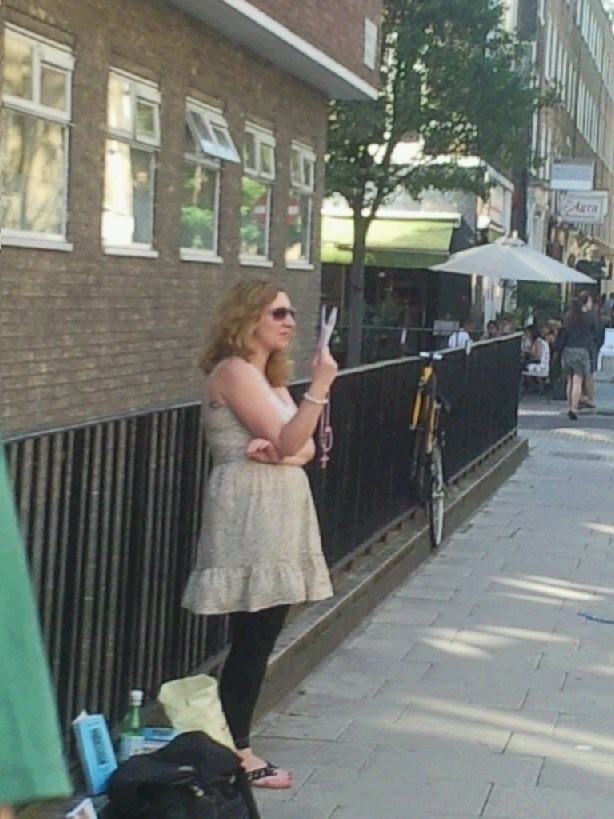
Opposite the Marie Stopes centre in Fitzrovia was an anti-abortion demo. A woman stood on the pavement, with a rosary wrapped around her wrist. Next to her, on the pavement, was the word “LIFE” spelt out in plastic foetuses. It shocked me. It was one of those things I associate with the US, not something that happened yards away from my office.

I decided to take a photo. I crossed the road, and, standing outside the centre, prepared my camera. It was at this point I realised there were two of them. The other anti-choicer, a man, stood in front of me and refused to let me take the photo. He spoke with an Irish accent. In his hands were two rosaries and a handful of leaflets printed on cheap coloured paper. I didn’t see the text, but there was a great big cross on the front, so I think I can guess at the subject matter.

I informed him calmly that it was my right to take a photograph of a demonstration, and he became rather enraged and threatening, so fixated was he on moving me away. Across the road, out of the corner of my eye, I saw Jed lining up a sneaky snapshot. I created a distraction while Jed took the photo above.

As we were about to leave, the man had been pretending to call the police. Of course he wouldn’t have really called the police. He had been rather threatening towards me, and the demonstrators were wise not to want their pictures taken. They were in the process of committing a crime: section 5 of the Public Order Act, causing harassment, alarm or distress. Having an abortion can be a very stressful experience for people, and this is exacerbated by people hanging around with misleading leaflets, rosaries and plastic foetuses, harassing them and causing distress.

I found it very interesting that the woman never spoke. She stood, placidly in her position while the man spoke for her: “She doesn’t want her photo taken”. It was a microcosm of patriarchal privilege and power, which is a huge motivator of the anti-choice agenda.

The experience left a bad taste in my mouth. It is one of those things that I hope I will never see again, but, sadly, I suspect I will. I do not want such demonstrations banned–it sets an ugly precedent, and those anti-choicers have as much right to protest as any other soul.

But I don’t want to see it again. I don’t want women to have to enter clinics for advice, for contraception or for abortions when they are at risk from harassment. So what is the answer here?

Long-term, it is to build a world where choice and bodily autonomy is respected completely, and nobody feels the need to be poking about in someone else’s womb-business. For now, though, we must work to foster an environment where anti-choice demonstrations are not welcome–a less confrontational, smaller-scale version of counter-demos against fascist groups like the EDL. This may be as small as taking a photograph of the demonstrators. We may, at some point in the near future, need clinic escorts, who protect people entering centres from the anti-choicers.

I don’t want to ban demos like this, but I truly hope that I never see one again.


How to oppress men a little more effectively: what we can learn from fish

I’m a feminist, and so I absolutely hate men and want to do everything I can to oppress them. Feminism is, after all, about female superiority and completely ignoring the men. It’s true! Everyone says it! I want to make sure that we women absolutely demonstrate how we are better than men and herald in a new dawn of women’s supremacy.

The thing is, we’ve stalled. We need inspiration. It’s not enough that we oppress men by fighting for equal pay and bodily autonomy and generally wanting to carve our own paths in life and find ourselves on equal footing with the men. Our demands aren’t unreasonable enough yet. We need to oppress harder, damn it.

Evolutionary psychology often looks at animal behaviour and compares it with humans. I decided, in my quest to stomp my Doc Marten on the face of men forever, that I would do the same. I took inspiration from fish.

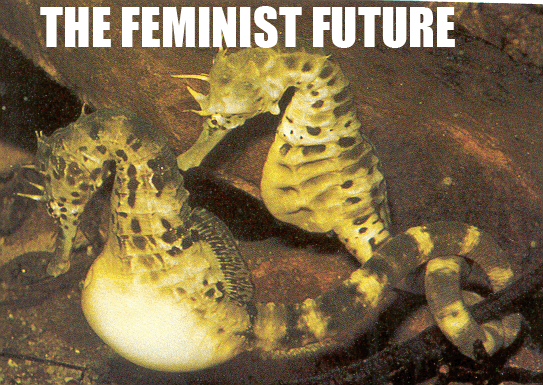
Seahorses are brilliant. The male seahorses are the ones that get pregnant. One of the biggest things standing in the way of female supremacy is the fact that sometimes we find ourselves knocked up, and we fancy carrying the foetus to term just so that the man–sorry, spunk hose–can spend the rest of his darling life paying child support. Other times, those spite abortions that we have are time-consuming. At any rate, wouldn’t it be better if it was the men who get pregnant?

Seahorse culture is like a feminist utopia. While the male is at home, bare-tailed and pregnant, the female is CEO at Coral Towers. It’s perfect! This is exactly what we as feminists want! We’re finally in our rightful places, on top of men. The men wouldn’t mind at all, either. They’d know the kids were theirs. Because men have been doing a spectacularly poor job at getting pregnant so far, we women have had to do it, and because we’re all sluts, the bloke we dupe into paying for our kids probably isn’t the real father. I’m sure this probably makes them feel sad, so I’m sure they’d be very happy about getting pregnant.

But perhaps we don’t want men to be happy, right, sisters? We’re better than them, who gives a fuck what they think about us? Really, men are only good for one thing.

The fish pictured above is an angler fish. The thing is, that’s a female angler fish. Male angler fish look kind of different. This is what a fully-grown male angler fish looks like. Like human men, he is a pathetic and tiny parasite. The male clamps on to the side of the female, and slowly becomes a part of her. Gradually, he is absorbed into the female angler fish until he becomes nothing but a spunking cock and balls welded to her side.

Isn’t that just brilliant? The female angler fish doesn’t need to bother with listening to any of his whining, she just has the relevant bits of him on hand, whenever she needs it. We feminists could learn a lot from this. Also, we would be even better at asserting our superiority if we looked a bit more like angler fish. I’m an advanced feminist, of course. My vagina already boasts a set of teeth that could rival the most brilliant of angler fish. To my feminist sisters, when you hate men as much as I do, you, too, will grow a row of sparklers in your nether regions.

That’s still not enough though, is it ladies? I mean, that spunking cock welded to your side is eating your food! What an ungrateful little bastard. Perhaps, then, we should have a special someone over for dinner…

In some species of octopus, the women eat their mates. That’s right! Like praying mantises, female octopodes sometimes eat male octopodes, during or immediately after sex. That’s because sex is hungry work. Also, once they’ve blown their load, is there really any point to men? I applaud the female octopus. She has shown us the way.

But what of we feminists? We’re doing pretty well, but unfortunately we’ve still not fully assimilated into the Hive Vagina. We’re still not quite there yet. Although a lot of people think us a homogeneous mass, there’s still some traces of individualism among our ranks.

Here, we can learn from the fish once again.

A lot of fish swim in shoals. This really confuses predators: myriad upon myriad of identical fish, they find it impossible to pick out their prey and get confused and swim off. We feminists could do well to learn from it. Imagine how much easier we’d find it to shut down debate if we fully assimilated into a swarm like so many fish do.

If we take tips from fish, we as feminists can do a far better job of oppressing men. Right now, we’re just not good enough. We’re not even equal yet. How can we achieve female supremacy if we still find ourselves oppressed by men?

Simple. We swarm and eat their heads.


Rats and levers: how to smash capitalism with behavioural psychology

Almost eighty years ago, rats in boxes led to a new paradigm in our understanding of human learning. The famous Skinner trained rats to pull a lever to receive food. Later, with the same methodology, he taught pigeons to play table tennis.

The phenomenon is called “operant conditioning”, and it is pervasive. It is the ability to connect a behaviour with a stimulus: press a lever, receive food; press a lever, avoid pain. It is one of our primal impulses: behaviour leads to an effect. Without that ability, we would get very little indeed done.

For operant conditioning to happen, we need to feel pleasure when we receive a good stimulus and an unpleasant feeling when we receive a bad stimulus. We can see this from when the brain goes wrong: when the ability to feel a sweet little dopamine kick at a pleasurable stimulus is impaired, learning too is impaired. To learn to associate our behaviour with something pleasant, we need to be able to feel good.

It is hardly surprising, then, that the system which we have in place taps into this basic system so well. We spend money, we receive something nice, we feel very good about that. It’s nice to have nice things, and so it’s nice to spend money. We learn to become consumers, because ultimately the stimulus-response effect is positive. Spending money is all too simple. We walk into the shop, bung our money down, and in return we get our nice new handbag or book or delicious burrito. A sweet little dopamine kick tickles our mesolimbic pathways. The response gets carved in deeper.

It goes slightly deeper than this, though. Money is an interesting reinforcer: on its own it has no value whatsoever. It is purely symbolic. You can’t eat a fiver; you can’t play with it much beyond folding it in a way to give the Queen an amusing sadface; a fiver is not entertaining or useful in any tangible way. It is only by exchanging that fiver for the real reward that it has value. This is called a secondary reinforcer. It can be compared to when someone trains a pet using a clicker: the animal will respond to the clicker because it associates the clicker with rewards.

We perform all sorts of actions which are reinforced with this essentially valueless stimulus: we sell our labour, we exchange goods for money, we fill in forms. Some of the money is spent on actual rewards: that shiny new handbag, that book, that telly, all wrapped up with the bow of a sweet little dopamine kick.

The thing with Skinner, though, is that the rats weren’t always working for nice things. Sometimes those rats were starving and they were stuck in a box, pressing that lever so they could eat. This is, usually, how we exchange our tokens: basic food to keep going, shelter, warmth and even water. We are sitting in that box frantically pressing that lever just to stay alive.

This is how the system feeds. We need the money, so we perform the actions. Every so often, we’re rewarded with something to makes us feel good. It’s smart. It’s instant. It taps into a basic learning system: even a rat can do it.

And that’s why it’s so hard to dismantle. Alternatives to the system do not always tap into that instantaneous stimulus-response system. Working against the whole shitty system often does not tap into that instantaneous stimulus-response system. We press the lever and nothing happens. Perhaps ten minutes after the lever press, the pellet of food drops down, but by this point the association is not there. The adage “good things come to those who wait” applies here: those who can build associations and put off an immediate reward in favour of a bigger one in the future tend to do better out of life. For most of us, though, this ability involves a cognitive struggle. And sometimes it’s easier to just play on the immediate stimulus-response reactions.

In activism, a lot of the time we find ourselves bored and standing in the miserable drizzle until we finally fuck off to the pub. Nothing is achieved. In part, this is because our goals are too vast: we will hardly dismantle capitalism by standing in the rain feeling cross and handing out leaflets. What if, though, our goals were smaller? That for each action, we set a simple goal: to change one mind, to block a road for an hour, to disrupt a bank so it will lose a certain amount of business that day? These goals are achievable, and the trip to the pub with comrades suddenly feels like a little treat, combined with a fizz of dopamine. This method is called mastery, an offshoot of operant learning: measurable behaviours, measurable and achievable goals, slowly building.

Satisfaction can come from other sources than buying, as many in the left wing community will know. I take more joy from a scarf I have knitted than one I have bought. I feel happier sharing a meal cooked with friends than something pricier in a restaurant. Gratification is possible, and consumerism is not the only way to get that sweet little dopamine kick. It is simply the most salient way of being.

While this works for activists, it is preaching to the converted. How can this rat and lever response be used to help those who are currently buying wholesale into the system? What we want is for people to know about the problems and act to become part of the solution. The bad news is, those leaflets we hand out in the rain are only useful for awareness-raising. Providing information does not tend to lead to magical change of behaviour. For people to act, we need to be ready.

One way is to negate the reinforcing value of money and the things bought with money. There are few legal ways of achieving this, and it is not necessarily a feasible course of action–and for our own morale, pursuit of the feasible is important. The other option is gradual: starting with helping people to do simple tasks which are rewarding, things that make them feel good. Simplicity, at first is crucial: start off with an e-petition, perhaps. E-petitions are largely pointless, but the signers tend to feel good about themselves afterwards. From the petition, progress to a slightly larger task–such as writing to an MP. Escalate slowly and gently, facilitating people to move to increasingly larger tasks until eventually they, too, are ready for revolution.

This is, essentially, why movements such as UK Uncut have been so successful, with mass appeal. UK Uncut actions involve performing a simple behaviour (sitting down in a shop) with measurable results (the shop loses business). It is hardly surprising that this movement has been a gateway for many into activism: it taps into that simple stimulus-response system.

Awareness of this basic response can help us shape the world. It can help us achieve the ultimate reward: liberation.
What does getting over it look like?

Trigger warning: this post is about rape, and the experience of dealing with that. 

A couple of years ago, I was raped. I have also had sex in the past which could be termed coercive. These pieces of information are usually not important; these experiences do not tend to infringe on my day-to-day life. I am privileged in that respect: the sex I have now, I thoroughly enjoy, and I do not think much about what happened in the past. One could say, I’ve got over it.

And that’s all well and good apart from the times when I realise that perhaps I haven’t quite got over it. There are times when I realise why so many feminist bloggers put a trigger warning above articles about rape; those little times where I feel an anger and sadness that is personal rather than political at a sad tale of rape or an infuriating case of rape apologism.

Another time, there was a small incident in which a lover did something in their sleep. I was halfway across the room and somewhere between anxious and utterly fucking furious before I had even properly woken up. When the lover woke up due to me very loudly failing at rolling a cigarette between sobs, they were understandably rather baffled.

It was the sort of thing which was a fairly neutral incident, and looking back, kind of funny. The lover in question was fast asleep, unresponsible for their actions, and someone I know and trust. Rationally, it was nothing. Yet the mood I found myself after this sleepy farce was the kind where I could have easily gone on the offence.

It made me realise: am I really over what happened to me a few years ago? My reaction to the situation was not warranted in the slightest; it was an overreaction which had been thoroughly coloured by previous experience, despite the fact that it was unrelated to my previous experience. It was an old scar itching.
I wonder if I am over it, or if I had just papered over the cracks. Am I really all right? Can I expect, one day, for those cracks to be filled completely and for things to not bother me as much as any other person who had not experienced what I have? Or is this occasional overreaction going to be the best that I will ever be?
I hope it is not, I fervently do, yet I suspect that it is.

If “being over it” is the ability to lead a life where I am usually untroubled by painful memories, then I am over it. If “being over it” is a return to completely normal, no hair trigger reaction, no prickle of personal outrage, as though nothing had ever happened at all, then I am not over it at all.

It a way, what happened to me made me the angry feminist that I am today. It is that occasional flash of anger, a deep empathy and understanding for other rape survivors, which makes me determined to kick and scream and fight for a future where rape is a thing of the past. If even at my level of peace, I am not over it, what of the many women who are not so lucky as to be where I am.

Yet I wish to be normal. I wish for the scar to fade completely. It feels like a weakness to me. If I, the lucky one, am not completely OK, what for the others who have been through what I have and worse?

Getting over it. I’d love to do that. If only I knew what that even looked like.

In which I am visible and bi

Today is Bi Visibility Day. It is a necessary day, not because bisexual people tend to be completely transparent, but because there is still a lack of acceptance for bisexual folk.

I suppose, technically, I am bisexual, although I hate that word as it reinforces binary notions of gender. Instead, I tend to use the vaguer term “queer”, or simply “hi. I fancy you.” I’m roughly a 3 on the Kinsey Scale. I like cock. I like cunt. I like boobs and bums and beards and I don’t really mind if all of those things occur on the same person.

A lot of the time, I do not really feel the need to be visible. Most of my friends and lovers also happen fall somewhere in the great territory between heterosexual and homosexual. Those who are not are usually unfazed by my sexual orientation; it doesn’t bother them in the slightest.

And yet, from personal experience, there are some times that I see just why we need a day for bisexuality to be celebrated. There are some times that I see just why we need a day for bisexuality to be visible.

It’s those times exclusively gay women will believe me to just be experimenting, and therefore will reject any opportunity for us to experiment with each other to see if they are sexually compatible. There are still some people that hold the belief that it is not possible for me to be genuinely attracted to both women and men (and, of course, those in between). Luckily, they are few and far between, but when that happens it’s like a slap in the face for how far we need to go.

It’s those times when heterosexual men will believe that I am attracted to women purely for their gratification and wonder if maybe, just maybe, I might snog their girlfriend so they can get their cheapies.

It’s those times when I hear that godawful Katy Perry song that reinforces this awful stereotype that bi women do not really exist, because it’s a pop song about precisely that. It’s those times when I see that very same godawful stereotype rehashed in a popular women’s magazine as a way to turn on “your man”, and nothing else.

It’s all those times I turn on my TV and characters will be either straight or gay. They might “turn gay” or “turn straight”. The notion that they are bisexual is never even entertained. When a show which had previously good bi credentials seems to forget its roots, it makes me cry a little inside (and blog, angrily).

I exist. I do not need the media and other people telling me I do not. I exist, and I am furious that we are still in a position where we need a day to point out that I exist and that millions of others like me also exist.

We have work to do. Heaps and heaps of work to do. To start with, let us make sure we are visible every single day; challenging our general invisibility with in-your-face visibility; challenging prejudice with love.

I exist, and I want everyone to know this.

Right wing authoritarianism: you’ll probably recognise this personality trait

Ever found yourself trapped in an argument that is going nowhere because the other person is so dogmatically right wing that reasoning is impossible? Perhaps they’re cheerfully bellowing “hang ’em all!”, and you want to point out that perhaps the death penalty is a bad idea. Maybe they’re griping about immigrants “coming over here and taking our jobs”, or suggesting that gay marriage is wrong as marriage can only exist between a man and a woman. It might be best to just down tools. That person is likely to be a right wing authoritarian, and you probably won’t change their mind.

What is right wing authoritarianism?

Right wing authoritarianism (RWA) is a personality trait, conceived by psychologist Bob Altemeyer. The right wing authoritarian personality consists of three attributes:

  1. Authoritarian submission: submissiveness and acceptance of authorities which are perceived to be legitimate and established in society, such as government or the police.
  2. Authoritarian aggression: aggression against outgroups and “deviants”–people who the established authority mark as targets. Examples of this includes travellers, immigrants, Muslims and other kinds of scapegoats.
  3. Conventialism: high adherence to traditions and established social norms. This can manifest in a respect for “traditional family values”, for example.

RWA is measured using a scale consisting of 20 items, with a score ranging from 20 (no RWA) to 180 (high RWA). I scored 22; try it for yourself. Depending upon the sample, university students often score around 75, while a large-scale American study found the average about 90.

Correlates of right wing authoritarianism

First of all, right wing authoritarianism is called such because it tends to correlate strongly with endorsement of political conservatism. Furthermore, while attempts have been made to investigate “left wing authoritatianism”–high adherence to left wing party lines and aggression to those who do not endorse left wing values–these attempts have fallen flat, suggesting that perhaps such a thing does not exist. When one measures submission to authority using different scales, it is still found to correlate with right wing ideology; it is likely, therefore, that authoritarianism and being right wing go hand in hand.

Following a lot of research, Altemeyer has identified a lot of ideologies which correlated with right wing authoritarism. The right wing authoritarian is likely to oppose abortion, support nationalistic ideas and behaviours, capital punishment, capitalism, religion and conservative economic policies. They believe the world to be a dangerous place. They also put less value on social equality, and are far more accepting of infringements on civil liberties–Altermeyer found that high RWA people were often not fazed by the Watergate scandal. Unsurprisingly, given this set of correlates, high RWA people are also more likely to be prejudiced against ethnic minorities and gay people, and more likely to be bullies or friends with bullies in childhood.

RWA is not correlated with intelligence, but arguing with a person who is high in RWA may be difficult, as they have been found to uncritically accept poor evidence–how many times have you found yourself arguing with someone who will not listen to reason and instead clings on fervently to a story they were once told by a friend of a friend? High RWA people often hold the perception that they are right, with less ability to accept their own limitations. They are also less creative than less RWA people. High RWA people have less tolerance for ambiguity: this means they are less able to accept change and jump to conclusions in ambiguous situations.

What can be done about right wing authoritarianism?

Some critics have suggested that RWA is not an immutable personality trait, but, rather, a response to an external “threat”, and that some people have a disposition to manifest RWA beliefs when they perceive they are threatened. This threat can come in the form of economic crises or 9/11, for example. As RWAs make the best followers for a right wing authoritarian regime, a somewhat frightening implication arises: by ramping up the threat level, a larger number of followers who are willing to accept undemocratic ideas appear. On the other hand, by reducing the threat level, RWA can be decreased.

Due to the reverence for authoritative sources of information and poor assessment of evidence, though, reducing the threat level may prove challenging. An anecdote, which non-RWAs will probably see as poor evidence: I have tried to do this on several occasions. It is incredibly frustrating and ultimately fruitless.

In truth, though, there is very little evidence as to whether RWA can be changed: the bulk of it focuses on correlates and whether it is a personality trait with a genetic basis, a trait with a social basis, or a reaction to circumstances. This is an area which sorely needs research, as RWA is a somewhat dangerous ideology, given that it is so related to prejudice and violence and can lead to worrying policymaking such as capital punishment.

For now, though, I would recommend, for the sake of your own sanity, disengage from the high-RWAs. It’s an argument you won’t win.