Ched Evans fans are not a problem with Twitter, but a problem with rape culture

The story of Ched Evans, the rapist footballer, continues to find its way into the news as yet more foul behaviour is unearthed. The survivor of this rape was named by rape apologists and bombarded with vitriol and death threats, all because there continues to be a culture which supports rapists.

The survivor has been forced to leave the country due to the shit she has been getting, which is, ultimately, the endgame for rape apologists. They want rapists to continue to go on raping, and part of this entails making it as awful as possible for survivors to come forward. Meanwhile, a prominent rape apologist remains unrepentant, refusing to acknowledge that naming and smearing a survivor of rape was wrong, and that paying compensation was the “last thing” she wanted to do, putting it behind such horrors as genocide, war, poverty, and, you know, being raped, to name but a few things that paying compensation to a rape survivor you smeared and hounded out of the country is worse than.

This is a grotesque picture of what rape apologism does and the sort of people who engage in this to a stronger-than-average degree.

And of course Twitter and Facebook are being blamed for this, particularly by the Star and Telegraph, but this is missing the point entirely. That was just the medium through which this viciousness occurred. We don’t see people queuing up to ban conversations when a death threat occurs verbally, nor do we see vociferous calls for regulation of the postal service if someone receives a vicious letter.

The fact is, this shit was always there, and unless the root problem–rape culture–is tackled, it will continue to be there. One can close down Twitter, and they’ll continue to perpetuate their beliefs in words, and in deeds, and they’ll keep on writing shit that contributes to it in newspaper columns and the powerful will use the legal system to keep survivors silent.

Because that is the problem. There’s a culture that defends rapists, and it’s not going anywhere unless it’s challenged.

What we need to talk about is not “how should Twitter be regulated, and how shall we punish people?” but, rather, “why do some people defend rapists? Why do some people defend rapists so vociferously that they hound survivors out of the country? What can we do to overturn this culture of violence?”

I continue to be alarmed and disgusted by some of the shit that I see, some of the things people believe and the lengths they’ll go to keep rapists raping. This is why I want to attack the cause rather than the symptoms.

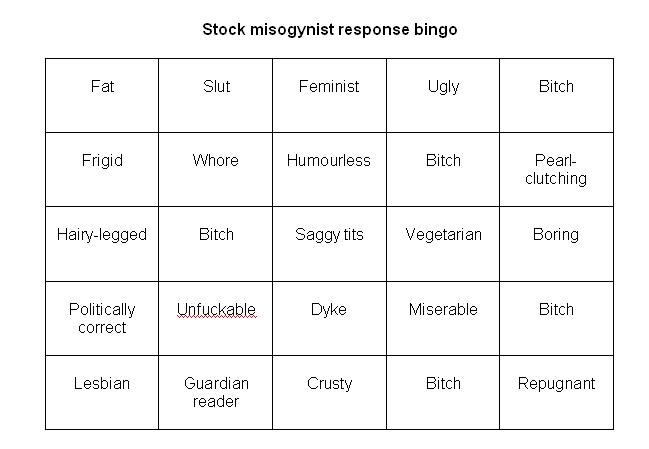
Anticipating FHM’s response: let’s play stock misogynist responses bingo!

So, after I wrote a letter to FHM which was somewhat critical of their editorial choices to appeal to the perpetrator demographic, and it was crossposted in Independent Voices (albeit less sweary), I’m anticipating that FHM might respond.

Being the sort of tired, humourless misogynists, I can almost see their response through the mists of time, so I’ve prepared a bingo card. If there’s five in a row on these common insults from misogynists to women with opinions, humanity dies a little inside.

misogynistbingo

ETA: it has just been brought to my attention that I have missed off “man-hating” and “bra-burning”. Consider these bonuses, so if we only get four in a row, but they use one of those two, we’ve still won. Or lost. Whatever.

Dear FHM

Dear FHM,

I get it. I really get it. You’re useless fart-huffing dicknozzles. I know this. You really don’t need to prove this by normalising violence against women.

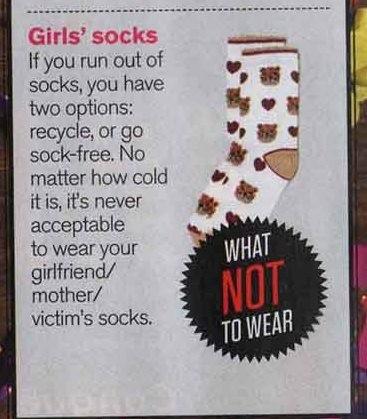
In your “What Not To Wear” feature, you decided to be very funny by advising your readership not to wear women’s socks. Might I just point out that you’re really missing out here, as women’s socks tend to be a little softer than men’s socks, and if you buy the over-the-knee ones, your legs will be toasty all winter?

A9RT7PYCYAAeQOi

Sorry, I wandered off the point, there. Where was I? Oh yes, you are shitmunching chancres.

See, at the end of the little slot, you advise your readers not to wear their “girlfriend/mother/victim’s socks”. You might think this is a light-hearted little joke, a friendly bit of fun. Banter, if you will.

If that’s the case, you’re wrong in the way only the true arsenugget can be wrong. Have you thought at all about what a “victim” is, other than the butt of your edgy humour? Did you know that one in twenty of your readers might have raped–maybe more than once–and shared a wry smile upon reading your little joke, while resolving not to steal the socks off of anyone he rapes in the future? Or that one in five of your readers are likely to think it’s all right to hit a woman, and you’ve just made that a little bit more acceptable?

Or maybe you think your little joke is much funnier because all this happens. Perhaps you’re trying to market yourselves to that all-important “perpetrator” demographic by laughing with them?

If so, please catch on fire. I am asking you as politely as possible. Please catch on fire.

Furiously,

Stavvers (no hugs, kisses, and I’m not letting you near my socks)

__

Picture courtesy of @Seja75


Dawn raids for perpetrators of abuse: something doesn’t sit right

Trigger warning for domestic violence

Imagine you’re in an abusive relationship. Imagine you’re asleep in your bed, your abusive partner snoring next to you. Perhaps you sleep fitfully, or perhaps you are sound asleep and drained. Suddenly, your slumber is interrupted by a loud banging at the door. It startles you awake. Maybe you are scared of your violent partner’s reaction to being awoken by this cacophony. Nothing good can come from this knock on the door so early in the morning, and you’re terrified of what it may mean.

Maybe you answer the door, or maybe it is kicked in. Either way, there are police swarming round your house. You’re not decent, perhaps you managed to get your dressing gown on. They flock towards your partner. You’re still not quite sure exactly what’s going on, you’re confused, startled and frightened. The police grab your partner. Maybe your partner looks at you with blame in their eyes, and you know they think you called the cops. You didn’t.

This morning, the Met proudly tweeted that they have been undertaking dawn raids on perpetrators of domestic violence, culminating in, as the BBC reports, 264 arrests. In a show of class, the Met also decided to tweet a picture of themselves outside someone’s house, probably easily identifiable to anyone who knows those who live there. Judging by the force’s use of the hashtag #SpeakOut, and contextualising these tweets among others encouraging third-parties to report domestic violence they think may be happening, it looks as though the abuse survivors may have been as surprised by these dawn raids as the perpetrators.

While domestic violence is a pressing and serious matter, it strikes me that what the police are doing probably isn’t a particularly sensitive intervention for the survivors. In many cases, the survivor will live with the perpetrator, so it’s not just the perpetrator’s home being stormed, it’s the survivor’s.

This is exacerbated by the emotional side of abuse: it’s never just physical. In many cases, it is not just fear which prevents the survivor from leaving the situation, but the complicated relationship dynamics. There’s often a hefty dose of emotional abuse in abusive relationships, leaving survivors feeling that there is nowhere else for them to go. Sometimes this might take the form of “it’s us against the world”. This could very easily be exacerbated by the police suddenly dragging a partner out of your bed.

Then there’s the fact that these arrests probably aren’t going to keep the perpetrator away forever. They’ll be released, whether it’s within hours, days, or months. I can’t imagine that none of them will blame their partners for this arrest, and this is likely to have dire consequences for survivors.

Of course, not all abuse is the same, and not all survivors feel the same. There might be some survivors who would welcome this sort of intervention, but thinking back on my own personal experiences, this would be literally the last thing in the world I’d want.

It’s important that we are more aware of people we know who might be in abusive relationships, but it’s also crucial to respect their wishes and offer support as a community. Dawn raids based on reports to the police are an unsustainable and, in many cases, unhelpful response. Instead, we must keep our eyes open, and support anyone we may know who needs help, in the ways that they want.

Before Caitlin and after Caitlin: eras of feminism as defined by the privileged

In WHAT THE SHITTING HELL IS THIS SHIT ON MY SCREEN of the day, may I introduce you to a turd squeezed out by the lax editorial standards of Comment is Free? Here’s some choice quotes which are entirely representative of the piece, which I would thoroughly recommend not reading.

In years to come, feminist chronology will be separated into BC and AC – Before Caitlin and After Caitlin.

Caitlin Moran’s bestseller How to be a Woman has begun to make it okay again for a generation of women to be feminist.

She’s funny, she’s smart and she explains why it’s important to identify that way without preaching, hating men or using words like “phallocentric”.

Before I start with the fury, can I just say that judging by this article, I fully expect Caitlin Moran to join the Guardian staff within the next few months? Just thought I’d get that little bet in there on time.

Now, let’s talk about Moran. Regular readers will no doubt be aware that I am not Moran’s biggest fan, given she represents the interests only of a very small chunk of privileged women. I find it is no surprise for a puff piece for Moran appearing in a column in the mainstream media which is, after all, entirely dominated by these same privileged people who don’t take kindly to having their interests challenged.

I’m going to be kind to the author, though, and point out that she does have a point in her dire “Before Caitlin” and “After Caitlin” taxonomy. Caitlin Moran has proved to be the flashpoint in a discussion that feminism has needed to have for decades and divided feminists.

On one side we have those who challenge the lack of interest Moran has in broader social justice issues and intersectionality, and her occasional active contributions to oppression. On this side, we see that feminists must actively challenge our own privilege, and make sure we do all we can to avoid contributing to the intersecting layers of oppression. We make it our business to fight for broader struggles.

On the other side, there’s those who are rather comfortable with the way things are, thank you very much.

No prizes for guessing which side I’m on, but unfortunately, many of those with the privilege and the large platform afforded by the mainstream media are on the other. They don’t want to rock the boat too much. They don’t want to challenge their own oppressive behaviour (I note that a rather barbed comment about “frumpy lesbians” is made in the CiF piece).

For some reason, Moran has emerged as emblematic of the problem, despite the fact that feminism is riddled with such one-dimensional thinkers.

I am hoping, of course, that this is merely a transitional stage, and those who don’t care about liberation of those who need liberating will eventually fuck off or start giving a shit. That we will then see our eras as feminism not as AnteMoran and PostMoran, but as “that point where we actually started being able to achieve some shit, and the oppressors started to fear us”. We are actively challenging a system, a dominant ideology. It will send those who like this system on the defensive.

Here’s the thing: we shouldn’t have to make ourselves palatable to our oppressors. Why can’t they make themselves more palatable to us?

The Nadinenomicon

So here’s a thing. Regular followers of this blog will no doubt be aware that I rather passionately hate Nadine Dorries for her concerted efforts to peer into my uterus.

However, there’s some hate she’s getting that just isn’t cool. There’s a lot of misogyny thrown in her direction–calling her a bitch and so on. There’s also the “Mad Nad” moniker, which is hugely fucking offensive to people with mental health problems. There’s a lot to attack Dorries for, but the fact she’s a woman isn’t one of them.

I mean for fuck’s sake. Her politics are just dire. She’s frighteningly right-wing, and she’s fucked up the job she was elected to do by swanning off to munch on ostrich anuses in a jungle half a world away. And let’s not forget her curious obsession with uteruses. She really wants to try to control what we do for them.

Now, a nickname is a useful thing, but let’s stick with nicknames that aren’t oppressive, eh? Here’s a few putative suggestions, but feel free to add more!

  • The Womb Botherer Of Bedfordshire
  • Disappointingly unraptured
  • Tory scum
  • Nadir Dorries (from Jonnie Marbles)

I believe Steven Messham: examining the lies and smears in the Mail

The Daily Mail have written a vile piece smearing an abuse survivor. It is a classic example of victim smearing and is thoroughly disgusting. Let us go through each agonising point they make and examine how they are utterly fictitious yet using rape apologistic beliefs as a heuristic to allow their vile claims to sit comfortably and unquestioned in the minds of their audience.

“Newsnight failed to say that Messham triggered a 1994 libel trial by falsely claiming to have been abused by a senior police officer. His story was shown to be riddled with contradictions, costing the publications which reported his claims a total of £375,000 in damages and £1 million costs.”

When police officers rape, they have a cavalcade of their porcine comrades to cover for them. That the official investigation into the case failed is hardly a surprise: the police were the ones investigating it. It has been shown time and time again that they cover for one another: see Hillsborough, see the police coverups of their own active forging of rape investigations. This is likely to be no different and cannot be taken in any way as proof that Steven Messham has a track record of lying about abuse. Instead, he has a track record for being disregarded by virtue of having been abused by those with power.

“Messham physically attacked a lawyer at the Waterhouse public inquiry into sexual abuse in North Wales. He screamed obscenities at the barrister who was questioning him, leapt out of the witness box, and threw punches at him.”

An abuse survivor is angry! This is hardly surprising considering the emotionally traumatic event of having been systematically abused and raped by people with power, in conjunction with a public inquiry failing to fully investigate what happened to him. He was denied justice. That is a reason to be angry.

“Documents proved some of Messham’s evidence to the inquiry to be false. Although Sir Ronald Waterhouse concluded that Messham had experienced abuse, he described him as ‘an unreliable witness’ who was unlikely to be trusted by any jury – a conclusion also reached by the Crown Prosecution Service.”

Again, a powerful man has dismissed a survivor of abuse. Survivors of abuse are often taken to be unreliable witnesses due to their vulnerability and young age, and the fact they have experienced busloads of fucking abuse, repeatedly. Several people in a position of power, who, for some reason or another failed to investigate claims and dismissed a key witness. Why is the survivor being blamed here?

“Even Messham’s lawyer concedes he may be ‘disturbed’ and that he may have made up some of his claim.”

Messham needs a better lawyer. Incidentally, the lawyer actually said this: ‘People who are vulnerable . . .  a good part of them is so disturbed that they’re not going to be wholly consistent and reliable.” That is somewhat different from the Mail’s claim that the lawyer said he made it up, isn’t it?

“In 2004, Angus Stickler, the reporter behind this month’s Newsnight story, was publicly criticised for interviewing Messham on Radio 4 without mentioning he was facing charges of defrauding a charity he ran for alleged abuse victims. Messham was later acquitted.”

So Messham didn’t defraud a charity? How is that in any way related to his credibility as a witness for child sex abuse?

“In 2005, Messham was also cleared of a £33,000 benefits fraud. He admitted concealing savings of £40,000 – a result of compensation for the alleged abuse – when he made claims for income support and housing benefit, but insisted he had not intended to be dishonest.”

Again, what on fucking earth has this got to do with sexual abuse?

“Newsnight’s key claim that Messham was prevented from naming Lord McAlpine and other supposed paedophiles at the Waterhouse inquiry was clearly untrue. Transcripts show Messham could say whatever he liked about anyone he chose – and that he did so with abandon over his two weeks of testimony, during which time he did allege that a man referred to only as ‘McAlpine’ had abused him.”

This is (A) a criticism of a TV show, not what he said, and (B) completely ignoring the fact that Messham spent years thinking it was McAlpine due to a police officer showing him a photograph of the perpetrator and telling Messham it was McAlpine. Again, it’s got literally nothing to do with his credibility as a witness.

In all, then, the Mail have smeared an abuse survivor as a cheap attempt to get linkbait and profit from what happened to him, all the while continuing to create a climate where survivors are not believed. The only people who profit from this are abusers and perpetrators of rape. I have not linked to this article, because I don’t want to encourage the Mail’s cosy relationship with rapists, but the quotes are verbatim.

It is crucial that we believe Messham. He was raped and abused, and what happened to him must be investigated. The excuses the Mail have provided for him being denied justice are a vile, transparent attempt at a smear and an attempt to reinforce the culture which allows these horrific things to happen.

Addendum: the “journalist” who wrote this has a track record of trying to discredit witnesses in child abuse cases where the establishment are implicated. I can’t say I’m surprised, though I am utterly disgusted.
How the mainstream media derailed addressing child abuse

The two recent child abuse scandals have both found themselves derailed by exactly the same method: a protracted session of the mainstream media navel-gazing and taking pops at one another. The Jimmy Savile case turned into a study of why Newsnight didn’t report on the story. Meanwhile, the re-examination of the North Wales abuse scandal turned into a study of why Newsnight did report on the story.

In the noise of the quarrelling over who should resign and why, and squabbles about the quality of journalism, the real story got lost.

Children were raped and abused. There were cover-ups and failures to fully investigate the systemic instances of abuse which occurred. People were denied justice for the horrific things that happened to them.

On 10th November, the Guardian ran nine separate stories and a liveblog about the crisis at the BBC; on the 11th eight stories on the front page alone. It’s a similar state of affairs in the other major news sources, except for the BBC, who are running with a third arrest in the Savile piece. Where mentioned within the BBC stories, the child abuse is thrown in as an afterthought.

There are many important questions remaining regarding the child abuse that happened, yet these questions are lost in the media circlejerk; the problem of which is perhaps exemplified by this Observer editorial which manages to make the issue about everything from journalistic standards to austerity, tacking child abuse on as an afterthought. These are questions which ought to form the crux of the issue, yet they are drowned out in favour of discussion of the internal politics at the BBC and who is reporting what best.

1) Who did abuse children? It seems certain now, that Lord McAlpine was not one of the men who raped Stephen Messham, the man who told his story on Newsnight. By focusing on who did not rape Messham–to the point where Messham himself, a survivor of rape and sexual abuse, was forced to apologise–the media have lost sight of the fact that these rapes happened and were perpetrated by some people. Who were they, and will they be brought to justice?

In a way, it’s not really the names of the abusers that matter. The answer may be neither high-profile nor particularly newsworthy, considering sexual abuse and rape are frighteningly common. However, as a matter of urgency, we should turn our focus on this: in the interest of justice, it matters not who did not abuse these people, but who did.

2) Why are there so many systematic failures to investigate abuse allegations? While there was some emphasis on the BBC’s failure to investigate–and perhaps cover up–the allegations against Jimmy Savile, little has been made of failures in other areas, particularly that of the police. The police failed to investigate allegations against Savile, yet are not facing a public investigation in the same vein as that for the BBC. Likewise, Lord McAlpine was misidentified due to a police officer erroneously telling a survivor that the man in a photograph he had positively identified as his abuser was McAlpine. How did this happen and will the police officer involved be held to account?

Likewise, criticisms of the Waterhouse inquiry into the North Wales abuse scandal still stand. That Lord McAlpine was not involved changes absolutely nothing about the fact that the inquiry failed to investigate the abuse that happened outside the homes. Why are we not talking about how these survivors of abuse have their hands tied in seeking justice due to a systematic failure to investigate what happened to them?

3) How can we create a climate where it is safer for survivors of abuse to come forward? In both the North Wales and Savile cases, the picture of what happened only came to light years later. We do not live in a world where it is safe for survivors to come forward. When a person in a position of power rapes and abuses, there will be an army of people willing to cover it up and cast an aura of disbelief on the survivor. Take a look at Stephen Messham being dragged through the mud for what happened to him.

Rape and abuse happen, and too often they happen in silence. These are not things which happened in the past, but continue to happen today.

There was a narrow window of opportunity for survivors of abuse in the past to come forward and tell their stories, which has been effectively closed by derailing what could be a discussion of the ugly realities of a culture which facilitates abuse into talk about the BBC. It makes it harder still for current survivors to come forward when they are effectively told this is secondary to a debate about journalistic standards.

Please let us not lose sight of the real issues, the crux of the matter. Let us not contribute further to the culture of silencing survivors. Let us keep what happened to these people at the front of our minds and challenge ourselves to ensure that this can never happen again rather than allowing ourselves the easy route of the well-rehearsed examination of media practice.

Rape and abuse happens. It happens a lot. How can we stop that?

Being anti-rape must not involve being anti sex-work

Glasgow’s upcoming Reclaim The Night march has a slightly baffling message this year. Rather than being simply a march against rape, it also appears to be a march against sex work.

It starts at the very title of the march: “WOMEN ARE NOT FOR SALE”. While this could be construed as, perhaps, a critique of capitalism or an anti slavery message, its intent becomes clear as one delves into their press release:

“…in our call for the elimination of all forms of violence against women – violence that includes rape, sexual assault, prostitution and pornography, trafficking, domestic abuse, female genital mutilation…

This year the theme of the Glasgow event will be “WOMEN ARE NOT FOR SALE IN SCOTLAND”. We want to speak out in support of the importance of promoting equality in Scotland for all women, using a challenging demand approach to prostitution and highlighting potential legislation to support this.”

The emphasis, of course, is mine. One of these things is not like the other. One of these things, is, in fact, a diverse set of roles which fall under the umbrella term of “sex work”. The blanket assertion that sex work is violence against women reflects a somewhat dated mode of thinking in the present.

While not every sex worker is the stereotypical “happy hooker”, it is true that a lot of women choose to do this job. In a capitalist system, it may in fact be rather a good option for work, as one has more free time than under a 9-5 job, but for similar if not better reimbursement for labour. Due to the intersecting oppressions of capitalism and patriarchy, this is of course not a truly free choice, but, likewise, it can hardly be termed “violence against women”.

In fact, what Reclaim the Night are trying to do could also be classed as “violence against women”. They are seeking to bring in legislation which would make it harder for sex workers to work. While they are careful not to target the women themselves with demands for criminalisation, criminalising punters will have effects on sex workers. Let us remember that this is a job for these people, in a climate where there aren’t many jobs. The immiseration of poverty is already apparent in millions of people. People are starving, homeless, dying. Why on earth would Reclaim The Night want to consign more women to this fate?

Ultimately, the view put forward by Reclaim the Night displays a devastating lack of intersectional thinking. They are not showing solidarity with their sisters in the face of oppressions other than patriarchy. And sex workers need solidarity: their occupational hazards are violence against women. It is not what they are doing that is violence against women, but what they experience.

Reclaim the Night don’t seem to be giving any sex workers platform to speak about how we can ally with them to best give the support that they need in ending this oppression.  Instead, Reclaim the Night are focusing their work against sex workers. It’s entirely possible to be anti-rape and not be anti sex work, if you are willing to think intersectionally, have your preconceptions challenged and ally with those who experience intersectional oppression.

I hope Reclaim the Night listen to this criticism and, at the very least, actively seek to engage with sex workers. Sadly, given the history of the movement, I don’t think they will.

Note: I’m going to moderate comments very hard from this point onwards as I’ve had some complaints from sex workers about my laxness in allowing some upsetting opinions to get through.

WHAT THE THUNDERING FUCK IS THIS SHIT?

It’s rare I see something which makes me shut down completely because there’s so many layers of awfulness going on. But here, I present to you, an advertising promo for razors.

You are taken into a bathroom. It’s, presumably, your bathroom, so as a woman it’s all pastel coloured with a big luxurious bath and fucking razors everywhere. It couldn’t look less like my bathroom if it tried. Then you can take tests by opening your bathroom cupboard to find out how close you are to your man and what sort of goddess you are. Because women dig tests.

If you do the test to check how close to your man you are, you have to “use your intuition” to select pictures that respond to the question. My favourite of these questions is “My smooth legs make me feel…” There was no picture which in any way represented “indifference” or “I like my pins fluffy”. It doesn’t really matter. Whatever answer you give, you’ll be told that you’re already close to your man and that to feel closer you should shave your legs with their product.

You can also pick your goddess. Disappointingly, they don’t include Kali as an option, presumably because Kali has too many armpits to bother with shaving, and is too busy destroying everything anyway. Instead, you can be “zen” or “adventurous” or “romantic”, vague shit like that. Anyway, no matter how you’re feeling, the answer is to shave your legs. After shaving your legs, you may then do something really fucking daft, like apply stickers, spray tan, and then take off the stickers for little blobs in the shape of hearts that probably won’t look like a skin infection at all. Or, if you’re feeling natural, why not put blusher on your feet so you’ll look like you came back from the beach? It says that. Also, your man will love it. Don’t forget, YOUR MAN WILL LOVE IT.

So it’s fucking heterosexnormative as hell. It’s got that grim faux-empowerment message which I like to call “good body cop” (as opposed to the more hostile form of body policing). Everyone is thin and white in the pictures, like really thin and really white, and a lot of the “goddess” advice about having spray tans is literally only for white people.

So who the hell is this shit actually for? Who the hell did they think would like this? It must have been made by a bunch of men who have never actually met a woman and can only guess what they’re like from having watched a few rom-coms. It alienates vast swathes of women who would buy this shit–gay women, fat women, women of colour. And that’s presuming some people aren’t put off by the MASSIVE CLANKING SEXISM THAT PERVADES THE WHOLE THING.

Seriously. What the fuck is this shit?

ETA: Read the comments for a few more problems, including VIOLENCE AGAINST WOMEN BEING SEEN AS A NORMAL PART OF THIS SORT OF TERRIBLE RELATIONSHIP THE RAZOR MERCHANTS ARE ADVOCATING. WHAT? WHAT? AAAAARGH. NORMALISING THIS IS NOT OK IT’S NOT COOL EVER AND I CAN’T BELIEVE THEY SLIPPED IT IN WHERE I DIDN’T EVEN NOTICE IT BECAUSE OF THE SCREAM OF EVERYTHING ELSE TERRIBLE.

ETA 2: The razor merchants are now suggesting the site shouldn’t be live, but it’s still accessible through the direct click. What happened? Did someone hack their site and start advertising their product? Do they not understand what “live” means? At any rate, I’m fully expecting that when it “goes live” it’ll be EXACTLY THE FUCKING SAME except without the violence against women.

ETA 3: It’s gone now. Disappeared some time in the late afternoon, apparently. Good riddance, I say. I hope it doesn’t reappear with the same shit but with the domestic violence removed.