How Prometheus could have worked: an attempt at salvaging a train wreck

Warning: this post contains major spoilers for Prometheus. If you haven’t seen Prometheus yet, don’t bother.

I love the Alien films. Both of them. I therefore spent the best part of this year buoyant on little guffs of excitement that its prequel, Prometheus, was on its way and OHMYGOD IT’S GOING TO BE SO FUCKING AWESOME. I was delighted that Ridley Scott was back in his rightful place doing an Alien film and OHMYGOD IT’S GOING TO BE SO FUCKING AWESOME. I yelped with glee on discovering its cast consisted of some of my favourite actors all together in the same film and OHMYGOD IT’S GOING TO BE SO FUCKING AWESOME.

About half an hour into actually finally getting to see Prometheus, the crescendo of crushing disappointment began. It had absolutely none of the subtle brilliance of its predecessor. It was trying to do too much, far, far too much. It was an incoherent arse-splatter of special effects with a bunch of cardboard characters doing stupid things that made no goddamn sense whatsoever.

Ultimately, perhaps, its biggest undoing was its budget. Alien was magnificent due to its shoestring budget forcing it to be all about reaction rather than action. Aliens, while more a straight-up action flick, managed to be great as it was still within the constraints of the special effects of its time.

Meanwhile, Prometheus felt like Ridley Scott looked at his cheque and said “OHMYGOD THIS IS GOING TO BE SO FUCKING AWESOME! I’m going to have a jars of alien-juice and aliens in someone’s eyeballs and a man possessed by zombie-alien-rage and some aliens that look a bit like snakes and an alien in someone’s tummy and gigantic white different aliens and a massive fuckoff facehugger and fuck it, let’s show a whole alien because we can do it with CGI and it definitely won’t look shit.”

Well, Ridley, thanks to all that, your film was a complete pile of shitting arses. And the CGI alien did look like shit.

The thing is, though, there were ideas in that film that could have worked. There were scenes that could have worked. Had Scott been constrained, he might have actually had to think about ideas rather than various high-budget body horrors happening to people we didn’t really care about.

In a conversation with Mediocre Dave–who possibly humoured me in any attempt to salvage that film because I paid for his cinema ticket–I began to think about how it could work. I will sell this pitch to Hollywood for a complete refund of our cinema tickets, a written apology from Ridley Scott for Kingdom of Heaven, and an evening in the company of Michael Fassbender. It will be much better and much cheaper than Scott’s Prometheus.

The premise remains the same: Noomi Rapace and her boyfriend who is probably a famous actor too find another cave painting and persuade some rich dude to let them go to a far away planet to find their ancestors. On this ship are also Idris Elba and Charlize Theron and android-Fassbender (who was by far and away the best thing about that film), and the rich old dude, who can actually be played by an old dude, because I’m not sure why they bothered with covering Guy Pearce with prosthetics. We don’t need to worry about any of the rest of the characters, and Old Rich Dude isn’t hidden away in a box, there in the open, having co-opted Noomi Rapace’s misson for his own, like he did in the film except without some shitty attempt at a plot twist.

Several themes will be explored in this version of Prometheus, many of which I suspect Scott was attempting at doing if he hadn’t got all overexcited by the myriad ways he could literally ram xenomorphs down people’s throats. It will explore patriarchy, a robot’s attempt at understanding human emotion and the perils of curiosity.

We’ll keep the scenes of the android studying languages, playing bicycle basketball and learning to be human from old films, because they were cool. The aesthetic of the ship, though, should be less swish, as should all the technology: recall this is taking place before Alien, after all. We don’t need any fancy drone-ball things. And when the humans wake up, it would be nice if they could establish some relationships with each other.

So then they all get to the planet, and Noomi and Boyfriend and Space Stringer Bell and Robo-Fassbender go and explore the big creepy Ancestor-Cave. Old Rich Dude and Charlize Theron stay aboard the Prometheus, with Old Rich Dude barking orders of where to go and Charlize Theron being pragmatic. Our characters have a poke round the cave, realise it’s terraformed and start taking off helmets while Charlize Theron perhaps suggests that this is a terrible idea.

But they do it anyway, probably with Old Rich Dude egging them on.

Down in the caves, they realise Something Is Terribly Wrong and the ancestors are all horribly deaded, and the water’s moving, and they get the fuck out of there. Unfortunately, by some accident, Boyfriend ingests some water.

Back on the ship, everyone’s very disappointed, except Robo-Fassbender who is kind of baffled by this. Crucially, though, they never leave the ship again, thus radically reducing the film’s budget and adding some dramatic claustrophobia. Also, this neatly does away with the utterly ghastly “meeting the creators” theme which never works, as is beautifully explained here.

In this version of Prometheus, Noomi’s infertility and the impact it has on her relationship with her boyfriend is better explored and discussed in more depth than a few lines before they have a misery-fuck. In general, there’s a lot more character development and dialogue other than “AAAUGH IT’S BREAKING MY ARM”. But, nonetheless, Noomi and Boyfriend have their misery-fuck.

Trapped miles away from any safety, Boyfriend realises Something Is Horribly Wrong when he notices Alien Eyeball Worms. Naturally, everyone freaks the fuck out over this (except, probably, Rich Old Dude, who is fascinated and curious), and pop him in Magical Medi-Pod, which gives him a once-over and reckons he’s all right. Charlize Theron is sceptical about this. Boyfriend and Noomi are terrified. Space-Stringer just wants to get the fuck out. Robo-Fassbender is politely baffled by mortality and sickness.

Naturally, Boyfriend gets progressively worse, and our characters continue to freak the fuck out as Something Is Dreadfully Wrong. Eventually, this all culminates in him shoving Noomi out of the way and getting flamethrowered by Charlize Theron. Who then airlocks him for good measure, which obviously rather upsets the people who are closer to him.

They check themselves for contamination, and Robo-Fassbender announces Noomi’s pregnancy to Noomi, who, of course, freaks the fuck out. Robo-Fassbender is befuddled, knowing about her upset about her infertility.

Off she goes to the Medi-Pod which is only configured for treating men, and therefore cannot give Noomi the abortion she desperately needs. With the right set-up, this can suddenly be metaphorical for patriarchal access to medical care: my Prometheus has already shown a bit of men exerting their dominance with Rich Old Dude and Boyfriend. And obviously, it’d be better set-up than what I puked out in a late-night blogpost. So she goes for the excruciating abdominal surgery and attempts to immolate the facehugging foetus.

Unfortunately, all this is in vain, as the bastard gets loose and crawls around the ventilation ducts generally causing a menace. We never get a good look at it, we don’t want to.

Ultimately, our characters realise what they have to do. Their ship lacks weaponry, and they can’t survive to tell their story because that’d fuck up the rest of the Alien canon. They discuss this. Perhaps Robo-Fassbender with his confused emotions proposes it. Eventually, they take the decision.

The film ends with the ship exploding and the “last transmission of the Prometheus” playing in voice-over.

In this slice-and-dice, I attempted to preserve as much of Prometheus as possible, while hacking out the very worst. Were I to cut any further, it would be two minutes of Robo-Fassbender walking round a spaceship.
Nationalism is sexy (for small values of “sexy”)

As London prepares for the Jubilee, it begins to resemble Nuremburg, albeit with a flag with far worse Gestalt than the original. Flags are draped everywhere. Bunting crosses streets, gold-trimmed flags hang vertically from lampposts, windows and police watchtowers. If it’s static, they stick a flag on it. Even if it moves, they’ll probably find a way of bunging a flag on it.

Capitalism and nationalism often make comfortable bedfellows, so it is hardly surprising that manufacturers of cheap tat with a tacky Union Jack on it stand to make a killing. It should also come as no surprise, then, that this flag-waving nationalism is trying is best to find its way into our bedrooms–and, in some cases, our cunts.

Perhaps the guiltiest party in this is Ann Summers, who are still falling over themselves to be the worst sex shop in the observable universe. In their flagship Soho store, posters proudly proclaim they are celebrating “60 YEARS OF GIRLS ON TOP”–a tragic misunderstanding of the difference between The Queen and queening. They encourage customers to put on Jubilee-themed Ann Summers parties, standing to win a bit of wine and a special edition Jubilee vibrator if they take over £200. Their limited edition Jubilee vibrator, incidentally, looks like this. Were it not for the name “Diamante Jubilee Bullet”, one would never know it had anything to do with the Queen. It’s like they had a stock of low-grade bullets and needed to get rid of them by any means necessary.

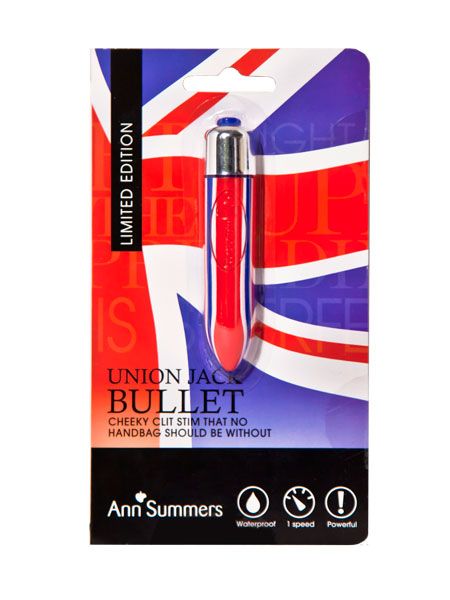
For the more overtly nationalistically-inclined, Ann Summers offer a Union Jack bullet, which apparently no handbag should be without. I’m glad we’ve cleared up the matter of what the Queen carries in that mysterious clutch of hers, then. Incidentally, I use the term “jack” rather than “flag” not to troll the pedants, but because there are no clear guidelines as to which one to use when the symbol is flying between someone’s thighs.

For the nationalist who prefers better quality vibrators, with more power and the possibility of insertion, I’m afraid I couldn’t find anything. Likewise, I am not aware of the existence of any butt plugs, which means puns about anal nationalism will not be forthcoming. However, for nationalists who find their sex lives enhanced by adornments, there are plenty of options.

First up is the “sexy pout lip transfer“, which turns a minor erogenous zone into something resembling a BNP rally. It’s a niche fetish, but someone’s probably into it. That, however is not a sign of the apocalypse. This is:

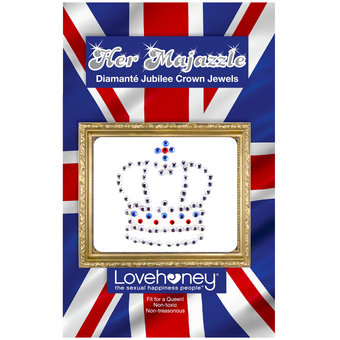
For the lucky people who do not know what a vajazzle is, stop reading here. Preserve that beautiful innocence. Basically, a vajazzle involves removal of the pubic hair and replacing it with stick-on gems. In this case, gems celebrating the Queen’s amazing prowess at living for a really long time. This product comes from Lovehoney, who generally sell a mix of low-end fetish wear and mid-range dildos, and I’m thoroughly disappointed in them as their USP is “a bit better than Ann Summers”.

If you want your nationalistic vajazzle slightly less seasonal, never fear. You may also adorn your cunt with these Union Jack hearts, which look frighteningly similar to coasters made by small children.

BUT WHAT ABOUT TEH MENZ, you cry? Unfortunately, there don’t seem to any nationalistic products catering to men. Perhaps we really are celebrating 60 years of girls on top?

It’s not all bad, though. For the next round of bread and circuses, the discerning gentleman may like to demonstrate his support for the Motherland with this:

That right there. The Olympic Cock Ring. I would be far more in favour of the Olympics if the opening ceremony consisted of Boris Johnson and four LOCOG representatives getting in to that contraption. Given that the vendors of the product are no longer selling it, I suspect that the Olympic branding lot have issued a swift C&D, and somewhere a designer of patriotic sex toys is rotting in a police cell.

Nationalism and sex. We have moved on slightly, perhaps, since the days of cheesecake girls painted on bombs, but not as much as one might think. It is  sexy-lite which is sold to us draped in flags, the socially acceptable high-street sexy which is more about appearances than pleasure itself. It is the sex of More Magazine rather than anything else.

This Jubilee weekend, why not riot instead?

Update: @MediocreDave has brought to my attention some nationalist-sex I have missed: Zoo Magazine’s “DIAMOND BOOBILEE“. Between the disembodied tits and the fact the headline was clearly written by a six year old, I have three words: Fuck. This. Shit.

Sheila Jeffreys, RadFem2012 and the imaginary trans conspiracy

For those not in the know, in July a conference entitled RadFem2012 is supposed to be happening, with headline speaker radical feminist–and noted transphobe–Sheila Jeffreys. The conference is open only to “women born women living as women”, a clunky way of saying “no trans people”.

Kickass feminist and activist, the thoroughly inspirational Roz Kaveney recently wrote a takedown of this particular branch of radical feminism, rightly likening it to a cult (although arguably  there are also fascistic overtones to the radfem party line on this issue). If you haven’t read it yet, please do. It’s utterly brilliant.

Sheila Jeffreys has responded to Roz’s excellent piece with an argument with so many holes it would be better suited to function as a colander. Again, this piece is worth reading, though for the exact opposite reasons to the one above. Jeffreys’s entire argument hinges upon the idea that it is only trans people who could possibly ever object to this particular murky brand of transphobia.

This is, of course, patently untrue. I’ve written myself that transphobia has no place in feminism, and I’m hardly the only one. One does not have to be trans to care about the rights of trans people. One simply has to be free from bigotry.

Jeffreys claims persecution from the trans community in the form of utter horrors such as glitter bombing and captioned photographs. Perhaps the most stark example of the hideous persecution faced by poor Jeffreys and her transphobic ilk is that Jeffreys claims the RadFem2012 conference venue to have banned her from speaking, citing evidence of her hate speech that she believes to be entirely reasonable. Throughout, notably, Jeffreys can only blame a shadowy cabal of trans people: the idea that cis allies may have in any way been involved simply fails to occur to her.

This line of thinking is not unique to Jeffreys. In the past, coming up against a transphobic radfem who I will not name because I’m utterly terrified of her, I received a string of tweets saying “sorry you’re male”. It simply did not enter this person’s imagination that anybody but a trans person could care about transphobia.

For cis feminists, there are three major reasons to fight transphobia coming from those who are supposedly on our side. The first is a moral one: we should be against misogyny and hatred in all forms. Second, we must fight gender essentialism. And third, we must stand up for bodily autonomy.

Trans people are more likely to experience violence, sexual or otherwise. Trans people are more likely to be excluded from areas of public life. A large group of women are more vulnerable than others, and in their ignorance (at best), the transphobic radfems ignore this travesty: in the case of RadFem2012, and many other instances, they are actively partaking in exclusion.

Gender essentialism is something we have fought against for years, and I had honestly hoped that it would be at least mostly dead since the publication of Delusions of Gender. Alas, no. The radfems obsess over chromosomes and what genitals a person might have and testosterone levels as if it means anything. They view trans women with an almost McCarthyist suspicion, believing that they can never be anything but men infiltrating women’s spaces. All because of a peculiar fascination with biology in an age where such essentialism is largely discredited.

And finally, bodily autonomy. This is a fundamental aspect of feminism which is ignored by the transphobic radfems, who believe the surgical and medical interventions some trans people undergo to be inherently wrong. Jeffreys couches it in the language of concern-trolling, claiming it to be a “human rights violation”, yet, surely, having the right to do whatever the hell you want to do with your own body is the basic human right?

It is curious, then, that the men’s rights activists and the radfems do not make good bedfellows: both position themselves against these feminist struggles. In her piece, Jeffreys even uses the same argument tactic as the MRAs: all she wants, she says, is to have a debate (the irony of excluding trans people from this debate is apparently lost on her).

I am not alone in thinking that transphobia and feminism are diametrically opposed ideologies. The shift in feminist thinking is firmly on this side. Jeffreys and her ilk are anachronistic curiosities, though loud and dangerous. The trans conspiracy Jeffreys fights is non-existent: in fact, she is attacking a foe far bigger than she can possibly imagine.

We are in the majority, we who reject transphobia. We must continue to be vocal in our rejection of this dated and frightening rhetoric.

The solution to millennia of patriarchy? Confidence building, apparently

Beloved readers, I have some news for you. The BBC is dead. It was not a good death, nor a dignified one. In its last breath, it rasped “Are women their own worst enemy when it comes to top jobs?

Yes. According to some talking heads, the only thing stopping women from getting top jobs in politics, business and even the sodding army is women. Not other women, mind. When we don’t succeed it’s entirely our own fault.

Chief talking head Emer Timmons, who has been promoted eleventy bazillion times and is CEO of the Entirety of Space and Time reckons there are few lifestyle obstacles and it has to be down to the individual. Cherie Blair, whose career includes picking the wrong side in a land dispute involving dispossessed people, concurs and spouts the dreaded “30%” statistic, the proportion of female board members which would supposedly magically transmute capitalism into a functional economic system.

But what of the very real issues facing women, such as the fact that they are still expected to care for children? Not to worry, Timmons reckons there’s oodles of free childcare, presumably going on in the same alternate dimension where the only problem facing women is their lack of confidence and there are actually fucking jobs happening.

I wish I were misrepresenting this article, but sadly this is what the BBC have actually seen fit to publish on their website. It is so far from the reality of most women’s experiences, and thoroughly insulting to boot.

It represents the same line of thinking that pervades Tory feminism, right libertarianism and many other unpleasant ideologies: the shifting of responsibility on to the shoulders of the individual. It is a means by which the privileged can entirely absolve themselves of playing any part in an oppressive system, and as an added bonus can feel good about themselves for earning the position they were probably always going to get anyway.

The fact is–as the closest thing to voice of reason Averil Leimon points out in the article–the world isn’t a meritocracy. Unfortunately, Leimon’s solution to this is the same as the rest of the article: confidence and a go-getting, can-do attitude. This is woefully insufficient when we consider the convergence of factors which can hamper a person: class, race, disability, gender and so on. Were millennia of discrimination simply overcome with a bit of a swagger, kyriarchy would have never happened in the first place.

The pervasive stereotype of a confident professional woman still remains–in the year fucking 2012–a ballbreaker, a bitch, a devil in Prada. While we’re up against this, all the confidence in the world cannot shatter the glass ceiling.

Of course, discrimination is only part of the story, and the lack of confidence is a real problem, although it is not the only factor keeping women down. The root cause of this lack of confidence is not due to the individual, but, rather, an effect of living in a system wherein the odds are already stacked phenomenally against us. It creates a negative feedback loop. This is not our fault: we are not our own worst enemy. Patriarchy and kyriarchy are.

The thing is, this article also betrays a staggering lack of imagination when it comes to aspiration: to the people quoted, it all boils down to just getting a job and earning a lot of money. What of, instead, working somewhere less well-paid but offering a greater degree of satisfaction? What of happiness and personal fulfilment and self-actualisation? What of abolishing the entire sorry concept of wage labour entirely?

The BBC’s death throes represent just about everything that is wrong with kyriarchy, neatly packaged in an uncritical bundle. I shall not weep at its funeral.

The Taxpayers’ Alliance use evolutionary psychology: apparently their opposition isn’t getting laid

The Taxpayers’ Alliance are hardly famed for their intellectual analysis of situations, but this one takes the piss-soaked biscuit.

Those who oppose tax cuts for the rich are apparently suffering from sexual jealousy because the rich people get all of the best women. I am not making this up. Here are some select quotes I could be arsed to type out from page 92 of their latest report:

The successful hunter gatherer knows better than to resist the theft and he still garners some rewards–in terms of gratitude, prestige and sexual affairs–for his success. Among hunter gatherers, even the tiniest inequality is translated into more babies.

It was the still same in early agricultural societies: the man with  with the most corn or cattle had the most wives or concubines. And it is still true today: even in an age of working women, sexual continence and gender equality, the man with the most money still gets more sexual opportunities than the man with the least money. Ask them.

So no wonder we dislike inequality. No wonder we want to tax that money off a Vanderbilt before he grabs all the best women.

Who can really think that when confronted with all the middle-class benefits that flow from the taxpayer? No, at least it’s partly plain old sexual jealousy at the root.

This is actually a report that was actually commissioned and published, and I promise I haven’t just cherry-picked quotes to misrepresent their argument. It actually is that.

Now, it’s hard to begin deconstructing an argument as plainly stupid as this, so let’s all take a break to laugh until we shit ourselves. Once this is done, let’s pop on some clean pants and talk about how risibly wrong the TPA are.

The big glaring elephant in the room is that evolutionary psychology is almost entirely complete bollocks. It is largely speculation based on “these ancient people did this, and we do something similar SO WE EVOLVED IT AND IT’S NATURAL”. It is often used to justify existing inequalities, as it is being applied by the TPA.

The TPA are using the typical evolutionary psychology justification, but with a twist. They are actually more open about their lack of evidence than most evolutionary psychology papers: they suggest “asking” a rich man if he is having more sex than a poor man. I think we can all sing in chorus that the plural of anecdote isn’t data, but seeing as the TPA have decided this is sufficient evidence, I will point out that I have had sex with nine people since the beginning of May and science says that the TPA publish these reports specifically to piss me off because they’re jealous of the sheer quantity of orgasms I have.

To damn the TPA with faint praise, it’s kind of gratifying to see that at least they don’t pretend that the rich are mostly men–in fact, given the wording of the report, it would seem that all of the rich are men. It’s also nice to see that on planet TPA, gender equality exists, presumably because all the women know their place in servicing the super-rich in harems while pointing and laughing at anyone without a diamond-encrusted helicopter.

Now I think about it, the TPA exist in the same dystopian universe as Catherine Hakim.

It’s interesting to note that at no point do the TPA acknowledge that this sex-surplus of the rich might boil down to the fact that they can afford to pay for it. By evolutionary psychology standards, actually, there’s some “evidence” to suggest it’s the most generous men who get the most sex.

So, basically, the TPA have, as always, commissioned a report that is complete and utter fuckwitted bollocks, and the only saving grace is that most people will never be bothered to read through a 400-page report to read this shit.

__

Hat tip to Political Scrapbook for highlighting this and @MediocreDave for making sure I saw it and kicked off.

Hollande’s Honeys: putting women back in their place.

New French president Francois Hollande has been making quite a splash and in his first few days in office hasn’t yet revealed himself to be a crushing disappointment. He has taken steps towards gender equality by making sure that half of his cabinet are women: something which should not be a surprise, given that half the population are women, yet under patriarchy this is not the norm. I’ll give props to Hollande for this: he’s meeting transitional demands admirably. Next up, abolishing hierarchical power structures, I hope.

Meanwhile in the UK, right wing bog roll The Daily Mail has reported on this story rather poorly. I will not link to the article, but here’s a taster from the beginning of an article entitled “HOLLANDE’S HONEYS: NEW FRENCH PRESIDENT UNVEILS HIS CABINET OF BEAUTIES”:

Carla Bruni has only been out of the Elysee presidential Palace for a matter of days.

But already a new line-up of glamorous political beauties is threatening to make the French former first lady a distant memory.

Newly sworn in French President, Francois Hollande, last night unveiled his cabinet, led by a bevy of young, stylish Mademoiselles.

Unsurprisingly, the rest of the article is largely photographs of women’s legs with commentary on how their looks. I would really, really recommend not reading it, as this summary I have given is completely accurate and every time you look at the Mail a baby penguin dies.

The title “Hollande’s Honeys” echoes the “Blair Babes” of the nineties, which makes it ghastly enough in and of itself. It also fails at alliteration: are we meant to voice the silent “h” in “Hollande”, or are we meant to drop the “h” from “honeys”? Most importantly, though, it is sexist as hell.

Words like “babe” and “honey” manage to simultaneously sexualise and infantilise the target. They attribute characteristics of saccharine femininity, yet are also almost always used to cast the target as a sex object. While regional variations of the words apply, the intention behind the the Mail’s label is clear: look at these sexy little things doing politics! Isn’t that cute? Let’s all have a furtive wank over what they’re doing.

The fact of the matter is that Hollande’s “honeys” are highly unlikely to have been appointed as a bit of popsy, and are actually capable grown women who have successfully managed to smash through the glass ceiling and into positions of political power. Rags like the Mail, dedicated to preserving patriarchy at all costs simply cannot handle this and feel obliged to throw these women back into their place. It reminds us that women can’t be successful: we are sweet little things who walk the tightrope between whore and Madonna, teetering in our heels as we wait to be told how pretty we are.

The appointment of a cabinet which is somewhat representative of the population (at least, in terms of gender; race, disability, etc seem to be as neglected as usual) is big news: a wedge has been driven into a crack and it might just be possible to wriggle it open and smash down the wall of patriarchy. The Mail can’t let this happen, so it pretends to celebrate the success of these women by turning them back into the delicacies that they believe them to be.

If I had my way, this woman would be dead (according to her)

Meet Rebecca Kiessling. Kiessling was conceived in horrific circumstances: her birth mother was brutally raped at knifepoint. Her mother sought an abortion, and, because it was illegal, ended up giving the baby for adoption. It is a very sad story for both the unnamed woman, and for Kiessling herself.

In her struggle to process the circumstances surrounding her birth, Kiessling has become a vocal spokesperson for the anti-choice movement, speaking out to make abortion illegal, in particular attacking “the rape exception”, a watered-down anti-choice position which suggests that abortion should be available for rape survivors. She uses the following rhetorical device to make her point:

Please understand that whenever you identify yourself as being “pro-choice,” or whenever you make that exception for rape, what that really translates into is you being able to stand before me, look me in the eye, and say to me, “I think your mother should have been able to abort you.”  That’s a pretty powerful statement.  I would never say anything like that to someone.  I would say never to someone, “If I had my way, you’d be dead right now.”

It is a very emotive argument, and thoroughly fallacious. To counter it, I am going to use as ludicrous an example. In the following scenario, I have travelled back through time to late 1984, and my mother–who, by the way, is a happily married woman impregnanted by the conventional means of happily married monogamous couples by my lovely father–is considering an abortion, because she doesn’t want a kid right now. The embryo inside my mother will become me, and I know this. So what would I do? Would I look her in the eye and say, “go on, mum, kill me, you big killy murderer”? Would I wave around pictures of foetuses and pray aggressively in her face? Would I ask Margaret Thatcher to ban abortion?

No. I am pro-choice, so I would respect that choice the woman who could have been my mother made, and I would respect it as I dissipated into the time-void. I wouldn’t be dead. I’d have never existed at all.

Because that’s how choice works. I don’t want Rebecca Kiessling dead. I want a world wherein any woman can make the choice to terminate a pregnancy. I do think Kiessling’s mother should have been able to abort her, just as I think my mother should have been able to abort me if that was the choice she made.

It must be horrible for people like Kiessling to find out that their existence is the result of a brutal attack. Nobody should have to go through it. Not Kiessling, and certainly not the woman who gave birth to her. Yet Kiessling’s proposed solution–banning abortion–would lead to the suffering of millions more women, forced to carry pregnancies or endure dangerous illegal abortions. The violence inherent in taking away a safe option for women is stark: with what she is proposing, Kiessling endorses a different kind of invasion of women’s bodies. She would be better placed throwing her energies into building a world where rape is not possible.

Drag him away: another problematic ad campaign with good intentions

Trigger warning: this post discusses domestic violence/abuse

Interactive billboards seem to be the New Favourite Thing of advertisers. Hot on the heels of the billboard that judges your gender (badly) and the billboard that shows you boobs if you hold your phone up to it, National Centre for Domestic Violence has decided to take a slice of the pie.

The ad takes place on billboards at Euston Station. On one billboard, there is a moving image of a man shouting aggressively at a woman. Next to them is a caption, reading “USE YOUR PHONE TO DRAG HIM AWAY” and a URL. If you enter the URL into your smartphone, you are faced with a little yellow arrow next to the man, and using your finger you can drag him away, and he’ll still be bellowing, helplessly dragged across the rest of Euston’s billboards followed by some text about injunctions. You can see a video here.

Now, I can see the good intentions to this campaign. Really, I can. But unfortunately, this campaign is problematic as fuck. The biggest problem with it is the same problem inherent in all of these “shock” campaigns: triggers. The experience depicted in this billboard is one which is frighteningly common, and at a busy train station, it is likely that at least some women will have experienced this. While some might feel empowered by the interactive nature of the billboard and drag the fucker off, it is likely that many will respond negatively. Ad campaigns of this nature are flat-out irresponsible for this reason alone.

On top of this, there’s a whole heap of other problematic content. Firstly, the campaign portrays a very “typical” example of violence with a male aggressor, shouting overtly and aggressively. Sadly, abuse often doesn’t look like this. The perpetrator can be of any gender, as can the survivor, and, most crucially, it often doesn’t involve overt shouting. There is a host of tactics used by abusers, and many of them are stealthy and subtle, causing the survivor to doubt hirself. A lack of acknowledgement that this happens maintains the culture of silence, keeping survivors in that perpetual state of doubt. This campaign could work just as well with images from the film Gaslight, and would then branch out beyond the “traditional” view of abuse.

It is notable in this campaign that while the aggressor is animated in his aggression, the woman remains still, only blinking slightly to demonstrate that she isn’t just a photograph. This continues throughout the display. She does not move when a passerby interacts with the billboard, she doesn’t react as the aggressor is conveyor-belted away. She’s just there. To me, this seems like a distasteful lack of agency bestowed upon the survivor: things just happen to her. While abuse often takes away a sense of agency, I would have expected some notion of activity to be demonstrated in the “response”. It would have been gratifying to see, at the very least, her posture shift from “frightened” to “strong”.

This ties in, though, with the solutions NCDV are providing in their campaign: recommending securing an injunction. Now, this can be very important in abuse cases, as it is legally-enforced space between survivor and aggressor, but it is hardly a panacea. An injunction can be broken: it is not a magical forcefield, and a determined aggressor will not be deterred. Given that even in this ad campaign the aggressor is still shouting as he is “dragged away”, this suggests that the injunction is not the route to a happy ending. Furthermore, given the conservative nature of the legal system, injunctions may not be passed, particularly for less “recognisable” forms of abuse. Finally, if only dragging an aggressor away were so simple!

Ultimately, NCDV tried, and they tried hard, but trying isn’t enough. Campaigns of this nature need to be better. Being eye-catching alone is nowhere near enough.

Lush and the instrumentalisation of violence against women

Another day, another oppressive ad campaign. This time, soap-merchants Lush decided to “raise awareness” about animal testing by putting on an “art performance” wherein a woman was tortured by a man. Graphically. In a shop window.

Now, this isn’t the first time women have been instrumentalised and objectified in an ad campaign, and certainly won’t be the last. What is interesting about this particular stunt, though, is that Lush clearly put some thought into it (unlike PETA, who tend towards the “let’s stick in a naked lady, and we’ll get more attention”). Unfortunately, their thought process was this:

It was a performance of violence (not violence against women) where – unsurprisingly – the oppressor was male and the abused was vulnerable and scared. We felt it was important, strong, well and thoroughly considered that the test subject was a woman.

This line of argument is summarised quite nicely by @NadiaKamil: “it wasn’t misogynist but -unsurprisingly- we had to use misogyny”. Both sentences appear to be diametrically opposed to one another, to boot. The first seemingly argues that the “performance” definitely was not gendered, which some defenders of the campaign have also been using. The second states that it definitely was.

And it was gendered; it doesn’t matter if the performer was playing the role of an animal. Violence against women is something that happens, and happens a lot. Each day, women are injured, raped and murdered. I don’t believe this is in any way the same as animal testing, but even if one does, this is not how one would raise awareness.

It is somewhat comparable to the awful adverts targeted at “raising awareness” of rape, which feature graphic depictions of violence which will somehow magically end rape. Such campaigns are triggering for the sadly vast number of people who have had similar experiences. The same goes for a performance involving the torture of a woman by a man in a shop window.

Lush’s stated aim of this action is to raise awareness of animal testing, because they’re very against that. Defenders of Lush have argued they do very good work to make sure that no animals were harmed in the making of their products. By raising awareness, then, Lush are implicitly inviting consumers to purchase more of their own products.

In other words, Lush are instrumentalising violence against women to generate profit for themselves. This may be entirely well-intentioned, but it probably isn’t, as Lush are a commercial company whose ultimate motivation is to turn a profit. They are capitalising on depicting a violent, every day occurrence.

There is also an issue of class here. Lush is a fairly expensive shop, charging ludicrous sums for a small phial of bubble bath. Maybe they are more ethical than other cosmetics companies, but few people can afford to purchase their products. The effect here may therefore be that many people, upon feeling shocked and triggered by the instrumentalisation of violence of women, feel a sense of guilt that they cannot reconcile as they cannot fork out a small fortune for something which is sold as more ethical.

Whatever the intentions here, there are some unpleasant effects from the campaign that must be examined and cannot be excused. Lush have used violence against women to promote their own products. This is never acceptable and ultimately serves to perpetuate the context in which this occurs.


The anatomy of rape apologism

Trigger warning: This post discusses rape, rape apologism and quotes some utterly hideous examples of rape apologism.

A footballer named Ched Evans has been convicted of raping a young woman who was too drunk to give consent. What has followed is, of course, the foul chorus of rape apologism which ignites in an ugly crescendo every single fucking time. Each time this happens, the same set of tropes are trotted out as a means for somehow excusing the crime.

Victim-blaming

This is the first port of call for the rape apologist, and the prop on which all rape apologism ultimately rests. Here, rape apologists will do whatever they can to imply that the survivor somehow deserved what happened to them. Maybe they were too drunk, or wearing the wrong length of skirt. Whatever it is, apparently their actions somehow imply consent, as tweeter and repulsive shitstain @JosephWestley suggests:

In a Premier Inn with 2 footballers after a night out. Expecting tiddlywinks? And ruin a poor blokes life?!

Here, it is implied that being in a hotel room with some men is exactly the same as consent. Which it definitely isn’t.

“It wasn’t really rape”

With the survivor sufficiently blamed, it is time to move into suggesting that whatever happened, it definitely wasn’t rape. Sometimes, this can come from a risibly faux-naif pretence of not understanding the difference between non-consensual sex and rape, such as this from @jonnypotter:

Curious to find out more about the #chedevans rape conviction. Not premeditated but locked away for 5 years for lack of consent

Now, I’m sure most of us can explain to Jonny that lack of consent is rape, and that’s how he got convicted of rape for raping someone.

As the Ched Evans case involved a woman who had drunk too much alcohol (and, is, therefore, entirely responsible for everything that happens to her), this is also seen as “definitely not rape” in the eyes of rape apologists. They consider it ludicrous to suggest that alcohol could possibly impede consent, as  @IchWillNichts, who probably thinks he’s very funny, tweets:

Cops are busy tomorrow: hungover women who can’t remember how they got home will claim kidnapping against their taxi drivers.

Yes, Anthony. When drunk, the worst thing that can ever happen to you is a bit of confusion and regret.

Finally, there’s the distinction between “rape-rape” and not-actually-rape-due-to-lack-of-stranger-in-a-balaclava-leaping-out-of-a-bush. This can come in many guises, always with a hearty dash of misogyny. Sometimes, it can run concurrently with threats of violence against women, as evidenced by this thoroughly charming tweet from @BenWhitehorne:

 I hope that silly tamp gets properly raped one day

I literally have no words for someone who thinks that one rape is not enough, and wants to see the job done in a way which better fits his construction of rape.

Victim-smearing

Perhaps simply blaming the survivor isn’t enough, as those awful politically correct bra-burners are making some headway in pointing out that victim blaming simply doesn’t fly in 2012. The rape apologists therefore scramble all over themselves to make out that the survivor is an evil person with evil, evil ulterior motives. The most egregious example of this comes from a team-mate of the convicted rapist, who declared that the whole thing must be due to the survivor being a “money-grabbing little tramp“. In a two-for-one special, he also offers us a hefty dose of victim-blaming and a truckload of overt misogyny:

“If ur a slag ur a slag don’t try get money from being a slag (sic) … Stupid girls… I feel sick.”

The rape apologists have ran with this rather peculiar suggestion that somehow the woman got raped for money, despite none being able to offer any sort of coherent explanation as to how rape could possibly be lucrative.

Without a leg to stand on in this respect, the rape apologists decided nonetheless to name the survivor and set up a fake twitter account where “the survivor” boasted of getting lots of money and going on a lovely holiday.

Naming the survivor is a disgusting tactic. They may claim that it’s because it’s somehow unfair that rapists get named publicly while the survivors do not, but ultimately it is down to one thing: revenge. Because they believe it is all the survivor’s fault, they believe that somehow their football-playing hero is completely innocent and it’s time for some vigilante justice. They cast themselves as heroes, crusaders for truth, rather than the nasty little abject turds that they are.

The conspiracy theory

For some rape apologists, the outright misogyny is somewhat unpalatable, and so they take a different tack by theorising about some sort of stitch-up. In the Ched Evans case, they have fixated upon the fact that only one of the two accused footballers was convicted. Somehow, believing themselves to know more than the jury who heard all the evidence, they believe that some sort of miscarriage of justice has occurred, as suggested by Stuart Marshall:

Well,it’s a right hornets nest this one….I’ve been careful not to stigmatise the young lady in question but merely ask the question about how one guy walks,the other gets 5 ???? As for fb etc etc comments…well,I give up.THE JUDGE SAID SHE WASN’T “FIT” TO GRANT SEXUAL CONSENT.So,she’s sober one minute and it’s ok…..but then for his mate it’s not ok ? Get a life.

Often, they use the “I’m just asking these very reasonable questions” approach, though sometimes they will throw in a bit of victim blaming on top of it, like @Thomaskingsley:

To drunk to consent to #ChedEvans yet perfectly able to let Clayton McDonald smash you? Id like to see how the courts came to that decision?

Apparently, possible consent with one man is definite consent with all men.

These tropes of rape apologism happen every time. In the Roman Polanski case, the biggest focus was on how it definitely wasn’t rape, while with the Julian Assange case, all of the above applies in sickening great dollops.

And it’s not all right. None of it is. Looking at these comments, we see rape culture laid bare, all of its feeble excuses and nasty tricks converging simply because a woman had the gall to be raped by someone popular.