In the news this week: cis white men are awful, water is wet

This week has been a week of complete non-surprises.

Today, we’ve seen shocking revelations that Nigel Farage, leader of UKIP, is a massive racist who thinks protections against racism should be scrapped. I use the word “shocking” because that’s the word Labour’s press officer used, apparently having not paid any attention to thing this opposition politician has said until today. I doubt anyone who has been following Farage and didn’t learn politics from late night talk radio will be particularly surprised that the leader of the most respectable fascist party is a racist, but the way the media are going on is certainly acting as though this is news.

In other dreadful bigots, Jeremy Clarkson’s been having a less-than-brilliant week. It turns out that a man who has made his fortune saying ghastly bigoted nonsense is a bit of a spoilt brat who punched a producer over not getting a sirloin steak and fondant potatoes (whatever that is) for his tea. Nonetheless, humourless men have been getting their knickers in a twist about his employer’s decision to suspend him, believing a rich man’s right to fondant potatoes to be absolute. I suggest, out of solidarity, they all go and punch their own colleagues in a temper tantrum over dinner.

These two clowns were the obvious awful men, but a special mention goes to Tim Lott, who joins the ranks of Clarkson and Farage in a persecution complex of the dreadful bigot who has noticed the world has moved on past him. Poor Tim is sad because people challenge him when he spouts crap. Poor Tim is so silenced that he is continuing to be paid for parping out the same column for a decade, because ten years ago you also couldn’t be racist about Muslims.

These men are representative of a breed which is, hopefully, dying. They growl and whine that you can’t say anything any more when implicit in their words is the acknowledgement that the world moved on without them. They self-identify as a silent majority, when in fact it’s a small circle of wankers getting paid to be wankers, with a small army of sockpuppets barking like sealions. I am surprised at how few people signed Clarkson’s petition or will vote UKIP, given how this lot seem to imagine themselves as representative of a population.

They’re not, that’s why. They’re a gobby little minority who feel threatened as they awaken to a world that doesn’t want them any more. And that can only be a good thing. I hope it terrifies them.

Captive audiences and borrowing publicity tactics from a shitty film nobody wanted to watch

Content warning: This post discusses transmisogyny and whorephobia, as well as mentioning some well-known perpetrators of these forms of oppression

Yesterday’s Observer carried a letter, signed by over a hundred people, complaining about the use of no platforms and generally questioning authority. The letter was full of myths and misdirection, which Sarah Brown has dispelled, and it’s shameful that the Guardian-Observer decided to publish without even the most basic fact-checking.

The letter, and the politics behind it, have been thoroughly demolished by Sara Ahmed, and I strongly recommend you read her article in its entirety, because she’s taken it down so completely that I don’t need to repeat much here. I wish simply to add some things that have struck me about the letter and its signatories.

I find myself repeatedly drifting back to the publicity surrounding the film The Interview. The film looked awful, and therefore there was little interest in it, right up until Sony announced they were pulling it because of some nebulous reasoning surrounding North Korea. At this, people who had shown no interest in a film they hadn’t seen sprung into action, screaming FREEDOM OF SPEECH. Shortly after, the film was released, and made available on Netflix, turning a certain flop into a cash cow.

We know that Kate Smurthwaite’s show was similarly cancelled largely due to poor ticket sales: Goldsmith’s Comedy Society said only eight people had booked to see the show. Since the cancellation of the show, Smurthwaite has been on Newsnight bemoaning her plight, and columns have been written, and connections have been forged among the media class. Had the show gone ahead, Smurthwaite might have mildly amused eight people for an evening. Its cancellation, on the other hand, has made her a star because FREEDOM OF SPEECH.

Likewise, two of the signatories who are well known for being violent transmisogynistic bigots* have been publicising an event they are putting on off the back of this letter. And guess what the theme is? How no-platforms are evil and bad.

Bluntly put, crying CENSORSHIP and framing issues as a precious FREEDOM OF SPEECH concern can be fairly good publicity, as it means that contrarians will be more likely to go and see something objectively crap to spite a shadowy conspiracy of possibly-imaginary enemies. I predict that Bindel and Yardley will do a fake-out cancellation of their event at some point before it takes place because the lure of this tactic is so strong.

The other point I noticed about the signatories is their roles. The signatories fall under three broad strands of career: academics, paid campaigners and journalists. All of these careers are fairly used to what I would call a captive audience. The journalists write their columns and it’s there, it’s published, and if you’re reading the newspaper it’s in, you’re probably going to have to read it, or if you’re clicking through the website, it’ll be right there on the front page. The only power we have to avoid this is to skip over the page, a quiet and solitary act of dissent. A similar thing is true of paid campaigners: they’re the ones approached for quotes; their relationship with the journalists is symbiotic. Meanwhile, academics lecture from their comfy platforms, safe in the knowledge that if their students skip out, they’ll probably fail the degree they’re paying a lot of money to do.

People who occupy these platforms are not used to being told “no, I don’t want to hear you”, because the way that their platform is structured means that usually this is not an option. It must instill them with an enormous sense of entitlement, as it does for anyone who is not used to hearing the word “no”.

The means for event organisers–young grassroots feminists, for the most part–to control who enters their environment must feel like a threat to those with this sense of entitlement. Of course they lash out; they are used to captive audiences, not those who express a choice as to whether to listen to them or not. Grassroots feminism got stronger, got more capable of enforcing its own boundaries and those who believe that everyone should listen to them are furious. 

I’m really proud to see the hard work being done by young grassroots feminism with no-platforming and speaking out against nastiness. I hope they are not put off by the roar of a dinosaur that has just noticed the vast meteor hurtling towards it, threatened by the possibility of losing the ability to preach to a captive audience and make money off them. Feminism is moving forwards, and the Observer letter has provided us with a handy list of baggage to leave behind.

__

*Apparently “TERf” is a slur, so I’m trying something a little bit different.

Let’s talk about how the front page of The Sun is fucking terrible

Content note: this post discusses sexual violence

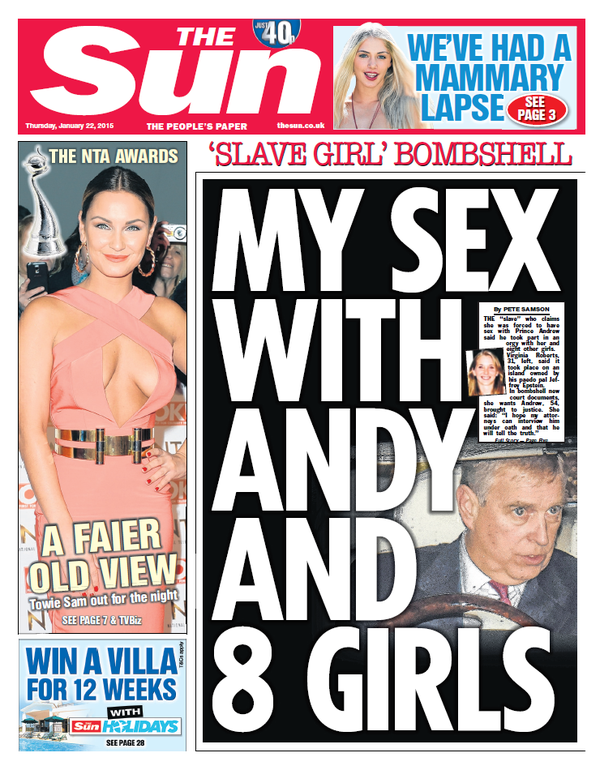
Rumours of Page 3’s demise have been premature. This is very good news for The Sun, because it means that everyone is furious about a photo of boobs on the third page, rather than what’s on the front cover. Indeed, most of the outrage over the front cover seems to be about poorly-constructed breast pun rather than the truly terrible thing. Allow me to draw your attention to the headline story–that’s the bit underneath the boob pun and to the right of the other boob pun.

B76LDhBIUAE2Mq5

It might not look it, but that is a report about a woman who was kept as a slave and trafficked to rich and famous friends of her abuser between the ages of 15 and 18. New legal documents have been filed, with more detail, and this is how The Sun have chosen to report it: as a fun little royal romp.

What does this front page teach those who will see it about sexual violence, about abuse, about women? First and foremost, that it’s cheeky and fun. The way it’s presented, it seems as though these traumatic events occurred with a Benny Hill sax parping away merrily in the background. It seems almost glamorous, as well as sexy: orgies and a real live prince!

The word “rape” is unsurprisingly absence from what happened here, as is “coercion” or “trafficking”. A survivor’s search for justice has been turned into lurid, titillating revelations, and given exactly the same editorial treatment as the testimonials of the “kiss and tell girls”. It is calculated to arouse rather than to anger, to excite rather than outrage.

Alongside the frankly horrible article is a picture of the survivor. It’s hardly just The Sun that have violated her privacy, indeed, I commend them ever so slightly for not using her name right there on the front page like many of the headlines about this story have. Nonetheless, each instance that this happens contributes further to a culture wherein we are perfectly happy to parade women who speak out about sexual violence around, to suck away their anonymity.

I’ve spent more time than I ever cared to receiving vile tweets from fans of rapist footballer Ched Evans. They believe it’s perfectly fine to provide private details of rape survivors. They all, also, seem to be labouring under the false impression that sexual violence is sexy and glamorous. With the front page of a national newspaper sending out messages like this, of course they believe these things. It’s all part of the background radiation of rape culture. Headlines like this are not a meaningless bit of fun, they’re teaching people that rape isn’t so bad, and they’re showing the world how survivors should be treated.

It is not enough to remove nipples from the tabloids. The misogyny problem, the rot, goes far beyond that, to far worse places. Over the last week, The Sun has shown clearly its attitude towards consent, and it’s an attitude which matches the logic of many rapists. Sadly, I think they know they can get away with this, that Page 3 will draw the fire of the people who should really be destroying them for a front page like this.

Every single page of The Sun is nasty. The pitiful excuse for a newspaper reflects and magnifies every ugly bigoted thought. The whole rag needs to die; it becomes clear again and again that this is the only solution. Dismantling that foul rag piece by piece would be but a start, but a tiny step along the way, because all news sources contribute to the problem in the same way. So let us see The Sun in flames, and as we dance upon the ashes, let us turn to the other hacks and let it be clear to them that they’re next.

And they’ve replaced Page 3 with something far worse.

VICTORY FOR FEMINISM. The Sun appears to have dropped the topless model on Page 3. The No More Page 3 campaign is dizzy with joy, retweeting every ounce of praise for them winning this campaign.

The problem the NMP3 campaign had all along was with the presence of nipples, which is one of the very many reasons I had misgivings about it. By their own campaign goals, if it’s true and the Sun has indeed dropped the topless model on Page 3, then they’ve won. No more bare boobs over breakfast.

Personally, I’m a little more sceptical. I have a tendency to flick though the Sun if there’s a copy nearby, for the same morbid reasons as I sometimes subject myself to Question Time or click on New Statesman links. What I’ve noticed in my perusal of things that make me annoyed is that when they don’t have a posed picture of a model on the third page, they tend to have a candid photo of a celebrity. I’d been hoping–being a perpetual optimist who is repeatedly bitterly disappointed–that the Sun would switch to posed photos of models who have covered their breasts, if they’re getting rid of the topless shots. Indeed, last night, it looked like that was the way the wind was blowing, and I felt genuinely relieved that it wasn’t going to be more candid shots.

Of course, that wasn’t to last. Today’s page 3 of the Sun is… candid shots. Of some women who were in a soap opera. Enjoying a beach holiday. Being photographed without their consent.

This is the major problem with candid shots. They’re infinitely worse than posed photos. What does a photograph snapped without a woman’s knowledge or blessing say about our attitude towards consent? Paparazzi shots are invasive and, crucially, completely non-consensual. Fame, according to the paparazzi model, gives men the right to stalk women, to watch them through telescopic lenses while they think they are alone, to watch and wait for a moment deemed suitably titillating or humiliating. If a woman is famous, she loses every right to privacy, and must live her life in a state of perpetual camera-readiness, because she knows that one bad shot where she’s bending and her stomach looks ever so slightly off a completely flat plane will be splashed across the media with gleeful laughter, trying to shame the witch with her rounded witch abdomen. I can only imagine how hellish it must be to be stalked with your harassment encouraged by the national media organisations. In contrast, the topless model, during a shoot, knows exactly what is happening, when the shots are coming. She can portray herself as she wants, and then go home to her privacy.

Another key difference between candid shots and posed photos is who gets paid. Models, of course, get paid for their work. They might not get paid much, but they’re paid for the labour of maintaining their bodies, of being able to work with a camera. With the candids, the subject is not reimbursed for her troubles. Photographers grow rich, they are incentivised to continue their misogynist stalking. Meanwhile, their victims must go through all sorts of affective labour to avoid the cameras, or to at least try to look “attractive” every time they go outside in case there’s a paparazzo hiding in the bushes.

The notion of women getting paid for what we do is, unfortunately, quite alien under patriarchy. It’s a big part of the reason why the paparazzi model flourishes. Women are expected to look good all the time, with no thought given to the sheer amount of effort this labour takes. It’s broadly similar to how demands such as wages for housework remain a niche interest rather than a major feminist campaign. Our work is not considered work. Also related, here, is the general sneering at women who do glamour modelling (as well, of course, as other forms of sex work). It’s not seen as a “real” job, despite the phenomenal amount of devalued labour that goes into it. The No More Page 3 campaign have been just as guilt of this as the misogynists they claim to be fighting. I note that Page 3 is continuing online, behind a paywall, and I hope the models continue to be fairly reimbursed for their work: I’d hate to see a feminist campaign that threw women into poverty!

What was on Page 3 has been replaced by a far nastier flavour of misogyny, born out of a sense of entitlement and a complete disregard for women’s consent. Paparazzi intrusion has ruined lives, even killed women. That anybody could think that replacing a photo which was taken with a woman’s knowledge (and she was paid for) with candid photos is baffling.

I’d honestly rather see a pair of nipples as I eat my beans on toast than this horrifying form of misogyny any day.

Channel 4’s diversity policy won’t work

Channel 4 have produced new diversity guidelines, and get your martini glasses ready because they’ll likely make the rich cis straight white abled men media class start sobbing. Women, PoC, LGBT and disabled people must now be given leading roles in new shows, and characters must also reflect this diversity.

It sounds good on paper, but it won’t fucking change much. The big problem here is that Channel 4 haven’t hit the issue where it matters: the showrunners. The thing about rich cis straight white abled men is they’re not very good at writing diverse characters. They write tokens rather than rounded characters. They write fucking rubbish, because they can’t step outside of their own very limited life experience. Without a change to who is running shows, we’re not likely to see much interesting new content, just a rehash of the same old tired tropes that happen when characters are viewed through the eyes of the rich cis straight white abled man. Channel 4 could have attacked this problem at the very root, and drastically cut the quantity of shows commissioned that are run by this demographic so it reflects population level.

Saying that, even if they did that, I expect what we’d see was a sudden rise in shows run by rich cis gay white abled men.

There’s also a lot of bullshit which falls into compliance with Channel 4’s self-imposed guidelines which won’t help anything. Take, for example, Dr Christian’s pharmacopoeia of nastiness: he’s a gay man (TICK!) and he’s making shows which feature disabled people (TICK!). The fact that these shows generally take the tone of “HEY LOOK AT THIS FREAK WANNA FIND OUT HOW SHE FUCKS?” doesn’t factor into these diversity guidelines. Representation is representation is representation. It doesn’t matter how people are represented, just that they are there.

On the character side of things, I anticipate a little bit of change, maybe. I expect to see less queer-coding villains and more overtly queer, deviant villains. I foresee an enormous rise in racist tropes, with magical negroes leading the white heroes on their quests while at least getting to be in the opening credits for once. And oh! So much naughty, after hours shows with physical comedy about rimming because everybody knows gays can’t go on before the watershed. But worst of all, I predict a rise of the freak show formula. It’s done Channel 4 well so far, and it’ll only serve it better.

Channel 4 has taken a step, but it’s a pretty useless step. I only hope the amount of discomfort it causes the rich cis straight white abled men media class outweighs the negatives.

Another open letter to Russell Brand (this one’s shorter and not shit)

Dear Russell,

You’ve no doubt seen the tl;dr open letter to you, which the Indy rather bafflingly described as hilarious and the best thing I’d read today. It’s a cartoonish parody of a city worker, about as funny as a smear test and ranks only slightly lower than the HTML template I had to find an error in in terms of things I read today. Let’s be honest. We both know that pigshit helps you, precisely because the protagonist comes across so thoroughly unsympathetic and concerned about his fucking lunch. I half-wondered if you wrote it yourself: parts of it were reminiscent of your book in its tendency to ramble and repeat itself and kind of skirt around a point without ever making one.

But anyway. On to my points. First of all, let’s talk about you, Russell. I’m hardly the only one who’s sick of seeing your face leering everywhere, like Nigel Farage with unbrushed hair and an orange juice instead of a pint. You’ve rather successfully made vast swathes of movement all about you (in much the same vein that Farage has made vast swathes of different movements all about him). I’m not sure if this is intentional or not, but I think you’re quite an intelligent man, Russell, so you must know that when you turn up somewhere, the meaning and the cause will be lost in a rush to photograph you. If I were in that situation, I’d stop turning up places, take on a more supportive role. I’d publicise, promote and signal boost, making the words of those I wanted to support clear rather than making it about myself. Or fuck it, if I really wanted to be there, I’d wear a mask, and slip into anonymity. You’re not doing this: you’re eclipsing the work of ordinary people organising with your fame.

It’s beginning to look rather a lot like you’re simply profiting from the hard work of others. You’ve published your booky-wook, and I hear you’re now working on a film. It’s sad, because there’s so much thought coming out from the people who are knee-deep in this, for whom the stakes are high. You could have used your connections to get them published. Hell, you could have fronted some money for printing zines. You could make this work more visible.

More broadly speaking, Russell, you’re a bit of a sticking point at the moment. See, you’ve never really let yourself be held accountable for the sexism or the racism you perpetrated in your past. You’ll notice that your supporters are predominately straight white men. Meanwhile, there’s a lot of us who would rather you weren’t around. I’m neither the only queer nor the only woman who would really rather you buggered off. Your hanging around like a bad smell is alienating: your revolution is not our revolution. Your supporters insist on unity, and for some reason that manifests as unifying around you rather than unifying against yet another rich white straight dude who fancies centring the world on himself.

I’ve read portions of your book. I know you think rapist Julian Assange is hard done by, a slap in the face for the vast number of survivors shafted by capitalism. I know you think that deep down we can all get along with homophobes like the Westboro Baptist Church, which is something most of us queers know isn’t possible. I know you still think it’s acceptable to manhandle women: I saw the way you grabbed that woman during that whole business where you were confronted by that journalist about your housing arrangements.

Basically, Russell, I’m asking you very nicely to sort your shit out or fuck the fuck off. I suspect the former might be a challenge, but I’m willing to keep an eye on you and make sure you do your stuff. Likewise, if you choose the latter, I have a very nice bin in which you can be placed.

Anyway, been nice chatting to you. Toodle-pip. xoxo

P.S. In writing this, I bet the shop I get my lunch from has sold out of hot food. And nice food.

The new online porn regulations and how they disproportionately affect women

Content note: this post discusses consensual BDSM

Today, new regulations have come into force which bans vast swathes of online porn. Fisting’s on the list, obviously, because someone at the CPS has an enormous fetish for showing juries fisting porn. So is hard impact play, simulated non-consent, urination, facesitting, and female ejaculation, among other things. The justification is that this is an attempt to bring online video under the same regulations as would apply to porn DVDs.

Which is all very well and good until you notice that these regulations are ridiculous when applied to porn DVDs too.

If we look at the list again, we see some strange things. It’s worth noting that facefucking–an activity which, when shown in porn often involves a man putting his penis in a woman’s mouth hard and fast (so basically, exactly how it sounds)–a staple of mainstream heterosexual (and often deeply misogynistic) porn isn’t on the list. It’s fine to be there on DVDs, and it’s fine online. Meanwhile, facesitting–which usually involves a woman sitting on a man’s face–is banned. So, a representation of female dominance is banned, while a representation of male dominance is perfectly legal.

Furthermore, the new guidelines explicitly say that actual consent of the performers is immaterial. What matters is how it appears. I’ve written before about the major concerns I have when dismissing real consent in porn. The consent of all involved should be a central concern, but once again, it isn’t.

It’s been pointed out that a lot of people who were, until recently, doing pretty well in the online marketplace, are femdoms, dominatrixes and dommes. These women have been independently producing their own porn, and profiting from this work, without having to rely on the male-ruled world of the mainstream porn industry and porn production. What this legislation does is strip businesswomen of their livelihood, while letting the men get on with making their commercial ventures.

If this doesn’t convince you that these guidelines are terrible, note that even female pleasure is banned under these new regulations. Female ejaculation is banned, because it is considered indistinct from urination: something anyone who has ever squirted will laugh out of town.

So, ultimately, what these new regulations have done is rip away a space for women to express alternatives to the models of sexuality we are sold, and replace all this with what a bunch of men behind closed doors have decided it’s appropriate for us to see. Unsurprisingly, what they don’t want us to be looking at or producing is us stepping out of our patriarchy-approved gender roles and onto a pair of stretched-out balls.

Update: Myles Jackman has provided a full list of what’s allowed and what isn’t. It’s worse than I thought! For example, swallowing semen is allowed, but swallowing or consuming ejaculate from a vulva isn’t!!!!!!!!!!!!!

On Lena Dunham

Content note: this post discusses child sexual abuse and quotes an account from the perspective of an abuser

Over the last few days, a right wing news site published something readers of Lena Dunham’s book “Not That Kind Of Girl” with better politics probably should have noticed: in her essays, Dunham describes some incidents which could potentially amount to her sexually abusing her baby sister. This includes bribing the child in order to gain some sort of gratification:

“three pieces of candy if I could kiss her on the lips for five seconds . . . anything a sexual predator might do to woo a small suburban girl I was trying.”

Inspecting her genitals in a way which goes beyond general child curiosity (and I question whether a one year old baby has the manual dexterity to perform this “prank”; it’s possible that maybe by “vagina” Dunham means “vulva” here):

“One day, as I sat in our driveway in Long Island playing with blocks and buckets, my curiosity got the best of me. Grace was sitting up, babbling and smiling, and I leaned down between her legs and carefully spread open her vagina. She didn’t resist and when I saw what was inside I shrieked.

My mother came running. “Mama, Mama! Grace has something in there!”

My mother didn’t bother asking why I had opened Grace’s vagina. This was within the spectrum of things I did. She just got on her knees and looked for herself. It quickly became apparent that Grace had stuffed six or seven pebbles in there. My mother removed them patiently while Grace cackled, thrilled that her prank had been a success.”

Dunham also describes masturbating in bed beside the child, who would have been pre-pubescent if Dunham was 17 years old at the time. From Dunham’s own words, incidents like this were ongoing and took place over years.

It is important to note that these quotes were not fabricated by some shadowy right wing conspiracy, but, rather, came from Lena Dunham herself. On some level, Dunham must have known the behaviour was inappropriate, since she herself compared it to a sexual predator.

Defenders of Dunham–and Dunham herself–have rejected claims that these behaviours were in any way abusing, using a two-pronged method. First, they are focusing on the source of the first media outlet to pick up on how concerning the behaviour Dunham confessed to was. They behave as though this is merely a right-wing issue, and these are the only people criticising Dunham, when in fact the vast majority of what I have seen has come from feminists, women, survivors. All these complaints are being erased, swept under the rug to form a narrative that it’s only bad people who have a problem with what Dunham said. That is categorically untrue.

Second, and more worryingly, Dunham’s defenders are trivialising this as something which is merely normal, healthy, childish exploration of bodies, and a normal, healthy way for children to interact with one another. Again, this is not true. Child-on-child sexual abuse exists, and some of what Dunham said, particularly pertaining to the bribery on a much younger child,can be described in this way. Ultimately, there is only one person who can say with any certainty whether she perceived this behaviour as abusive or not, and it is Grace Dunham herself–who, if she sees it this way, is a survivor of child-on-child sexual abuse. I do not expect her to come out against her famous sister, in front of worldwide media and out herself as a survivor: she seems to be a private person who objects to being a character in her sister’s soap operas (Grace once said “Without getting into specifics, most of our fights have revolved around my feeling like Lena took her approach to her own personal life and made my personal life her property.”)

However, it is very important that the abusive nature of this behaviour is not erased. While Grace Dunham may not see herself as a victim, a lot of people who have had similar experiences do. When Dunham’s defenders categorically state that it is impossible for this to be abuse, it is a slap in the face for survivors of child sexual abuse and child-on-child sexual abuse across the world. They will see it, and they will feel completely invalidated when they are already engaged in a daily struggle for recognition and acceptance of their own histories. Survivors’ stories will resemble this one, and they see it as abuse. The defences coming out for Dunham could very easily harm survivors, and lead to further pain and possibly even deaths.

It is therefore crucial that we do not deny that behaviours like this can ever be abusive. It is essential that throughout this storm we support survivors and do not act as though this is all a normal part of development. If any survivors have been negatively affected by what’s going on in the media over the last few days, here are some resources that might help you.

White feminism has a nasty history of rallying around abusers, and this needs to stop immediately. It’s so important that we listen to survivors and put their needs first.

What the media isn’t telling you about the Heywood And Middleton and Clacton elections

On checking the news and Twitter this morning, I’d kind of expected the country to have been overrun by frog-eyed pint-swilling overlords to whom we must all bow. Now, I’m going to outright assume that nobody who reads this blog is particularly interested in having UKIP in charge because I have low expectations of pretty much everything, but they’re not that low, so I have good news for you: don’t panic. 

The media construct narratives surrounding elections. They do this because they need something to report in a 24 hour news cycle, and stories get blown up and spun, despite the fact they’re not really all that true. So, as they treat this as a storming victory for the petty little racists they’ve been building up over the last year or so, that’s not actually the case. Here’s a few things the media conveniently haven’t bothered mentioning much in their quest to create narratives.

UKIP are really bad news for the Tories and quite good news for Labour

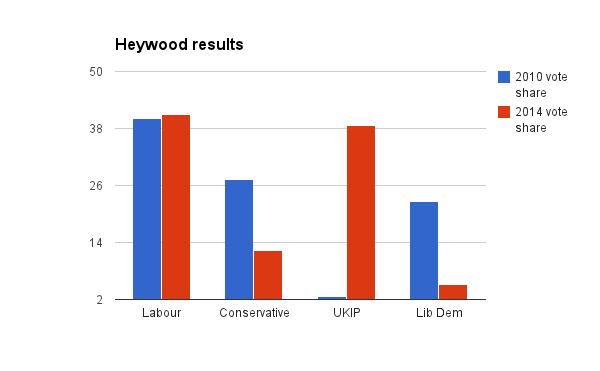
Let’s take a look at the Heywood and Middleton results. I’ve made a little graph of vote share, comparing 2010 with this by-election. I’m only showing the parties that were in both elections.image


Now, the media are very fixated on the massive jump UKIP have made, but what interests me is what’s happened to the share of the vote for the other three parties. The Lib Dems and Tories have lost what is technically referred to as a massive fuckload of votes. This election is an unmitigated disaster for them (lol). See, they’ve had their go in government and haven’t satisfied anyone, so the right-wingers have decided to vote for this shiny new party instead. Meanwhile, Labour’s share of the vote has held. It’s even risen ever so slightly, for the first time since 1997. I have seen this election treated as TOTAL WIPEOUT for Labour, when in fact, it’s a perfectly cromulent outcome for them. You see, this is a quirk of our electoral system. It’s how first past the post works. You only get one vote. In 2010, the sort of people who don’t vote Labour spread their votes about, while in 2014 they’ve all gone for the same bunch. And this is at the expense of the Tories and Lib Dems, not at Labour’s expense.

Of course, the Labour Party will take this as an excuse to go further right and more authoritarian, but don’t let that fool you. They’re doing that because they want to, not because it makes electoral sense.

Of course people voted Douglas Carswell in Clacton

Douglas Carswell was the MP for Clacton. Douglas Carswell still is the MP for Clacton. For whatever reason, they like him as an MP. This would be a tedious non-story if he hadn’t changed parties. “MP gets re-elected” doesn’t exactly sell newspapers. In 2010, Carswell was elected as a Tory MP on a 53% share of the vote. In 2014, he was re-elected on a 59.7% share of the vote. Meanwhile, once again, we see the Tory share of the vote tumbling–it’s more than halved.

Usually by-elections happen when the incumbent isn’t there: maybe they’re dead (like in Heywood and Middleton), maybe they were forced to resign due to fiddling expenses, maybe they were just fucking done with politics. It’s very rare that they’re still around to contest their seat. Before Clacton, by-elections triggered to ratify an MP switching parties have only happened six times: Merton, Mitcham and Morden in 1982; Lincoln in 1973; Preston in 1929; Kingston-Upon-Hull in 1926; the Isle of Wight in 1904; and Orkney and Shetland in 1902. In five out of these six instances, the electorate voted for the incumbent MP. In the other case, MM&M, we saw a similar pattern to Heywood and Middleton: the vote was split between two similar parties (Labour and SDP; the incumbent had defected from the former to the latter) while the Conservative vote held allowing them to get in.

It just goes to show: people really do vote for the person rather than the party.

The media manufactured this whole thing

Our democracy is very much controlled by the media. The media pretty much invented UKIP, because at the moment UKIP can give media owners what they want. In 2010, we saw something similar with the Lib Dems. The more the media blart on about how UKIP are a credible party, the more credible they become. This is why people bothered voting for them at all. At present, UKIP best represent media owners: like media owners, they’re a bunch of terrible old rich white men. So of course the media has a peculiar hard-on for UKIP.

Furthermore, journalists are bored because elections are boring. To make them interesting, you need a narrative, and the novelty value of UKIP is currently very exciting to them, especially because UKIP love talking to journalists and mugging for the cameras. It makes journalists’ jobs easier, so of course they’ll regurgitate UKIP press releases.

Unlike the Lib Dems in 2010, though, we’re unlikely to see a Tory-UKIP coalition in our future, because UKIP are wiping them out at elections. Instead, I predict we’ll see destabilisation of Tory safe seats, which will likely guarantee a Labour government in 2015.

Representative democracy is a shambles

If you’ve made it this far, you’ve probably noticed that this whole system is flawed. Elections are easily influenced, and our first past the post voting system makes it even harder for the will of the people to truly be heard. These by-elections–and the media analysis thereof–lay this bare. If you believe in voting, you’re lumbered with the possibility of having to root for UKIP to keep the Tories out (it splits the vote, remember?). If you want to campaign for electoral reform, you might have an issue where suddenly small parties like UKIP do become a real problem, as well as the nice smaller parties like the Greens getting to have a go. There’s also the option of becoming an anarchist, which is working all right for me, except for the having to organise with some awful people sometimes. However you choose to navigate this territory, be aware: everything is broken. The rot is deep.

The thing we really need to worry about is not whether UKIP win any elections or not, but the fact that our society is so riddled with racism that all of the major parties are spouting nastiness similar to UKIP, and a lot of people seem to genuinely believe it. This is the root that we need to fight, and it won’t be won at the ballot boxes.

Guest post- “The public have no right to know”: how the Morning Star threatened to sack me for reporting domestic violence allegations

This is a guest post by Rory McKinnon. Content warning for domestic violence. It is published with permission of the survivor.

My name’s Rory MacKinnon, and I’ve been a reporter for the Morning Star for three years now. It’s given me a lot of pride to see how readers and supporters believe so strongly in the paper, from donating what cash they can to hawking it in the streets on miserable Saturdayafternoons. I was proud to represent a “broad paper of the left”, as my editor Richard Bagley always put it: a paper that saw feminism, LGBTQ issues, racial politics and the like as integral to its coverage of class struggle.

It’s for this reason that I thought I would have my editor’s support in following up domestic violence allegations against the Rail, Maritime and Transport union’s assistant general secretary Steve Hedley. Instead the Morning Star’s management threatened me with the sack, hauled me through a disciplinary hearing and placed me on a final written warning.

If you want to see my reasons for writing this, skip to the bottom. But I’m a reporter, and in my mind the most important thing is that you all know exactly what’s happened behind closed doors. So let’s get on with it.

—–

Last March a former RMT assistant branch secretary, Caroline Leneghan, went public about what she described as a “violent assault” at the hands of Hedley while they had been in a relationship.

“On this occasion he kicked a pot of paint at me, threw me around by my hair and pinned me to the floor repeatedly punching me in the face.”

Leneghan said she had approached both police and the union after their break-up to seek an investigation: her RMT rep confirmed that police had suggested “a high chance of conviction” but that the six-month window for a charge of common assault had since expired.

Despite this, the union’s then-leadership had decided not to refer the allegations to its national executive for a formal investigation. It was at this point that Leneghan decided to go public (you can find Leneghan’s full statement and photographs here).

Now, I don’t pretend to have any inside knowledge, and at the time I had only just been assigned to a post in Scotland and was busy trying to get my feet in under the table up there. But I am a journalist, and when the union agreed to consider an appeal from Leneghan only to see it eventually withdrawn at her request – amid a pretty vile reaction from some elements of the left – I mentally filed it away as something to keep an eye on.

In March of this year I went as a Morning Star reporter – with the RMT’s approval – to cover its women’s conference in Glasgow. Women I knew of in the RMT were still talking about Leneghan’s case, and it made sense to me as a reporter to follow it up in the public interest, so I took advantage of a Q&A session with the union’s national organising co-ordinator Alan Pottage – a session on recruiting women organisers and combating sexism in the workplace – to ask whether he thought the lack of formal investigation into the allegations against Hedley had affected women members’ perceptions of the union. Pottage declined to comment and the session continued, but when delegates reconvened for the afternoon session the union’s equalities officer Jessica Webb and executive member Denis Connor approached my seat and forcibly ejected me from the conference. (You can find my full statement on the incident here).

The very next day the Morning Star’s editor Richard Bagley informed me that I had been suspended following allegations of gross misconduct and that any public comment I might make “could risk bringing the paper into disrepute and could have a bearing on [my] case”. (You can see the letter here and subsequent charges here.)

Six weeks later, I found myself back in London for a disciplinary hearing, with the company’s secretary Tony Briscoe bringing the charges and Bagley sitting in judgement. But as the Morning Star management’s minutes (for some reason presented as a verbatim transcript), andmy own notes here show, it quickly became clear that the real nature of the accusations had nothing to do with the charge sheet and everything to do with appeasement.

From the minutes:

“RB: You have three years’ experience as a Morning Star journalist. Given the type of stories you’ve covered previously do you think the paper would have published a story on the issue you raised?”

—–

“RB: So let’s clarify the role of the Morning Star here: internal union matters are different from inter-union matters.”

—–

“TB: It’s debatable whether the NUJ (National Union of Journalists – Rory) code of conduct applies in a situation such as this and the fact you asked it raises a question about your approach. The question feels more like something a Daily Mail reporter would ask than someone from the Morning Star. You should have known better. This indicates a lack of journalistic etiquette and has damaged our relationship with the trade union movement.”

And from my own notes:

TB: “I would have thought the role of the Morning Star reporter was to progress the aims & goals of the paper.”

—–

TB: “I would expect that sort of question to be asked in the Daily Mail or the Sun.”

—–

TB: “I would say the public has no right to know about the ins-&-outs of the relationship between Leneghan & Hedley.”

Shortly afterwards I received Bagley’s written judgement. Again, you can read it for yourself here, but the thrust of the Morning Star’s editorial policy is below:

“After three years at the paper you should reasonably be expected to be familiar with the paper’s news priorities, which do not include reporting internal union rows or personal controversy. Your actions suggest a fundamental failure to grasp the Morning Star’s news focus, and by extension the role of any journalist employed by it.”

I was placed on a final written warning with twelve months’ probation, then went on to appeal (dismissed, ruling here), but that’s procedural stuff that isn’t strictly relevant.

What’s relevant, to my mind, is that readers cannot trust the Morning Star’s current leadership to report on abuse allegations and failures to formally investigate when they concern favoured figures in the trade union movement, even when those figures are elected officials. As the edition for 24 July shows, however – coincidentally the same day I had decided to give my notice – those Nasty Tories cannot expect such discretion. Feminist principles are a weapon with which to attack the right, but not an end in itself for the left.

I’ve written this because I was told that “the public has no right to know.” I think the Rail, Maritime and Transport Union’s members do have a right to know about their leaders’ decision not to hold a formal investigation into reports of violence against a female member, and I think the Morning Star’s readers and supporters also have a right to know that the paper’s senior staff have an explicit policy of suppressing such allegations.

It is quite possible that the Morning Star’s management committee – a panel which includes the National Assembly of Women’s Anita Wright – have not been told anything about this. If so, I hope that they will investigate and reassert the paper’s editorial independence. I am not trying to wreck the Morning Star here. I am insisting that it commits to its feminist principles and treats readers with the respect they deserve.

Rory MacKinnon
Morning Star reporter (2011-2014)
mackinnon.rorySPLATgmail.com
@RoryMacKinnon


UPDATE – This post was drafted on Saturday 26 July, the day after informing the Morning Star’s management of my intent to quit. On Monday 28, the paper announced company secretary Tony Briscoe’s retirement and editor Richard Bagley’s departure “for family reasons”. Bagley would continue to work for the paper, the report added.

__

ETA: The survivor has clarified some of the sequence of events. Caroline says:

“There’s a mistake here,the executive refused me to appeal, after that the only route was the agm, which is the quashed one, as i realised all my documents, statements etc had been distributed to hundreds of people without my knowledge”

ETA 2 (19.14 08/08/14): The MS have issued a statement denying everything. To borrow their phrasing, it is interesting to note they haven’t started issuing libel threats…