Transphobia has no place in feminism

TRIGGER WARNING for transphobia

I write this as a cis woman. If I’ve fucked up anywhere due to cis privilege, please, please CALL ME ON IT. 

Hundreds of women have been killed violently. Many more live in fear of violence, sexual assaults and are at a greater risk of suicide. It’s a fucking travesty.

Yet there are some feminists who don’t really give a shit about this particular group. There are some feminists who actively partake in systemic oppression of others. There are some who call themselves feminists yet express hate-filled transphobia which, on closer inspection, is thoroughly indistinguishable from that coming from outside our supposedly safe space.

The vast majority of feminists are perfectly accepting of trans people. As far as I can discern, the transphobia comes from a small, though noisy minority. Unfortunately, this minority seems to be influential, and still get the platform to speak: I write this post after seeing that people are still paying attention to Julie Bindel, who spouted transphobic thought in an Oxford student newspaper today.

Bindel argues that trans people reinforce ideas of gender essentialism: that by getting surgery, or by living as a women when born a man one somehow metaphorically scabs as they “fly in the face of the feminist notion that feminized behaviour or masculinized behaviour is a social contract”. The logic here is flabbergasting. Apparently gender is a social construct, but it cannot be changed. So much for malleability. In arguing that people must stick with their biologically-assigned gender, Bindel herself is the gender essentialist.

Likewise, transphobic feminist Sheila Jeffreys labels reassignment surgery as “self-mutilation” and suggests that transmen are just lesbians trying to be more manly. It’s nothing more than a nasty hateful diatribe, and by arguing this line, it removes bodily autonomy from people. Bodily autonomy is apparently a privilege that only applies to some in Jeffreys’s book.

The “theory” underlying feminist transphobia is as flimsy as an Argos flat-pack, which suggests to me that it is not theoretically-driven at all, but rather a manifestation of a lack of understanding of intersectionality, combined with a hearty dollop of spite and prejudice. Twitterer @scattermoon recently found herself responding to Julie Bindel’s tweets about Channel 4 show My Transsexual Summer, pointing out that many trans people agreed that the editing of the show presented gender essentialism. This was retweeted by Bindel, yet hours later, Bindel bemoaned the fact that there was little to no condemnation of essentialism in the show from the trans community. Either Bindel has a goldfish memory, or, more likely, she is disingenuously pushing an agenda which is harmful to trans people.

Beyond hate speech dressed up as theorising lies another worrying fashion among some feminists. A few months ago, pseudo-feminist Caitlin Moran casually used the phrase “pre-op tranny”. This is hardly the first time Moran has used oppressive language; she has a history of throwing around words like “retard” to get a cheap giggle. When called out on her use of a word which is used as a weapon, Moran decided to block her critics, so desperate was she to hold on to such a vile word.

The shit from these influential transphobic feminists rolls downhill. The thorny issue of inviting trans women into women-only spaces periodically rears its ugly head, when the patently obvious answer to this debate is “of course. It’s a women-only space. We should allow women into the women only space.” Sometimes this manifests as dangerous, aggressive bullying, such as a feminist blog outing trans women. Given the very real threats many trans people face, I cannot believe that some feminists would gladly expose fellow people to such risk.

Transphobia has no place in feminism. None whatsoever. You can dress it up in as much theory as you want, you can stick your hands over your ears and deny you’ve done anything wrong, you can wilfully twist the truth into lies, but if you’re transphobic, you have no place in feminism.

For too long, we have been giving platform to those who actively harm members of an oppressed group, people on the same team as us. Enough is enough. We don’t need our Bindels or our Morans; they are not part of the struggle, they are manifestations of the problem we are tackling.

We do not have to listen to them. We must not.

How to stop your man from cheating

The Sun is hardly known for inhabiting the same universe as the rest of us. The newspaper dwells in this strange limbo where the line between fiction and reality is blurred to nothing. It is hardly surprising, then, that this drivel appeared:

Of course, the solution to partners cheating is not to become a perfect, pliant little domestic goddess. The solution is the following:

SMASH MONOGAMY

SMASH HEGEMONIC HETEROSEXUALITY

SMASH PATRIARCHY

I’m glad the Sun will probably go under soon.

__

Credit to @RupertNeate for bravely combing that rag and finding this, and @jedweightman and @TheNatFantastic for bringing it to my attention.

10 pickup lines that show you’re a dickhead

I shall begin by saying that I hate the notion of pick-up lines. I hate the notion of pick-up culture. I hate the notion that there is a large subculture which dictates that men must pick up women, and that this effect mushrooms into many men believing that the only way they can possibly spend time with a woman is by following these ludicrous rules and feeling like failures if it doesn’t work out for them.

It is not surprising then, that this article, 10 Pickup Lines That Work, pissed me off somewhat.

As its title suggests, it presents ten pick-up lines that apparently work. Unfortunately, little detail is given as to how these techniques were evaluated: it all appears to be anecdotal evidence. In order to adequately test the efficacy of these pick-up lines, one would need to administer the pick-up line to a large sample of recipients, ideally pitted against a control pick-up line with already-known effectiveness.

The unscientific and misleading title aside, these pick-up lines are absolutely awful, and if a man came up to me and started saying any of these things, I would, at the very kindest, decide never to have sex with him ever. At the very kindest.

Our top ten tips come in a number of varieties. All of them are pretty fucking sexist. All of them, in order to work, rely on a vision of society that wants radically throwing: that where it is a man’s responsibility to “approach” and “pick up” a woman. That society wants killing with fire. And so do these pick-up lines.

Type 1: Assault a woman

Remember how, in the popular construction of the Stone Age, men hit women round the head and dragged them by the hair for dating purposes? This pick-up procedure is still alive and well according to Proven Efficacious Pick Up Lines 10 and 4.

Tip 10 involves a bit of minor grabbing followed by the threat of further assault, saying “You’re going to kiss me or I’m going to punch you in the nose!”. Tip 4 is somewhat more direct in the violence and is, for some peculiar reason, titled “be modest”.

As she walks by at a bar, pinch the side of her butt (not hard, but enough to get her attention). She should be mad and say something negative about you. Then you say:

“Sorry, I thought that girls like you would just ignore a normal guy like me. Did it hurt? Maybe another drink will ease the pain.”

I suppose there is some modesty in there. Right next to the sexual assault.

Type 2: Be bafflingly creepy

Ninjas use smoke bombs. Stage hypnotists bark out a strange range of conflicting orders. Confusion as a tactic is also incredibly popular among men who subscribe to the cult of the pick-up line. Utilising confusion seems to comprise a large chunk of the list of useful techniques, ranging from Tip 9 (Stare straight at her, and smile broadly while slowly advancing towards her) to Tip 7 (the thoroughly puzzling “nice shoes, want to make your parents proud?”) through to Tip 5 (which is not, as it says, being sarcastic, but asking a woman’s favourite colour knowingly).

Apparently, women are “always thankful” after being completely thrown by a total non-sequitur. The explanation for how this works is as bamboozling as the line itself, and I still don’t want to have sex for the author, providing anecdotal evidence against the efficacy of this approach.

Type 3: Be cocky in a flat-out sexist way

The word “cocky” contains the word “cock”, so it’s hardly surprising that cockiness implies a performance of the most unpleasant aspects of masculinity. The pick-up lines of this type tend to include displaying a massive amount of sexism, in the hope that the woman on the receiving end finds it funny.

The least offensive is Tip 6, which involves telling a woman she should buy you a drink as she has been “checking you out”. Tip 3 is titled with the rather innocuous “find something you have in common”, which is actually very good advice for men who are interested in meeting and forming relationships with women. What is not good advice is what follows: “convey[ing] it to her with a well-balanced delivery of cockiness and playful insult”.

Then there’s Tip 8, wherein men are directed to use a classic street-harassment tactic: “Hey girl, why you being all sexy ‘n shit?”

The last time someone said that to me, I considered wearing their testicles as earrings. The only thing that stopped me was the fact my earlobes can’t really support pendulous accessories.

Type 4: Assume she wants a boyfriend

Traditional gender roles hold that men want sex and women want a boyfriend. Traditional gender roles are, of course, a big heap of shitting arses.

The readers of askmen.com apparently missed this memo and so voted, as their top pick-up line, the following:

“You know what material this is?” [Grab your shirt]

“Boyfriend material”

Unlike most of the pick-up lines, this one does not come with an anecdote about how use of this line resulted in fifty young nubile nyphomaniacs immediately losing their knickers, “proving” that the approach works. It is just printed there, on its own, and presumed to work.

It is presumed to work, because that is, of course, what women are presumed to want. There is absolutely no concept that women might not be interested in the concept of a boyfriend and might just want a shag. Target is woman. Target wants boyfriend. Hunter disguises self as boyfriend.

I suppose that perhaps, I would not mind a shirt made out of ex-boyfriend material. As long as the material was the tanned hide of an ex-boyfriend.

…and the one that actually works

Surprisingly, Tip 2 contains some actual, decent advice for starting a conversation with a stranger. Unfortunately, it is placed under the heading of “be a gentleman”, which is unfortunate, as “being a gentleman” generally involves subscribing to benevolent sexism.

The “lines” presented are very good advice, though. They involve introducing yourself, saying hello or simply having a conversation with the other person to see how you get on. This advice is not really gendered in the slightest: it is a good approach to initiating contact with someone you don’t know that we can all follow fairly easily. As the tip begins, “no pick-up line is the best pick-up line”.

And that is completely true. Fuck pick-up culture. It is outmoded, outdated, and we would all be better off if we consigned it to the dustbin of history along with the bourgeoisie, Mensheviks and Trotskyism.  Oh, and of course, patriarchy.

__

People sometimes send me things, presumably so they can find themselves amused by my blind rage. This gem was a little gift from @jedweightman.

__

Edit: I’ve asked askmen.com to explain why they think the violent tips are acceptable. I will update if I get an explanation.

__

Update 11/11/11: Askmen.com has not replied, but have quietly changed the tips advocating assault and threat (10 and 4) to more innocuous ones (introduce yourself and show off, respectively). This is a step in the right direction, but nowhere near good enough. They need to formally apologise for the earlier version of the article, as is good practice.

For fuck’s sake: Dominique Strauss-Kahn, the porno

Some news fails to raise the anger, and just causes a tired sigh of having one’s lowest expectations met. This story is one of them. The article is in French, so I will translate the important bits. Unfortunately, my French isn’t brilliant and I lack the fluency to spot implicit sexism and subtle rape apologism. That doesn’t really matter: it’s not like any of the crap in the story is subtle.

In short, they’re making a porn film about Dominique Strauss-Kahn and that time he sexually assaulted a woman who was cleaning his hotel room. A high-profile rape case is apparently deemed sexy enough to crack one out to these days: perhaps the Daily Mail articles didn’t go into sufficient detail to achieve maximum turgidity, so a porn film became necessary.

According to the synopsis, “David Sex King, owner of a large financial institution, cannot resist the charms of a chambermaid who comes to work. Oh dear! This is a great opportunity for her to emerge from anonymity and use all ways to make this horny old goat pay.” This scenario gives priority to the side of the venal Naffissatou Diallo and is likely to startle feminist associations.

Not so much a startle as a weary “for fucks’s sake” from over here. It is nothing but simple, blatant victim-blaming. Diallo is lascivious, Strauss-Kahn the lusty chaud lapin who is completely incapable of resisting Diallo’s sexy wiles. He couldn’t help himself, as they say.

It’s not even novel porn. As the article says,

Otherwise, “in the bathroom of the suite, to the hearing in court, to prison”, it sounds like a traditional porno.

The same old tedious porn tropes will be trotted out. A sexy French maid. A sexy judge (possibly with a sexy jury). A sexy (probably inexplicably heterosexual) prison. The only difference here is that it is pasted on top of a real-life event where real people were involved. I wonder, what would Diallo make of being portrayed as a bit of exotic porn-totty, the sexual assault nothing more than a set-up to a string of hackneyed porn clichés?

It’s more than tasteless. It’s insensitive, it’s unpleasant, it’s downright nasty. I am not in the least bit surprised that this exists.

__

Big hat tip to @petitefeministe who found this story. Check out her blog; she’s one of my favourite feminists.

ETA: Futher awesomeness: Petite Feministe has translated the article here

The Tories try to absolve responsibility with magical in-utero interventions

Following the summer riots the Tories have been falling over themselves to look like they’re Doing Something (usually terrible ideas). Another dreadful idea has emerged from the Cabinet Office, this one inexplicably originating from the Department of Work and Pensions, with somewhat unfortunate implications.

Here, Iain Duncan Smith has proposed magical in-utero interventions to stop kids from joining gangs. It is the logical conclusion to the “blame the parents” line; the parents are now so much to blame that it must be happening right at the moment of conception.

 “I am talking about intervening when the child is conceived, not even when born.”

This has the implication of following the anti-choice line: that life begins immediately at conception. This is hardly surprising, considering IDS has a distinctly anti-choice voting agenda. I do not think this is a poor choice of words here. He genuinely wants early intervention from the moment of conception.

Now, while in utero environment may have some effect on later life, it is hardly likely that the solution proposed here will be helpful in any way: IDS wants “more male role models”. It is another subtle rehashing of the “single mothers are to blame for the riots” line.

There are three other interesting things in the proposals. Firstly, IDS is falling over himself to not appear like a misogynist, repeating over and over that it’s actually gangs that are misogynistic, and that his proposal to blame women for their children’s behaviour is absolutely fine and dandy.

Second is the outright admission that for something so important, the government is actually not going to bother trying to spend any extra money on the solution:

“There is a lot of money being spent on families and estates but it is dysfunctional money that goes to solve only short-term problems.”

They are absolving responsibility here. Shifting around, looking as though they are Doing Something. when in fact they’re just rehashing rhetoric and not bothering investing in evidence-based interventions.

Finally, it just doesn’t make any goddamn sense. In the rush to blame the parents, IDS has confused himself hugely. Sometimes the gangs are the problem; sometimes parents. I think he thinks parents are responsible for children joining gangs. It’s hard to tell.

Essentially, what is happening here is that Iain Duncan Smith is spraying his blame-gun around indiscriminately. He doesn’t want to bear any responsibility for riots caused by poverty caused by the government of which he is a part. And so, nonsensically, he absolves responsibility.

It is the norm for this government. It will have real implications for generations.

Cargo cult activism

During the Second World War, the indigenous people of the South Pacific experienced an upheaval: suddenly their islands were flooded with naval airbases. It wasn’t all bad: the big aeroplanes bought exciting new things: food, clothes, medicines. The people grew to like it. When the war ended, the troops were gone, but the people wished the big aeroplanes full of fantastic goods would come back.

So they did what they thought would summon them. They built runways, performed military drills and fashioned air traffic control towers, where they sat wearing headphones of wood.

Unsurprisingly, the big aeroplanes never came back. It was never about the headphones or the military drills? Yet how were the cargo cults to know this? By all appearances, these trappings summoned the big aeroplanes and all of their bounty.

In activism, we sometimes find ourselves in a similar position. The most egregious example, perhaps, is the occupation of public squares. It stems from the uprising in Egypt early this year, where millions of Egyptians occupied Tahrir Square until they toppled their government and achieved regime change. Admittedly, things have not exactly got better for the Egyptians since their regime change, but the formula appears to go like this:

  1. Camp out in public square
  2. ???
  3. REVOLUTION

And so Tahrir Square became something of a meme. In the months that followed, conscious attempts were made to copy the great Tahrir Square occupation. In Spain, they camped out in Puerto del Sol. In Greece, Syntagma Square. The UK made several attempts: on March 26th, the word went up to turn Hyde Park into Tahrir Square. People camped out in Trafalgar Square for several weekends. A picnic was held on the steps of the Bank of England that was called an occupation.

What do these things have in common? None of them led to a revolution.

Then there is the example of the ongoing occupation of Wall Street. The people have been there for weeks, now, and are gaining vast popular support. Comparisons to Tahrir Square have been made, of course. Unlike Tahrir Square, Occupy Wall Street is unlikely to lead to revolution: perhaps that was never their goal at all–the occupation has been described as its own demand. There is hope, of course. There is always hope: the occupation could genuinely be used as an organising space to build a better world if it so chose, but it will need to go beyond camping in a public square. The numerous copycat occupations springing up across the States are as unlikely to breed revolution as any of the other squares.

So what is the difference between these occupations and Tahrir Square?

As MagicZebras points out, it’s not about a bloody square. We are a cargo cult, pitching tents in public squares in the vain hope that it will summon better times.

Part of the problem is location. Tahrir Square was prominently placed in front of governmental offices, a visible statement of “we’re here and we’re watching you”. In contrast, many of the other square occupations, including Wall Street, have been tucked away in minimally-invasive places.

Another problem is numbers: millions of people were in Tahrir Square, in contrast to the thousands who camp out in the larger derivative square occupations.

Another big difference is the conditions from which the occupations sprung up: Tahrir Square happened after days of lively protesting and rioting, while all of the others, save Syntagma Square, happened in conditions of relative peace.

In contrast to organising camps such as Climate Camp or the Greenham Common Peace Camp, square occupations are often not used as a springboard for proximal direct action. This is a shame: Occupy Wall Street easily has the numbers and the proximity to do some serious disruption of trading, yet they have not. While its utility as a collective living space and a demonstration of communal spirit is admirable, it could do so much more.

And I wonder, then, if it is hamstrung by attempting to be like Tahrir Square. In Tahrir Square, their presence alone was disruptive: millions of people, refusing to leave until the government they despised had gone. In Wall Street, the protesters now have mayoral approval to stay as long as they like. Time will tell if they seize this opportunity and escalate. It is certainly the best way to move forward, if their ultimate aim is to fix a broken system.

In short, then, we must stop with the Tahrir Square cargo cult. Tahrir Square was perhaps unique: a product of its conditions. It was certainly not just occupying a square that caused revolution, and we may need to let go of the romantic notion that going camping will overthrow governments. For our own motivation, we must be realistic about what we can achieve with an action, rather than dreamy aspirations. Failure is ultimately disheartening.

We are unique. We are not Tahrir Square, and nor should we try to be. Let each action be a response to its own circumstances, with conscious awareness of our own strengths and limitations.

We are not Tahrir Square, and nor do we need to be.


Unlucky and lucky

Today is World Mental Health Day, and I mark it with the revelation that I have depression. One in four people will be affected by mental health problems at some point in their lives, and I am on the wrong end of those odds. Still, I am not alone: I know dozens of people who are affected by a rainbow of mental health problems. Sometimes, given my social circle, I forget that in our general culture, mental illness is still massively stigmatised.

And it is. There are many who do not believe that mental illness is “real”. Being “all in the head” is somehow distinct from physical illness. This is not true: many mental health problems require treatment, mental illnesses can be disabling, and the diseases of the mind/body distinction is false anyway. Despite this, when I go through bouts of depression, I am harangued by work colleagues about when I’ll be “over it” and back. Most days, I see tabloid newspapers screaming about how people are claiming disability benefits for depression. Of course they are. It can be debilitating.

Then there’s the treatment. I waited ages before I got any treatment. One dear friend of mine was twice referred to the wrong sort of counselling–only discovering this after having waited to receive this treatment for months. Another friend asked for bereavement counselling and was curtly informed there is a nine month waiting list for that. Treatment of mental illness leaves a lot to be desired.

Then there’s the having to explain to people that sometimes I won’t get out of bed all day, or I might run off in tears, or react strangely to something, and it’s not like there’s a magic wand to cure this problem. I’m different, basically, and that’s sometimes a little difficult.

Despite all of this, maybe I’m lucky–just a little bit lucky. As I mentioned, today is World Mental Health Day, and I have just given a run-down of the experience of a not-impoverished person living in the capital city of a developed country.

If I suffered from mental health problems somewhere else in the world, I’d probably be a lot worse off. Stigma is higher than that which is experienced in a reasonably-aware society. 4 in 5 people in developing countries do not receive treatment at all, even though treating a condition like depression is as successful as treating HIV with antiretrovirals. Mental health problems interact with other problems people face: people with HIV, cancer or other chronic conditions are more likely to experience depression, and as a result of their depression less likely to adhere to treatment regimens for their physical conditions.

And, of course, the elephant in the room: mental illness is a killer. Every 40 seconds, someone commits suicide.

There’s a lot to be done, and it needs to happen globally. Morally, we cannot let people continue to suffer from illness, and we need to get better at supporting people, both through treatment and through destigmatisation. Beyond morals, even to a cold capitalist it makes sense: improving mental health provides a big, happy workforce and a bunch of cheery consumers.

This is what World Mental Health Day is for: let us be aware of the vast public health problem in front of us, and give us the will to fix it.

It’s OK to wank over Foxy Knoxy now

Amanda Knox has won her appeal, and her conviction for the murder of her flatmate has been overturned.While I am no legal expert, it had seemed to me like much of the evidence against Knox had been circumstantial, and, considering further scrutiny found her innocent, it would appear that Amanda Knox is not a murderer.

Whether Knox was a murderer or not always seemed to me to be the important thing about the story: who killed Meredith Kercher? Was her flatmate somehow involved in the crime? Unfortunately, for many, this was not particularly relevant. Aside from the typical tabloid recounting of grisly scenes of murder, what was more salient was that Amanda Knox was an attractive young woman. The tabloids lapped it up. “Foxy Knoxy”, they called her.

It is immediately apparent that the interest had never really been in whether Knox killed anyone: after all, we never hear of Horny Hindley or Chesty Westy, as both Hindley and West were not deemed attractive or young enough to provide the fascination.

Amanda Knox, on the other hand, was reported on at times in a way that only omega-list celebrities going to the shops are reported. Take for example, the 2010 Mail article about Knox’s slander hearing: the headline read “AMANDA KNOX CHOPS OFF HAIR AND SUFFERS “DEPRESSION” BEFORE SLANDER COURT HEARING”. Here, the hearing–the actual, newsworthy part of the story–is added almost as an afterthought, behind the story of a young woman getting a haircut and suffering from mental health problems, which, with typical Mail sympathy, are hygienically sealed off with quotation marks as though they do not exist at all. The first line is even more telling: “The cool-headed composure and piercing blue eyes remain familiar from her murder trial.” Knox’s looks, to the Daily Mail, are far more important than the news.

The tabloids appeared to have quite the crush on Amanda Knox, and therefore desperately tried to crowbar in as many photographs of her as possible around slight allusions to the actual story. Never is this more apparent than in tabloid discussion of Knox’s sex life: gushingly lurid descriptions, followed by a slight tut-tutting, just so they don’t look too much like they’re cracking one out over someone who might be a murderer–except for those, like this tweeter, who actively preferred the idea that Knox was a murderer.

It must be an utter delight, then, for the crass media types to finally be free from the guilt of a crafty wank over a killer, following Knox’s appeal result. No-one was more open about this fact than Channel 5 televisual torture The Wright Stuff, who proposed as their phone-in question:

Parts 2 & 3: Foxy Knoxy: Would Ya?
So Amanda Knox has been cleared of the murder of British student Meredith Kercher. She’s entirely innocent. She’s also undeniably fit and loves wild sex. Or did. So if you were a guy who’d met her in a bar and she invited you back to hers, would you go? I’m being quite serious. Or would something in your brain make you think twice?

There are interesting, relevant things to be discussed around the story of Amanda Knox’s appeal. For example, what might be the impact of being imprisoned almost four years? How does this reflect on the Italian justice system? What about Raffaele Sollecito, who was also cleared on appeal?

Instead, though, there is the same old tired focus on Amanda Knox as a sex object rather than a human being, except now one can spunk on her photograph without having to fold the Daily Mail article over where it alludes to her crimes.

Our misogynistic media is thoroughly obsessed with two things: attractive young women and lurid crimes They must be utterly delighted that finally some legitimate wanking material has emerged from the story of a murder.


I encountered an anti-choice demo

This afternoon, I had a lovely lunch with my friend Jed. We ate sushi in the park and enjoyed the glorious unseasonal sunshine. On the way back to work, our mood was sullied.

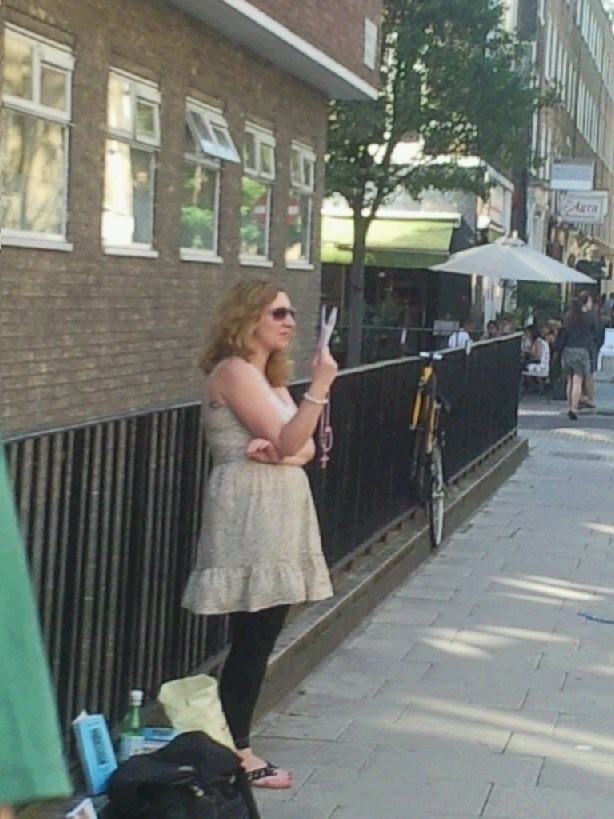
Opposite the Marie Stopes centre in Fitzrovia was an anti-abortion demo. A woman stood on the pavement, with a rosary wrapped around her wrist. Next to her, on the pavement, was the word “LIFE” spelt out in plastic foetuses. It shocked me. It was one of those things I associate with the US, not something that happened yards away from my office.

I decided to take a photo. I crossed the road, and, standing outside the centre, prepared my camera. It was at this point I realised there were two of them. The other anti-choicer, a man, stood in front of me and refused to let me take the photo. He spoke with an Irish accent. In his hands were two rosaries and a handful of leaflets printed on cheap coloured paper. I didn’t see the text, but there was a great big cross on the front, so I think I can guess at the subject matter.

I informed him calmly that it was my right to take a photograph of a demonstration, and he became rather enraged and threatening, so fixated was he on moving me away. Across the road, out of the corner of my eye, I saw Jed lining up a sneaky snapshot. I created a distraction while Jed took the photo above.

As we were about to leave, the man had been pretending to call the police. Of course he wouldn’t have really called the police. He had been rather threatening towards me, and the demonstrators were wise not to want their pictures taken. They were in the process of committing a crime: section 5 of the Public Order Act, causing harassment, alarm or distress. Having an abortion can be a very stressful experience for people, and this is exacerbated by people hanging around with misleading leaflets, rosaries and plastic foetuses, harassing them and causing distress.

I found it very interesting that the woman never spoke. She stood, placidly in her position while the man spoke for her: “She doesn’t want her photo taken”. It was a microcosm of patriarchal privilege and power, which is a huge motivator of the anti-choice agenda.

The experience left a bad taste in my mouth. It is one of those things that I hope I will never see again, but, sadly, I suspect I will. I do not want such demonstrations banned–it sets an ugly precedent, and those anti-choicers have as much right to protest as any other soul.

But I don’t want to see it again. I don’t want women to have to enter clinics for advice, for contraception or for abortions when they are at risk from harassment. So what is the answer here?

Long-term, it is to build a world where choice and bodily autonomy is respected completely, and nobody feels the need to be poking about in someone else’s womb-business. For now, though, we must work to foster an environment where anti-choice demonstrations are not welcome–a less confrontational, smaller-scale version of counter-demos against fascist groups like the EDL. This may be as small as taking a photograph of the demonstrators. We may, at some point in the near future, need clinic escorts, who protect people entering centres from the anti-choicers.

I don’t want to ban demos like this, but I truly hope that I never see one again.


Silliness about gay marriage


Roger Helmer, the Tory MEP who previously suggested that all men are rapists in a messy attempt at rape apologism is at it again. This time he’s feeling all cross about the government vowing to bring in gay marriage. I mean, I’m less than happy about this blatant attempt at distraction that isn’t sexual liberation at all, but Roger Helmer MEP is cross for thoroughly different, thoroughly unpleasant reasons.

The whole piece is worth a read as it’s lulz-tastic, and one can easily play a drinking game while reading along with the following rules:

  1. Every time Roger Helmer MEP bemoans political correctness–ONE FINGER
  2. Every time Roger Helmer MEP talks about how gross gay people are, couching it in “but of course I don’t think that”–ONE FINGER
  3. Every time Roger Helmer MEP makes a really confusing analogy–ONE FINGER
  4. Every time Roger Helmer MEP makes a veiled reference to the gay agenda–ONE FINGER
  5. Every time Roger Helmer MEP says he is not talking about morals while moralising–ONE FINGER
  6. Every time Roger Helmer MEP bemoans the coalition for not being right wing enough–TWO FINGERS
  7. While reading the entire piece–WATERFALL

There are some particularly egregious parts of the article that warrant further inspection. First, this:

I don’t approach this as a question of morality.  Indeed I take a broadly libertarian approach.

Now, keep this bit in mind as we get to his conclusions. SPOILER WARNING: He doesn’t take a broadly libertarian approach.

Of course I know that some people find the idea of homosexual behaviour repugnant.  Maybe some homosexuals find the idea of heterosexual behaviour repugnant.  And as a libertarian, I support the right of people to hold those opinions, just as I support the right of individuals to behave as they choose — though it seems that in these politically-correct times, it is no longer acceptable to voice such views.  It is worth adding that these opinions may be intrinsic, and not a matter of choice.  I did not (for example) choose to like ice-cream and to dislike foie gras.  It’s just the way I feel.

I hope you downed your finger for Roger pretending that he isn’t disgusted by gays, here, and another finger for a tortured analogy. Now you’re good and tipsy, have a burble of shocked laughter at Roger seriously trying explain his prejudice with “I was born this way”. He actually does this, and tries to distract us by talking about tasty, tasty foie gras immediately afterwards. What is particularly interesting here is that it is unclear as to whether he is talking about general homosexual behaviour, including going to the shops, eating sandwiches and getting married, or simply limiting it to his disgust about gay sex. If it’s the former, I think that Roger Helmer MEP is a revolting, bigoted dingleberry. If it is the latter, I think that Roger Helmer MEP is a revolting, bigoted dingleberry. I can’t help it. I was born that way.

And also, he’s behaved like a revolting, bigoted dingleberry.

While legislators may occasionally need to define some technical term in the context of a piece of legislation, it is not the business of government to legislate to change the meaning of a common and well-established word, and least of all a word that describes such a key institution in society.  The government doesn’t own the English language: the people do.

Second, yes, marriage is a right, but marriage is a relationship between a man and a woman.

Here, Roger is trying to suggest that in the English language, marriage can only pertain to a solemnised relationship between a man and a woman, which is patently bollocks. How often is the word “marriage” also used to describe the coming together of two ingredients–for example, one could easily describe the music of Gogol Bordello as a marriage of gypsy folk and punk music. Does this mean the two musical styles are now legally married in a way two men or two women cannot be? If that’s true, what are Gogol Bordello doing to ensure full marriage equality?

Everyone should have the right to procreate, but that doesn’t mean that a man can or should get pregnant.  There are certain things that people can and cannot do because of their gender.  It’s a limit placed on us by nature and biology, not by law.

Actually, it’s not.

The next bit gets really silly, so I hope you’re all good and drunk by now. It’s the only way one can read this drivel without throwing things.

Thirdly (and it cannot be stressed too often) marriage is a relationship between three parties: a woman, a man and society.  Society down the ages has recognised marriage, and offered married couples recognition, respect and often financial benefits in terms of taxation and inheritance, because society recognises the importance of the institution.  The expectation is that marriage will generally lead to procreation and children, and that the resultant nuclear family will promote stability in society, replenish the population, and provide the ideal circumstances in which children can be raised and socialised.

A same-sex partnership is a relationship between two parties, not three, and there is no reason why society should treat it in the same way as marriage, because it does not offer the same broad benefits to society as a whole.

Excuse me. I just threw all of my belongings in the direction of the East Midlands. Strangely enough, Roger Helmer MEP has articulated many of the reasons why I am opposed to marriage in general: essentially, that it is a tool for social order and enforcing the “nuclear family”. And apparently those gays are just free-riders because they don’t crap out lots of babies to keep the population going.

To Roger Helmer MEP, marriage is all about popping out kids. He is far from alone in using this ridiculous notion to oppose same sex marriage: a lot of the bigots do. Not one of them has yet been able to offer a satisfactory, consistent explanation as to why, by this line of thinking, marriage should not be denied to an elderly heterosexual couple or an infertile heterosexual couple.

Roger ends his piece with a plaintive whinge that Those Pesky Gays are trying to undermine the meaning of marriage, and that society will automatically descend into anarchy. I wish I shared the opinion in the last clause. I’d be happier about the news myself.

Roger Helmer MEP has once again displayed himself to be a steaming twat, with an inability to form a coherent argument. I find him thoroughly repulsive.