
What conclusions can we draw from the “porn performers feel good about themselves” study?

It’s been a while since I’ve got my teeth into a close reading of a paper, and this week has gifted me with a doozy: Pornography actresses: An assessment of the damaged goods hypothesis. The study was authored by psychology academics and former porn performer turned founder of a healthcare programme for porn performers.

The paper aimed to test the veracity of a set of beliefs surrounding women in porn. These attitudes were gleaned from a studies into attitudes towards porngraphy, finding that those with a negative attitude towards porn tended to believe that porn performers had low self-esteem, were drug addicts and had experienced sexual abuse in childhood. These attitudes, the authors point out, are also apparent in anti-porn feminist writing, which is backed up with little evidence. The authors also point out the distinct lack of quantitative research into the women in porn themselves, drawing attention to the fact that while there’s a couple of qualitative studies about why women get into acting in porn, there’s nothing quantitative.

So they decided to examine quality of life, self-esteem, attitudes towards sex, sexual behaviour and drug use in a sample of porn actresses. The headline findings were rather interesting: it turns out that the stereotypes aren’t true. Comparing porn actresses to a sample of women matched by age, marital status and ethnicity, they found that the porn actresses actually had higher self-esteem than comparable women, were more likely to feel positive, felt they had better social support and were more spiritual. There was no difference in current drug use, apart from marijuana (porn actresses were more likely to get high), although the porn actresses reported more drug use in the past. There was also no difference in incidence of sexual abuse in childhood. And finally, the porn actresses reported greater levels of sexual satisfaction, were more likely to identify as bisexual, enjoyed sex more, were having more sex than the women who weren’t in porn (sex as part of their work was not counted: this was entirely extracurricular sex), were more likely to be concerned about catching an STI, and had started having sex a little earlier.

Does this mean that the stereotypes about women in porn coming from some feminists and the general population can finally be put to bed? I’ll get back to that after we’ve had a little look through a few criticisms of the paper.

The sample

The study used a clever sampling method for accessing porn actresses–a task which is usually rather difficult and goes some way to explaining why there is little, if any, quantitative examination of porn performers’ lives. The porn industry requires that performers have regular STI tests, particularly for HIV, so participants were recruited from a clinic where they were tested. The comparison group were recruited from a college and an airport (annoyingly, it’s not specified whether this airport and university were also in California). While it is not ideal that the porn actresses were all recruited from Los Angeles, which might not be representative and generalisable to the entire population of porn performers, it is not as bad as one might think: the authors were testing whether stereotypes about women in porn were true. The majority of porn distributed in the west comes from southern California, which shapes discussion and thought about porn by western people as about this group of porn actresses. They’re not entirely representative of everyone in porn, but they’re certainly the people about whom the stereotypes are formed, and therefore this is a reasonable sample to draw from.

Since the authors were also concerned about stereotypes about women in porn, it’s also not a problem that men were not included in the study. The “damaged goods” stereotype that was being examined exists only about women!

One commenter on Jezebel (yes, I looked at a Jez discussion thread. Yes, I’m traumatised. No, I don’t ever want to go back to Jez ever again) points out that the sample of porn actresses may differ from average in being slightly older and having worked in the industry for longer. However, this isn’t actually backed up by a link to where she got this information from, and her comment is preceded by “I believe”. This might be true, but I haven’t been able to find this information anywhere, so can’t comment on whether this is a problem for sampling. However, it is important to note that the women included in this study were those who were participating in above-board porn which was compliant with the regulations, and there might be differences in women who are working in grey or black market porn. Unfortunately, these women are even harder to access and study.

Ultimately, this was an impressively large sample for such a difficult-to-access group: data from 177 porn actresses were collected (and, of course, 177 women in the comparison group). Of course, in any quantitative study, no sample is going to be completely representative, but as far as things go, this was reasonably strong.

The design

This study used a matched pair design: data collected from each porn actress was matched with data collected from a woman the same age, ethnicity and marital status. This is a fairly robust design when comparing groups, and means that differences cannot be attributed to these variables. I am even more impressed at the sample size with the researchers using this type of design, as it’s notoriously difficult to collect data for these designs, being massively time- and resource-intensive.

I have beef with the matching criteria, though. While the authors were right in selecting these, particularly as their sample of porn actresses were far more likely to be single than the general population, there’s an important thing missing that wasn’t measured at all and probably should have been controlled for. Socioeconomic status–class–was never measured, so we don’t know at all whether the porn actresses were better-off or worse-off than the comparison group, and if so, whether it was this that was the cause of their general feeling a bit better about life. Perhaps a way of establishing a better comparison group would be to compare porn actresses with TV or film actresses of the same age, ethnicity and marital status. This would likely control for a lot of the noise, although it would be an absolute arse to research.

Rather irritatingly, the authors never mentioned if they asked the women in the comparison group if they had ever worked in porn (or, indeed, if they were currently porn actresses who happened to be at college or at an airport that day). Since the likelihood of them being porn actresses is fairly low, this probably doesn’t pose much of a problem, I’m just a pedant.

The statistics 

Feel free to skip this bit, as it will get a little technical, and is mostly minor statistical nitpicking. The biggest statistical elephant in the room is that this study ran a lot of statistical tests. A metric fuckton, to use the accepted statistical term. The researchers conducted an awful lot of T-tests, which is a statistical test used to check if one thing significantly differs from another: in this case, whether porn actresses differed significantly from women who weren’t porn actresses on number of sexual partners, or alcohol use, or any of the other eleventy bazillion variables which were being measured.

When one conducts a metric fuckton of statistical tests, one increases the likelihood of encountering a Type I error: a “false positive”. Purely by chance, one of the tests came up as significant, when in fact there isn’t really a difference there. This can be controlled for, although the authors didn’t. Luckily, there was enough data present for me to do this task for them. I did a Bonferroni correction, where the threshold for significance is revised based on how many tests are being performed. It’s pretty easy to do. You take the generally-accepted significance threshold, which is p=0.05 (or, a 5% probability that the results are entirely down to chance and you’re seeing an effect that isn’t really there), and divide it by the number of tests performed (in this study, 19 t-tests were performed). So, the significance threshold for the tests should actually be p=0.0026.

All of the p-values reported came up as less than 0.001, which means they’re still significant even with the Bonferroni correction, with the exception of sexual satisfaction, positive feelings and social support. However, enjoyment of sex was still significant, so it looks like our porn actress sample were enjoying sex significantly more than the non-porn actress sample anyway.

What wasn’t examined (and I wish it had been)

I’ve already mentioned how I wished the authors had controlled for class, but there’s a few more things I’d love to have seen addressed in this paper. Firstly, how the variables related to each other. Given that the porn actresses had had a lot more sex than those who weren’t in porn, could this be the reason they seem generally happier and with higher self-esteem? I have no idea, because the authors didn’t check this, and it would certainly be interesting to find out if this was the driving factor, or even just mediated the relationship.

The other thing missing, I feel, was the type of porn the women were performing in, and how that related to the variables. Were the participants who identified as bisexual more likely to be appearing in lesbian or bisexual porn? Do certain types of porn affect the self-esteem of the performers? Again, no fucking idea, I wish it had been measured, and I seriously hope future research addresses such questions.

Feel free to add more interesting questions you’d like to see addressed in the comments!

So what does it all mean?

Ultimately, from a single study, we can never conclude anything concrete, but it is a good thing to see these questions being addressed systematically, and I hope that it leads to future research. Too often, the experiences of those involved in porn or sex work are ignored, and it is genuinely refreshing to see research attempting to examine their experiences and feelings.  This study provides a foundation for further examination and to build upon its flaws so we can better understand what it’s like for women in porn and replace the stereotypes with solid evidence.
The NetMums survey: how not to conduct a survey

I’ve been trying to ignore this, as frankly it’s utter bollocks but people keep sending it my way anyway.

Transparent knock-off of Mumsnet, who are creatively called Netmums, have produced survey data declaring feminism is dead. Predictably, the media have leapt on it and are masturbating frenziedly to the whole thing. Now, obviously feminism isn’t dead, unless there’s some sort of Halloween witchcraft keeping all the zombie discussions of the liberation of women from patriarchy going, so that’s a non-point in the first place.

Now, there are discussions to be had about the label of “feminist” and whether or not people want to wear it, but this definitely shouldn’t be hung off of the Netmums survey, for the simple fact that the Netmums survey doesn’t actually show us anything whatsoever, except how to conduct one a survey really poorly and then get it into all the papers, thus promoting your brand as better than those splitters at Mumsnet.

(for what it’s worth, I proudly wear the label feminist, but see why others are reticent because there’s some utter wankers who also call themselves feminists storming around being thoroughly wrong about everything)

To conduct a good survey, you need a good sample of people to conduct the survey on. You want people who are representative of the population: a spread of races, ages, class and so on, in a way that is roughly similar to how things are distributed in the real world. It’s also best to seek out people to participate in the survey rather than stick it online and see who volunteers to take part–this helps make your data more representative. This is why opinion polling services are often engaged to gauge public opinion.

Netmums had a pretty big response to their survey–1300 people took part. However, only Netmums members were surveyed. They literally have a “surveys” section of their website, where users can participate in surveys to win prizes. This is hardly a particularly representative sample of women in the UK, and therefore it comes as no surprise that the survey data revealed that “women” want the next struggle for social liberation to be “reinstating the value of motherhood”. If you ask these questions only to women on an internet forum centred around the identity of “mother”, of course they’re going to say this is one of the most pressing issues to them.

The next issue in developing a good survey is how the questions are asked. Ask a leading question, and you’ll get the answers you want. Rather unsurprisingly, Netmums didn’t bother linking to a full set of survey questions, so it’s pretty much impossible to discern what they were actually asking participants and the order in which the questions were asked.

The glimpses we get suggest that the questions weren’t particularly well thought-out, asking to what extent people agreed with various statements like “I would like a bit of old-fashioned chivalry”. There’s a particularly risible question where participants are asked “Which of these activities are acceptable for feminism”, listing a range of options which respondents presumably tick, including highlights, baking cupcakes and prostitution. For real. Firstly, “acceptable for feminism” is a pretty complicated and confusing way of phrasing the question, which would mean different things to different people. Secondly, these things are all lumped in together to guide responses: it’s really no wonder that so many “women” think that sex work is unacceptable, when they’re comparing it to wearing false nails.

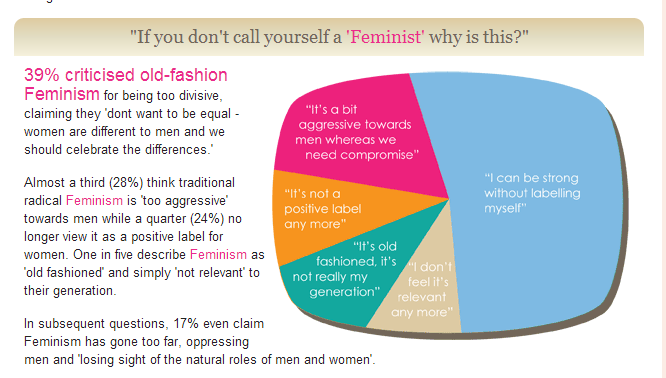
So it’s a pretty shittily done survey, and you’ll be delighted to know their reporting of it isn’t any better. Please study the image below for an example of how horribly they fucked it up (description below, for those using screen-readers):

Note that the text next to the pie chart–of presumably the same questions–bears literally no relation to what’s outlined in the pie chart. Admittedly, it’s a crap pie-chart and the weird oblong shape makes it very difficult to discern percentages, but absolutely nowhere is anything that can be remotely construed as anyone agreeing with a statement about feminism saying it’s not about equality, and the percentages don’t seem to add up at all. I don’t know if there were more questions asked or if Netmums are literally pulling things out of their arse, but either way it’s a thoroughly disingenuous way of reporting data.

Also noteworthy is what they don’t draw attention to in the blurb next to the pie chart: the fact that more than half of the respondents have said they don’t identify as feminists because they don’t need the label.

It’s a smart tactic, though. They stick the shit they want people to see on the press release, highlight the bits they really want people to see, and hope nobody actually bothers looking at their data. And they usually don’t, because journalists are lazy and they will therefore just spew out whatever Netmums told them to say.

Ultimately, then, let’s forget this survey ever happened. It’s a crap survey which tells us nothing. I imagine it’ll rear its ugly head periodically, so consider this a public service explaining why this is something to which no attention whatsoever should be paid.

_

Image depicts text and a pie chart. The text reads:

<“If you don’t call yourself a ‘Feminist’ why is this?”

39% criticised old-fashion Feminism for being too divisive, claiming they ‘dont want to be equal – women are different to men and we should celebrate the differences.’

Almost a third (28%) think traditional radical Feminism is ‘too aggressive’ towards men while a quarter (24%) no longer view it as a positive label for women. One in five describe Feminism as ‘old fashioned’ and simply ‘not relevant’ to their generation.

In subsequent questions, 17% even claim Feminism has gone too far, oppressing men and ‘losing sight of the natural roles of men and women’.>

The pie chart consists of five slices. Moving clockwise from the top, the largest segment, comprising more than half is coloured blue and labelled “I can be strong without labelling myself. A beige segment equivalent to roughly 10% is labelled “I don’t feel it’s relevant any more”. A turquoise segment, also around 10% is labelled “It’s old-fashioned, it’s not really my generation”. An orange segment, also 10% is labelled ” It’s not a positive label any more”. A pink segment, slightly larger than 10%, is labelled “It’s a bit aggressive towards men whereas we need compromise”.

Police taser a blind guy: there’s a scientific reason they’re bastards here

In the news today, a police officer tasered a blind man for walking down the street with a stick. Apparently the poor little copper was frightened by the victim’s white stick, and thought it was a samurai sword, so attacked him with a deadly weapon. The context behind this event was that the police had heard that apparently someone was wandering around with a samurai sword, which really doesn’t give the copper any excuse because the sticks used by blind people to navigate look exactly fuck all like a samurai sword.

Now this is hardly the first time a police officer has developed very questionable judgment of the nature of a threat: recall the case of Delroy Smellie, who beat the fuck out of a woman for waving a juice box. He told the court that he’d thought it was a weapon–a fucking juice box!–and was acquitted.

Obviously, I’m hardly going to rule out the parsimonious explanation that these cops are simply just lying bastards. However, even the nice cops will be susceptible to this effect, as once again science proves that all coppers are bastards (for those interested in more science about why the police differ from the non-porcine population, please read this overview).

A study conducted this year–unfortunately paywalled, but summarised here–found that when people are holding a weapon, they are more likely to think that others are holding weapons. They’re also more likely to get jumpy.

The participants in this study were given one of two objects to hold: a foam ball, or a toy gun. They were then shown people holding objects: sometimes neutral, like drink cans, but sometimes guns. Those who were holding toy guns were far more likely to classify the innocuous objects as guns. There was no effect if the toy gun was just near the participant, rather than in their hands.

Furthermore–and this bit is less clear in both the abstract of the study and the summary–participants were more likely to raise the toy gun in response to a perceived “threat”: again, remember this “threat” is nothing more than a drink can.

The researchers concluded that this effect is due to perceiving the environment in terms of intended action: by holding the gun, people switched into an “I intend to use this gun” frame of mind, and began to see the world differently and seeing people as threats.

Now think about how this applies to the police, a group who are typically armed as part of the job. They walk around with batons incredibly close to their hands, and are sometimes instructed to draw them as part of standard public order procedure. When even normal people suddenly start perceiving the world as being full of threats and weapons, is it really any surprise that the cops do routinely?

It’ll only get worse if Bernard Hogan-Howe gets his way; he wants to stick a taser in every police car, which will likely result in increasingly edgy and trigger-happy cops whizzing round London. I can’t say I’m comfortable with this.

There’s a decent explanation for police being trigger-happy, but this doesn’t make it right in the slightest. In fact, it’s an argument to move towards disarming the police force: keep the weapons hard to get hold of, and maybe they’ll stop harming innocents.

_

Thanks @gmartin for telling me about this study

What’s so sexist about the Indy’s new big report?

The Independent have published a big new special report today, and are slice-and-dicing it across the week. It’s about how more women are going to prison and how terrible that is. Today’s piece is about women in mother-and-baby units in prisons. It’s also expanded on in an opinion piece, which spells out what we’ll be seeing in the Indy over the next week.

The focus of the investigation is mothers going to prison, and being separated from their children. This is a Very Bad Thing, apparently: according to a vaguely-written headline, either the women or their children are the “hidden victims” this system. All three of the pieces linked smack of benevolent sexism, the societal reverence for this special female magic which in fact doesn’t exist and is massively sexist. Benevolent sexism basically needs to die in a suicide pact with its brother, hostile sexism (for a full overview of benevolent and hostile sexism, read this).

The benevolent sexism in their line of agrument is exemplified in the introductory article:

Britain has the highest rate of female imprisonment in the European Union, with 10,181 women put behind bars last year alone. That statistic has raised fears that the criminal justice system is creating a lost generation of children raised without mothers.

Children need mothers. Mother knows best. MOTHER MOTHER MOTHER. It’s like the article was co-written by Freud and Stephen Moffat. Women have special mum-magic, and the consequences will be Very Bad otherwise.

So what does this mum-magic prevent?

Nearly two-thirds of boys with a parent in jail will go on to commit some kind of crime themselves, research shows, and children with a parent behind bars are three times more likely than their peers to engage in anti-social behaviour. Their chances of suffering mental health problems also increase threefold.

Now, look very carefully at the first sentence there. Notice it says “parent” not “mother”. That’s because it’s referring to parents, not mothers. And that’s because it’s closeness to parents, not mothers, that’s important. Not that this deters the nameless author of the opinion piece, who gives us a sneak preview of the latter instalments of the report with this gem:

Over the coming week, we will lay bare the shocking truth about what happens in the majority of cases where mothers and their children are separated. We will consider the impact on the women themselves, both in and out of custody. We will look at the lives of those who are left holding prisoners’ babies, or bringing up their distressed children and disturbed teenagers – a burden which mainly falls on grandmothers and other female relatives. Indeed, it is a staggering indictment of modern fatherhood that only 9 per cent of such children are looked after by their fathers.

Replace “modern fatherhood” with “patriarchy”, and the author has a point. Otherwise, it’s just yet more benevolent sexism. Women are caring, and waft around farting rainbows.

I can see the future articles laid out before me. It will be a return to the earliest incarnations of the work of John Bowlby, who authored a monograph on “maternal deprivation” and how it led to delinquency, decreased intelligence, aggression and affectionless psychopathy in children. However, later Bowlby clarified his work pertained to general upheaval of a close parental attachment and wasn’t specific to mothers. The Indy don’t seem to have read this bit.

What amplifies the benevolent sexism of the Indy’s new report is what isn’t mentioned at all: that the vast majority of people in prison are men. And that the vast majority of people in prison are men precisely because of the underlying set of attitudes driving the Indy’s report: women are too nice and good to commit crimes, and if they’ve reproduced they’re probably fucking saints. It’s dated, and it’s sexist as hell.

I can think of ulterior motives for publishing this piece. The first is a desire for a return to “traditional family values”, an idea which basically needs to fuck off as it places the mother as caregiver, the father as breadwinner, and keeps everyone neatly in their patriarchal places. The second is to attempt a broader critique of how more people are going to prison. Now, this is a very important point indeed. As an anarchist, you might have guessed I’d not be so keen on the concept of prison, and, indeed, I find the whole notion of retributive justice grotesque and the concept of the state locking people up fairly abhorrent (in fact, the concept of crime is somewhat baffling to me). For those of a more liberal persuasion, you can argue against prison on the grounds of how expensive prison is compared to rehabilitation. Prison’s basically bad. If the Indy are trying to push this line, they’re going entirely the wrong way about it, given they just focus on one very small group of prisoners and drag in a lot of sexism.

Ultimately, what we need is two things: a radical rethink of our justice system with a move to not putting people in prison, and a radical rethink of how families are constructed and how we view women in general. That will be the thing that stops fucking up future generations, and demand nothing less.


The anchor effect: how to drag a debate your way (also, I hate Liam Fox)

Liam Fox, the worse of the two Dr Foxes, has said something so horrifyingly, cartoonishly evil that it’s hard to know where to start. He thinks the economy should be shocked back to life by doing away with capital gains tax–something that makes the very rich all cross–and make up for the shortfall by slashing benefits–those things that help poor people not die.

The brazen, naked announcement of where his priorities lie–firmly on the side of the most repulsive form of capitalism–is disgusting. It’s flabbergasting that someone can think this way, and feels that it’s appropriate to say something that amounts to “fuck you, ordinary people, we only care about money”.

The thing is, it’s actually a fairly smart thing to say. It’s disgusting, but it’s pretty clever in achieving the things that scum like Fox want.

This is due to a psychological effect called anchoring. A good way of explaining how anchoring works is to look at sales. Now, it’s become a running joke that sofa-floggers DFS have a sale which will last until the heat death of the universe, but what they’re doing is actually some pretty clever marketing using anchoring. The “WAS” price they provide sticks in your head. A smaller price therefore becomes more reasonable, even though that sofa was probably never worth £599 and you’re almost certainly still being ripped off when you pay £399 for it.

In short, you’ll fixate on the first thing you’re told. Your brain will stick to that number even when thinking of another number. It will be “anchored” to it.

Even though Fox probably fervently believes what he is saying about capital gains and slashing benefits, he’ll know that this is a particularly nasty pipe dream. The thing is, he’s thrown down his anchor, and dragged discourse in his direction. Suddenly, smaller benefit cuts and a smaller cut to capital gains tax seems far more reasonable, because we’re fixated on the BIG AWFUL HORRID THING he just proposed.

Anchoring is a powerful tool, and it’s used well by a lot of terrible specimens. Take, for example, the fact it’s now practically impossible to talk about fascists like the EDL without going “well, there are concerns about immigration”. The fascists have successfully dragged people a bit further right. Likewise, look at the state of the Labour Party, who are about as left-wing as a row of jars of bankers’ farts filling a recently-closed library. At least in part, they’ve been dragged right by the dominant right-wing discourse that they’re anchored to.

Generally speaking, while the radicals on the side I’ll broadly call “not evil” are pretty good at not falling victim to the anchors of the right, the liberals are very bad at this. This is why the TUC are marching not for anything interesting, but for more jobs and other such waffle. This is why there’s such a rush to condemn any form of property damage. This is why there’s no imagination any more.

And this is why there’s very little positive change and we’re all drowning in a mountain of neoliberal turds.

We need to use the anchor effect to our advantage, and drag everything back our way. When pleas for “unity” come from the liberals, what they need to do is back the radicals rather than the other way round. Demand FULL COMMUNISM, and maybe then it’ll sound more reasonable to revive the welfare state. Demand KILL ALL MEN, and maybe then it’ll sound more reasonable to give women equal representation in politics.

The anchor effect is a powerful tool. It’s time we used it as well as the bastards of the world do.

HOT CUM-GUZZLING EVOLUTIONARY PSYCHOLOGY

The news has whipped itself into a frenzy about the latest headline-grabbing guff from evolutionary psychology: blow jobs cure morning sickness. Specifically, the pregnant woman should swallow the semen of the father of the baby because then she’ll develop a tolerance to his genetic material. That sentence alone is eyebrow-spraining. Delving deeper, it only gets worse.

The research comes from an evolutionary psychologist named Gordon G. Gallup. It is useful to view the morning sickness story in the context of his previous work because a pattern starts to emerge.

Gallup’s career started out fairly promisingly, with him developing a paradigmatic test for recording self-awareness in animals, which has been widely used. He was then the go-to guy for research into what happens when you hypnotise chickens, which is probably far more interesting than it sounds.

Somewhere along the line, though, Gallup lost his way, and moved towards the side of evolutionary psychology which is obsessed with sex and comes to thoroughly bizarre conclusions about both sexes through the use of dodgy science. Many of the studies I’m going to highlight here are paywalled, but you’ll probably shit a brick off the abstract alone if you know anything about science or have ever enjoyed sex.

Gallup became interested in boobs, hypothesising that breast implants were a way for women to advertise their fertility, then never testing this hypothesis because, let’s face it, how the hell would you? He delved into homophobia, suggesting that it was an adaptive response to parents thinking the gays would bum their children into homosexuality. This was tested by getting college students–not actual parents–to fill in questionnaires about hypothetical children, and some of them saying they wouldn’t like their kid to go to a gay paediatrician. When the work was criticised for implying that gays are paedophiles and maybe this was down to “xenophobia” (in the evolutionary sense, rather than the sociological sense; i.e. a fear of strangers), Gallup responded by saying that actually there is a disproportionate number of homosexual paedophiles, so there. Another study of Gallup’s ostensibly showed that women take more care to stop themselves being raped when they are ovulating, by guessing when the participants were ovulating and administering a questionnaire.

None of this encompasses Gallup’s true love though. Shaking off the mantle of being the chicken-hypnosis guy, Gordon G. Gallup is now the semen guy.

Regular readers of this blog might remember the time I went ballistic over a study claiming to show that semen was an antidepressant. That was one of Gallup’s studies. It showcased some almost criminally bad science, which I covered here, and it’s worth reading the whole thing to see just how bad it is. If you can’t be bothered, the tl;dr summary is that vaginally-administered spunk isn’t an antidepressant and there was no way he could have ever shown it with that study. Other miracles of semen, according to Gallup, is that if a man regularly spaffs into the mother of his kids, he’ll be a better dad. Again, Gallup didn’t even bother testing that hypothesis.

After covering his bases in getting semen into women, Gallup turned towards how to keep it there. Readers with penises, did you know that your cock looks like that because it evolved to displace semen of rivals from a vagina? It totally is, because Gallup has some hardcore science to prove it. This paper is open-access and well worth a read if you fancy a laugh. He used two different tests for this hypothesis. In the first set of studies, he bought some dildos and an artificial vagina from a sex shop, mixed up some fake spunk, put it in the rubber fanny, then fucked it with some dildos. He found that the more realistic the dildo, the better it displaced the jizz-mixture. Oh, and the dildos being dildos, they lacked foreskins, which throws an enormous spanner in the works as it means that human cocks would function entirely differently, considering circumcision is a minority practice and didn’t happen while we were evolving.

So he turned his attention to humans. Rather than watching them fuck, he went for a questionnaire, which is distinctly less fun, and proved about as much as his sweaty session with a fleshlight and a dildo. From a survey, he discovered that men fuck their girlfriends harder if they’ve been away for a while, or if they’ve heard their girlfriend was cheating. Passionate reunions and angry hatesex, according to Gallup, are actually just the chap trying to thrust any stray spunk out of his lady-friend.

Which brings us, finally, to the morning sickness research. Having exhaustively researched how to get sperm into a vagina and get it out again, he wondered how best he could get it into a lady’s mouth. His theory is this: morning sickness arises from the woman reacting to having unfamiliar genetic material inside her, i.e. the father’s DNA in the foetus. In order to build up a tolerance, the woman needs greater exposure to the father’s genetic material which means loads and loads of semen, and apparently eating it will totally work.

It’s important to note here that this has never been tested, and, like much of the work we have seen here, it is just a hypothesis presented at a conference, which the media have picked up and ran with, presenting it as SCIENCE. It isn’t. Also, it’s a pretty fucking shitty hypothesis for two major reasons.

First, it goes against the general evolutionary thinking regarding morning sickness: that it’s a way of protecting the foetus from any toxins or bad nutrition by causing anything harmful that has been ingested to be shouted into rainbows. Secondly, and perhaps more crucially, how the hell does Gordon G. Gallup think women get pregnant in the first place? It kind of involves exposure to semen. While a lot of pregnancies may not stem from regular exposure to the same jizz, a lot of them do, and morning sickness affects up to 80% of women. Furthermore, within Gallup’s hypothesis, if it’s just the father’s genetic material the woman needs and it can be got through ingested semen, this can easily be transmitted by any other means, such as lots and lots of snogging to exchange saliva, or touch, or blood rituals, or whatever.

It makes no goddamn sense whatsoever, and I look forward to seeing him try to prove it.

I don’t know if Gordon G. Gallup has dedicated the later part of his career towards discovering escalatingly spurious reasons to insert his semen into women–if so, I think we can expect future studies which show that bukakke makes you immortal–or if he has simply found the recipe for media success: say something silly which dovetails with existing patriarchal prejudice. Either way, I wish he’d stop, and I wish the media would stop gushing with excitement about hypotheses and bad research.

__

Update: commenter James, who is an experienced midwife and pre-eclampsia researcher has found a cohort study which Gordon G. Gallup obviously hasn’t read. The study looked at recurrence of hyperemesis gravidarum, a severe morning sickness. It found that sickness was less likely to occur in a second pregnancy than in a first. The authors had a large enough sample of women whose second pregnancies were from a different father than the first pregnancy. Comparing recurrence of hyperemesis, it emerged that risk was lower in women whose second pregnancy was by a different father than those who had had two pregnancies from the same father: 11% risk of hyperemesis for those who had changed paternity, versus 16% for those who had not. While this is a cohort study, and therefore low down on the pyramid of evidence, it’s still far better than some dude who had a hypothesis, and provides some evidence to suggest that “unfamiliar semen” is not what causes morning sickness.

Why rape jokes aren’t funny: the science

There’s been an awful lot of discussion surrounding rape jokes this week. It all seemed to start with a “comedian” named Daniel Tosh deciding to announce that he thought it would be funny if an audience member got gang-raped. Numerous comedians waded in to defend this piece of alleged humour. Tosh’s fans cheerily threatened to rape anyone who thought that maybe the joke wasn’t on. Accusations of humourlessness flew around.

But here’s the thing. It wasn’t humour. It flies in the face of funny.

There’s been rather a lot of research into humour and how it works. One of the major veins in this research is Incongruity Theory, which I touched on in explaining why Jeremy Clarkson isn’t funny. Essentially, Incongruity Theory posits that humour is the state of realising  incongruity between a concept in a certain situation and the real objects which are thought to be related to the concept. This is what is almost always missing from rape jokes: there’s no incongruity. Rape is a horribly commonplace occurrence. There’s no incongruity. It’s just something that’s there, humming in the background. It’s like the antiquated comedians asking “what’s the deal with buses?”.

Another theory in play is Benign Violation Theory. Under this theory, humour happens when the recipient receives a threat to how things “should be”, the threatening situation seems benign, and they can see both of these interpretations at once. One of the conditions to be satisfied for benign violations to occur is psychological distance: the ability of a person to feel far away from the threatening situation. When it comes to rape, once again, this is a tricky condition to be met. Women are brought up to fear rape in the hope that it will somehow make us be more careful and therefore magically stop us getting raped. And let us not forget the sheer numbers of survivors.

The theories offer an explanation of some people who might find rape jokes funny: people who have not been paying attention to the world around them. The privileged, the wilfully ignorant. They might find rape jokes funny. It says a lot more about them.

Imagine that you are a comedian. You tell a rape joke, and 20 men in the audience laugh. Of these guffawing pricks, 19 of them are, at best, tedious little solipsists, who probably watch Top Gear and would be just as amused if you asked about the deal with buses. The other one is a rapist, who will go home thinking his behaviour is perfectly normal and everyone’s in on the joke.  If you find being this comedian a remotely desirable situation, please report to your nearest neighbourhood SCUM chapter for an induction that definitely doesn’t involve razorblades and meathooks.

The problem with rape jokes extends beyond only being funny to narrow-minded wankers and rapists: there are real-world effects. Some studies suggest that after exposure to sexist comedy, men are more likely to discriminate against women and less likely to donate money to women’s organisations.

Ultimately, the humour fall flat at every level. Unlike a hackneyed Knock Knock joke, though, rape jokes can have dangerous consequences.

__

Further reading:

The anatomy of a joke

Dear comedians and people like me who think they’re comedians: please stop

Feminists don’t think all men are rapists. Rapists do.

Oops! Evolutionary psychology bedrock turns out to be made of manure

Much of evolutionary psychology’s work on gender has rested on a simple paradigm: females are choosy in mate selection, while males will just promiscuously stick it anywhere. I’ve written before on how evolutionary psychology has a tendency towards producing retroactive explanations for modern gender roles and saying we somehow evolved that way.

The mate selection paradigm in particular holds a singular intuitive appeal–if you happen to be a sexist. This is why vast swathes of pseudoscientific theory rest upon it, which trickles down into sexists arguing that they’re not being sexist, this is just how things are and it’s a scientific fact.

But what if that paradigm turned out to be wrong? It rests, largely, on a single iconic study of fruit fly mating behaviour. Now, if we pretend that human and fly mating behaviour is in any way comparable in the first place, it turns out that the study was fatally flawed and impossible to replicate.

The original study was carried out in 1948. Geneticist Angus Bateman put some mixed fruit fly populations in jars, let them mate, and then had a look at whose offspring survived into adulthood. Being 1948, he couldn’t do this by analysing the offspring’s DNA, so he went for the next best thing: he used fruit flies with really distinctive mutations and only bothered examining the offspring who had freakish hideousness identifiable from both parents.

These mutant fruit flies, as it happened, had a nasty habit of dropping dead before adulthood if they ended up with a mutation from both parents: having curly wings and thick bristles has a fairly poor effect on aerodynamics. This effect completely skewed the sample and fucked everything up statistically. While Bateman concluded that males have more offspring when they’re promiscuous and this doesn’t work for females, the findings of the replication were incredibly conclusive.

Also, applying the mating habits of ugly fruit flies with human mating behaviour is probably a little bit silly, evolutionary psychology.

The lead author of the replication study, Patricia Gowarty interprets the results positively: it’s time to build some new paradigms. I wholeheartedly agree with this, but the cynical part of me wonders if this will happen. There are many vested interests tied up in the mate selection paradigm: vast areas of theory are built upon this one study, which will require revision and–shock, horror–examination of the social implications of this.

I would welcome this. I am not sure if the institutions are ready.

On gendered food

I love burritos. There is nothing not to love about a face-sized pocket of joy bursting with meat and chilli and veg. It gave me great dismay, then, to visit my favourite burrito joint for the first time in months and discovering that my gigantic joy-pockets have become gendered. This discovery came quite by accident: most of my vowel sounds are schwas, and when I was handed a disappointingly tiny joy-pocket, I was informed of my error. Instead of ordering a burrito, I had ordered a burrita.

It’s a feminine name. A needlessly feminine noun, because this is a burrito for girls. It’s smaller, see, so we won’t get terrified by the mighty mighty girth of the man-burrito.

It might sound as if I’m overreacting to the feeble portion of luncheon I was given. This is certainly a possibility, but food is gendered. Take meat, for example. Meat is, apparently, very manly. Meat is marketed at men in a way to reinforce their heterosexuality by making it as deliciously sexy as possible. Meanwhile, salad is girly. Salad is for women to eat while laughing alone.* We’re also allowed to like chocolate and cake in moderation. This photoset shows starkly just how gendered food marketing is.

It’s worth asking ourselves why this is. A few years ago, Salon magazine asked a few experts. Some of the answers are utter bollocks, involving women being more genetically predisposed to sweet things, or men needing more meat to build muscles because thousands of years ago they were definitely the hunters, or mysterious ladyhormones. Salon concludes that this is probably rubbish, and I wholeheartedly concur.

The thing is, it’s not that some food is inherently more palatable to people of a certain gender. Of course it isn’t. It’s just the symbiotic relationship between marketing professionals and patriarchy at work once again. Patriarchy instils a certain set of insecurities and expectations into people. Playing on these existing stereotypes makes the marketing jobs easier, and they can all take a cocaine break and then work out how to make women a little more paranoid about the shape of their earlobes. Marketing and patriarchy feed each other in an ouroboros of tedious stereotyping.

Eating for basic sustenance is not a gendered activity. Neither is eating for pleasure. Yet patriarchy and its PR cheerleaders make it so. I wish they’d keep their politics out of my lunch.

_

*Although, it is worth noting that the marketing executives might have started to worry about men getting scurvy from all the meat they’re cramming into their faces, so decided to make fruit a bit sexier.

Lesbian sex: IT’S A TRAP! (apparently)

AskMen.com is one of the darker corners of the internet. I last turned my fire on them for presenting pick up lines to run away from really quickly, but this time they’ve excelled themselves with an article entitled “SCIENTIFIC FACT: HOW SHE TRICKS YOU INTO CHEATING“.

So, how are these conniving bitches tricking men into accepting infidelity? Apparently, by fucking women. Twitterer @cwhelton has illustrated this conjecture admirably.

According to “science”, apparently men are far more likely to accept a woman partner’s infidelity if she cheats with a woman rather than a man. AskMen offer this scientific analysis:

Research shows that part of the problem is that the male’s perception of two women getting it on is erotic, and envisioning themselves joining the party is like the double rainbow of sex fantasies.

Out of morbid curiosity, I hunted down the original study, “Sex Differences in Response to Imagining a Partner’s Heterosexual or Homosexual Affair”, which can be downloaded from the author’s website. The study takes an evolutionary psychology tack, and the AskMen article is therefore an instance of the “human centipede” approach to science reporting: regurgitating a shit study into even shittier shit.

The authors hypothesised that men would be less likely to forgive a female partner if she cheated on them with a man than with a woman, because of the risk of her getting pregnant from a heterosexual affair. They weren’t really sure about women’s responses.

To test their hypotheses, they administered a survey to some students, in two parts. In part one, they were asked to imagine a scenario wherein a partner was cheating in either a same-sex or heterosexual affair, and then quizzed on how likely they would be to forgive the partner. As a point of comparison, they were asked if they had ever experienced infidelity and whether they forgave the partner. In this section, they were never asked if it was a same-sex or heterosexual experience of cheating, which sort of blows any real-world significance of the results right out of the water. Also not asked: whether the participants were heterosexual or somewhere on the queer spectrum. Also not asked: anything to do with why they would forgive or not forgive the real or imagined partners.

On the whole, women were less likely to forgive infidelity than men. This was probably skewed by more than half of the male participants saying they would forgive a female partner who cheated with another woman (although only 22% would forgive cheating with a man). The results skewed the other way with the women participants: fewer would forgive a partner cheating with another man than with another woman.

In their discussion, the authors return to banging the pregnancy drum, an analysis that their own results don’t really support: if it were entirely down to risk of pregnancy (and all the childrearing shit that evolutionary psychologists obsess over), then, surely, women would also be more likely to forgive a same-sex affair.

It gives me great distress to announce that AskMen’s analysis of the experimental results–lesbian sex is hot–is actually a better analysis than that provided by the authors of the study. There are a lot of societal prejudices at play here: lesbian sex isn’t seen as “real” sex by many heterosexuals (poor them), while sex between men is still subject to a lot of stigma. Lesbians are hot; gays are icky.

This attitude pervades not just the Normals with their tedious concerns about cheating, but also the poly/open relationship community: it is still far more common to see men with harems of women, men defining terms of their relationships wherein women may only play with other women, and the dreaded Unicorn Hunters. It’s everywhere, and it really needs to fuck off.

With some better science, it might be interesting to get to the bottom of why so many are squicked by gay sex but turned on by lesbian sex. And then we can make the myth die forever.

__

Tip of the masochistic hat to @syn who found the AskMen article.