If you’re a woman, don’t go to the Pride of Spitalfields

Content note: This post discusses sexual violence and apologism, quoting first-person accounts.

Last week, I went to the Pride of Spitalfields for a nice drink with some comrades. The evening ended on a rather sour note as two of my friends were groped and the landlady blamed them for what happened. Aside from my group, the whole pub felt as though it was full of people who were enabling this behaviour, if they were not themselves actively perpetrating it. I’ll let the two women tell their story in their own words, though I’ve trimmed for length. You can read Sam Ambreen’s account in full here, and MagicZebras here.

Sam:

Pride of Spitalfields is the name of the pub where Meow Meet – a gathering of like-minded individuals’ crazy about communism and cats – took place. There was a planned pub crawl but as the night went on, we settled and occupied the back quarter of the pub. Being with kindred spirits aside, I felt myself on full alert having clocked the various leering geezers dotted around the bar. Very early on in the evening a large skinhead attempted to woo me with his American accent all the while slurring how much he liked the cat on my dress, his eyes fixated on my breasts. After we’d done a good job of ignoring him, he sloped off.

I felt safe. A mixed group, I was friends with many of them and since we’d been out together and tackled patriarchy effectively before, I felt reassured I could just be. With these righteous men and women I felt free. Except patriarchy was more brazen that night. I caught the bald American through the corner of my eye, as he left his table to walk past me for the loo. He stroked my shoulders and back whilst I was sat on a stool between two of my friends. Shocked and utterly grossed out, I told the group what had just happened. When he came out of the toilet, one of my beautiful sisters pointed at him and said “how dare you touch her? Don’t fucking do it again?” Far from being embarrassed he’d been caught out, he leant in to her and asked her to slap him. In an attempt to distract him, I asked if he was American. When he replied yes, I said “figures”. Well, then he called me a “fucking cunt”. When the rest of our group stood up, he crawled off, mumbling expletives.

Shaken but proud and empowered, I told one of the barmaids what had happened. I was happy when she immediately said she would not serve him anymore. She also said he had been aggressive but they couldn’t throw them out because there were only three women behind the bar. However, I was just pleased that she’d acknowledged what had happened. Shortly after, the man and his friends left. One of them even apologised to one of the men in our group. We were able to enjoy a few more drinks before the second incident of the evening.

Sat on my stool at the side of the table, somebody grabbed the back of my neck and pushed me down. Alarming and distressing, yes, but I also have a spinal injury. I’ve been told never to attempt to touch my toes. I have to think of my every movement before I make it. I am having an MRI in three days. Livid, I shot up and shouted at the man. I can’t remember what I said; I was too frightened and angry. Other people in the bar started shouting at me, how it was funny it was always the same girl complaining, how our stools were in the way of the path to the toilet and my blood ran cold. I asked the older landlady whether they were saying I was making it up and she matter of factly nodded yes. I didn’t exactly want to burst into tears and start rolling off all the other times I hadn’t been believed but that’s what happened. Like a collage of all the other times I’d been violated but made to feel like the evil scheming temptress I must be. All of it poured out as the mascara gushed down my cheeks. I’d had a drink but the pain is always the same and I react in exactly the same way. Triggers, emotions so strong and so embedded because of careless caretakers and patriarchy; that I try and keep a lid on. For years, I slapped a smile on it until the corners of my mouth hurt so much from smiling, they’d quiver. Now, I cannot.

One of the things said to me by the patrons of that pub was that we should just accept it. Accept what? Being groped? Being leered at? My body does not belong to the public. It is mine and it is fragile. If anyone touches me without my consent, I will shout and scream blue murder.

When I finally calmed down I learnt the man who’d grabbed my neck had also groped one of our teenage comrades. The guy was in his 50s. One of my friends hugged me as she said she’d challenged one of the younger barmaids as to whether she’d been harassed more than a coupla times in one evening and she said yes. The landlady responded there was little they could do with their customers of old. And there, patriarchy is atoned. Capitalism is what makes the misogo man’s world go round.

MagicZebras:

The evening started well, even though the pub was really crowded. We piled in, chatting amongst ourselves and ignoring the uninvited advances of the odd creepy drunk guy with efficiency and grace.

However, at about 11pm, a very drunk man in a stupid hat walked past us on the way to the toilets. On his way, he grabbed my arse so hard it hurt and pushed my friend Sam’s down aggressively – really fucking dangerous considering she has a spinal injury. Outraged, and surrounded by friends who we knew would support us (really vital!) we both stood up and challenged the guy, yelling at him that his actions were not fucking ok and he needed to fuck off. When he went to the toilet we comforted each other and told our friends exactly what had happened. When he returned from the toilets he had the cheek to make sarcastic comments and lots of those at MeowMeet stood up, telling him to fuck off, leave us alone and never touch a woman without her consent again. Other people in the bar got involved, it seemed quite a few men, trying to be “nice”, had a hell of a lot to say about the subject. I was told in a seemingly reasonable tone that I should pipe down because “this sort of thing happens all the time, shouting’s not going to change it.”. I walked away from that patriarchy-accepting wankstain to support one of my friends who was challenging the landlady and other female staff about what had happened. The landlady’s response to the incident was disgusting. She told us that she didn’t believe us, asked me if I was drunk (I hadn’t had a drop of alcohol all night, not that it makes any difference whatsoever!), blamed us for any incident that might have happened and refused to challenge harassment from a regular customer because he often spent money there. For me, that’s pretty much the relationship between capitalism and patriarchy in action – capital comes before the security of women. Always.

Fuck. That.

The incident and the rhetoric we got from staff and customers at the pub was highly distressing; both me and Sam cried hysterically, I threw up and even had flashbacks from other times I’ve been sexually assaulted and harassed – which from talking to my female friends seems to be really common. Mostly, I was upset by the attitude of other people who thought that something being a common occurrence meant that it was acceptable. Utter bullshit, and the same bullshit that perpetrators of any sort of sexual violence rely on to go about their behaviour unchallenged.

It’s abundantly clear that at least one member of staff in the Pride of Spitalfields had a terrible attitude to the misogyny perpetrated by the clientele: this woman was the landlady. The rest of the bar staff seemed more supportive, although there was little they could do to help. I hope that they are able to unionise and support each other in these horrible circumstances.

I’d urge you, if you’re a woman, to avoid Pride of Spitalfields for your own safety–it fucking sucks that we have to do this, but Pride of Spitalfields is not a safe space. And, actually, everyone should avoid the fucking place, because it is a seething shithive of misogyny and maybe they’ll go out of business.

In the future, we might take action against the place, but in the meantime, please share these stories to avoid this having to happen again.
Farewell, welfare

It is not an April Fool, no matter how much I wished it would be. Over the next month, we will see our fears unfurling. The bedroom tax, the benefit cap, the cuts to legal aid, council cuts, scrapping DLA, Universal Credit, the butchering of the NHS. It will all come this month.

And it will hit the most vulnerable the hardest: the sick and disabled, the poor, women, and especially those experiencing intersecting layers of oppression. It is clear why they are doing this: those who are the most vulnerable, they believe, are powerless to resist. They do not want a repeat of 2010. They do not want any sort of resistance, so they pick on those they believe to be least capable of doing so.

We will see deaths. We will see lives ruined, and mental and physical health declining as people struggle to survive in the immense stress the bastards in Westminster have forced upon them. It is bad now; it will get worse. They have made it that way.

And they expect people to quietly lie down and die, out of sight. All the while, they will slander those they have abused, saying they were undeserving of the means to survive. They will repeat the same fictions over and over, and credulous apologists will swallow these narratives wholesale.

Yet as it gets progressively worse, it will be harder to hide the lies, harder to hide this heinous violence the state are perpetrating. It will become clearer and clearer what they are doing.

And they have given us nothing to lose.

People are better than those who want to rule over others. We will face their attacks with solidarity, we will watch what they are doing and we will not allow the murders they commit to be hidden. We will observe, growing ever more furious.

And we will fight back. We are under attack, and we will defend ourselves from this onslaught. We will be avenge those killed by these bastards.

We know what they are doing.

And we are not as powerless as they like to think.

Are the cis supremacists winning?

Content note: this post discusses transphobia

Last week, an awful New Statesman column was published which featured a cis woman whining about being called cis. Me and Cel West wrote a takedown of it.

Things haven’t died down since then. In fact, a lot of cis women seem to have become empowered to spout utter nonsense. I will not link to specific nonsense, lest I get accused of being Big Mean Stavvers Bullying The Poor Defenceless Women, but suffice to say there’s rather a lot of cis women who agree with the the original assertion that they don’t like the word cis.

And it gets worse. Today, I have had nakedly transphobic hate speech tweeted at me, and tweeted at me from corners I would have never expected. It came from people I had previously thought to be all right, but it was that same old nasty cis supremacist line which has never quite made any sense to me about how trans women are really “males”.

It strikes me as particularly sickening that this comes in a week where Lucy Meadows had been disrespected in death by the mainstream media, the same mainstream media that may well have played a role in killing her with their violent lies, replicated again and again by people who think themselves feminists.

Yesterday, over 200 people mourned Lucy Meadows, standing in the cold with candles, outside the Daily Mail offices. Over 100,000 people have signed a petition calling for Richard Littlejohn to be fired for his tirade of hate. A part of me wondered–as it did in January when Julie Burchill and Suzanne Moore went on transphobic diatribes to mass outrage–that perhaps the tide was beginning to turn. That maybe, just maybe, we were overcoming the seething cissexism of society.

But we have not. If anything, these vile sorts are gaining traction, crying about being silenced. It is defended by women who do not think they are bigots themselves, finding that calling out any woman spouting hate speech to be far worse than the hate speech itself.

It isn’t.

It really, really isn’t. It is utterly vital that we reject transphobia wherever it exists–even where it is within our backyard. Especially when it is in our own back yard.

I am fearful that we have hit a pivotal point in the discourse, one where the bigots have effectively managed to neutralise any attempt to point out that they are bigots by complaining of bullying. They wave their hands like a stage magician, diverting attention from the very real bullying they themselves are perpetrating, the structural violence that they perpetuate, the things they say that can very easily kill people.

And I don’t quite know what to do about this. I’ll keep on fighting where I can, but suddenly it feels far bigger, far more daunting. As a cis woman, I am not personally affected by transphobia. This is precisely why I fight it, because I know I have more strength and more resources to do so. But it’s a thankless task, and some are such severe bigots I believe it is impossible to reason with them.

So cis feminist readers, I ask you to join with me in fighting the rising tide of cis supremacy. It is not acceptable. Be a fucking ally. Stand with your trans sisters in solidarity, and don’t let this slide. We have a huge struggle ahead of us, against a structure many of us have internalised, but if we are to win anything, we must first attack the problem within our ranks.

There is nothing unusual about the Steubenville rape

Trigger warning: this post discusses rape and rape apologism

And so the sad story of the Steubenville rape continues. The perpetrators were found guilty of raping an unconscious girl, as many others looked on and watched, finding this assault nothing more than an exciting topic for gossip. A community was torn apart as the perpetrators happened to be integral members to the football team, their important social standing meaning that many decided to twist reality and try to fervently believe–and make others believe–that this was somehow the fault of the survivor. And even after the guilty verdict, the rape apologism continued, pundits mourning the fallen careers of the perpetrators. And Steubenville, in a bid to make sure this never happens again, has decided to launch a probe into why it all came to pass.

Time will tell what is unearthed, what conclusions are drawn by these officials, what they learn from what happened in this community.

I’ll save them the time and expense of their investigation.

It was rape culture. All of it.

It is perhaps more horrifying to realise just how banal this whole affair was. That perhaps this exact combination of circumstances and individuals involved is unique, but all of these aspects happen regularly, devastatingly regularly. It is almost impossible to unpick how these aspects interacted with one another to cause what happened, so forgive me if what I say jumps back and forth. All of this is connected.

Rape happens a lot. An awful lot. We are socialised to believe that there are a lot of things which are acceptable. In the “no means no” model of consent, silence is take as a form of assent. This particular survivor was unconscious. She could not say no. And rape culture creates a perception of some survivors as more acceptable targets than others. That if one does not behave in a perfectly patriarchy-approved fashion, one is at least partially to blame for what happens. Drinking alcohol is one of those factors. That young woman became fair game through her behaviour. This was seen in the hurricane of rape apologism attempting to defend the perpetrators, but it also went some way to explaining why it happened to her in the first place.

This is not to say she was in any way responsible. She was not. In the minds of the perpetrators, and all those who stood by and filmed her violation with their phones, though, she was. They diffused their own responsibility and projected it onto the survivor.

Those bystanders, they are far from uncommon. It is perhaps unusual for them to document this in such a fashion, but people have stood by, idly observing violence since time immemorial. You have no doubt heard of Kitty Genovese.  I don’t doubt that the majority of people present that night thought that what was happening was all right, and, as person after person failed to challenge this assault, it rapidly became seen as normal. The social power of the perpetrators, and the close-knit status of some of the bystanders no doubt exacerbated this effect.

And the social power of the perpetrators meant that others who had not been there that night were more willing to excuse what they did. When powerful men rape, communities all too often close ranks around them, throwing the survivor to the wolves. There is a pervasive belief that being accused of rape is worse than being raped–a line of argument which its proponents like to pretend they are not promulgating by claiming that in this instance, they’re definitely not talking about a rape. It was imaginary, they say, and it ruins a man’s life.

To an extent, it does, though only in the unlikely event they are found guilty by a broken and corrupt system of justice. However, why shed tears for them, rather than opening up to sympathy for the survivor? It seems all too easy for too many people socialised within this culture of violence to instead sympathise with the perpetrators.

And yes, some are saying the sentences are too short, while others are saying the sentence is too long. Both of these arguments are rooted in a belief in retributive justice. It is my belief that this system cannot help address the cultural attitudes that make rape possible. Indeed, it may make it harder to address these: it reinforces the view that a rapist is some sort of aberrant monster rather than your friend, your boyfriend, your star quarterback, those people that you know and you respect, those people that you love. And this belief stays your hand in stopping them, and it sticks in your throat to admit that what happened was rape.

It was rape culture that made Steubenville happen, and it will be rape culture which will mean that this will happen again and again. Each time the exact combination of circumstances and individuals involved will be unique, but all of these aspects happen regularly, devastatingly regularly.

What we need to stop this is a radical shift in our thinking about everything. Steubenville was torn apart as a community by this rape, and Steubenville can heal itself, transform itself. Steubenville needs transformative justice. We all do.

We need to learn from this, examine what happened and think of new ways of organising, new ways of holding perpetrators accountable, new ways of supporting survivors and new ways of unlearning the cultural attitudes that allow rape to happen. We need change. Actual, real change at every single level.

It is a vast task we have ahead of us, but it is the only way to ensure that this banal culture of violence is demolished, once and for all.

The blood on the hands of the state

I want you to read this story of a man who died in prison having been jailed for stealing a gingerbread man. He was ill, mentally and physically. He was jailed for stealing a gingerbread man and died in a prison, having been thrown on the mercy of a state which refused to address his needs. I want you to feel the horror at the senselessness of this man’s death, of how it should have never happened.

It is a gutwrenching horror, difficult to put into words. A life ended over a gingerbread man. It pricks more keenly as you realise it is connected to so many other villainies.

Deaths in prison are startlingly common. Since the beginning of this year, there have been 34 deaths in prison, and five deaths in police custody. And the figures may be higher: it is hardly unheard of for the state to fudge the figures and pretend that this all happened elsewhere, to twist the truth so far that it becomes a lie.

And let us not forget the numerous failings of the state to care for people with mental and physical health problems. With their ATOS assessments and their bedroom taxes, with their attempts to cut the things which people need to stay alive, there have been deaths. There will be more.

This man was in prison due to a bloodthirsty crackdown from the state. They wanted to reassert their authority after the riots, pretend that justice was being done to assuage the fears of a mob which may have never existed at all. The media and the state colluded to whip up a panic about lawlessness and a hunger for revenge, when in fact this man had merely stolen a gingerbread man. He should have never been in prison in the first place.

And in fact, the whole institution of prison is merely a violence enacted by the state. You may attempt to justify it by crying out about the rapists and the paedophiles and the murderers, but remember that here you are braying in chorus with the foul bastards who would throw anyone they do not like into a hole to die, using your fears to protect their modesty. And if prison is your only solution, you lack imagination in devising new means for restorative justice–or new means for vengeance.

And why should we let these state murderers be the gatekeepers to justice? It is even, now, a crime to say that they have blood on their hands, with the judge–a cog in this vast machine of violence–saying “I can think of nothing more alarming than the statement that ‘Cameron has blood on his hands.” What about the fact that he does have blood on his hands? What about the fact that so do judges, and politicians, and police, and the state-sanctioned contractors who enact violence on behalf of this vicious state?

Do not justify it by saying there is nothing better. Think of things which are better.

And we shall grind all their prisons to dust, build a bonfire of their symbols of power, and we shall burn their machinery piece by piece. They cannot continue to murder with impunity. From the ashes, something new will rise. Something beautiful.

Rape in the headlines: is there a war on?

Trigger warning for rape

A quick look at the headlines today reveals a bucketload of stories about rape, sexual abuse and sexual assault. From the utterly unsurprising revelation that the police had heard complaints about Jimmy Savile and did precisely fuck all to the lead singer of a band appearing in court charged with conspiracy to rape a baby. From the death of one of the Delhi gang rapists to the ongoing fallout in the SWP over their utter failure to deal with sexual violence. All the way round to this utter shit-turd in the Daily Mail declaring that it’s actually the fault of teenage girls that they get sexually harassed and assaulted by powerful men [clean link, but don’t read it if you don’t want to spend the rest of the day furious/sad/triggered].

Is the media actually starting to care? Is this war finally going to be fought, colours nailed to the mast and the battle lines being drawn? On the one side vile old rapists, the cops and Petronella Wyatt, and on the other, everyone else? Could it possibly be that that is what is happening at last?

Nope.

To quote @FutureFutures, who encapsulated the problem perfectly in two words, rape sells.

They aren’t actually interested in reporting the nagging background reality of the fact that women get raped every single fucking day. They are interested in portraying only that which can be made lurid and reported in exactly the same way as one might report expenses fiddling or a public divorce.

The “real life” magazines have pursued this business model for decades, to the point where sometimes I wonder whether Take A Break editors are contractually obliged to include at least one “RAPED AT KNIFEPOINT BY THE GAS MAN” story per issue.

And it sells. It sells because they instances of rape that get reported are unimaginably horrid to far too many people. What gets put in the newspapers is mercifully rare: the stranger rapes, the celebrity rapists, and so forth. These are the ones deemed newsworthy not due to the fact that what happened was a rape, but rather, the glamour of celebrity or the tears of human tragedy.

For society at large, this war is not being fought. It’s just entertainment, a thing that sells papers and is interesting to read about.

The real war will continue to go unreported, unremarked upon. It is banal to those who set the agenda. It is traumas inflicted daily, it is denial that what happened was a problem. It is a deafening conspiracy of silence. It is rape apologism, trivialisation and dismissal. It is violence, it is manipulation. It is a feeling of unease, a burning desire for vengeance, a tenderness as friends mop away the tears. It is families and friends torn apart over who to believe, it is fear and it is loathing. It is feminists attempting to make noise, silenced by the dominant opinion that there is not a problem. It is support in any way possible.

And the war will rage on, unreported and unremarked upon, because all of these aspects of rape and rape culture are unmarketable. After all, it is only a certain line that will sell.

Solidarity is for life, not just for International Women’s Day

Two years ago today, I started blogging. I like to think I’ve come a long way and expanded my thinking since then–if I wasn’t growing, I’d merely be stagnant, after all.

The reason I started blogging, on International Women’s Day of all days, was because this was a day where the voices of women are actually listened to by those who claim to be on our side. It’s “our” day, is International Women’s Day. The mainstream media trots out a few white women to make some pithy statements, the news will report on some events, and maybe, just maybe, the police will try not to club in a few heads at any mass gatherings.

For that one day of the year, women’s voices at least appear to matter, and there is at least a pretence that they are listened to. A veneer of solidarity is painted over the fact that actually, society at large, still doesn’t really give a fuck.

Women’s issues are still someone else’s issues as far as those who set the agenda are concerned. Even within the examination of women’s issues, there is still precious little examination of how this intersects with other oppressions–this can be seen all too often among a certain sort of feminist outright rejecting intersectional thinking.

All oppression is not the same. All women’s oppression is not the same. When we ask for equality, it is simply not enough. What use is equality when the playing field is so grossly uneven that gender is but one set of bumps in the turf?

We don’t need equality; we need solidarity. Solidarity with all of these struggles for recognition, for rights, for freedom. And it’s not enough to make the right noises one day a year: it needs to be a perpetual attack on the whole broken system until we can all live in dignity.

One day a year won’t unfuck this mess.

“The fatal decision to abide by the law”: Squatting criminalisation kills

Daniel Gauntlett needed a roof over his head to survive the freezing winter temperatures. But because of recent parliamentary machinations, it was illegal for Daniel Gauntlett to seek shelter inside an empty bungalow. The police were called when he tried to enter. So he froze to death on the veranda of the building which could have protected him.

In a local news report on the story, one particularly poignant line stands out, highlighting how this man’s death should have never happened:

And so Mr Gauntlett, had taken the fatal decision to abide by the law.

This is the corner into which the law–Section 144 of the Legal Aid, Sentencing and Punishment of Offenders Bill–has pushed people. So many must now make a decision like Gauntlett’s: to freeze to death a law-abiding citizen, or to survive and swell the prison population of people punished for desiring a roof over their heads.

I wonder if this very human matter was given a second of thought by the politicians who passed this law, or whether their thoughts only went to the owners of property they wanted to leave empty and didn’t want it to become a home because it was theirs–the perceived real victims. Through lies and distortions, they shoved this legislation through. If you want to learn the truth about squatting, have a read through Squash Campaign’s resources.

And share this story–and these resources–with those that you know. The politicians decided to force vulnerable people to choose between death and prison, because an empty building staying empty means a world more to them.

Sign Squash’s petition, a government e-petition which could lead to a debate if it is signed enough. While I don’t feel petitions to be a particularly effective form of campaigning, I feel it’s only right for them to have to discuss the blood on their hands already, and how it will only get worse if they insist on pursuing this.

Nobody should have to make these fatal decisions like Daniel Gauntlett was forced to.Yet this is a natural consequence of a law criminalising people turning an empty space into a home.

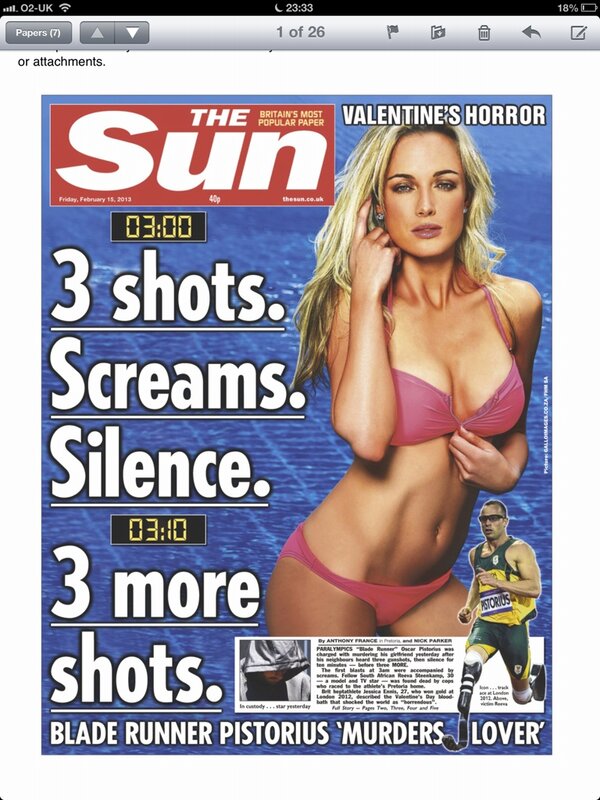
Fuck the Sun.

BDGgaAWCUAA39Mj

The woman, pictured in a bikini, positioned carefully by the editors to invite leering. She was killed. The headline, sensationalistic and lurid. The scare quotes, trivialising violence.

Her name was Reeva Steenkamp, not that you’d know from the reportage. It’s irrelevant to them.

This is hardly the first time I’ve been appalled by the lows to which this vile rag can sink. I am shocked and sickened, but not surprised. This is par for the course for The Sun. This is not new, merely different.

I have spent the last few days arguing with defenders of the No More Page 3 campaign, and when I see this I wonder how anyone can continue to argue that the page beneath this is the problem.

It’s how these bastards operate. I don’t doubt that this will sell well, and our disgust will be dismissed. It happens every single fucking time they do this.

Come and perv on the dead woman. Stay for the sensationalism and trivialisation. It’s just another method of exploitation that can be marketed, and our society is fucked enough to buy.

Why did they try to lock us out of the Alfie Meadows trial?

Yesterday, I trudged to Woolwich Crown Court, in deepest darkest Plumstead, at stupid o’clock in the morning. It was for an important enough reason: it was the beginning of the third trial for Alfie Meadows and Zac King, two young people arrested for their participation in the 2010 student protests on a charge which was simply stuck there for the police to cover for the fact that they very nearly killed Alfie with their aggressive tactics. I was there to show support as were many others.

There was a small demonstration outside the gates of a complex which housed to the right the court, and to the left Belmarsh Prison, connected to the court by an underground tunnel in a clear illustration of the purpose of the buildings. We turned to enter the court to sit in the public gallery: as members of the public, this is something that we are allowed to do in an open court. The way was blocked by police. They told us we couldn’t pass: not even the families of Alfie and Zac.

It was still early, so we concerned members of the public went for breakfast. During this time, after some cajoling and an attempt to lock the doors of the court, the families and the defendants were finally allowed into court for their own fucking trial. When we returned, the doors were locked.

Woolwich Crown Court is a public building. It’s not the sort of building one would ever choose to go to, just an ugly functional factory for churning out a certain definition of justice. It is a public building, which members of the public can access: maybe they’re lawyers, maybe they’re on trial, maybe they’re witnesses or jurors or work in the canteen. Or maybe they’re journalists, there to report on the trial. Or maybe they’re just there to support someone in court. Literally everyone was locked out of the front of Woolwich Crown Court yesterday morning, because the court security did not want to allow access to those who had come to support Alfie and Zac.

None of the security seemed to understand quite why they couldn’t let us in, just that it was forbidden by the court manager. Direct attempts at communicating with this court manager resulted in a ringing telephone with no answer; apparently he just didn’t want to hear it. Trapped outside were friends of Alfie and Zac, supporters and a journalist. We were hardly a terrifying baying mob ready to make the storming of the Bastille look like a picnic; there were seven of us huddled like penguins. Eventually, a security guard informed us that six seats had been allocated in the public gallery (which held twelve 18*) for supporters. That meant two of us could go in. It was an easy decision to make, and those closest to Alfie went inside, promising to let us know of any developments. Soon after, the arbitrary proof that the journalist was, indeed, a journalist, was received by the court, and she, too, was allowed in, leaving four of us.

We spent our time shivering and pointing people who wanted to access the court to the door that security would allow them to pass through, since security weren’t exactly making their reasons for locking an entire public court to the public particularly clear. At one point, some police smugly asked us if we were cold. It made me glow briefly with irritation, at least.

It was freezing, and we came to realise that there was no way that we would be allowed to sit in the public gallery of an open trial, and after an hour in what had turned into hail, we decided it was time to head back and warm up. “State-1, us-nil,” I was muttering, just as we got a text from someone inside, who had left the courtroom to text us and tell us the judge had said that the public gallery should be open to the public. I heard later that he had been rather surprised to learn that the doors to a busy public building had been locked to bar our access.

As we walked back past the security a hundred metres from the court the guard asked “Are you protesters?” We didn’t even dignify that with an answer–we patently weren’t protesting anything apart from grumbling about how cold our hands were. Annoyed, and feeling as though he had to do something, the guard continued. “Is the lady of the group taking pictures?” he asked. It was a very silly question. I had my phone in my hand, and I was clearly typing on it. It was pointed at my feet; or, if it were the front camera, would be poised to be taking the least flattering selfie imaginable. He gave me an impotent lecture about how I was not allowed to take pictures. I decided not to tell him off for referring to me as “the lady of the group” as I had more important things to do.

When we returned to the court, the doors were still locked, and the same security guard still wouldn’t let us in despite our assertions that the judge had said so. He hadn’t heard anything about that, he said, and refused to check the information he could have easily accessed. It was only when a second security guard came down and let us in that he conceded. The second guard, apparently forewarned by the man in the hut, once again informed me I wasn’t allowed to take pictures. He delivered this in a wearied tone, unable to even pretend he thought that was the case.

Finally, after the first security guard had nicked my perfume out of my bag (presumably in case I scented the court), we were in and able to watch the–by my reckoning–half hour of court proceedings that happened in between all the hanging around that is commonplace in court.

I’ve supported people in court before and it was always farcical, but this was by far the most absurd of my experiences. Never before have I known of the doors to a public building to be locked like that, and based entirely on the say-so of security going against the judge’s wishes. From the looks of it, they were taking their lead from the police. And why?

Your guess is as good as mine, but it seems to me that this was the state once again exerting its power in any way it could. This has marked the entirety of the Alfie Meadows case: him and Zac are currently on their third trial, as the fact the police nearly killed Alfie kind of looks bad for them. They wanted to hide the level of support–from Alfie, and, perhaps, from the jury. They didn’t want witnesses to the injustice of the whole humourless farce of a trial.

If you’re outraged by this, remember that this is only the tip of the iceberg. Feel that outrage, and understand that things like this happen all the time. Talk about your outrage, the state of the justice system. Familiarise yourself with Alfie’s story, and others that are similar. Know that the state does not act fairly or justly, and share these tales because it’s absurd and it’s repulsive.

And remember that that’s just how power works.

__

Corrected the number of seats in the public gallery, thanks to Nina pointing it out below. Should also mention that when we got in there, there were plenty of empty seats as the court officials had done such a fine job of getting rid of supporters.