I do not have real, human enemies. There are, however, institutions which I hate as deeply as though they had crapped in my shoe. In fact, what they do is a lot worse than crapping in any shoes.
Take, for example, Topshop. There are so, so many reasons to hate Topshop.
Firstly, I have an almost Pavlovian reflex to quickly utter the phrase “pay-your-tax” following the word Topshop. A quick history lesson for the uninitiated: Topshop is owned by a company called the Arcadia Group. The Arcadia Group’s business is run entirely by one Sir Philip Green, who is also, coincidentally, a government advisor on which public services to cut. Despite Green’s active role in the company, Arcadia is registered in the name of Green’s wife, who happens to be a resident of Monaco. In Monaco, one does not have to pay tax on personal tax. By exploiting this loophole, Arcadia have avoided paying approximately £285 million of tax. In December, Topshop was targeted by activist group UK Uncut, who exist mostly to point out how thoroughly unnecessary any cuts to public services are, when one could just ensure that the super-rich paid all of the tax they are supposed to pay.
That Topshop do not pay their fair share–no more than anyone else, just the amount they are supposed to pay–is thoroughly unfair when vulnerable groups are disproportionately affected by government policy. To put this into perspective, from £1.2 billion pounds, no tax was paid. The £285 million tax bill avoided would hardly make a difference to the Greens, and push the full dividend to slightly less than a billion pounds in one year. Despite this, they decided to grow richer. £285 million on its own is more than one could reasonably spend in a lifetime, yet it is equivalent to a year’s pay for 20, 000 NHS nurses. This money could mean the world to many.
In order to further maximise their profits and procure Philip Green yet another yacht, Topshop and the Arcadia Group use sweatshops for labour. This report suggests that workers who manufacture clothes sold by Arcadia are paid about 40p per hour. For comparison, the unpaid tax bill alone is worth more than £32, 500 per hour. This horrifying exploitation of people–human beings–in the name of allowing the already-rich to grow even richer is unjustifiably wrong.
Then there is this image, which until yesterday was featured prominently on Topshop’s website:
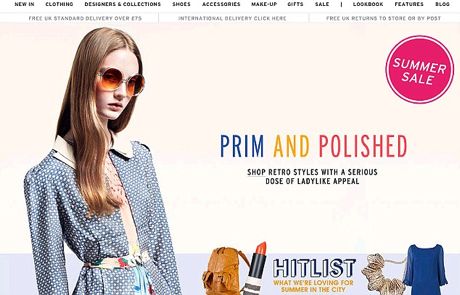
The model is so slim, it seems as though it has been photoshopped, like the classic botched airbrushing in which a Ralph Lauren model ended up with hips smaller than her head. I do not know whether the image has been doctored or if it is a photographic trick, or if, indeed, the model really is that thin. I am disinclined to believe the latter, as in all of the other photographs, the model does not look that unrealistically thin.
The article which managed to catch the screengrab before Topshop took it down calls for discussion over whether such images are a risk for eating disorder, but such a discussion is not necessary: science has cleared up the matter [article sadly paywalled]. A large number of studies have been conducted to understand whether exposure to “thin-ideal” pictures in the media is linked to eating disorders. Some have found that it is, while others found that it is not. In order to work out what the “true” effect is, the authors in the study above took all of the available data and put it together in the same spreadsheet. This is called a meta-analysis, and basically means turning a lot of small studies into one huge study. The authors found that exposure to images in the media like the image Topshop thought appropriate to use was linked to body dissatisfaction, internalising the thin-ideal, and effects on eating behaviours and beliefs about food. In other words, these images are dangerous. While they may not be sufficient to trigger an eating disorder on their own, they are certainly a contributing factor. For Topshop to run such a picture is therefore highly irresponsible.
Not only could this picture possibly facilitate eating disorders, it also represents some fairly tired gender stereotypes, selling women the ability to look “ladylike”. “Ladylike” is one of those unpleasant words used to regulate women’s behaviour. Being ladylike is submission, being ladylike is to accept the role prescribed for you, and, apparently, being ladylike requires buying Topshop’s products. Make sure you stay polished, ladies! That the words were run next to that picture speaks volumes: to be ladylike is to be feeble, frail, fragile. It is not enough to capitulate to docile femininity. You have to buy your own oppression. It is, frankly, fraudulent.
But perhaps you don’t care about how Topshop is a case study in the interplay between the foul side of capitalism and murky misogyny, with just a splash of dangerous body policing. Maybe you don’t care because this sort of thing doesn’t bother you much. Perhaps you don’t care because it is not like Topshop is the only company doing this. Let’s face it, they’re all at it. We just have the numbers and brazen evidence for Topshop. Even if you don’t care, there is still reason enough to hate Topshop.
Their products are really awful quality and terrible value for money. They are not built to last. They are horribly overpriced for what you get. I should know. Before I declared Topshop my nemesis, I bought clothes from there. It was always dimly disappointing.
I cannot go in there any more. I have participated in UK Uncut actions in Topshop, I have tweeted vitriol about them with my name and my face, and the last time I tried to enter a Topshop I was told politely by security to leave. By Topshop security’s standards, I understand that this was fairly lenient treatment.
I do not feel a sense of loss. I do not feel like I am missing out on their sub-par clothing, or their Stone Age attitude towards women or the opportunity to donate to Philip Green’s yacht fund.
If anything, I am relieved. I do not have to waste my energy on a boycott.