Dear Jeremy Hunt

Trigger warning: frighteningly real risk of a return to back-alley abortions, coathangers and violence against women, and demi-castration fantasy.

Dear Jeremy Hunt,

I was really interested to read your opinions about lowering the abortion time limit to 12 weeks, based on scientific evidence that you didn’t bother citing, and I’d like to offer you a little bit of advice. This will help you a lot in the long run.

Basically, I feel like you should remove one of your testicles. Now, there’s a trick to this. What you need to do is take a bottle of your favourite alcohol–I’d recommend Buckfast, but that’s a personal preference–and smash the bottle. It needs to be a glass bottle, obviously. Now, take a shard. Take a shard that looks particularly pointy, and apply it to your scrotum. Feel the coldness of it. Do you feel that, Jeremy? Do you feel it?

I bet your penis is shrinking slightly at that vague chill. Don’t worry, that’s only natural. But I promise what I’m telling you will help you.

Now, this bit is going to be tricky, and I imagine it’ll probably hurt rather a lot. So to help with the pain, maybe drink the Buckfast before you break the bottle. Sorry, I should have told you that before. I forgot. I hope you’ve not been following my suggestions in real time. If you have, go to the shop, buy another bottle of Buckfast, chug that shit, then break the bottle and see if you can get hold of anything a bit pointier. Pointy is good.

It’ll probably also help if you can bite down on something.

Now, Jeremy, I don’t know what your dominant hand is, so I’m going to assume you’re right-handed like most people. Take your right testicle in your left hand. Hold the glass in your right. With your left hand, really feel where the ball is, feel that strange, squishy sensation. Hold your thumb just above the top of it, towards where it meets your cock. Now, holding the glass, cut just above where your thumb is.

It’s likely there’ll be a bit of blood at this point, but hold firm. This is for your own good, and there’s scientific evidence on my side. Loads and loads of medical evidence. I don’t need to cite it, just like you don’t need to cite yours when you’re telling me what to do with my body.

You’ll feel a pop as the skin breaks, a gentle pop as it gives. It’s a surprisingly thin layer of skin, really. If you’ve got the stomach, take a look. You might see something stringy inside. That’s your epididymis, Jeremy, and I’d like you to cut through it too. I have absolutely no idea how that’d feel. From diagrams, it looks like the glass could take it, but if it doesn’t, a pair of scissors will suffice. On the other side of the epididymis, there’ll be a bit more skin. Cut through that. You’ll be a pro at withstanding pain by this point, and that makes you strong.

Now, at this point, you’ll have two things: a disembodied testicle in your hand, and a bleeding wound between your legs. The priority, I suppose, is disposing of the disembodied testicle. Pop it into your mouth. Scientific evidence suggests Paul Burrell did very well at eating a kangaroo testicle, so I’m sure you’ll do well noshing down your own. Be careful for the bit where it bursts, and white fluid dribbles down your chin. I hope you’re not doing this in company.

As for the bleeding wound, try a chef’s blowtorch. It’ll hurt like bejesus, but it’ll cauterise the wound. Be careful not to singe your knob. That’d be a disaster.

So ultimately, thanks for your evidence-based concern about my uterus, Jeremy. I hope you appreciate mine, too. I only have your best interests at heart you understand.

Sincerely,

Stavvers xoxoxo

P.S. If you get someone pregnant following this usually-f0olproof procedure, I recommend repeating it for the right ball.

Related: Let’s scrap the abortion time limit altogether, me on abortion time limits in the NS.

For anyone who wants to send Jeremy Hunt a picture of their reproductive system, here’s how to photograph your cervix. Remember to CC in Maria Miller, as she’s also really interested!

Happy National Mansplaining Week!

Just kidding. Every week is National Mansplaining Week. This week I’ve just noticed it a bit more than usual.

The first example that pissed me the fuck off came from Graham Linehan, which was fairly disappointed as I’m a big fan of Black Books and Father Ted. Now, Graham reckons that sexism and misogyny aren’t the same thing, and it really gets his goat that people use them interchangeably. Now, I called him up on this, pointing out that he wasn’t quite right, and he got a bit arsey.


Despite my better instincts, I did engage on his terms, and dictionary definitions of the two were sent his way, but strangely he didn’t reply after even on his own terms he was pointed out to be wrong. And then he decided that his own opinion was far more important anyway, and blogged this, where he decided to use very cropped definitions of the words which meant what he’d decided they meant, and–literally–said Page 3 couldn’t be misogynistic because the people who like it must like women.

Seriously.

Our second instance of mansplaining this week comes from columnist Martin Robbins, who wrote about the No More Page Three campaign. The vexing part of this is that in places, Robbins was completely right, and to save time I’ll quote those bits.

The most disturbing thing about Page 3 isn’t the fact that there are naked breasts on it; it’s that every pair of naked breasts looks the same, expresses the same opinions, and exists in a context where the owners of naked breasts are casually belittled and dehumanised.

Personally I can’t stand Page 3, but I say the answer is more nudity in newspapers, not less. Put more boobs on Page 3, and add some cocks too. Show people of every size, shape, colour, gender and sexuality; let them speak in their own voice, and celebrate them all. That, rather than self-censorship of adult-oriented content, would be a progressive tabloid revolution worth fighting for.

For what it’s worth, I have similar reservations about the campaign, and would also like to propose that it might be nice to just get rid of The Sun entirely.

But the rest of Robbins’s article has the supercilious tone of “explaining things to the ladies” and telling us how to fight our own battles. It seethes with privilege. And had a similar argument been put across by women, it would have been much, much better. I don’t see why the New Statesman didn’t ask a woman to write about it. They’ve got a fair few on staff.

Now, I expect in the comments I’ll get a lot of men mansplaining to me why I’m wrong about mansplaining because this has happened rather a lot in the last few days. So I’m not going to let those comments out of the moderation queue, and they can scream into the void about censorship.

You might think I’m being harsh, or that I’m picking the wrong targets, or that I clearly haven’t read this one thing written by a man that explains why I’m wrong, or that there’s things far more important than calling out mansplaining to do. But do you know what? Every time a man decides to tell women what their experience is, to patronise about women’s issues from a position of relative ignorance, a woman is silenced.

No matter how much men think they’re on our side or being good allies, if they can’t pull back and say “You know what? You’re right, I don’t actually know anything about this”, they are perpetuating patriarchy.

_

Thanks for @FunnyGrrrl for the cap!

In which I gush about Christina Aguilera

I will confess here to a not-even-guilty enjoyment of Christina Aguilera, and her latest video is a thing of brilliance. In short, it features her looking amazing in a variety of costumes and killing men. Watch it:

See? Isn’t it EVEN BETTER than I described?

Xtina plays around with costumes which represent various facets of “slut”: sometimes she goes for the Beverley Hills look, other times, a tight black dress and sometimes even a dreadlocked grungy girl. These are the women who will, under patriarchy, often end up as victims and blamed for what happened to them. Not so in this video: they are granted strength.

Each of these characters picks up a man and then murders him. Delightfully, the killings feature an aspect of traditional femininity: a car is blown up in a cloud of pink fire; a man’s head is smashed into a shower of glitter, and, my personal favourite, a man is murdered in the loo with arcs of blue blood, reminiscent of the blue liquid used in sanitary towel adverts.

Even the song is far better than what pop culture generally shits out: it’s about a woman who just wants to fuck a guy, and nothing more. The juxtaposition of this with the violence of the video literalises a word that doesn’t actually exist: “mankiller”, the heterosexual female version of the heterosexual male “ladykiller”, a man who seduces a lot of women. There’s a reason there isn’t an equivalent for women: we’re not supposed to have any sexual agency.

Ultimately, it’s a provocative video and will probably create a bit of a temper tantrum from those who didn’t understand the point of the SCUM Manifesto: that we live in a society where violence against women is endemic, to the point where the very notion of the roles being reversed and women suddenly having the same level of power over men is unthinkable and causes everyone to freak the fuck out. At the same time as Xtina wields a baseball bat in very stylised violence, Chris Brown is topping the charts despite having put his girlfriend in hospital and proudly displaying a tattoo of a woman with very similar injuries. Xtina’s video, like SCUM before it, puts men on the back foot for once, allowing them a taste of the fear that we live in.

It’s fun, it’s provocative, it’s sexy, and it’s bound to make the MRAs whinge about reverse sexism. Sterling stuff from Ms Aguilera all round.

The age of consent: a woefully inadequate concept (and why Peter Tatchell is wrong)

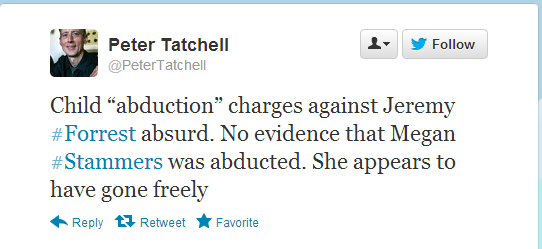
The case of the missing schoolgirl, Megan Stammers, who disappeared with her teacher, has been resolved, with the young woman having been found safely. Unfortunately, some people have used this story to promote their own causes. Last night, Peter Tatchell tweeted this, deciding apropos of nothing that the whole thing must have been consensual on Ms Stammers’s part:

Now, one of Tatchell’s pet causes is to lower the age of consent to 14. He has written volumes on the matter. While he might disclaim the living fuck out of everything he has said, there is still something that sits awkwardly with me with his vocal advocation of this. A man Peter Tatchell’s age should have no interest whatsoever in what 14 year olds are doing (or not doing) in their bedrooms.

The thing is, while he claims the people he wants to see protected are the young people- a 16 year old should not be prosecuted for having sex with a 15 year old- he conveniently forgets to mention that this very seldom happens, and usually only when other abusive shit is going on. Put simply, the law is there to protect young people (usually girls) from older men. When two underage people have consensual sex, there might be a few checks on their welfare, but it’s phenomenally unlikely that anyone will be prosecuted. The prosecutions come when one person is significantly older than the other.

The age of consent is a complicated business, and I find it woefully nonsensical that there’s a magic number of years that happen and then suddenly you’re capable of consenting to sex with anyone of any age older than this figure. Whether it’s 14, 16 or 25, there’s always going to be some people who are more vulnerable to abuse than others. People mature at different rates.

What’s more helpful to examine is the interplay of power differences. Where there is a significant age gap–where one partner is 40 and the other 15 or 16–the extra arbitrary year probably isn’t going to make a blind bit of difference. The problem here is that one person is more than twice the age of the other, with far greater social and legal power. When the older partner is a man, further kyriarchal power differences creep in. If the older partner has a social role which puts them in a greater position of power–such as a teacher–then it becomes even more problematic.

It is these power differences that lead to abuse, not the age. Relationships of this sort will not always be abusive, but there’s so much of a problem with power here that they’re definitely causes for concern.

In fact, the notion of an arbitrary age of consent can lead to problems in and of itself. When girls hit whatever the age of consent is, there’s a certain patriarchal assumption that they’re now “fair game” (TV Tropes calls this the “Jail Bait Wait“; click at your peril): here, there is very real protection for young women, as it seems the only thing protecting them from the creeps banging down their door is the fact the creeps don’t want to be labelled paedophiles. Youth and innocence are fetishised under patriarchy, and therefore the legal boundaries currently do serve as a form of protection, albeit fairly inadequate. Shifting the age of consent down would serve to open up more young women to these predatory creeps who subscribe to patriarchal beliefs.

Vladimir Nabokov’s Lolita provides an excellent exposition of some of the attitudes which allow abuse to happen. We find ourselves liking Humbert Humbert, and rooting for him. At times, we might find ourselves tutting at how difficult and unpleasant Lolita is being, before catching ourselves and remembering that SHE’S A YOUNG GIRL BEING ABUSED BY HER STEPFATHER. It’s a book everyone should read and experience, because it shows you just how easily you can fall into rape culture thinking (also, it is absolutely beautifully written).

Legal protections on the whole are not very good, and what we really need is a vast shift in culture away from retributive justice and towards community accountability. This allows us to respect the agency of young people while still keeping an eye out for causes for concern. And of course, the set of attitudes that allow abuse to happen must disappear.

And that’s a long way off, so what we’re currently lumbered with is an arbitrary number. Maybe it should change; maybe it shouldn’t. The people who should decide this are the ones who are affected by this legal situation: those under the age of consent, and those close to it. At the moment, all I’m hearing is rumblings from Tatchell, when it’s none of his fucking business. He is completely unaffected by this law, unless he intends on having sex with some 14 year olds, in which case he’s completely on the wrong end of the power difference to get a lick of support from anyone. And for him to use a high-profile case to promote his cause is unpleasant. Maybe Megan Stammers went freely. Maybe she was abducted. It is not for us, or Peter Tatchell to decide.


Why I can’t support @SlutwalkLondon any more

I’ve always supported the aims of the Slutwalk movement: sticking two fingers up at rape apologism.

The thing is, the London Slutwalk Twitter account has gone miles off message. Their anti-rape campaigning, it seems, only extends to clothing. If you happened to have been raped by a powerful man, on the other hand, they don’t give a shit.

Yesterday they tweeted a statement about Julian Assange. It featured the standard foil-hattery about the extradition to the US, and ended with a suggestion that he should stand trial–but in the UK.

Now, this is all well and good if you don’t care much for rape survivors. Imagine if you have been raped, and your rapist skips the country. You are told you can only get justice if you go to a country far away, and face a legal system with which you are not familiar, with a trial in a language you don’t speak (but your rapist does).

How is this in any way standing up for people who have experienced rape?

I can’t support Slutwalk London when they continue to engage in coded rape apologism. Rather than destroying rape culture, they are actively contributing to it. They’ve made it clear their support does not extend to all women, all survivors. And I will never support movements which stand for this.

ETA: Slutwalk Britain have disowned Slutwalk London. This is a positive step; I’m glad to see these views aren’t thoroughly entrenched across the whole Slutwalk movement.

Update 28/9/12: Slutwalk Toronto–who started the Slutwalk movement–have responded to Slutwalk London’s comments, finding them unacceptable.

No matter who Assange is, his political involvement and status should never be used to discredit or cast doubt upon his victims or protect him from being accountable. Suggesting otherwise goes against what we believe SlutWalk is.

Update 30/09/12: One of Slutwalk London has taken responsibility for the comment, saying:

The recent views expressed regarding the extradition of Julian Assange were my own rather than those of SlutWalk London. I apologise for using this platform to express these views and hope they do not deter from the purpose of SlutWalk, which is to send the message that there is never any excuse for rape and to demand protection and justice for all rape survivors. – Anastasia Richardson

This late in the game, it smacks of desperate backpedalling to save face. I’ve asked Anastasia if she sees how she (probably unwittingly) perpetuated rape culture. I’ll let you know if I get a reply.


Savages: not the kind of poly representation we need

This post contains spoilers right to the end for Savages. If you haven’t seen Savages yet, read this and save yourselves the price of a cinema ticket and two hours of your life. 

I went to see Savages today. The film has generated quite a bit of buzz in the poly community, as it’s a mainstream poly film wherein the relationship between the characters isn’t the main focus. What could possibly go wrong? Well, absolutely everything.

Our protagonist is a woman called O–which is short for OMG PLEASE STOP DOING CAPTAIN OBVIOUS VOICE-OVERS IT’S PRETTY GRATING–and her two male partners, Nice Boyfriend and Violent Boyfriend (I think they had names, but to be honest, this was the depth of their characterisation). They’re in a V-relationship (or as the mainstream media reviews tend to put it, O is their “shared girlfriend”).

Nice Boyfriend and Violent Boyfriend run a cannabis operation, where Nice Boyfriend does all the nice bits and Violent Boyfriend does all the violent bits. Meanwhile, O is just sort of there. Then one day, some mean Mexicans decide they want to take over the Boyfriends’ business, and because they’re the baddies, they kidnap O, and the Boyfriends work together to rescue her. Lots of violence ensues.

There’s a lot wrong with this film. So much that it’s pretty difficult to know where to start, so excuse me for being kind of stream-of-consciousness, because it’s so intersectionally awful that I’ll probably end up tackling it all at once.

Firstly, it’s pretty fucking sexist. There are two major female characters in this film. The first is O, who is our standard passive Hollywood damsel. She lets the men get on with their business while she just does… something. It’s not clear what she does, what she likes, anything. Awful, cardboard cutout characterisation is a hallmark of this film. O just provides a droning voice-over at various points in the film where the writers can’t be bothered to show rather than tell. She gets kidnapped and raped, and is largely a rather grating McGuffin so the men can do their thing.

Our other woman is Elena Sanchez, played by a Salma Hayek who looked a little young for the role she was shoved into. Elena is the head of a Mexican drug cartel, who starts out as a cardboard cutout female baddie, right down to the red dress. At this point, I’d thought the character was put in to detract criticism from the passivity of the other female lead, but it is later revealed that she’s so evil because her husband and sons were killed. And then motherhood turns out to be her major weakness, which is exploited by the Boyfriends who kidnap her daughter in order to get O back (they literally stuff this woman into a fridge during the kidnap).

Because O is so horribly badly characterised and lacking a single trait other than vapidity, it’s hard to see why the Boyfriends want her back. Perhaps it’s because she’s the only person in the world as one-dimensional as they.

You might have noticed that the baddies are Mexican. This is not handled in a way that is anything other than really fucking racist. We are presented with two sides. On the one side, we have the white, blonde O and the white Boyfriends. They are the GOODIES. On the other side, there’s a bunch of Mexicans. They are the BADDIES. The GOODIES describe the BADDIES as “savages” occasionally, presumably as the scriptwriters give each other a self-congratulatory pat on the arse for having managed to name-check the title so clunkily. Meanwhile, the BADDIES think the GOODIES are savages because they’re in a poly relationship. Yes. They say that. They actually say that.

As well as Elena Sanchez, there’s also two other Mexican baddies of note. One is played by Benicio del Toro, and his character is a rapist and a murderer and generally a thoroughly unpleasant human being. The other is a young guy who ends up getting killed by Benicio and I’m not entirely sure why. They’re all just cardboard cutouts, with various stereotypes about Hispanic people tacked on for good measure.

Also present is benevolent sexism. Nice Boyfriend is shown to be nice because sometimes he goes to Africa and cuddles brown children.

Now, it’s worth looking at where the characters end up to lay bare the fucking mess of sexism and racism in this fucking film, but this matter is complicated by the fact the film has two endings. It has a sad ending, wherein everybody dies, and a happy ending, which is the “actual” ending. This isn’t some alternate ending deal, though. It’s like they decided this film was so shit that nobody would shell out for the DVD so just stuck both endings in the film, with the sad ending being something O and her irritating voice-overs have just made up.

In the “actual” ending, Elena gets arrested along with all the other Mexicans except Benicio, who has quite a nice ending and lives happily ever after. The (white) cop who does the operation does really, really fucking well for himself. O is rescued by not one, but two men, and our protagonist triad go and live somewhere remote and cuddle brown children.

Among all the racism and sexism, it isn’t even that good a depiction of polyamory. This might be somewhat related to Hollywood’s general aversion to sex, while it embraces violence. We get teased with the beginnings of a threesome scene which fades to black before the clothes even come off, while we are treated to, among other things, a kneecapping scene and a shot of a big fucking hole in the back of someone’s head. So perhaps this goes some way to explaining the utter clusterfuck of the main relationship.

O explicitly describes her two partners as being equivalent to one–each representing a “half” of something she needs. Nice Boyfriend is nice; Violent Boyfriend is violent, and a voice-over informs us of exactly how they are opposites of each other and the only thing they have in common with each other is O (and their drug business, which O has conveniently forgotten for the purpose of the voice-over). Um, right.

In the bad ending, Nice Boyfriend is shot in the neck and Definitely Going To Die, so the other two commit suicide and they all die together in the desert, because apparently the writers couldn’t possibly imagine any other way for a poly relationship where one partner dies could end.  Meanwhile, in the happy ending, in another of O’s fucking voice-overs, O informs us that she isn’t sure if three people can ever love each other in a way that is balanced, and that they’ve become savages and she’d rather not live like a savage. And they cuddle some brown children, and they cuddle each other. In both endings, they pay their dues for their sin.

So, in short, it’s a terrible film. Yes, it depicts some characters who happen to be poly, but quite frankly if it’s happening in films that awful, I’d rather we stayed invisible.

“You’re polyamorous, right? Like in the execrable Savages?”

No. Nothing of the sort.

What it means to be pro-choice

Imagine, if you will, that the revolution has happened. It’s happened, and, in this scenario, it’s gone really fucking well. 

Suddenly, everyone is free. There’s no more poverty, no more working every hour imaginable just to survive. There’s no more capitalism, no more class system. We’re all equal, with time to spend at leisure as machines labour for us. We have everything we need to survive and live a good life. And this delicious standard of living is open to absolutely everyone. Inequality has been abolished in all forms. Racism is dead, the class war has been won, we’ve made our society accessible for people of all abilities, ensuring everyone can live in dignity.

Yes, even gender inequality. That’s a thing of the past. It’s such a thing of the past, the word is meaningless except to historians. All those intersectional problems have gone. Rape, abuse, harassment. They’re words that pop up in great art made about the Before-Times, but nothing relevant to modern life. They just don’t happen any more. Like I said, the revolution went really fucking well. 

The idea of family has changed, because how we conceptualise gender itself has changed. The rainbow of gender and sexuality is fully accepted, appreciated, embraced. Families come in all forms, children have any number of parents of all sorts of various genders and relationships with each other. And they’re raised with love, because everyone’s so fucking happy all the time. And every child is wanted, because contraception has been sorted the fuck out. It just works whenever the user wants, with no ill-effects.

Everyone’s well-educated in this beautiful, impossible future. They know what they’re doing. It’s all the necessary ingredients for making a choice that is free.

Now meet Qarmin, a character who lives in this world with a suitably futuristic name, and has been created to make a point. Qarmin has a female reproductive system. Zie lives with hir partners Xargrob and T’lara, whose names I made a little less effort with because they’re less relevant to this. Together, the three of them decide they want to have a child. Qarmin stops taking hir contraception, as does Xargrob (who has a male reproductive system), and soon Qarmin falls pregnant.

A few months into the pregnancy, Qarmin changes her hir mind. Zie doesn’t want to be pregnant any more. Hir body is changing, and zie doesn’t want it to do that any more. Zie visits an abortion clinic for advice.

Should Qarmin have an abortion?

If your answer is anything other than an unequivocal “none of my fucking business”, you might want to re-assess your pro-choice credentials. Ultimately, it rests on bodily autonomy. Even when you take away every single economic and social factor, and perfect foolproof contraception, the pro-choice position should–and must–rest on the right to do whatever the fuck you want with your own body. Abortion is something that must always be an option; no matter how perfect the world, there’s always going to be a reason for it to exist.

And along the way to building a perfect world, abortion must be available. safely and legally, always.

Dear anti-choice signatories


Remember that awful “ban abortions for disabled foetuses” letter to the Telegraph yesterday, which I took down here? Twitterer @jonanamary has done something rather brilliant. She’s written to all the signatories asking them what they actually do to help people with disabilities. The full text of her letter is below, and she’ll let us know if any of them bother replying. She’s not hopeful for any replies, and neither am I!

Dear Signatory
I am writing to you following the publication of a letter in today’s Daily Telegraph (link: http://www.telegraph.co.uk/comment/letters/9551209/Rigorous-exams-are-important-but-teachers-need-classroom-discipline.html) which was co-signed by your organisation.
The letter states:
“A special-needs child in the womb can be aborted at up to 40 weeks. But once he or she is born, we do a moral volte-face and become full of compassion.”
I was wondering how you square this assertion – that “we”, i.e. society, become “full of compassion”, for “special-needs” children – with the recent and extensively covered cuts to essential benefits and services for people with disabilities?
Here are just some examples of articles on cuts to services and benefits for people with disabilities:
I could continue. The evidence is clear that life for people with disabilities is difficult, and becoming even more so, as austerity measures target essential services for disabled people. The side-effect of this – the demonisation of people with disabilities in certain parts of the media – has led to a rise in hate crimes against disabled people (see BBC News article: http://www.bbc.co.uk/news/uk-19589602). This grim picture seems far from the “compassion” you claim disabled children are met with – although it should go without saying that there are still many good people, in the NHS and outside it, who do their utmost every day to help disabled children and their parents/carers.
It seems nonsensical to talk about the abortion of foetuses with severe abnormalities without looking at the wider economic picture which influences decisions regarding termination. I do not doubt that many parents making the agonising choice on whether or not they feel able to support a disabled child would opt to bring a pregnancy to term, were better support guaranteed to be available – and were the outlook for disabled people not so grim.
I am sure you agree that the truly compassionate act, in this instance, is to look to change societal attitudes about people with disabilities, and to support benefits and services which help make the lives of disabled people and their carers easier – despite the government’s counterproductive austerity drive.
I note that in your letter, you do not refer to the savage cuts causing havoc to the lives of many, many people with disabilities, as outlined in the links provided above. I am sure this is a simple oversight.
To this end, I would like to know if your organisation has:
  • campaigned for the protection of services designed for people with disabilities, including children;
  • spoken out against the cuts, because of the impact they will have on those caring for a disabled child;
  • lobbied the government to protect such services, publicly or behind the scenes;
  • offered economic support to charities and groups which offer care and support to disabled people;
and finally, if you are prepared to issue a statement or letter – similar to the one sent to the Daily Telegraph – which sets out in the clearest possible terms your opposition to the erosion and outright destruction of the support infrastructure upon which many people with disabilities rely on a daily basis.
Thank you for your attention. I hope to hear from you soon.
Yours [Jonanamary’s real name]
__
20/9/12: A response has been received from Comment on Reproductive Ethics, reproduced below.
Dear [Jonanamary’s real name]

Thank you very much for getting in touch.

You raise very important issues which we are indeed aware of and some of the other signatories to the letter will no doubt reply to you and explain some of the specific things they have done and are doing to address the needs of children and adults with special-needs and disabilities.
The letter today is just intended as the first step in a long battle of raising public awareness as to the reality of our current attitudes to disability before birth, and I would encourage you to write directly to The Telegraph to add your comments to the discussion and focus on the inadequacies of support for those who do get past the birth hurdle.  There is already quite an extensive exchange taking place online.
LIFE, for example, has a particular focus on babies and children with special needs, and colleagues working in Down Syndrome Research UK are also searching for positive responses  to the specific special needs of those they represent, whether of a medical or a practical nature.
We work together on a number of issues and one particular initiative I have been involved in recently has been the creation of a directory of hands-on help for women in crisis pregnancy situations, which includes contact for positive help to face whatever problems lie ahead, which often includes advocacy for special-needs children and their families.   This initiative is being supported by a number of those who signed the letter.  This directory will be launched next month and we hope will be added to by others as it becomes known.
This is by way of an immediate albeit brief response to your letter, but I hope we can keep in touch and find ways of collaborating in the future.
Sincerely
Josephine Quintavalle