Harassing me will not help your cause

“Hey, gorgeous,” he says. I speed up my pace; he follows me. “I just want to talk to you.”

The next one stands right in front of me. “Just give me two minutes,” he says. “I only want to talk to you.”

“You’ve got a pretty smile,” another says with a creeping grin. “Come and talk to me.” He tries to grab my arm. I walk away, as fast as I can.

These interactions happen on a regular basis. Often it’s the usual, the leery-beery tiresome street harassment of daily life, the drunks, the creeps, the men who want to make women feel uncomfortable.

Sometimes, they are not. The men in the incidents outlined above are wearing bibs and told to harass women in the street by major charities. The techniques employed are identical. The objectifying icebreaker. The assertion that they “only want to talk”. The unwanted contact, the grabbing, the following.

The only differences between “chugging” and bog-standard street harassment is the bib, and the fact that you know exactly what it is that the chugger wants.

Having lived and worked in central London for several years now, I have had plenty of contact with chuggers, and witnessed many other incidents. I’ve noticed that the men always go for women, and the women for men. I’ve noticed they pick off people walking alone rather than groups. I’ve noticed they don’t really like to take “no” for an answer.

And I wonder, do such tactics actually work?

It costs the charities a lot of money, outsourcing their fundraising to other companies. It costs the charities money dealing with cancelled direct debits. Is there really much net gain from employing tactics which are at best incredibly annoying?

On a personal level, I disinclined to engage with a man who follows me and shouts at me. I get it enough on a daily basis that I really couldn’t give two shits if that man is doing it to get a bit of money for a spa for blind donkeys rather than to try to have sex with me or frighten me or tell me he likes the bounce of my walk. It’s all the same to me. It’s unwanted contact with a man who will not let me be.

When I have a man standing in front of me, blocking my movement, breathing rum-fumes in my face as he asks for my number, I find the smell of rum turns my stomach and renders me unable to enjoy mojitos for a while. It is exactly the same when a man stands in front of me, blocking my movement, wearing an Action Aid bib and asking for my number. It kind of makes me hostile towards Action Aid, as I associate the charity with ugly patriarchal harassment.

I wonder, are chuggers trained to do this? Are they told, perhaps, to flirt a bit, to break the ice? If so, they are going about it in completely the wrong way, rendering themselves indistinguishable from the oppression of day-to-day walking while female. It is a grotesque parody of social interaction, nothing more than low-level stalking with all of the emotional intelligence of a particularly obnoxious wasp. The only way I could remotely imagine such tactics could possibly be effective is that some people will acquiesce to the chugger’s demand and give up money to make them go away.

If that is the case, charities really need to ask themselves whether doing this is worth it. I simply cannot get on board with any charity that pays men money to harass me in the street. For one, it’s fucking unpleasant. On top of that, there are plenty of men who will do that for free.

Charity is supposed to be nice and good. So why are they paying to upset women?

How to stop your man from cheating

The Sun is hardly known for inhabiting the same universe as the rest of us. The newspaper dwells in this strange limbo where the line between fiction and reality is blurred to nothing. It is hardly surprising, then, that this drivel appeared:

Of course, the solution to partners cheating is not to become a perfect, pliant little domestic goddess. The solution is the following:

SMASH MONOGAMY

SMASH HEGEMONIC HETEROSEXUALITY

SMASH PATRIARCHY

I’m glad the Sun will probably go under soon.

__

Credit to @RupertNeate for bravely combing that rag and finding this, and @jedweightman and @TheNatFantastic for bringing it to my attention.

Happy birthday, Voltairine de Cleyre

Happy birthday, Voltairine!

I hope this virtual birthday card breaks all realms of plausibility and somehow reaches through space-time to you. 145 years after your birth, you’re still remembered and much-admired.

I’m sure you’ll be pleased to know that those who remember your name comprise a radical bunch of anarchists and feminists. Your speeches and writings, more than a hundred years later are still cited by us, loved by us.

There often comes a moment when I think to myself, ‘what would Voltairine do’? This usually comes when discussions of action come up, and I always think about your essay, Direct Action. The bad news is, in my time, we’re seeing an increase of rejection of the tactics of direct action. These days, you can’t break a window without a clusterfuck of liberal handwringing.

I know it was much the same in your day, and that we still haven’t combatted liberalism, but the state has made itself more powerful than ever, with the advent of new technology,and abuses this privilege to send people down for the smallest, most peaceful actions such as sitting in a shop. They’ve taken away our ability to strike, Voltairine: the once-powerful unions now defanged dinosaurs.

The will of the unions just isn’t there anymore. It’s hard enough to get them to walk out for a day, let alone the burning steel-mills and sabotaged printing-presses you wrote of.

Direct action is the only way we can achieve change, I agree with you and so do many. But while the spirit is willing, right now the flesh is decidedly weak. The best we can muster is a lot of people going camping, which has pissed off the police a bit, but it looks to me like people waiting around to achieve a majority while in a state of mild discomfort. It’s nice to see baby steps, but I feel like the time has come to run head-on at the whole corrupt system.

You’d probably shit a brick if you saw it, Voltairine.

With social issues, we’ve hardly got much better. Although men are no longer legally allowed to rape their wives, most of Sex Slavery still applies. Our mass-media sells women the idea that we must truss ourselves up in discomfort and dedicate our lives to attracting a mate. They mask fear of women’s sexuality in “oh God, think of the children”, thus dragging the next generation into this way of thinking.

As for marriage, you were absolutely spot-on there: your thinking still resonates a century later. The divorce rate is steadily climbing, but despite this, society insists on banging the marriage drum. In good news, the right to marry will soon be extended to same-sex couples. In bad news, that means a whole other bunch of people will have that norm forced upon them. It looks like equality, but it smells like extension of oppression.

In the long run, some things have got a bit better, but really nothing has happened. It’s not your fault, Voltairine, it’s ours. We haven’t been doing enough.

The few of us who remember you, we are continuing your battle, we are inspired by you. We commemorate your birthday. We will fight until your thoughts become an amusing historical artefact, a time capsule of a life before liberation.

Happy birthday, Voltairine!

Love,

Stavvers xxxx

P.S. If you ever fancy coming to visit, try to settle your differences with Emma Goldman. Her and Mary Wollstonecraft have mastered time travel.

Edit: Voltairine, I spoke too soon. On this, your birthday, people in New York are blockading Wall Street, engaging in a massive act of direct action that has been labelled “economic terrorism”. I’m sure you’d be happy.

…but is it evidence?

Have you ever found yourself in an argument with someone who claims they have “evidence” for something and will not shut up about it? Do you find yourself feeling uncomfortable with quarrelling with said “evidence”, even though you know the other person is wrong?

Here is a simple guide to spotting what is good evidence and what is not.

Is it even research?

This shouldn’t even need to be said, but I have seen a lot of people who believe a hypothesis to be evidence. It is not. This is particularly true in the case of evolutionary psychology: much of it is hypothesising without research. In other words, the authors publish a paper about what they think might be the case without actually testing whether it is the case.

It is perfectly possible to publish hypotheses without tests to stimulate discussion and debate. There is a whole journal dedicated to this! Medical Hypotheses has published some gems, including a particularly offensive paper about how “mongoloid” is an adequate name for people with Down’s Syndrome because like people from the Far East, people with Down’s Syndrome sit cross-legged and like eating food with MSG in it. Seriously. That was actually published.

Check whether the “evidence” contains data collection and statistical tests. If it does not, it is likely to be wild speculation, not evidence.

What sort of research is it?

This graphic is called the “pyramid of evidence“. It is a good way of looking at the best sorts of evidence in medicine, although it can be applied elsewhere. At the bottom is “background information”–upon which hypotheses are formed and, as seen above, sometimes published to stimulate debate. Moving up through the pyramid, we see better types of evidence: case studies, cohort studies, randomised controlled trials, and then, right at the top, systematic reviews. A systematic review is the “gold standard” of evidence. It takes all of the data for all of the tests of a theory, drug, medical intervention, etc, and puts it together into one data set, spitting out an “effect size” which tells us exactly how effective or “correct” the object in question is.

The differentiation between different types of research is important. Cohort studies are usually correlational: while it is not entirely true that correlation does not imply causation, correlational studies can only point us in the right direction. To properly establish causation, we need to manipulate some variables. Say, for example, we want to test whether exposure to feminist thought leads to lower levels of sexism. This can be tested by exposing one group of people to feminist thought, while having a control group of people who were not exposed to feminist thought. Before and after exposure, one would measure levels of sexism. This study has actually been done, and found that sexism decreased following exposure to feminism.

If the “evidence” being provided is one correlational study, then it might not be very good evidence. Ask if there’s any systematic reviews available, or at the very least an experimental study.

Quality of the evidence

On the evidence pyramid, there is a second dimension: quality of the research. Quality is made up of a number of important attributes, and it is important to check whether the evidence is good quality or not.

One crucial indicator is the sample. To get good results, the experiment needs to be conducted on a large group of people. The sample should, ideally, comprise of different people from different walks of life. Unfortunately, a lot of psychological research is conducted on psychology students, which throws a lot of it off-kilter, as students are younger and richer than most of the rest of us, and a lot wiser to taking psychological tests. Look and see who was in the study. It is a useful way of understanding how well the results apply to everyone else.

Another aspect of quality is the state of the comparison group. If there is no comparison group whatsoever, be very cautious: the evidence is probably terrible quality. I have seen many people try to draw conclusions about the differences between men and women based on studies of only men, or only women. The comparison group, if  present, needs to be, of course, comparable. If a study is testing the differences between men and women, and the women in the comparison group are less educated, for example, then the results could be down to education rather than gender.

For the sake of brevity, I point you towards this excellent (freely available) paper which teaches readers to critically evaluate the quality of a paper. Knowledge of this is power.

Popular science books are not evidence

Anyone can write and publish a book, particularly with the age of self-publishing. Even books from “big names” such as Steven Pinker are not good evidence, as books are not subject to peer review. Peer review is a process which is used in the academic community for checking whether a paper is valid: before anyone publishes the paper, it will be read through by several other experts in the same field of research. Often, the reviewers will want to see some of your data to verify your findings. They also, more often than not, send the paper back to you and tell you that perhaps you might want to reinterpret your findings or clarify certain bits of the research, or that you’ve made a massive honking error. They also ask you to draw attention to the limitations of your research, so readers can be aware of any of the possible pitfalls in the papers outlined above. It’s a lengthy process, but it means that  journals aren’t publishing any old crap.

For books, this is not the case. Often, the text is read by an editor with no experience in the field of research. If the writer fucks up somewhere, it won’t get caught and will be published anyway.

One example of this is the book The Spirit LevelThere are a few holes in the evidence presented in the book which are dealt with in the reply book The Spirit Level Delusion. The author of Delusion rightly criticises problems which appear in the book, though, unfortunately, is tilting at windmills: most of the peer-reviewed evidence upon which The Spirit Level is based stands up pretty well. It is only some of the bits that didn’t get peer-reviewed and were thrown into the book anyway which can be picked apart. Essentially, The Spirit Level stands up, but due to the sloppiness of the book publication process, it left itself with some open goals in the form of downright shoddy analysis, leaving many (wrongly) thinking the entire theory disproved.

If the only evidence linked is books, be wary. Demand to see peer-reviewed evidence instead. These days, a lot of it is available for free, and even if a paper is not, you can usually see the abstract.

I hope this guide will be helpful for would-be troll-slayers. Use your knowledge. Use it wisely. Happy hunting!

For those awful times where you realise nothing has changed in 200 years

A while ago I wrote about how Mary Wollstonecraft would have reacted to realising she was completely vindicated in her Vindication, and that she was absolutely bang-on.

To summarise, here is a macro to wheel out at those times where you know Wollstonecraft would have been livid, like if she read More! magazine or found herself stuck watching skin cream adverts.

Safe spaces in the #occupy movement: My piece for The Occupied Times

Last week, I was privileged enough to be asked to write a piece for @OccupiedTimes, the newspaper for the London Occupy camps. I wrote about the need for safe spaces for women and how to build these. I’ve cross-posted the article here for anyone who can’t get down to the camp to pick up a copy of this brilliant paper. 

What are we doing here? Are we building a new society, or are we merely the latest incarnation of a wave of indignant protest? I hope we are the former: the beginning of something special.

If that is so, we are currently building our new society in the image of its predecessor, albeit with more tents and banners. In our camps, we see the same kinds of oppression as we do in the unoccupied old world.

In the outside, a beast called patriarchy rules the social domain. In our camps, the situation is little better. Many women do not feel safe camping overnight. Perhaps it is not safe for us to stay.

Over the last week I have heard accounts of women who have been sexually harassed in the camps, usually by drunken men. There has been gendered name-calling and dismissal of the opinions of women. There have been rapes: one in Occupy Cleveland, the other in Occupy Glasgow. Women face the same kinds of oppression in occupied spaces as they do outside. While rape is an issue which can affect people of any gender, it is most commonly men raping women. The system which allows this to happen thrives upon silencing other kinds of sexual violence.

Meanwhile, Occupy Baltimore has included in its security statement on rape the promise to provide abusers with “counselling resources to deal with their issues”, as though a rapist is a victim too. In Anoynmous’s document providing guidance for living in a revolution, they suggest the solution to prevent rape is to “NEVER PROVOKE”, as though rape is the victim’s fault. At Occupy LSX, when we discussed banning alcohol, a topic that often came up was whether this would solve the problem of lagered-up harassment.

These solutions do not attack the root of the problem and some present somewhat dangerous thinking, tangled up in the language of the outside world. To build a new society, we must all work together to make our camps a safe space for women. First our occupied spaces, then the world. This is what we can do.

· DON’T RAPE PEOPLE. Rape is never the fault of the victim, always that of the rapist. To stop rape completely, don’t rape.

· LEARN ABOUT FEMINISM. We’re here to learn from each other. Feminism provides the solution to taking sexism out of life, and provides us with a language to discuss such issues. Read books, read blogs, talk to feminists.

· ADOPT A ZERO-TOLERANCE POLICY ON SEXISM. We say we have this. Let us show we have this. Do not let an instance of sexism—be it a gendered slur, a pat on the arse, or an “ironically” sexist joke—go unchallenged. Call it out. Something as seemingly harmless as a joke reflects and legitimises sexist beliefs in wider society.

· If a woman has a complaint, TAKE IT SERIOUSLY. It is a myth that a lot of rapes are falsely reported. Statistically, it’s very likely the allegation will be true. The same goes when a woman talks about experience of sexism or sexual harassment. She’s probably not overreacting.

· WOMEN-ONLY SPACES. Until we have stamped out all instances of sexism in our camps, women will need somewhere safe to be. Many women find it a lot easier to deal with problems without men present.

· If any of the above seems unreasonable, CHECK YOUR PRIVILEGE. Perhaps you’ve been lucky enough not to experience sexism in your life and don’t see why you should have to do anything to help others as you’ve never experienced any of the problems yourself. This does not mean the problems don’t exist. Not having experienced these problems is what feminists call “privilege”. It doesn’t make you a bad person, but it means you need to learn more.

· Finally, and I cannot stress this enough, DON’T RAPE.

What are we doing here? Are we building a new society, together as a community? It will be hard work to overcome sexism yet to grow this movement and rebuild from the bottom up, it is a matter of urgency that we begin to create a safe space. Women are 50% of the 99% after all.


10 pickup lines that show you’re a dickhead

I shall begin by saying that I hate the notion of pick-up lines. I hate the notion of pick-up culture. I hate the notion that there is a large subculture which dictates that men must pick up women, and that this effect mushrooms into many men believing that the only way they can possibly spend time with a woman is by following these ludicrous rules and feeling like failures if it doesn’t work out for them.

It is not surprising then, that this article, 10 Pickup Lines That Work, pissed me off somewhat.

As its title suggests, it presents ten pick-up lines that apparently work. Unfortunately, little detail is given as to how these techniques were evaluated: it all appears to be anecdotal evidence. In order to adequately test the efficacy of these pick-up lines, one would need to administer the pick-up line to a large sample of recipients, ideally pitted against a control pick-up line with already-known effectiveness.

The unscientific and misleading title aside, these pick-up lines are absolutely awful, and if a man came up to me and started saying any of these things, I would, at the very kindest, decide never to have sex with him ever. At the very kindest.

Our top ten tips come in a number of varieties. All of them are pretty fucking sexist. All of them, in order to work, rely on a vision of society that wants radically throwing: that where it is a man’s responsibility to “approach” and “pick up” a woman. That society wants killing with fire. And so do these pick-up lines.

Type 1: Assault a woman

Remember how, in the popular construction of the Stone Age, men hit women round the head and dragged them by the hair for dating purposes? This pick-up procedure is still alive and well according to Proven Efficacious Pick Up Lines 10 and 4.

Tip 10 involves a bit of minor grabbing followed by the threat of further assault, saying “You’re going to kiss me or I’m going to punch you in the nose!”. Tip 4 is somewhat more direct in the violence and is, for some peculiar reason, titled “be modest”.

As she walks by at a bar, pinch the side of her butt (not hard, but enough to get her attention). She should be mad and say something negative about you. Then you say:

“Sorry, I thought that girls like you would just ignore a normal guy like me. Did it hurt? Maybe another drink will ease the pain.”

I suppose there is some modesty in there. Right next to the sexual assault.

Type 2: Be bafflingly creepy

Ninjas use smoke bombs. Stage hypnotists bark out a strange range of conflicting orders. Confusion as a tactic is also incredibly popular among men who subscribe to the cult of the pick-up line. Utilising confusion seems to comprise a large chunk of the list of useful techniques, ranging from Tip 9 (Stare straight at her, and smile broadly while slowly advancing towards her) to Tip 7 (the thoroughly puzzling “nice shoes, want to make your parents proud?”) through to Tip 5 (which is not, as it says, being sarcastic, but asking a woman’s favourite colour knowingly).

Apparently, women are “always thankful” after being completely thrown by a total non-sequitur. The explanation for how this works is as bamboozling as the line itself, and I still don’t want to have sex for the author, providing anecdotal evidence against the efficacy of this approach.

Type 3: Be cocky in a flat-out sexist way

The word “cocky” contains the word “cock”, so it’s hardly surprising that cockiness implies a performance of the most unpleasant aspects of masculinity. The pick-up lines of this type tend to include displaying a massive amount of sexism, in the hope that the woman on the receiving end finds it funny.

The least offensive is Tip 6, which involves telling a woman she should buy you a drink as she has been “checking you out”. Tip 3 is titled with the rather innocuous “find something you have in common”, which is actually very good advice for men who are interested in meeting and forming relationships with women. What is not good advice is what follows: “convey[ing] it to her with a well-balanced delivery of cockiness and playful insult”.

Then there’s Tip 8, wherein men are directed to use a classic street-harassment tactic: “Hey girl, why you being all sexy ‘n shit?”

The last time someone said that to me, I considered wearing their testicles as earrings. The only thing that stopped me was the fact my earlobes can’t really support pendulous accessories.

Type 4: Assume she wants a boyfriend

Traditional gender roles hold that men want sex and women want a boyfriend. Traditional gender roles are, of course, a big heap of shitting arses.

The readers of askmen.com apparently missed this memo and so voted, as their top pick-up line, the following:

“You know what material this is?” [Grab your shirt]

“Boyfriend material”

Unlike most of the pick-up lines, this one does not come with an anecdote about how use of this line resulted in fifty young nubile nyphomaniacs immediately losing their knickers, “proving” that the approach works. It is just printed there, on its own, and presumed to work.

It is presumed to work, because that is, of course, what women are presumed to want. There is absolutely no concept that women might not be interested in the concept of a boyfriend and might just want a shag. Target is woman. Target wants boyfriend. Hunter disguises self as boyfriend.

I suppose that perhaps, I would not mind a shirt made out of ex-boyfriend material. As long as the material was the tanned hide of an ex-boyfriend.

…and the one that actually works

Surprisingly, Tip 2 contains some actual, decent advice for starting a conversation with a stranger. Unfortunately, it is placed under the heading of “be a gentleman”, which is unfortunate, as “being a gentleman” generally involves subscribing to benevolent sexism.

The “lines” presented are very good advice, though. They involve introducing yourself, saying hello or simply having a conversation with the other person to see how you get on. This advice is not really gendered in the slightest: it is a good approach to initiating contact with someone you don’t know that we can all follow fairly easily. As the tip begins, “no pick-up line is the best pick-up line”.

And that is completely true. Fuck pick-up culture. It is outmoded, outdated, and we would all be better off if we consigned it to the dustbin of history along with the bourgeoisie, Mensheviks and Trotskyism.  Oh, and of course, patriarchy.

__

People sometimes send me things, presumably so they can find themselves amused by my blind rage. This gem was a little gift from @jedweightman.

__

Edit: I’ve asked askmen.com to explain why they think the violent tips are acceptable. I will update if I get an explanation.

__

Update 11/11/11: Askmen.com has not replied, but have quietly changed the tips advocating assault and threat (10 and 4) to more innocuous ones (introduce yourself and show off, respectively). This is a step in the right direction, but nowhere near good enough. They need to formally apologise for the earlier version of the article, as is good practice.
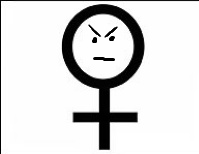
Brendan O’Neill is a dangerous weeping syphilitic chode.

I am beginning to think that I need my very own tag dedicated to professional troll and weeping syphilitic chode Brendan O’Neill, whose previous adventures have included declaring that domestic violence is funny, that sexual abuse victims should keep their mouths shut, and that women are anti-social if they don’t like being harassed in the street.

Seeping from the chancres of O’Neill today comes the not-so-fresh revelation that women are delicate little flowers for wanting to experience the internet without being threatened with rape and other torrents of misogynistic abuse.

O’Neill is reacting here to women bloggers and journalists courageously speaking out about abuse they have received. O’Neill apparently believes we’re overreacting, and we’re stifling poor little chode-face’s freedom of speech:

The crashing together of threats of violence with ridicule is striking, because it exposes a fairly Orwellian streak to modern feminist campaigns to “stamp out” bad things. There is an attempt here to treat words and violence as the same thing. Indeed, the Guardian report discusses “violent online invective” and quotes a novelist complaining about “violent hate-speech”. Anyone who cares about freedom of speech should sit up and take notice when campaigners start talking about words and violence in the same breath, because to accept the idea that words are as damaging as violent actions is implicitly to invite the policing and curbing of speech by the powers that be. After all, if speech itself is a kind of violence, if ridicule is on a par with threatening behaviour, then why shouldn’t internet trolls and foul-mouthed loners be treated as seriously as the bloke who commits GBH? Muddying the historic philosophical distinction between words and actions, which has informed enlightened thinking for hundreds of years, is too high a price to pay just so some feminist bloggers can surf the web without having their delicate sensibilities riled.

O’Neill trots to the last resort of the desperate as it’s abundantly clear he has no actual argument: FREEDOM OF SPEECH STOP SHUTTING DOWN DEBATE STOP CENSORING ME YOU BIG MEANIE. Somehow, suggesting that hate speech is bad and maybe we should work on stopping it makes us into big nasty Stalinhitlers who are fucking with Brendan O’Neill’s fundamental human right to hurl misogynistic abuse around.

O’Neill is also railing against a point which was not made, demonstrating staggeringly poor reading comprehension. I suppose it’s not his fault: chodes only have one eye and his is perpetually weeping sore syphilitic discharge. O’Neill seems to have misread the whole bulk of articles as feminists being offended by a little bit of bad language.

That isn’t the problem. The problem is that women expressing opinions online find themselves under attack. Not their arguments, but themselves. There is no ‘you’re wrong about this point, you bitch’, only the second clause. If you’re lucky. Far too often, it’s threats of rape with kitchen implements or personal details posted.

Even here, while calling O’Neill a weeping syphilitic chode, I’ve attacked his argument. And that’s the difference between colourful language and plain abuse.

O’Neill cannot understand this distinction. Or perhaps, more worrryingly, he does not want to. Having read selected excerpts of his ‘writing’, I have noticed that O’Neill really desperately wants to protect the ability of men to abuse. He wants women to suck it up when under attack online and offline. He wants to wear T-shirts making fun of rape without women getting pissed off about it–in fact, much of the current article is a rehashing of his defence of rape-shirts. He even wants victims of rape by paedophile priests to shut up about it.

At every turn, he seems to want to preserve a culture of violence. It is so pervasive that I wonder if perhaps he has a vested interest in this. Could Brendan O’Neill be one of those leery pricks who believes all women to be stuck-up bitches for rejecting his beery, gropey advances? Could Brendan O’Neill be that vile troll who incites fear to silence? Could Brendan O’Neill possibly be a rapist, an abuser? Perhaps not, yet his impassioned defences of violence make all of this possible; rapists are more likely to believe in cultural myths about rape.

Brendan O’Neill is a weeping syphilitic chode. He is also thoroughly dangerous.

Liz Jones, spunk-heists and adult egocentrism


Oh dear. The professional trolling from the Daily Mail has today produced for us this eggy wet fart: “THE CRAVING FOR A BABY THAT DRIVES WOMEN TO THE ULTIMATE DECEPTION“, by Liz Jones. The link is clean; it won’t give the Mail any traffic that they desperately crave from printing such utter cock.

Liz Jones’s thesis is that women in their late 30s and early 40s are so desperate to have babies that most of them deceive men into getting them pregnant by stealing their sperm. Jones’s evidence for this assertion? She’s done it herself.

Because he wouldn’t give me what I wanted, I decided to steal it from him. I resolved to steal his sperm from him in the middle of the night. I thought it was my right, given that he was living with me and I had bought him many, many M&S ready meals.

The ‘theft’ itself was alarmingly easy to carry out. One night, after sex, I took the used condom and, in the privacy of the bathroom, I did what I had to do. Bingo.

Further evidence for Jones’s statement comes from anecdotes about friends, who may or may not exist, who apparently sneakily pretended to be on the Pill, and an unreferenced survey which suggested that 42% of women said they “would” do it*. Curiously, even the examples she cites of possibly imaginary friends conducting clandestine jizz-burglary seem to be more like examples of women longing for babies without nicking any semen. The survey cited also provides rather poor evidence for her claim: it says “would” do it, not “have done”. That’s quite a difference, there.

The only real evidence for the phenomenon provided by Jones is that she herself did it. Somehow, this is extrapolated into a dire warning that men should be careful when sleeping with women over the age of 37 as they’re probably only interested in his gametes. This argument has been used countless times by MRAs, but is perhaps the first documentation of it actually happening. In one instance. By Liz Jones.

Liz Jones is probably not a well woman. Steven Baxter writes eloquently of why she probably deserves our pity: this is not the first instance of Jones owning up to erratic behaviour. She has run herself into debt, and here she expresses a desperation for children so large that she resorts to downright immoral methods. It’s worrying and kind of tragic. She probably needs help rather than having her myriad psychological issues played out in a national newspaper.

In her piece on spunk-heists, Jones displays a psychological effect called adult egocentrism. Egocentrism is a cognitive bias wherein we fail to differentiate our own thoughts from those of others, and we assume everyone else thinks the same way as us. In other words , it’s kind of the opposite of absorbing group norms: rather than internalising the opinions of others, we project our thoughts onto them. From a developmental perspective, usually we grow out of thinking egocentrically by adulthood.

Not everyone does, though, and certainly sometimes it persists into adulthood. For example, research by Kruger and colleagues found that people are hugely overconfident in expecting others to identify sarcasm in text-based communication, suggesting that this was due to them “hearing” their sarcastic tone as they wrote the message. For my undergraduate dissertation, I replicated this research, finding something similar with politeness. The major limitation in these studies was that the participants were college students, who tend to show similar levels of egocentrism to adolescents. Furthermore, it may be that this environment brings out egocentrism, rather than it being a pervasive trait.

The level of egocentrism shown in Jones’s piece goes far beyond assuming someone will guess you’re being polite in an email. If she isn’t just trolling us, Jones genuinely seems to believe that because she’s done something, every other woman in her demographic bracket will do the same. Now, I’m hardly one to armchair diagnose, but it’s worth saying that is a characteristic of Cluster B personality disorders, which includes antisocial personality disorder (“psychopathy”), borderline personality disorder (a dubious classification: it may be pathologising extreme femininity, and the label is often slapped on patients the doctors don’t like), histrionic personality disorder and narcissistic personality disorder. Essentially, high levels of adult egocentrism are thought to be somewhat pathological.

We must take Jones’s warning to all men about nasty women and their spunk-stealing ways with a whole mine of salt, then. She is projecting her own experience and behaviour onto everyone else, and it is neither healthy nor factually correct.

And of course, spunk-stealing behaviour is abhorrent. Deception takes away the capacity of the other person to consent to the sexual encounter, and in my mind verges into sexual assault. It is serious, it is thoroughly wrong, and I am glad that this is something that most women wouldn’t dream of doing.

Or perhaps I’m wrong here. Maybe we’re jizz-robbing harlots, and I’m too egocentric to notice.


__

*A little bit of research leads me to discover that the results were published in the reputable scientific journal That’s Life! magazine.


Who’s afraid of a bit of muff? No Shave November and pube-phobia

This month is No Shave November, a month wherein moustaches are grown and hair is left unshaven to raise money for prostate cancer. It’s a little easier to do than NaNoWriMo, and I’d’ve participated had I had time to get my shit together for sponsorship. I could probably grow a better tache than many of the men I know.

The extension of “growing a moustache” to “not shaving at all” has provoked no measureable rejoicing among women, but a peculiar backlash to such invisible jubiliation.

“Attention ladies,” barks the top tweet in the trending topic, “No Shave November is meant for men not women.” The whole topic is riddled with such shit. “If you are a female participating in no shave November im forced to believe you have no morals,” admonishes one tweeter, using the sexist red-flag “females”. “Ladies,” begs another, “No Shave November doesn’t apply to you. Please”. One bellows, “LADIES NO SHAVE NOVEMBER IS FOR DUDES AND THEIR FACIAL HAIR. So you nasty bitches still need to shave everywhere like normal.”

After immersion in the topic–which I thoroughly do not recommend–it becomes abundantly clear that the hair grown by women that is the subject of such terror is of the pubic variety. Muff is apparently terrifying.

I wondered why. I asked. I got some jokey replies. @Commuterist suggested that “a lion might hide in it and eat me”. I got some serious replies. @sredniivashtaar proposed “what frightens them is the idea that women might not perceive themselves solely as sexual subjects of men”, while @Cruimh postulated in a Freudian fashion “the reason men are scared of lady muff is that we exit through balded ones”, referring to the traditional practice of shaving before birth.*

Why are so many people so averse to a bit of bush these days? My guess would be that it is related to porn: younger men are exposed to plucked-chicken porn quims long before they encounter a real cunt. And so the expectation rears up: there’s not meant to be hair there.

And it trickles down into women, many internalise this expectation. I invite you to guess which tweet came from a man, and which from a woman.

A. No Shave November… God, my sex life will suffer with the bush down there…

B. Lol at someone writing “Bring the bush back” In the No Shave November trend! I am against this.

In truth, it doesn’t really matter, but click the links if you want to find out. The fact is, we’re all participating in the double standard for a binary that shouldn’t exist.

And it’s fucking ludicrous. As @mortari succinctly puts it,

I don’t care much about body hair. But seeing the reaction of absolute horror to No Shave November has convinced me to ditch the razor.

Quite. We have nothing to fear from a bit of fanny-fluff. Pubes aren’t disgusting. Society’s reaction to them is.

__

*It is now not routine to shave women before birth. In fact, removal of hair from the perineum leads to an increase in maternal infections after birth, so a full Brazilian is inadvisable.