Advance knowledge is power: The banality of trigger warnings

This is the second in a short series on engagement and trigger warnings.
Part 1: A trip to the dentist
Part 3: Exposing the true nature of exposure therapy
Part 4: A strange hill to die on

Content note: this post discusses mental illness and mentions potentially-triggering material including rape scenes, war, blood and violence.

I’m watching TV, and the announcer warns that in the upcoming show, there will be scenes of graphic violence of a sexual nature. I don’t go off on one, screeching about censorship or coddled millennials.

I’m at the cinema, and just before the film starts, a little card comes up saying that the film will include blood and violence. I don’t go off on one, screeching about censorship or coddled millennials.

Just before I click through to a website, a little message pops up saying there will be nudity. I don’t go off on one, screeching about censorship or coddled millennials.

I’m loading up a video game for the first time. It gives me an epilepsy warning. I don’t go off on one, screeching about censorship or coddled millennials.

I’m a kid, visiting my great-uncle who had nearly died during the Second World War. My mum frantically tells me not to make loud noises or sudden movements near him. I don’t go off on one, screeching about censorship or coddled millennials.

*

It would be deeply unreasonable in any of the above scenarios for me–or anyone else–to start loudly grinding axes over something perfectly mundane, everyday. And yet, it’s considered a perfectly normal response if you put the name “trigger warning” in front of these trivial messages.

These messages have been there, though, for a very long time. Often, they’re ignored, but sometimes people appreciate them.

I cannot emphasise enough how this is all that a trigger warning is. Unfortunately, the meaning has been twisted for political ends, conflated with all sorts of other things, with a big old heap of straw men tossed on top.

A trigger warning, or content note is simply a note about content which may provoke a strong negative response in some people: just like when the TV announcer says there’s going to be a rape scene in EastEnders.

How did something so neutral become so politically-charged and maligned? I suspect a number of factors which combine and interact to produce a distaste for a common practice under a different name.

Disablism and mental health: Mental health concerns, compared to physical health concerns, are often dismissed. They’re dismissed because people cannot see them, so they assume some sort of fakery must be involved. It is often just about comprehensible that someone who cannot hear will need a sign language interpreter, for example. However, the notion that someone with PTSD might appreciate an advance warning about something which could potentially trigger a flashback so they can prepare themselves is harder to understand in a society wherein the disablism levelled at people with mental illness is so often rooted in the assumption of faking.

I introduced this blog series with a story about a physical procedure I had done on an observable part of my body because of how differently mental and physical health problems are treated.

This is not to say that disablism does not exist in the realms of physical disability: god knows, it does. And the presence of disablism in the “trigger warnings” debate stinks strongly.

Privilege projection: The thing about a lot of the people weighing in about trigger warnings is that they’ve seldom encountered much difficult in their lives. They’ve been kept, all tucked away, in comfortable lives. It might come as no surprise, then, that they have very little understanding of what it’s like to experience a strong negative reaction to a traumatic stimulus. At worst, perhaps they’ll feel uncomfortable.

And then they go and project that feeling of discomfort onto those who appreciate a heads-up about content. They assume because that’s the thing they feel, surely that’s what everyone else feels. And as this combines with disablism and the trivialisation of disability, we end up with a ridiculous “feeling uncomfortable” narrative, neatly eliding the true purpose of trigger warnings.

I also wonder whether the immediate assumption that people will disengage from material if they’re given a trigger warning is a form of projection. For example, some parents, upon seeing a content warning on a film, won’t let their kids watch it. Other parents will watch with their children, addressing and answering any questions their kids have. Do those who object to trigger warnings fall into the former category?

Anti-feminism: It will not have escaped anyone’s notice that perhaps the most vocal proponents of trigger warnings often come from a feminist background and are therefore not men. This is not a coincidence. Patriarchy likes for us to not be taken seriously. Distaste for feminist demands is as old as feminism itself. Ridicule of feminist demands is as old as feminism itself. Outright disgust at anything suggested by a feminist is as old as feminism itself. Same large floating turd, but this time the stench is eggy rather than cabbagey.

Rape culture: There are certain types of PTSD which are dismissed more readily than others. Many of the narratives against trigger warnings focus in particular on rape survivors, and these commentators would never say similar things about military veterans. This is likely due to rape culture, the way society is set up to enable rape. If rape itself isn’t real, then neither can be the resulting trauma.

The power struggle: The context to the trigger warning debate is that a bunch of historically-privileged folk are really keen to cling on to the luxuries they didn’t earn. They don’t like it when the boat is rocked. They don’t like it when marginalised people organise together, and make a perfectly reasonable demand. Requesting trigger warnings (and the much-derided-but-also-pretty-innocuous things they’re conflated with, such as safer spaces or no-platforms) feels like a threat.

This is particularly apparent in one of the key battlegrounds, higher education. Traditionally, education has been fairly didactic: the lecturer lectures, and the students listen. This is fortunately changing–although in some quarters there’s resistance: most notably from those who have held the power and like it.

The thing about trigger warnings is they put some control into the hands of the survivor. They get to choose how they engage. This scares the absolute shit out of those who’d prefer things to stay the same, and they fall back on their own defence mechanisms: the sneering intellectual mask.

Imposing particular readings: I read an article by a lecturer who tried to use trigger warnings, and one part stuck out in particular. The students were shown the film 9 1/2 Weeks, a film where the lecturer believed a sex scene to be consensual:

When conversation began in class, a white male student started talking about the scene as one of consent. Four hands shot up. One said, “no—it is clearly not consensual.” Other students concurred. They argued that if someone is in an abusive relationship, they can never consent to sex because they are being manipulated…

What these students were essentially doing was stripping every person in an abusive relationship of all their agency. They were telling every survivor that they were raped, even when the survivor may have wanted to have sex with their abuser. They were claiming god like knowledge of every sexual encounter. And they were only 20. If that. Their frontal lobes haven’t even fully developed.

The lecturer had a particular reading of the text, a debate happened, and the lecturer responds with utmost contempt at students’ readings of the texts because it conflicted with her own. Note, also, that in this anecdote the students had had a trigger warning and were engaging with the text. Somehow, nonetheless, the anecdote shows that trigger warnings are bad.

One of the key issues raised against trigger warnings is that they reduce the impact of, say, a rape scene in a book, which is supposed to be shocking. 

In other words, you should be having the emotional reaction (they think) the author wanted you to have.

That is an absurd demand to make. It’s impossible. Some people might have that emotional response. Some will merely be bored, some will find it mawkishly hilarious, and, of course, some people will experience a PTSD response.

Basically, if popping a trigger warning on a text spoils what you think is the surprise then you should probably just whack off to M. Night Shyamalan films because if that’ll fit your main criteria for engaging with the text perfectly.

Ignorance: I saved this till last, because I often feel like “ignorance” is a lazy opt-out answer. However, there are still a lot of people who do exist in ignorance. If you don’t say “trigger warning” but put across the principles of it, they’ll agree. However, they’ve only heard of trigger warnings as some sort of issue on which they are required to have a hot-take, and the media does like to conflate it with other things they’re scared of.

I suspect a lot of people who think they’re against trigger warnings aren’t really, it’s just they don’t know what these warnings actually are.

*

Factors combine to create a hostile climate against what is essentially something perfectly neutral. And then out comes the pop psychology and everyone thinks they’re an expert in anxiety disorders. Unfortunately, here’s another place where misunderstandings are rife. Tomorrow, we’ll be delving into what evidence actually exists.

Part 3: Exposing the true nature of exposure therapy

__

This series was made possible by my patrons on Patreon, who give me the motivation to keep on writing. If you found this series helpful, please consider becoming a patron.
Advance knowledge is power: A trip to the dentist

This is the first post in a short series on engagement and trigger warnings/content notes.
Part 2: The banality of trigger warnings
Part 3: Exposing the true nature of exposure therapy
Part 4: A strange hill to die on

Content note: this post talks about dentists and dental procedures in detail, as well as PTSD and rape.

“It’s going to have to come out,” the dentist said, and my brain squawked fuckfuckfuckfuckfuck.

One of my wisdom teeth had done what wisdom teeth tend to do, and grown in at a decidedly funny angle, meaning that whenever I chewed, talked or smiled, it would scrape against the inside of my mouth, causing regular mouth ulcers. I’d sucked it up and dealt with the pain, because, to be quite blunt, I was quite terrified of having to have the thing taken out. I’d heard horror stories about wisdom tooth extractions, and had hoped against hope that maybe my own gob would behave itself.

The dentist couldn’t just yank it there and then, because he didn’t have his instruments of torture to hand, so I had a week to prepare myself.

I read everything I could on wisdom tooth extraction in that week. I learned about exactly what the procedure would entail, what each step would feel like. I swotted up on aftercare, and what I might end up doing wrong and how to do it right. I looked at pictures of all the tools that would be used and where exactly they would be rammed into my poor fucked-up mouth, because I knew there was no way I’d be able to ask the questions I had during the procedure itself.

When the day came, I was prepared, and I went through with something I’d thought I might not be able to. I wasn’t even particularly scared. It all went exactly to the script. Afterwards, it healed perfectly, because I knew what I needed to do–and more importantly, why.

It’s not an experience I’d care to repeat, and I hope anything else that decides to grow in my mouth has the decency to point in the right direction. But it wasn’t traumatic.

*

When I was old enough to have my adult teeth, but still young enough to think strange things, I had my first scale and polish at the dentist. I’d had no idea he was going to do that to me, and I assumed it was some sort of punishment for me not flossing diligently enough.

The scale and polish was a huge factor in me going to the dentist as infrequently as possible, just about often enough to maintain my NHS patient status.

A few years ago, my old dentist–the uncommunicative grump who pulled my wonky wisdom tooth–retired and I got a new one. He was about my age, so must have been quite recently-qualified, with his patient sensitivity training still fresh in his mind. Every single thing he did throughout the dental checkup, he told me in advance what he was going to do, and how it might feel. He told me that if I wanted him to stop, I should raise my hand.

Just the knowledge that I could ask him to stop if it hurt, and knowing what he was going to do and when, was enough. I’m a little less dentist-avoidant now. It’s not exactly something I relish, but it’s not traumatic.

*

I’ve spent 500 words talking about dentists because people find the principles of giving a warning in advance far easier to agree with when one talks about matters of the body–even the body as it interacts with the mind. There’s no objections when you talk about getting a week to prepare yourself before you have a tooth pulled. So why are there objections over giving people who have survived trauma a little bit of a heads-up so they can better ready themselves?

Ultimately, that is all the trigger warning/content note is. It’s a flag which says, be prepared. There’s an asteroid field ahead, captain, engage coping mechanisms!

For me, when I see a trigger warning, sometimes it’s not particularly relevant to me, so I ignore it. Sometimes it is relevant to me, but that doesn’t mean I’ll disengage completely: I’ll make sure I’m in a place to engage. For me, this involves making sure I’m not caffeinated, because a kick of anxiety in combination with caffeine easily translates into a full-blown panic response. If I’ve had a coffee, I might wait an hour before engaging.

That’s the thing with trigger warnings: most survivors don’t simply avoid–they have the advance knowledge to do what they have to do. One survivor might open up a tab with a game they find distracting to play after they’ve read a blog post with a trigger warning. Another survivor might make sure she watches a television show in the strong, comforting arms of her girlfriend after hearing it contains a rape scene. One survivor might start practicing the resilience building affirmations he learned in therapy on a daily basis once again before throwing himself into the rape scene in the set text. Another survivor might steel zerself by taking a beta blocker before ze goes to a class that ze has been warned will be discussing rape.

Each survivor has a unique set of coping mechanisms, but each can only do these things with a bit of advance knowledge. It’s more than a simple choice of engaging or disengaging: it empowers people to choose how they engage.

The debate on trigger warnings has been absent of decent evidence: this is because there’s little to show they’re either helpful or harmful–instead, what we mostly have is anecdotes. Therefore, the question becomes mostly a political one.

Over the next few days, I’ll be looking a little bit more at both the politics and the extant evidence with trigger warnings, particularly looking at the conflation of random exposure with controlled exposure. Tomorrow, we’ll be looking at if it’s really so simple, why does everyone lose their shit?

Part 2: The banality of trigger warnings

__

This series was made possible by my patrons on Patreon, who give me the motivation to keep on writing. If you found this series helpful, please consider becoming a patron.

3 current freedom of speech issues which the media neglect to cry over no-platforming

Content warning: this post mentions CSA and benefits

Freedom of speech is under threat. Like, really really badly under threat. Some teenagers aren’t interested in listening to what crusty old bigots have to say.

No-platforming is a pretty hot topic in the media at the moment, as it seems to be whenever some crusty old bigot gets offended that not everyone wants to listen to their special snowflake opinions. However, what’s more interesting is the things which aren’t hot topics, which don’t get endless opinion pieces churned out, nor ubiquitous Newsnight debates. Now, of course, I’ve said before (and I’m fucking sick of saying it), that no-platforming and censorship are wholly different things. This holds.

In fact, while everyone’s talking no-platforming , they’re helping draw the fire away from some genuine and real freedom of speech issues which are going on, and are current. Your Germaine Greers and Peter Tatchells and Julie Bindels are helping the government get away with instances of censorship and suppressing free speech by simply banging on about their hurt feelings and making that the big media issue. These issues are the ones which we need to look at, because these present a real danger.

Gagging scientists and charities

The Cabinet Office wants to “muzzle” scientists whose research conflicts with government policy. Say you’ve done some research where you found that disabled people are dying at a higher rate under Tory welfare, and the research clearly points to a change in policy. If you had any government grants contributing to your research (which most academic research does!) tough fucking titties. You can’t publicly state the conclusion you drew from your research. Best hope you concluded that Iain Duncan Smith is The Best, or your science will never see the light of day.

This clause to be added to all new grant applications also affects charities. Charities which receive public funds (for example, pretty much any charity that provides any service) also can’t criticise or lobby to change government policy. This could ultimately prevent charities from functioning at all, since there’s rather a lot of government policy which directly impacts their issues.

The Trade Union Bill

The Trade Union Bill will suppress the democratic rights of workers to organise and protest. This, obviously, benefits the government, bosses and very few real people. The right to strike is hugely important, and the government would like very much to take it away, because it makes them feel sad when they have to get a bus instead of a tube. They’re also aiming allow bosses cap the amount of time union reps can fulfill their role and represent union members–which, you may recognise as something which union reps do. 

This is an enormous freedom of speech and civil liberties issue, and sadly the government is trying to force it through as quickly as they can. Near-silence on the part of the mainstream media has probably helped. There’s little that remains in terms of doing much about it, save cross our fingers and desperately hope that the House of Lords–yep, those unelected oyster munchers–manage to halt it or take out the worst. In short, workers freedoms are about to be severely fucked over, with little fanfare.

Coverups, all the coverups!

From calls to stop naming perpetrators in historic CSA cases, to demanding a public investigation into undercover officers deceiving women into sex and relationships be mostly private, the police have been helping cover up rather a lot recently. It’s weird that this goes mostly unremarked, considering usually the media hate a coverup and will do their best to dig at the truth. However, peculiarly, these issues have not been treated as the free press and free information issues that they are.

The police are covering things up. And it’s fucking working.

Freedom of speech is under attack. Usually that sentence leads to some bullshit whining, but it is actually true. While the bores at the media continue to spill column ink about sad baby boomers being deemed irrelevant, let’s talk about what’s actually going on, because it’s more frightening than we think.


So, you don’t like no-platforms. Fine. Let’s make public debates better.

Debate doesn’t really do a whole lot. Sorry, but it doesn’t. A public debate won’t change your interlocutor’s mind: in fact, them publicly stating their own opinion commits them to it, making them more inclined to stick with it. But maybe it’s not really for them, after all–perhaps, stating the facts publicly will make the public change their minds? Er, no. Not that either. Essentially, the whole form is a performance.

Nonetheless, columnists and crashing bores alike maintain a deep emotional attachment to debates, presumably because they’d never get paid gigs if everyone decided they’d had it with their shit. They believe a refusal to a public debate is some kind of suppression of free speech, rather than everyone finding something better to do with their time than spend an hour trapped in a room with a bigot. They believe refusing to provide someone with a space to spout their godawful special snowflake opinions is akin to censorship, which ought to achieve them little more than the public embarrassment of revealing they have no idea what censorship is, but actually seems to get them even more paid gigs.

These people are going to continue wanting money, and there’ll be fewer and fewer student venues that will take them on if they’re just going to be bigots about everything. Because of this, they’re going to need to change it up. I offer a few suggestions to those who continue to hold their emotional attachment to debate, and wish to continue to relive their glory days of Year 10 Debate Club… but make it a little more exciting for the rest of us.

  1. Each person in the debate takes one side of an unwieldy prop labelled “The Truth”. They wear matching comical outfits. Upon making each point, they begin with “to me, to you.”
  2. Armed gladiatorial combat. Perfect for debates like this one, featuring Julie Bindel and Milo Yiannopoulos. There can only be one winner, the last person standing.
  3. Make everyone participating in the debate live in a house together. They must stay in the house until one opinion has been proved to be right. We tell everyone the proceedings from within the house are televised, but they aren’t.
  4. As above, but on a deserted island, and anybody losing the debate gets eaten.
  5. Get everyone involved in the debate drunk. Everyone knows people are more truthful when they’re drunk.
  6. As above, but with LSD.
  7. Mention how David Cameron fucked a dead pig at least six times during any debate. It’s always pertinent. It cheers people up, remembering it.
  8. Program two AIs to take each side of the debate. Give them lasers and shit, too. Let them fight it out for all of humanity’s sake. Automate debate.
  9. Learn that people have fucking boundaries and you’re not entitled to be platformed everywhere, and quit your whining.
  10. Replace every instance of the term “logical fallacy” with “logically, phallus.”
  11. Encourage panto-style audience participation. Throw sweets out to all the boys and girls at the end.
  12. Armed gladiatorial combat, in the style of the 90s TV series Gladiators, except without foam padding or crash mats, because that would make the debate a mollycoddling safer space.
  13. Set everything up as you would for a normal debate. Dub the debate with fart sounds. The louder the fart, the better the argument being put forward!
  14. Bring back the gunge tank. Students love 90s nostalgia. They’ll be booking you as a speaker again in no time if you submit to being gunged if they disagree with your assertions.
  15. Have everyone involved in the debate wear a Donald Trump mask and wig. Do the arguments still sound reasonable when coming out of Trump’s mouth?
  16. Take a leaf out of the pro wrestling playbook. Take all the leaves out of pro wrestling. God, please, just make it pro wrestling, but with media personalities.

These are just a few suggestions I can think of for improving the form of public debate, and making this form of entertainment more entertaining. Please dump yours in the comments!

Guest post: The Fuck Off Fund–all right for some

Content warning: this post discusses domestic violence

This is a guest post from an anonymous woman. It is a response to the article A Story of a Fuck Off Fund, which has been widely shared and praised by middle-class white feminists. This guest writer has written a response to the article. 

Sometimes the mother and the feminist in me find themselves at odds. It shouldn’t happen but it does. As a feminist I want to tell my daughter to wear what the fuck she likes, say what the fuck she likes to do what the fuck she likes, but the mother wants to counsel her against the risks of getting too drunk or wearing shoes that mean she can’t run fast, or walking alone late at night in dark deserted places.

This is what it means to be a woman in this world -this constant battle between what should be our right and what is safe.

For this reason I can see why this article has been such a hit with some people. This is the advice I would give to give my daughter, before she goes out into the world. To be careful, not to take risks, not to be too trusting. To always have a get out plan. In an ideal world we would all always have a get out plan, but we don’t live in an ideal world.

Let me share something with you that I haven’t told many people yet. On Boxing Day I fled an abusive relationship, I took the children and we crept quietly out, in the dark of the night. We took little more than the clothes we were standing up in and we ran.

As it happens I did have some money saved, and I have many supportive friends, and my parents have been great and most importantly I have a secure place to live within my community and every day I am thankful for these things and more -that I was able to buy a washing machine (because of course we don’t have many clothes right now) that I could afford to pay for a bunk bed so they have somewhere to sleep, that there were school places available in the local schools. I know how incredibly lucky I have been and yet still it hasn’t been easy.

When I read the article I started crying. It is true that I’m emotional these days and it doesn’t take much to trigger a round of tears, but I haven’t stopped all day. I am horrified to realise that there are people in the world can write this shit or share it without appreciating the wider implications of what is actually being said. It is sensible to always have something saved in case of an emergency, to not max out your credit cards or take out loans, of course I agree, who wouldn’t agree? But to say that with no awareness that sometimes we are forced to this, to get through christmas, to pay the colossal gas bill that always comes in spring, to replace the broken laptop so your children can do their homework or to find the money for the school trip.

I live in the UK, and despite being one of the richest countries in the world it is a place where the majority of under 30’s are spending more than 50% of their income, not on halterneck dresses, but on paying rent to private landlords. Where visits to food banks are routine. Where until the government redefined what it meant to live in poverty more than half of all children lived below this line.

Britain is a country where some of us have to choose between feeding our kids and switching the heating on at night. I might have had a fuck off fund a few weeks ago, but I certainly haven’t got one now, and unless some kind of miracle happens I won’t be replenishing it any time soon.

Arguably financial independence is a good thing to strive towards, a good thing to teach your kids, I get that. But having savings is simply not an option for a large proportion of the world’s population. Not everyone has the luxury of being able to pull themselves up by their boot straps, many people but more commonly women don’t do jobs that are valued enough by this patriarchal capitalist society to make any more than just getting by a possibility. Being able to put a little aside every month is not something everyone can do. That doesn’t make them feckless and short-sighted, that makes them victims of an unforgiving world.

Misgendering is editorial policy at the Independent: Lola Phoenix shares their story

Content warning: this post discusses dysphoria, trans healthcare and misgendering

Lola Phoenix is an agender person who needs surgery to correct dysphoria. Because they are agender–they do not identify as any gender– and they have a feminine name, they have been denied treatment from the NHS​. So, like many other trans and non binary people who need surgery, Lola has turned to crowdfunding. Visit Lola’s crowdfunding page, and read why they need help in their own words.

To gain prominence for the crowdfunder, Lola decided to engage with the mainstream media, opting to work with who they thought was a sympathetic journalist. “Initially, I saw a story about GIC wait times in the Independent written by Paul Gallagher and I tweeted him and asked if he was interested in writing about my GIC experience. In my first email, I made it clear that I wanted my pronoun to be respected and I wanted to basically publicise my surgery fundraiser. I went through the whole rigamarole, ​spoke to him on the phone, filled out the questions he sent me, and answered his follow up questions. I even got photographed by one of their photographers and everything! I asked to see the article before it went live and in the one he provided for me, I corrected my pronouns.”

So far, so good. Surely the Independent covered Lola’s story in a way which was acceptable to everyone? Well, no. “The article that went up is not the same and when I asked him to change it, he gave me the spiel about the editorial decision.” Changes to the article included deletion of paragraphs on the issues non binary people face, such as immigration issues, and honorifics. Furthermore, Lola’s pronouns were not changed.

The journalist said “The was decision taken to use ‘she’ etc in the opening few paragraphs to describe you as a child as it was felt this provided clarity for readers coming to the story fresh and make your gender at birth clear. Then when we mention the fact you considered yourself agenda [sic] c. post 16 we stopped using those pronouns.”

Whoever made the editorial decision made a pretty nonsensical one. Having read the article (freezepage here, content warning for misgendering), it is more confusing, using “she” pronouns for Lola in the first six paragraphs–it certainly seems to have confused readers in the comments, who are using the incorrect pronouns. At no point does the article mention Lola’s correct pronouns, and it seems to go out of its way at avoiding using any pronouns whatsoever. Also, it’s a fib that the “she” pronouns–which shouldn’t have been there in the first place–were dropped after it was made clear that Lola is agender. Just one sentence later we get this crap: ‘She no longer wanted to be referred to as “she”.’ Just try to process that sentence for a minute.

Lola was understandably unhappy with this response and took action. “I wrote him back explaining why it wasn’t okay. No response.”

Lola asked explained why the Independent’s current editorial policy is wrong, telling Paul Gallagher, “By misgendering me, you send a clear message to your audience that it’s okay if they misgender me. In your own article, you state that I don’t like being referred to as “she” despite doing so yourself, so it sends a message to the audience that it’s okay for people to continue misgendering me.If that’s an editorial decision your paper wants to make, don’t expect a lot of trans people, especially non-binary people, to feel safe telling their stories to you.”

The email was sent on 30th December; it’s been a week and still no word. Lola hasn’t yet taken any further action, although they were clear in their emails to Gallagher that they would talk publicly about their experience if the matter was not resolved. While they’ve open to contacting editors, they’ve found it difficult to find out who to talk to and had “rubbish luck” in the past.

It’s shameful that the Independent are not even trying to engage any more. If it is indeed editorial policy that people are misgendered to make it easier for a cis audience to understand their stories, this needs to change sharpish. It is completely disrespectful to ignore a person’s pronouns. Lola’s gender assigned at birth is irrelevant to their current situation: one where a binarist, cissexist world is depriving them of the treatment they need. They suspect this bad reporting is down to ignorance.  “I think that they are trying to tell the story clearly and they’re trying to address a primarily cis audience that will be obsessed with what my “birth sex” is. In order to get media coverage for my surgery fundraiser, and talking about being trans in general, that’s kind of par for the course. Cis people are obsessed with it. But if you have to talk about someone’s “birth sex” you can do so and still use the right pronoun for them.”

Far from helping Lola, the Independent are exacerbating the problem. And after all that, the Indy haven’t even linked to Lola’s fundraiser (here it is again!). Lola says they wouldn’t have gone through this process if Gallagher had been open from the start that the article could not link to the fundraiser.

Lola has also tried appealing to the NHS for a breast reduction outside of a GIC, but the requirements for every borough they have ever lived in have excluded Lola due to the fact that their chest isn’t seen as large enough (Over a G cup) or requires a “normal” BMI. The irony being that Lola not only has a thyroid condition which makes it impossible for them to lose weight but also Lola partially wants a reduced chest because having one would make it easier for them to exercise. Lola also has flat feet and a knee condition that makes some form of exercise difficult, which the CCG does not take into account — they purely want the patient’s BMI to make a decision. CCGs in the boroughs Lola has lived in do not consider psychological distress as a factor for getting a breast reduction, despite a recommendation letter from both Lola’s therapist and endocrinologist explaining their thyroid condition.​

Lola has a few things they feel would right this wrong. For themself, a correction to their pronouns, or at the very least an explanation as to why they were repeatedly misgendered in the article. For the community, better journalistic standards are a must, and they suggest some simple changes to writing style: “People’s preferred pronouns should be used at all times. If you need to clarify someone’s “birth sex”, then you can do so by saying “born female” or what have you. But in general, the preferred pronouns need to be use for any person.” And finally, Lola would very much like it if you could help with their fundraising.

Lola is well on their way to raising the funds they need for their surgery, no thanks to the Independent. However, they still need another £3000 to be able to afford the operation and associated fees. Unless gender identity clinics revise their attitude to agender and nonbinary people literally right now, and instantly manage to deal with their lengthy waiting lists, going private is Lola’s only option–and that of many others in the same boat. In a just world, nobody would have to crowdfund essential medical attention, but we have not built that world yet. So please, please consider donating what you can to help Lola access the care that they need.

HelpLola.co.uk

My year of not reading men

Since November last year, I set myself a challenge: not to read any books written by men for at least a year. As of today, I still haven’t.

What’s perhaps been most notable in this challenge is how little I’ve actually changed my reading habits. I have no doubt that mediocre white men will scoff into their lustrous beards at my preferences, but I like my books to include at least some of the following: mythical creatures, sex, spaceships, lesbians, swearing, poetry by imagined cultures, lesbian sex.

Much, but not all, of what I read this year was completely new to me, even if it wasn’t necessarily new. However, I did also revisit a few old favourites: I reread the Harry Potter books for example, and concluded that Hermione probably wiped her parents’ memories and packed them off to Australia a hell of a lot earlier in the series than the point where she admitted to it; I binged on the Adrian Mole series and wondered on which side Pandora would fall in the rise of Corbyn; I treated myself to my favourite Sarah Waters novel, Fingersmith, which has something for everyone, if what you like is crime capers and lesbians. What I’m including in my round-up list of my top books that I read this year is only books that were new to me, the discoveries I made along the way.

Did I miss reading books by men? Honestly, no. All of the male authors I particularly love are dead, so it’s not like I’m going to be missing out on anything new. Pretty much the only words from a novel written by a man I ended up reading this year was Morrissey’s Bad Sex In Fiction Award-winning sex scene, featuring barrel-rolling tits and bulbous salutations, and frankly literally everything I read this year was better than that. 

If you’re considering trying your own personal experiment with not reading men for 2016, I would definitely recommend it. Fucking do it. You’ll be surprised at how little you miss it, and delighted by how many excellent reads you pick up along the way. You could start with some of these…

Imperial Radch series (Ancillary Justice, Ancillary Sword, Ancillary Mercy) (Ann Leckie)- Without a doubt, this trilogy of space opera novels are my books of the year. What Leckie has done here is build a fascinating, compelling world which I could spend forever reading about but definitely wouldn’t want to live in, and a host of characters who are complex and layered, but I definitely wouldn’t want to spend five minutes with. Through the lens of a sprawling space empire (and the eyes of a former sentient spaceship), Leckie examines colonialism and class.

Tiny Pieces of Skull (Roz Kaveney)- This is Kaveney’s semi-autobiography, a romp through the trans subculture in the late Seventies. I wrote a fuller review of it here.

The Companion Contract (Solace Ames)- If you’re judging a book by its cover, this is ebook erotica. However, it’s so much more than that: it’s a book about immigration and identity, a discussion of sex work and other work under capitalism, a story of trying to find community. And on top of all that, it’s also ebook erotica, with oodles of hot sex scenes. In a way, it’s like Lace–a feminist porn novel–except with  more modern feminist politics (i.e. without Lace‘s heterocentrism, racism and transphobia).

The Dispossessed (Ursula LeGuin)- This is about anarcho communists that live on the moon, and if that hasn’t captured your imagination already, we probably have very different taste in fiction and you’ll probably not enjoy any of my recommendations. This was my first time reading what is essentially a classic that I should have read a long time ago. If you’re interested in theoretical physics and/or what an anarchist society would look like under conditions of scarcity, this is a very good read.

Trans (Juliet Jacques)- The only non-fiction text on this list, and for a very, very good reason. You’ve no doubt seen this book listed on every “book of the year” list, and it deserves to be there. I wrote a fuller review of it here.

Scale-Bright (Benjanun Sriduangkaew)- I’ve no doubt that including this book on my list will prove controversial, since Sriduangkaew is a controversial figure, but forget about the author. This is an excellent novel, blending Chinese mythology with queer urban fantasy: it’s sexy, it’s hypnotic, it’s haunting, it’s evocative, and it’s urban fantasy which doesn’t focus on western myths and pantheons.

Kushiel’s Legacy series (Kushiel’s Dart, Kushiel’s Chosen, Kushiel’s Avatar) (Jacqueline Carey)- If you’re looking for porny medieval fantasy, this is pretty much exactly what you want: follow Phèdre, a woman chosen by a god to experience pain as pleasure, as she uses her unusual gifts for political intrigue and divine purposes.

The Gospel of Loki (Joanne Harris)- A fun slant on Norse mythology, from the point of view of the trickster god Loki. This novel manages to be laugh-out-loud funny, and doesn’t fall into the trap of turning a bad guy into a woobie: you’ll enjoy the misfortunes of its narrator.

Romanitas series (Romanitas, Rome Burning, Savage City) (Sophia McDougall)- McDougall’s alternate history in which the Roman Empire never fell is a disturbing and often distressing read, with images that stick with you long after you’ve turned the last page. It’s the dystopic speculative fiction where the fascists won that should have been turned into a television show.

Wide Sargasso Sea (Jean Rhys)/Jane Eyre (Charlotte Bronte)- Reading these two as a double bill is an experience, especially if you do it in that order. While most people likely know the plot of Bronte’s classic, Wide Sargasso Sea focuses on a character who is treated only a nuisance: the mad wife in the attic. The novel looks at her struggle to fit in as a Creole woman, and her madness becomes a natural reaction. I never liked Rochester anyway, and Wide Sargasso Sea validates this.

Happy 2016 reading, everybody!


Let’s stop using the term “revenge porn”. Please.

Content warning: this post discusses abusive behaviour, victim blaming and misogyny

Every time I see the phrase “revenge porn” it hits a kind of berserk button inside me. I am writing this post to save myself having to have the same bloody rant every time it pops up: automating my own fury as it were, because I doubt the phrase is going to go away any time soon.

Revenge porn is not, as the name would suggest, like Kill Bill but naked. It’s the name the media like to give to distributing sexual images or videos (usually of women) without the consent of the person featured in them, usually to humiliate them. I’m not sure who came up with the name–it may have been men attempting to trivialise the violence they are enacting, or it may have been those well-meaning but ultimately harmful anti-porn feminists who have decided to have a pop at pornography. Either way, it’s a gross name for it, and as feminists we must be deeply critical of it.

Revenge porn is neither revenge, nor porn.

“Revenge” is inherently victim-blaming. It suggests that there is something that ought to be avenged: something that the victim did to warrant such treatment. There isn’t. Intimate images and videos aren’t released to avenge, they’re released to intimidate, to control, to humiliate. It’s probable that the perpetrator thinks he’s enacting revenge for perceived slight on the part of the victim, but that’s not what’s really happening, and it is not all right to keep on using the language that abusers will likely prefer.

“Porn” is perhaps harder to define, but most definitions tend to include that it is produced for the purposes of sexual arousal to distinguish porn from other reasons people might be naked in representations. Again, “revenge porn” does not fit this purpose. In a lot of instances, perhaps, the images or video were created because the people involved found it erotic at the time, but the public distribution of them did not have titillation in mind. The purpose was to intimidate, to control, to humiliate.

The usage of “porn” here is much the same as in the equally ghastly phrase “child porn” to describe images or video of the sexual abuse of children (and we should stop using that phrase too).

Put together, what we have in the term “revenge porn” is something which trivialises the violence being enacted, while simultaneously rooting for the perpetrators.

As feminists, it’s important we question everything, but it’s not difficult to see why, in a culture which helps abusers at the expense of survivors, the phrase “revenge porn” grew so popular.

So what to use instead of “revenge porn”? Instead of the euphemisms, I suggest we call it what it is, and here are a few suggestions:

  • Abuse
  • Humiliation
  • Sexual shaming
  • Violence against women
  • Non-consensual distribution of sexual images or video

You’ll note at least two of those are shorter than “revenge porn”.


Just FYI, Kyle Sandilands is a liar

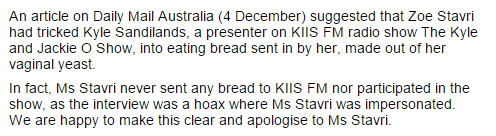
So, if you came out here to yell at me because I allegedly fed Kyle Sandilands some of my bread without his knowledge, know that he is a total liar. That was not me phoning in, that was an impersonator. The entire thing was faked without my knowledge or consent.

I mean honestly, think about it logically. With Australian import laws as they are, do you really think I could have somehow managed to get that bread into the studio?

The dude made the whole thing up. Literally all of it. Sorry to disappoint. I know how much you lot like to believe misogynists, but the only people who have eaten or will eat my bread are those who know full well what it is.

(yes, I am currently exploring options for taking legal action)

UPDATE: The Daily Mail have apologised for writing fanfic about me.