Dear Amanda Marcotte

Content note: This post discusses rape

Dear Amanda Marcotte,

I read your piece in Slate justifying a decision to incarcerate a survivor of rape to force her testimony with a kind of slack-jawed disgust, slowly morphing to a deep and visceral sense of terror.

I was horrified to read what happened to the woman who, having survived something so vile, was arrested and incarcerated until the trial. My heart shuddered at the thought that could happen. And the bile rose up in my throat as you said, over and over again, that this was all right. You say that in domestic violence cases, a lot of survivors recant their testimony because of the abuser, and go on to speculate that perhaps this is what happened with this woman. You say that there’s nothing that can be done to heal this in time for lawyers to get what they want, as though that’s the important thing here. You pretty much out-and-out blame women who do not comply with the justice system for any future violence that may be perpetrated.

Your article is sickening and frightening to me, a rape survivor who never reported what happened to me to the legal system. I’ve had to deal with many shades of bullshit from rape culture in my time, but you’ve given me something new to feel horror over. It had never occurred to me that some people might decide to blame me for any other things that might be perpetrated by that man. It had never occurred to me that the state could lock me up if they wanted to for not wanting anything to do with them, and self-professed feminists would cheer them on. I know that men who rape often don’t stop at one. And yet, what happened to me was deeply personal and I chose to deal with it in the way that made me feel safest. I feel like, for the most part, what I needed to happen, happened: all I wanted was him out of my life and to not have to talk about it in great detail to anyone.

As a feminist, I believe that the needs of the survivor are the only thing that matters in any instance of sexual violence. The way of starting to heal a deeply personal violation is also deeply personal, and deeply individual. For some survivors, this might be the route through the legal system. For others, it might be making sure everyone knows the name and face of the perpetrator as a warning. For others, perhaps recognition of what happened and reconciliation with the perpetrator is possible. For others, maybe setting the perpetrator on fire. It’s individual, it’s unique, and all of these are valid if that’s what the survivor wants.

Under rape culture, the wants and needs of survivors are ignored twice. First, in the initial violation, and second, in the response. We have our autonomy completely stripped of us by a state which supports and enforces rape culture, by peers who support and enforce rape culture, and, apparently, by people who consider themselves prominent feminist commentators who are also doing their best to sweep the wants and needs of survivors under the carpet when they get a little inconvenient.

So fuck your “greater good” guilt trip. Any greater good which involves kidnapping and incarcerating women is not worth it at all. Fuck your decision to ignore the wants and needs of survivors; you are just as bad as the rest of the rape culture which spawned your ideology. Fuck your supporting a move which will only put survivors off speaking out about what happened.

There is only one thing that matters, Amanda Marcotte, and that is what survivors want. Our role, as feminists dismantling rape culture, is to support each individual survivor unconditionally, in whatever course of action she chooses. Any other course is just rape culture, rebranded.
People I will never have sex with, ever: creepy white-knighting body hair enthusiasts

Hairy girls, rejoice! We’re not smelly and unattractive after all. Let me introduce you to our hero, Jon-Jon Goulian who has written an article in Vice, explaining exactly why we’re sexy.

I am going to assume the best of Jon-Jon, as I am in a charitable mood this morning, and imagine that his intentions are kind. Unfortunately, the effect is nonetheless something that makes my minge cringe. The article is framed around a conversation that the author had with a friend, and how this friend finds body hair on women gross, and how Jon-Jon explained that actually body hair is OK.

The framing is in and of itself pretty problematic, and is a subtle form of negging. Jon-Jon is making it clear that while he finds body hair on women sexy, other men are disgusted by it. The outcome of his conversation makes this obvious: his friend remains unconvinced, despite Jon-Jon’s impassioned arguments. This is what the friend (who, again, I am going to charitably assume is real, and not an authorial wingman) concludes:

“The reason you believe that women don’t freely choose to be hairless, and have simply been brainwashed by advertisers into believing that hairlessness is what they really want, is that you don’t believe that hairlessness is sexy. And just about every other man in America disagrees with you.”

The message here is that Jon-Jon is the only man who can ever love a chick with a hairy bum. And we ought to be grateful, because he will ride to our rescue and defend us.

The thing is, Jon-Jon’s fascination with body hair on women is fairly creepy, and articulated in a way that is more than a little bit reminiscent of James Joyce’s love letters. Here is a sample:

A woman with a hairy body has essentially four vaginas—two armpits, the asshole, and the vagina itself.

Yeah, no. Biological improbabilities aside, ew. Just ew.

There is a certain level of squick in knowing that certain parts of your body are being fetishised: that you, yourself, are irrelevant, because all this guy is into is your pitfluff. It’s just objectification: there is a marked contrast between someone enjoying the smell of your furry bush because it’s your furry bush, and someone enjoying the smell of your furry bush because it’s furry bush. And, to be honest, Jon-Jon’s florid excitement over carpeting makes me want to run as fast as I can in the opposite direction.

On top of all of this, there’s his presumption that we hairy chicks care what men think about us. He clearly believes his opinion on our bodies is important enough to pitch to a magazine. He clearly thinks we’re in need of defence, a much-maligned minority who need him to smite the unbelievers with his sword. In truth, we’ve got this. We really do. We’re not damsels in distress, in need of a man to protect us from patriarchy. And we don’t need validation from a man.

I get the feeling Jon-Jon wrote that piece in the hopes that suddenly all the fluffy ladies will drop their knickers, but the reality couldn’t be further from the truth. The whole piece just feels gross, objectifying and patronising. It’s like journalistic bonerkill, and has taken me from not knowing who the hell Jon-Jon Goulian is to adding him to the list of people I will never have sex with, ever.

In which Brendan O’Neill is, obviously, wrong again (and a weeping poxy chode)

Regular readers will know that I’m hardly a fan of Brendan O’Neill. And so it gives me no surprise to report that once again, he is seeping wrongness everywhere, this time about the Olympics up at Sochi.

Brendan’s got his knickers in a twist that everyone has come out in support of gay rights, and there are rainbows everywhere, and wonders if it’s just an excuse to get at Russia, and doesn’t think all of that will make a blind bit of difference to the level of support for Putin. You can read some highlights here, because fuck off am I going to link to it.

Now, I’ve also been pissed off about the ubiquitous rainbows and wondered if these hollow gestures are mostly an excuse to get at Russia, and I doubt it’ll change Russian policy. However, there’s a key difference between these critiques: I’m not a colossal raging homophobe, but Brendan O’Neill is. See, ultimately Brendan’s problem is that all of this is laying the groundwork for a big queer takeover, and the pink tanks will roll in and massacre red-blooded straighties like Brendan and Putin. Seriously.

“Over Sochi, the same sense of camp disgust with gruff blokes is being expressed, only this time an army of both straight and gay Westerners are wagging a finger at the backward antics of super-hetero Putin and his dumb, automaton supporters among the Russian masses.

[…]

“Where once the world was divided between the civilised and the savage, now it’s split between the gay-friendly and the homophobic. Welcome to the era of Queer Imperialism. How long before a Western nation goes so far as to bomb a country that is insufficiently gay-friendly?”

Now, I wish for nothing more than for the Queer Empire to have Brendan O’Neill shot into the sun with our special bespoke glitter cannons, but unfortunately, we have neither the resources nor the infrastructure to do this. Once again, we see Brendan O’Neill is fighting against imaginary enemies. I’d feel sorry for someone so deeply paranoid and terrified all the time, were he not such an obnoxious, gaping shitcake.

And it’s sad in a way, because perhaps Queer Imperialism is a good word for the direction that homonationalism–the incorporation of queerness into neoliberal values–seems to be taking. I propose, in fact, that we steal that phrase off of Brendan O’Neill, because it will piss him off and it kind of neatly articulates the problem. Nations don’t care about queer rights, unless it is an excuse to condemn others. The evidence stacks up day by day: here is the only the most recent story I have seen from the UK–who haven’t sent the Prime Minister to Sochi it would look bad–on how queer asylum seekers are forced to prove their sexual orientation. Queer Imperialism isn’t by the queers or for the queers: we’re instrumentalised as a barometer of human rights, and an excuse where needed.

Of course, Brendan O’Neill is just trolling, but the reason his trolling is so effective is this level of homophobia is how some people think. They think of us as colonisers, rather than colonised. And it is stupid and wrong, but really prevalent. And that’s why I took the time to respond to it, even briefly.

So you care about Sochi? Here’s some other shit to care about

I’ve been seeing a lot of people concerned about the Sochi Olympics, what with Russia’s frankly disgusting attitude towards LGBT rights. Many of these are the sort of people who I don’t usually see doing much for LGBT rights–or indeed broader human rights. And so I feel it’s necessary to point a few things out.

I’ll start with doing something I haven’t done in a while–quoting MediocreDave, who has managed to condense the issue very neatly:

Where is the outcry on these deportations of LGBT people–as I write, Jacqueline Nantumbwe faces deportation to Uganda, where there is a life sentence for being queer and corrective rapes are common. And she is not the first to be victimised in this fashion. Dave has succinctly put why this may be:

There are two things you need to think about when criticising Sochi without a broader analysis. First is that most nations are shitty towards LGBT folk. Their laws may pay lip service to LGBT rights–same sex marriage, anti-hate crime legislation and so forth, but that doesn’t mean their citizens are very good. Let’s look beyond the UK’s attitude towards deporting queers, and to a pile of other hideousness. This is a country where the national press can merrily print transmisogyny with impunity, and with little attention paid to this because the media just don’t give a fuck. This is a country where queer people are mass arrested before large spectacles. This is a country where heaps of unending bullshit are faced by bisexuals, and even the leading lobbying group for queer rights completely ignore and erase trans people. If you’re not furious about how things are here, then I am seriously side-eyeing your intentions as you tweet another fucking petition about sponsors of the fucking Sochi Olympics.

As an aside, if you’re the sort of person who is sharing things about how TOTALLY HOMOEROTIC Putin is, or how KINDA GAY sports are, to “highlight hypocrisy” or whatever the fuck you’re trying to do, congratulations, you’re a homophobic pisshole.

The second thing you need to be pissed off about is the Olympics on the whole. Bluntly put, they’re not a very nice thing to happen to a city. In London, a lot of people lost their homes in order to build a park they’d never be able to afford to visit. Some of those who kept their homes had missiles put on their roofs. And during the opening ceremony, almost 200 people were arrested for riding bikes. And was the world watching aghast, threatening to boycott as this happened to London–or any other city which has hosted the Olympics and faced similar problems? Not really, no. This is a world, after all, that doesn’t freak the fuck out when a country with more than two million people locked up in prison hosts the Olympics.

I’m not saying don’t be pissed off about Sochi and Russia. I’m saying, be more pissed off. Be critical of everything. Stand with LGBT folk closer to home, or further away. Stand against these games which form an excuse for gentrification and human rights abuses. Use your anger at Russia as a spark, and ignite the flames for a greater understanding of broader struggles.

And for fuck’s sake, I’m not going to sign your fucking petition.

Why #ibelieveher is so vital

Content note: This post discusses rape, child abuse and rape apologism

It happens every time a famous man is accused of sexual violence. A torrent of rape apologism as patriarchy gets in gear to maintain itself. The steps to this dance usually the same: the tango of smearing and blaming and conspiracy theories goes on. Those of us who seek to overturn rape culture are getting better and better at advocating for an ethos wherein survivors are believed. We say “I believe her”, because we know that it’s more likely for a man to be hit by an asteroid than it is for him to have been falsely accused. We say “I believe her” loudly, proudly and publicly to oppose the status quo.

And it looks like we have made great headway in publicly expressing our support for survivors, because the backlash has begun.

Obviously, there’s the standard drivel from the standard misogynists, the well-choreographed dance of “no evidence” which misses the point entirely, but Suzanne Moore has stepped up to the plate with an attack on the very core of “I believe her”. In a confused piece surrounding Dylan Farrow’s brave public words about the child abuse she experienced at the hands of Woody Allen, Moore decides that those tweeting in support of Dylan are a “mob” and a “kangaroo court”. While Moore says she is inclined to believe Dylan, she thinks people should not be tweeting publicly that they believe her and fixates on some sort of putative superiority of the justice system. It’s already been explained why Moore is flat-out wrong in comparing mass gestures of support and solidarity for a survivor with a kangaroo court, and it’s also worth noting that Moore might have a bit of an axe to grind regarding Twitter which has blurred her judgment and stopped her from understanding the very basic ethos of “I believe her”.

First and foremost, “I believe her” is a reaction to the way rape culture is stacked. When it comes to sexual violence, too often there is no physical evidence, the smoking gun that “proves” that it has happened. Traditionally, under patriarchy and rape culture, this works in favour of the accused. It is their denial that is believed, rather than what the survivor has said. “I believe her” takes into account the balance of probabilities and turns it on its head, starting from a position of believing that what the survivor says happened is true, because statistically speaking, it is overwhelmingly likely to be the case. To speak out about an experience of sexual violence is not a thing taken lightly: we all know that when we do this, in the court of public opinion we will be, for the most part, utterly eviscerated, because rape culture is a juggernaut.

Most of us don’t want to engage with the legal system, because we know what it’s like. We know that it is these beliefs lurking in the back of people’s minds, codified. And we know how that is instrumentalised by rape apologists, that if we cannot engage with the legal system, or if we the legal system fails us, that means that we as survivors are the ones lying. It is no coincidence that so much of Moore’s piece focuses on how Dylan Farrow’s case was thrown out of court, or that we should focus on a better legal system, because the notion of starting from believing survivors and how the legal system works are diametrically opposed.

The aim of “I believe her”, then, is not to directly work within the legal system to make it better, because the legal system is but one manifestation of rape culture. The aim of “I believe her” is to throw down a challenge to a notion as old as patriarchy: that the accuser, not the accused is the liar. From a position of believing a survivor, it is easier to speak out, to intervene however the survivor wants, and to start to dismantle the millennia of social conditioning to which we have all been party.

I was silent for years about what happened to me, afraid of not being believed. Then I learned about how some people start from a position of “I believe her”. It was interesting: the woman being believed was not me. All there was to go on was her words. What had happened to her was nothing like what had happened to me. But it empowered me to speak out nonetheless, to tear through the silence.

And this is why it’s so important to make loud and public declarations. Survivors see and hear it. Survivors see that society is no longer a monolith of blame and wild accusations of lying based on no evidence whatsoever. Survivors see hope, and are more likely to come forward.

Silence is the biggest weapon patriarchy has in keeping rape culture alive, and “I believe her” starts to tear down this wall and encourage and empower survivors to speak out.

Because of this, it is crucial that we resist the attacks on this notion, the slurring it as “mobs” and “kangaroo courts”, because it isn’t. It’s solidarity in the face of patriarchy, and we should be proud that it is starting to terrify those who would rather we shut up.

[catchy muff pun title]

Apparently this is the Year of the Bush, or something, which is interminably awful as it means the media will be mostly debating bush, from such nuanced viewpoints as “muff is great” and bizarre advertorials for laser hair removal with bonus fat-shaming and comparing pubic hair to the Gaza Strip. There is an awkward word looming over much of this debate, and it is a word which ought to immediately be purged from any discussion of anything anyone does to their bodies: “should”.

Ideally, we should be free to do what we want with our carpetry. Both the dangers of hair removal and the uncleanliness of keeping hair have been massively overstated: from a pubic health perspective, whatever you do with it is probably relatively benign. Paying money to make modifications to your body is hardly a manifestation of evil: hell, it’s cool that we live in a world where we can use tools–or even lasers–to change what nature gave us. I had my eyes fixed with a laser and it was awesome. Spending time to make modifications to what God gave you isn’t bad, either. There is nothing inherently gross about any quantity of hair: Renaissance smoothness is just as hot as an Age of Aquarius full bush if the person rocking it feels sexy as all fuck. 

Pubic hair should be nobody’s business but the individual who is holding it in their pants. It shouldn’t be political or a subject of hot debate. It should just be a thing, like haircuts.

Except it isn’t. (And neither, actually are haircuts, which come with a whole mess of political implications themselves)

Pubes are politicised by millennia of social conditioning, and in recent times patriarchy, white supremacy, cissexism and capitalism hooked up in a ghastly orgy and found themselves a cash cow in selling the motive and the means to remove body hair. It is not a free choice, what we do with our fanny fluff, because we are not making this choice in a vacuum. We’re making these choices amid a blitz of marketing and social pressure and all of this teaches us that there’s One True Way, and that is to nuke the short and curlies.

Last summer, I went swimming for the first time since I grew my bush back. I was terrified. Cascading curls of cunt-fur poked from the sides of my bikini, and I expected it would only be a matter of time until the villagers were out in force with the torches and pitchforks and silver bullets. But it was a hot day and I wanted a swim, and so I swallowed my nerves and quite literally jumped in at the deep end. I started to forget the nerves. I wandered around and I ate an ice cream. And not once did anyone say anything. Not once did I notice a side-eye. Not once did anyone try and bury me at the crossroads. It turns out, people don’t actually make a habit of staring at one another’s crotches in public spaces.

Feeling that fear was the first time I’d really understood the power of the social conditioning. In my own arrogance, I’d thought myself as above it; being a feminist, I was too enlightened to care what people thought about my muff. I wasn’t, and I don’t think any of us are, because we’ve all lived our whole lives under capitalist patriarchy.

I’d grown my muff as an act of rebellion, and started to love it as a little pet. I swelled with pride when I plucked out a pube and measured it, and it was just shy of an inch and a half long. I shampoo it as part of my beauty regime, sometimes adding conditioner on special occasions. Sometimes, when I’m alone, I stroke it absent-mindedly because I like the softness of it. And even loving my rug so much wasn’t enough for me not to feel anxious about wearing a bikini in public, because I had been bombarded with the same messages as everyone else: visible bush is hideous, a punchline at best.

It’s interesting because so much of the pubic hair debate hinges on personal preference, locating individual opinions in their relationship with the ideals we are sold. The conclusions drawn on either side are fairly facile: making peace with it and losing the fuzz because it makes you feel better, or defying it by growing in a veritable furry forest. We need to go further than this individual choice: the problem is structural, and so the structure must be torn down.

And unfortunately, it’s going to take a lot more than the individual choices we make to tear this thing down. There will be no critical mass of pubic hair to generate revolution. The reality is a more tedious slog than that, the bitter resistance of fighting multiple fronts at once. The politicisation of bush is a symptom of this system, not a cause. Just like a Brazilian wax, we need to rip it all out at the roots.

Of course the police are more interested in rude tweets than violence against women

Content note: this post discusses violence against women 

In news that is pissing me off today, the Twitter is inherently abusive line is out in the media again. This time the victim is Stan Collymore, who was sent racist and threatening tweets. The police are, of course, interested and investigating.

Now, of course, it is unacceptable to send racist and threatening tweets to anyone, but I’m getting a little concerned about how much of an interest they are showing in rude tweets. This isn’t the first time they’ve swooped in to help out Stan Collymore: late in 2012, a man was arrested for sending a racist tweet to Stan Collymore. Indeed, arresting people for tweets seems to be a new top policing priority, in sharp contrast with how they deal with violence against women.

Let’s look at Stan Collymore’s record. He violently attacked one woman, including kicking her in the head three times. As far as I can discern, the police didn’t get involved at all. He then went on to threaten to kill his wife and burn down her parents’ home. This time the police took the matter slightly more seriously, and charged him for a threat to destroy property, because apparently the structural integrity of a building is the most important thing here.

So why are the police far more gung-ho in going after internet trolls than perpetrators of domestic violence? Ultimately, it boils down to two things.

Firstly, they don’t really give a flying fuck about violence against women. This is why so few of us report our rapes. This is why we don’t trust the police to keep our violent partners away from us. We’ve seen their record, and we know that they’ll violate any trust we put in them. And many women, particularly marginalised women, have themselves been victims of violence perpetrated by police, because that’s their job: to beat us into submission. The role of the police is to keep everything as it is–and this includes protecting a structure which enables violence against women.

Put more charitably, the police are a product of a broken society, born and raised in it, and then paid to enforce this broken society. Is it any surprise that they reflect and enforce patriarchal control of women?

And secondly, democratised communication scares the shit out of the establishment. It is a way people can get messages out, outside of the controlled circumstances in which we may usually have a platform. Things get out that threaten the system, and that frightens them. Of course they will instrumentalise the very real experiences of misogyny and racism in order to try to clamp down on their own real enemy: their critics. It is important to remember, when thinking of police interventions into online abuse, to remember this. Twitter was blamed for the riots, while simultaneously lauded for causing the spread of democracy in the Middle East. These are the same mechanisms at work in both cases, and basically the state would rather keep such uprisings further away from home.

It is hardly a surprise that tweets will be policed more heavily than kicking a woman in the head. It is an inevitable reflection of how things are.

Russell Brand deserves no praise or gratitude

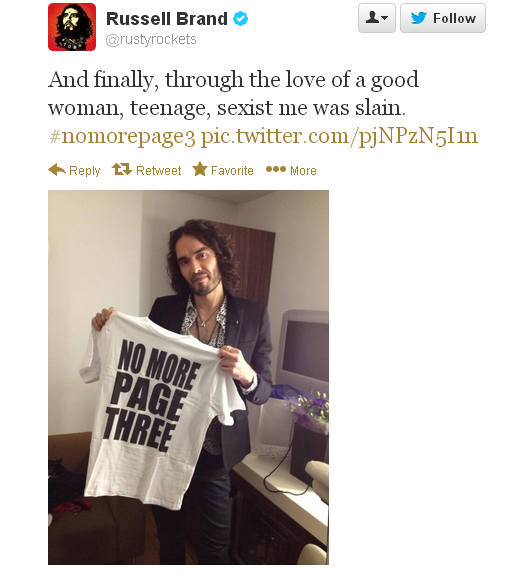
Regular readers will be aware I’m no fan of either Russell Brand (misogynist turdbagel) or No More Page 3 (too liberal to function). So, when I saw this tweet, I felt like I needed gloves to handle the sheer quantities of ewwww that it generated.

Twitter   rustyrockets  And finally, through the love ...


It’s hard to work out where to begin with this, so maybe I’ll counterintuitively start at the end with the reaction. It’s been rather gross to see feminists falling over themselves to praise Russell Brand for taking a free t-shirt and tweeting a picture of himself with it. That’s hardly a conversion, or a redemption narrative. That’s taking a t-shirt and not even bothering to wear it. 

I somehow doubt that Russell Brand has slain his internal sexism. It would take rather a lot of work to get over such unpleasant behaviour as bragging to a woman’s grandfather about her sexual behaviour, or prank calling a rape hotline. Frankly, I don’t think an expression of support for one small thing in any way makes up for what he did, and in order to move forward, first he must show understanding of his past sexism and hold himself to account for this.

Of course, that’s a moot point, when the very tweet in which he ostensibly renounces sexism is dripping with benevolent sexism. It was not winning the argument that brought Russell Brand round. It was a sexy lady with her magic lovely lady powers. It is only in thinking about where he could put his dick that Russell Brand was persuaded to take a photo of himself holding a t-shirt. He admitted this himself. And something murky lurks beneath this “good woman” narrative–none of the other women were good enough. No other women in Russell Brand’s life are apparently worthy to convince him that women are actually human. No wonder he treated Katy Perry so appallingly–she wasn’t good enough. It has handed the fedora brigade an excuse for sexism: if women won’t have sex with them, how can they learn not to be sexist dickwaggles?

It is only the good that can change the hearts and minds of sexists through having sex with them, says Russell Brand, to rapturous applause from liberal feminists.

And who was this good woman who managed to change Russell Brand’s mind? None other than Jemima Khan, who posted bail for Julian Assange. Forgive me for becoming even more pessimistic.

Russell Brand deserves no praise or gratitude for his participation in a blatant publicity stunt to get the heat off him a bit. He knows by now that women think he is a sexist bellend and has made a rather pisspoor effort at trying to deflect this criticism. Whether you support No More Page 3 or not, there is no reason to fawn over Russell Brand for this tweet. Let time be the judge of whether he has changed or not.

Forget Blue Monday, today is the most depressing day of the year (according to PR)

Traditionally, the last Monday of the last full week of January has been a special day for bloggers, where everyone gets together to debunk the media-friendly pseudoscientific Blue Monday. Indeed, the date has had such a thorough trouncing that PR has switched tack, and it disappoints and distresses me to announce that today is in fact the most depressing day of the year.

In some of the best journalism they’ve done in a while, the Daily Mail has synthesised a bunch of press releases all pointing to the trend. Except most of it doesn’t. Indeed, only two of the various PR surveys they report found anything to do with this day. Let’s take the easy one first: today is the most popular day of the year for starting divorce proceedings. A divorce firm reckons this is because of the strain of Christmas, and, well, possibly. However, it’s likely that the major underlying cause is more mundane: professionals–such as lawyers–tend to take a lot of time off over the Christmas break, and the first Monday of January that isn’t a bank holiday is the first day everyone will be guaranteed to be back at work. Far from a stampede to divorce spouses who cheated at Monopoly, this is more likely a backlog from office closure.

The other study appears at face value to be somewhat more convincing: certainly, it’s a little more robust than the original Blue Monday equation. Some company flogging some sort of shit analysed tweets looking for “negative language” and determined that this happens today.

Now, I hunted the internet for a detailed research methodology for this study, and came up empty-handed. So I downgraded, and decided to look for the original press release, which didn’t seem to be anywhere either. So basically all I have to go on is what is regurgitated in the Mail:

But over the past three years, researchers analysed more than 2million tweets posted by Britons in January looking for negative language and phrases indicating a drop in mood.

They found that today, there will be nearly five times the average number of tweets relating to guilt, as people abandon their promises to pursue a healthier lifestyle.

The analysis, by [like fuck I’m promoting them for this nonsense], also found complaints about the weather will be six times higher than usual – and men will feel more miserable than women.

First of all, the good: props to the PR people for doing this analysis over three years. On initial reading, I thought they’d just analysed tweets over a year, which would only tell us something about what the most depressing day of whatever year they analysed was. That’s about the only nice thing I have to say about this study.

Now, the most glaring thing about this research is that only tweets in the month of January were analysed. This means that a spike in tweets expressing a negative sentiment can only be identified during the month of January. What if there’s actually some sort of mystical force which makes the world an incredibly miserable place to live in on 23rd March? Tough titties. It was clear that they wanted a January date to flog whatever it is they’re flogging, and so they made damn sure it would happen in January, by only analysing January. It’s fairly elegant in its simplicity, although were I the PR people, I’d have buried that little fact deeper in the press release, because it really does detract from their “most depressing day of the year” message.

So, now let’s get to the minor niggles. The sample size looks like a complete turd. Twitter is a website wherein half a billion tweets a day are posted. Even if we assume that UK-based users only account for 1% of these tweets, we’re still looking at 5 million tweets per day. This research analysed only two million over the course of three JanuarysThat’s a mere drop in the ocean. And how was this sample selected? We don’t fucking know. Presumably it was based on whoever the company’s follow-shit-on-Twitter bot decided to follow. And that’s the better explanation…

How were words coded and analysed as pertaining to, for example, guilt? Again, we don’t fucking know, but given the fact that it was a large data set, I’d guess it was computer-based analysis using pre-defined word lists. Given that it’s already demonstrated how much the research set out to find something predetermined, I have little faith in how these word lists were constructed. If I were to guess at how they found their two million tweets, I’d suspect it was standing searches for whatever words they’d selected, and counting the number of tweets using these words per day. That’s just fucking lazy.

And finally, how on earth did the research determine which users were men, and which were women? I shudder to think. A seething hive of assumptions, all wrapped up in a blanket of “fuck knows”.

So, in short, today isn’t the most depressing day of the year, it’s just the same PR bollocks lapped up by a thirsty-for-bullshit media. Let’s be honest with ourselves, everything is shit. It’s hard to find social forces that make one particular day w0rse than any others, because everything is shit. About 8-12% of people in the UK alone live with depression, and if anything, that figure is probably an underestimation, because everything is shit.

I wish I could have a duvet today, because fuck it, I’m depressed. Do PR studies constitute a valid excuse? I wish I had the energy to try.

2013: The year of the hollow gesture

There is a certain fashion now to define a year and What It All Means as a comment piece. And so, in an attempt to be down with the kids, here is what the last year has meant to me.

To me, 2013 has been a year of Big Grand Media Gestures which do absolutely fuck all to change any of the system, as Big Grand Media Gestures are wont to do. Most recently, we saw this with the pardon of Alan Turing. Almost 60 years after the state drove Turing to suicide through their homophobic laws and “experimental” forced hormone administration, they have issued a royal pardon. Alan Turing is forgiven for being gay, to rapturous applause from precisely no-one paying attention.

It is not hard to see the hollowness of this gesture. Alan Turing was but one of the thousands of men persecuted in this fashion in the past, and it just so happens that he was the one who made himself most useful to history. This pardon was stage-managed by Chris Grayling, a man who believes B&Bs should be able to turn away gay couples. Homophobia is not a thing of the past, it is a thing which is still actively perpetuated by those in power, and they should be the ones on their knees, begging for forgiveness for the wrongs of the past, the present and the future. They should grovel at Turing’s grave, and prostrate themselves before those who–alive or dead–still bear the convictions that Turing did. One cannot magic this away, and all of the bits of paper rubber-stamped by the Queen in the world will not make up for it.

Maybe, instead of pardoning Turing, they should have stuck him on a banknote as a convicted criminal. Alan Turing, the queer who saved the world, convicted criminal. After all, it’s clear they wanted a war hero on a banknote, and unfortunately the only one they could think of was Churchill, the notorious racist and architect of genocide, whose major achievement was appearing the lesser of two evils next to Hitler. It was this that pissed me off when the face of the new five pound note was announced earlier this year.

Churchill’s jowly visage will be bumping off Elizabeth Fry, a social reformer who made conditions better for prisoners. A large campaign with a feminist flavour was outraged by this, framed only around how we need to have another woman on a banknote. Eventually, the Bank of England issued a press release earlier than they otherwise would have saying they’d be sticking Jane Austen on a tenner. Job done, women!

Except, once again, we see a certain hollowness. Elizabeth Fry is the sort of person who, in current conditions, would never make her way on to a banknote. She saw humanity in prisoners, while today the government are doing all they can to make the lives of those in prison as much of a living hell as they can get away with. The faces on our banknotes are a political decision. That is why they got rid of the woman who cared. It’s why they replaced her with a warmonger. And it is why they were perfectly happy to use the image of the relatively-inoffensive Jane Austen.

The state’s response to the banknotes campaign was a hollow gesture, but the campaign itself had a certain hollowness in a climate where many women just need some banknotes in our purses. Austerity is hitting women hardest, and many of us can’t hold on to a tenner for long enough to care whose face is on it.

The other large feminist-flavoured media campaign of the year has been No More Page Three campaign. I’ve written before about the myriad problems with it, so I’ll spare the screed and link you to this and this instead. As with the banknote campaign, I don’t doubt that those involved think they are doing good work, but as with the banknotes campaign, they are asking for something paltry which does nothing to change any of the underlying social conditions. It is for this reason that such campaigns are popular with the media. No More Page Three has been supported by almost every media outlet, with the notable exception being The Sun (obviously). Let us remember that the media is owned and run by the rich and white and male, who have a vested interest in the system changing as little as possible. And they’ll allow attention to be thrown over such campaigns because they know it won’t unseat them from their comfy thrones. It benefits them to reduce feminist discourse to simple requests for a page of a newspaper to be removed, or a woman–any woman–to be depicted on a tenner.

The media support is a hollow gesture, and playing the media support game is, ultimately, hollow feminism. It’s misdirected noise. There is a lot of good work going largely unnoticed, as Lola Olokosie notes here.

What we need is a revolution. Now, I’m not talking about the kind of revolution envisioned by Russell Brand, the kind which just magically comes if we wish hard enough for it. Brand’s words were hollow, only words, with little thought for what he was actually asking for other than something else. To watch people shitting themselves with joy over a millionaire sexist waffling an analysis which might have been pretty good if it came from a twelve year old was absurd. Brand wasn’t bringing the idea of revolution to the masses, he just said the word “revolution” on the telly.

Those of us who actually talk the detail and the process, those of us who translate these ideas into praxis–we are labelled at best “divisive” and at worst “criminals”. Even articulating the problems is frowned upon, so how can we build a solution?

These are the things that are likely to come up in the nostalgia shows of the future when we talk of 2013. These grand, yet hollow gestures, this token resistance. I am not saying it is a year where nothing has happened, because loads has. From the achievements of Black feminism to the gains made by the 3Cosas campaign, small victories are being won to little, if any popular attention. And this is what I hope to see more of in years to come, turning our backs on the Big Grand Media Gesture and moving towards the highly unmarketable organising and activism that is essential to immediate survival, and building a better future.